
Opinion
Local elections – spread them out

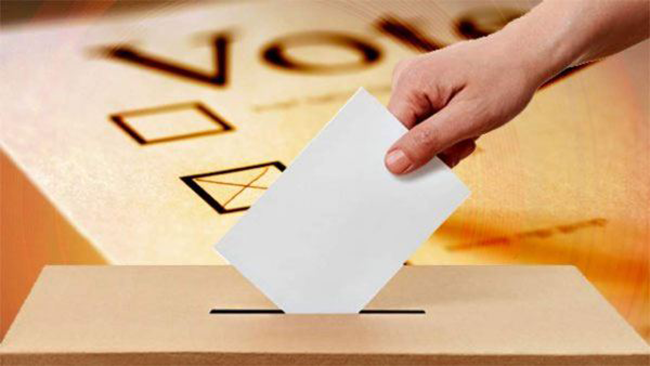
What are local elections for? They are to elect local representatives to run local authorities which provide key services to local people. Prior to 1977, these elections were held at different times of the year. We can once again return to that system of spreading out the elections over a period of a few months. The cost would be greatly reduced. The results could be seen as a vote for or against the central government.
It may or may not be considered a test of the central government’s popularity. By this arrangement, local elections will diminish in importance as a gauge of an incumbent government’s popularity. Getting back to a system of diffused elections might be an acceptable compromise within a democratic framework.
Leelananda De Silva

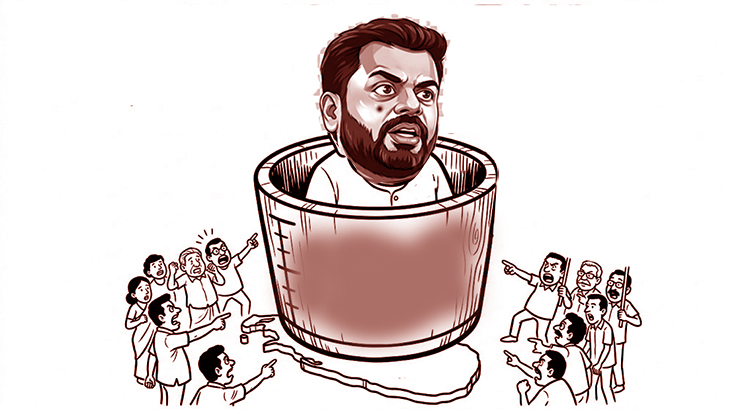
I was taken aback by the response of the well-known academic Uswatte-Aratchi (U-A) to my article “Achievements of the Hunduwa”, which appeared in The Island on 15 March. In his piece, titled “Pot calling the kettle black?” (The Island, 23 April) U-A accuses me of belittling Sri Lanka in just the same way President Anura Kumara Dissanayake (AKD) did with his reference to Sri Lanka as a hunduwa. Being an academic of repute, U-A’s comments cannot be ignored and before I proceed further to explain, let me state that I am very sorry if what I stated appeared in any way to be derogatory; my intentions were otherwise.
U-A states, “Most sensible people, even uneducated, judge that the volume of a little drop (of whatever) is smaller than that of a hunduwa; so is weight. When the learned doctor emphatically maintains ‘we are not a hunduwa’ but ‘a little drop in the ocean’, is the pot calling the kettle black or worse?” He implies that my ‘insult’ is worse. Whilst conceding that a drop is smaller than a hunduwa, what baffles me is how an academic overlooked the fact that comparisons should be made based on context. Whereas AKD used hunduwa in the parliament to belittle the country, I used the term ‘little drop’ to highlight our achievements, which are disproportionate to our size. In contrast, AKD used hunduwa to trifle with the country.
“Surely, this little drop in the Indian ocean performed well beyond its size to have gained international recognition way back in history,” I said in my article. This cannot in any way be considered derogatory. In fact, what U-A stated in his article about the achievements of countries, either smaller or with populations smaller than ours, only supports my view that there is no correlation between a country’s size and its achievements.
U-A casts doubt on the assertion that Sri Lanka was once the ‘Granary of the East’; he cites instances of drought and famine. There may have been bad periods, as we are at the mercy of nature, but it does not negate the fact that there were periods of plenty too. Our rulers in days of yore did everything possible to feed the populace by building tanks and extensive irrigation systems. In addition to major works, there were networks of small projects, Uva being referred to as ‘Wellassa’; the land of one hundred thousand paddy fields fed by small tanks. What has the present government done to ease farmers’ burden? Absolutely nothing! Whilst farmers are struggling to eke out a living, rice millers are importing super-luxury vehicles and even helicopters!
I agree with U-A that unfortunately the contribution of the ordinary people is not well recorded in history. This is a universal problem, not limited to Sri Lanka. When one watches some of Prof. Raj Somadeva’s programmes, it becomes clear how ordinary people helped complete gigantic projects. Although there are many documentaries on how the pyramids were built, no one seems interested in exploring how Great Stupas in Anuradhapura were built with millions of bricks.
AKD is doing just the opposite of what he preached whilst in Opposition and does not seem to have any sense of shame. His hunduwa reference, possibly, makes him the only President to have demeaned the country.
by Dr Upul Wijayawardhana
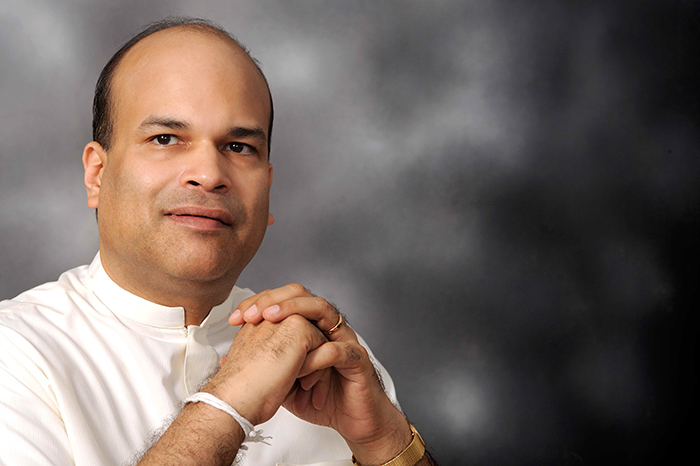
Recent statements from Washington show how global politics is being increasingly framed along civilisational terms. The U.S. Secretary of State Marco Rubio has referred to the idea of a shared “Western civilisation,” describing the U.S. and Europe as bound by common history, cultural heritage, and institutional traditions. At the same time, U.S. President Donald Trump has amplified comments about countries such as India, China, and Iran in the context of migration and geopolitical competition that reinforce a tendency to interpret global politics in civilisational terms. Taken together, these statements point to a broader shift: global affairs are being interpreted not only through the language of power and interest, but also through civilisational identities.
The appeal of such framing is understandable. It offers a sense of clarity in an era of rapid technological disruption, demographic change, and geopolitical uncertainty. But apparent clarity is not the same as analytical accuracy. Moreover, it is not an entirely new framing either. As early as the 1990s, political scientist Samuel Huntington had argued that global politics would evolve into a “clash of civilisations,” where cultural and religious identities would become the principal fault lines of international relations.
Civilisational explanations can obscure more than they reveal, particularly when they imply that cultural cohesion, rather than institutional adaptability, is the primary source of national strength. A historical record of the modem West suggests otherwise.
A look at history
Much of the West’s post-Cold War dynamism has rested not on homogeneity, but on openness — to talent, ideas, capital, and global competitive pressures. Its advantage has been institutional: the capacity to absorb diversity and convert it into innovation within rules-based systems.
Nowhere is this more evident than in today’s innovation economy. AI, in particular, has become the defining frontier of global competition, shaped by deeply international talent flows and research ecosystems. Companies such as Microsoft, Open Al, and NVIDIA exemplify systems in which breakthroughs depend on globally sourced expertise, cross-border collaboration, and the ability to attract the most capable minds regardless of origin.
The COVID-19 pandemic underscored this complementary reality: innovation now operates through globally distributed production systems. Rapid vaccine development and distribution, by firms such as Modema and AstraZeneca, depended on international research networks and global manufacturing ecosystems. In the case of AstraZeneca, large-scale production through partnerships such as that with the Serum Institute of India illustrated how innovation and industrial capacity now operate across borders.
This is not an argument against immigration control. Immigration must be governed effectively, and civic norms must be upheld. But managing diversity is fundamentally different from retreating from it.
In an era of intensifying geopolitical competition, openness remains a critical strategic asset. The West’s advantage lies not only in military alliances or economic scale, but in institutional resilience and its capacity to attract, integrate, and retain talent. Civilisational framing, by contrast, risks misdiagnosing this advantage —privileging identity over capability and boundaries over performance. Demographic realities reinforce this point. Many advanced economies face ageing populations. In this context, immigration is not simply a cultural or political issue, but an economic necessity.
Without sustained inflows of sldlled labour and human capital, growth slows, fiscal pressures increase, and innovation ecosystems weaken.
Openness as an advantage
The defining challenges of the 21st century —including AI governance and climate change —further highlight the limits of civilisational thinking. These are problems that cannot be addressed within cultural silos. Against this backdrop, framing global politics in terms of civilisational hierarchy carries risks. It encourages a narrowing of identity at precisely the moment when cooperation and adaptability are essential.
The question, therefore, is not whether identity matters. It dearly does. Societies require shared norms, institutional trust, and continuity. The more important question is whether democracies can manage change without losing confidence in the openness that has sustained their development. The strength of the West has historically rested on its ability to combine stability with adaptation — to absorb new influences while preserving core principles such as the rule of law, individual liberty, and accountable governance.
Therefore, the policy challenge ahead is not to retreat into notions of cultural purity, but to govern openness with clarity and purpose. This requires strengthening integration frameworks and reinforcing institutional trust. It also requires recognising that engagement with other civilisational spaces is not a concession, but a necessity in a globally interconnected world.
In a world of intensifying geopolitical rivalry, it may be tempting to define strength in narrower terms. But doing so risks undertnining one of the West’s most important strategic assets. Openness — disciplined, governed, and anchored in strong institutions — is not a vulnerability. It is a source of sustained advantage.
(Milinda Moragoda –Former Sri Lankan Cabinet Minister, diplomat and the Founder of the Pathfinder Foundation, a strategic affairs think tank. The Hindu – 08, May 2026)
By Milinda Moragoda
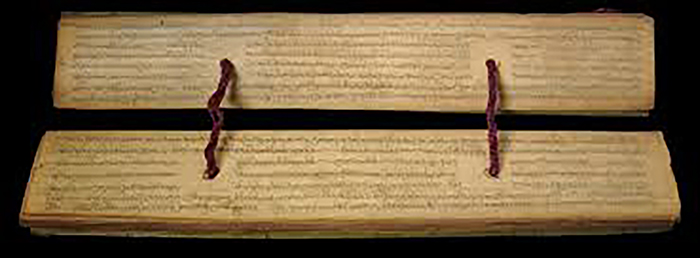
Palm leaf manuscripts are now valued as historical documents and collections of palm leaf manuscripts are carefully preserved in libraries, in Sri Lanka and abroad. Most of the palm leaf manuscripts available in these collections date only from the 18th and 19th century. The palm leaf is a perishable item. Manuscripts of an earlier period are rare and are greatly valued.
Sri Lanka has the greatest number of these palm leaf manuscript collections. This indicates the value placed on palm leaf manuscripts in this country. The largest collection in Sri Lanka and possibly in the world, is in the National Museum Library, Colombo. The collection exceeds 5000. It includes the collections of H.C.P. Bell, W.A. de Silva, Ananda Coomaraswamy and E.B Gunaratne as well as the poetry section of the Hugh Neville collection. In 1938, W.A. de Silva prepared a “Catalogue of palm leaf manuscripts in the Library of the Colombo Museum.” This was published by the Museum.
The Museum library has the oldest palm leaf manuscript in the country, the Cullavagga, dated to 13 century. Cullavagga gives an account of the religious life of the sangha and the legal confines of their conduct. The last chapter carries the earliest known account of the Buddhist Great Council at Rajagaha.
The library has a copy of Buddhaghosa’s commentary on Digha nikaya. The cover is of silver embossed with white sapphires. The library has a copy of Sumangala Vilasini , one of the Bodhiwamsa (Ref No 1823) in Sinhala giving the history of the Sri Maha Bodhi, and the Mahavagga, copied by the Peramuna rala of Siyambalapitiya Galboda korale, completed on October 1802 and offered to Malwatte.
The Museum library has approximately 300 medical manuscripts Saddharmaratnavaliya manuscript says that doctors had to be paid for their services and travelling expenses. It said that physicians jealously guarded their knowledge of medicine and kept their prescriptions for medical remedies in safe custody.
University of Peradeniya has the next largest collection of 4000 items. Peradeniya has the UNESCO recognised copy of the Mahavamsa and the 13 century Visuddhi Magga Tika. The library has the de Saram and Hettiarachchy collections and several collections of palm leaf manuscripts donated to it.When I was studying at Peradeniya in the 1960s, the Main Library displayed palm leaf manuscripts and their decorative covers, in a case, upstairs, by the staircase, where the readers would not miss it. That was our introduction to palm leaf manuscripts.
The National Library of Sri Lanka (est. 1990) has a small but distinctive collection of 523 items which include Sinhala vedakam, Sinhala bana katha and Yantra mantra gurukam . It has a rare literary manuscript, Diya Savol Sandeshaya, dated April 26, 1904. It begins with the evocative phrase “Sarada Sarada Somi Paharusamu.” It provides a unique glimpse into the late-modern period of Sinhala literature. The manuscript is in good condition, with beginning and end intact. It measures 50 cm in length.
Other state institutes also have collections. The Institute of Indigenous Medicine, Rajagiriya has 700 palm leaf manuscripts. The collection includes Besajja Manjusa , the oldest medical manuscript in Sri Lanka . The collection also has a very old, valuable manuscript on acupuncture, written in Sinhala. The manuscript is reproduced in full in the book “Palm leaf manuscripts of Sri Lanka” by Sirancee Gunawardana. She comments, it is well illustrated. The human form is drawn clearly and acupuncture points indicated.
There are valuable private collections of palm leaf manuscripts, acquired by knowledgeable collectors. University of Kelaniya has digitised and made available the manuscripts of 13 private collections. The Danton Obeyesekera collection includes an ath-veda-pota containing prescriptions. James D Alwis collection has a copy of the Jataka Atuwa getapadaya. L.S.D Pieris has an extensive collection of Yantra manuscripts and medical manuscripts as well as a copy of the Rajavaliya. It was noted that SWRD Bandaranaike also had a collection of palm leaf manuscripts .
Private collectors seem to have been specially interested in the pansiya panas jataka. K.V.J. de Silva’s collection had a magnificent pansiya panas jataka. The collection assembled by Rohan de Silva and Jacques Soulie at the Suriyakantha Centre for Art & Culture, Handessa, also has on display a palm leaf manuscript of the Jataka stories, dated to late Kandyan period, in exceptional condition. Its clarity of script, leaf preparation, and intact binding show the highest standards of Sri Lankan scribal craftsmanship, the Centre said.
The largest collection in a foreign library (western) is probably the collection in the British Library, London, which has around 2464 Sinhala palm leaf manuscripts . The major portion of this collection is the Hugh Neville collection of 2227 palm leaf manuscripts. Everybody has heard of the Hugh Neville collection and most think that this is the only collection of Sri Lanka palm leaf manuscripts in the world and that we must be grateful to Hugh Neville for collecting them. Some probably think he wrote them. They do not know of the much larger collections in Colombo and Peradeniya.
Hugh Neville (1869 – 1886) came to Sri Lanka during the British period as private secretary to the Chief Justice. He later became an Assistant Government Agent. He travelled across the country collecting palm leaf manuscripts. They were mainly 19 century manuscripts. Hugh Nevill observed that just one in his collection may be 100 years old. I have no copy over 200 years old, he said.[1]
Hugh Neville died in France, but London acquired the palm leaf collection at the instigation of D.M de Z. Wickremasinghe. They were catalogued by K.D. Somadasa and published in seven volumes, titled ‘Catalogue of the Hugh Nevill Collection of Sinhalese manuscripts in the British Library”. The British Library, in 2021, digitized and made freely available online, four Sinhalese palm leaf manuscripts from the Hugh Nevill collections, namely Dighanikaya, Majjhimanikaya and two copies of Mahavamsa.
The libraries of Cambridge and Oxford Universities have Sri Lanka palm leaf manuscripts. Bodleian Library in Oxford has the Mahavamsa manuscript which was used by Turner for his English translation. Jinadasa Liyanaratana has examined some of the manuscripts in Cambridge and has catagloued 24 Sinhala manuscripts of which 6 were medical texts, others were on Buddhism. This was published in Journal of the Pali Text Society, Vol. XVIII, 1993, pp. 131-47[2]
The John Rylands Library, University of Manchester holds over seventy manuscripts from Sri Lanka, “mostly on Theravada in the Pali language in Sinhalese script” . They are probably from the Rhys Davids collection. The manuscripts date from the 17th-19th centuries and include copies made in Sri Lanka for T.W. Rhys Davis. There are complete manuscripts of the Paṭṭhāna-Pakaraṇa and Nettipakaraṇa, which are rare even in Sri Lanka.
There are palm leaf manuscripts at Bibliothèque Nationale, Paris, the Azistische Kjust Museum, Amsterdam, and Bavarian State Library in Munich . Paris has the Talapata sent from the Udarata chiefs to Dutch governor Falck. Jinadasa Liyanaratne examined and wrote on the “Sinhalese Medical Manuscripts in Paris” for Bulletin de l’École française d’Extrême-Orient Année 1987 pp. 185-199[3] The Netherlands collection included 135 medical manuscripts.
The palm leaf manuscript collection in the Royal Library, Copenhagen is well known. It was obtained by Rasmus Rask who came to Sri Lanka in 1822 in search of them. The collection was catalogued by C.E. Godakumbure. The catalogue is available in Gunawardene’s “Palm leaf manuscripts of Sri Lanka”(p 339). This collection contains the manuscripts collected by Ven. Kapugama Dharmachandra who lived in Dadalla, Galle. He converted to Christianity and his extensive collection, went to Denmark, said Gunawardana.[4]
Small collections of palm leaf manuscripts are held in various other foreign libraries in the west. Casey Wood, (b 1856) an American ophthalmologist who had in interest in medical research, toured the world after retirement. In Sri Lanka he connected with Andreas Nell, also an eye surgeon, obtained palm leaf manuscripts, mainly medical, which he then donated to institutions and individuals all over North America. At least 50 different recipients have been identified.[5]McGill University has a collection of 27 palm leaf manuscripts gifted by him.[6] The Metropolitan Museum of Art, in New York has one manuscript on display[7]. (To be continued)
[1] Stephne C Berkwitz. Buddhist history in the vernacular. P . 115..
[2] https://hasp.ub.uni-heidelberg.de/journals/jpts/article/view/28096/27490
[3] https://www.persee.fr/doc/befeo_0336-1519_1987_num_76_1_1723
[4] Sirancee Gunawardana Palm leaf manuscripts of Sri Lanka . (1977 )p 1-9, 35,41-43,50,127,129,140-146,248,286-292,339-,
[5] https://findingaids.library.northwestern.edu/repositories/8/resources/1303
[6] https://hiddenhands.ca/sri-lanka-essays/
[7] ps://libmma.contentdm.oclc.org/digital/collection/p16028coll4/id/47247/.
by KAMALIKA PIERIS

Pakistan name Iram Javed in Womens T20 World Cup squad

Expansion of PayPal services in Sri Lanka officially announced

Showers expected in the Western, Sabaragamuwa, Central, North-western and Northern provinces and in Galle and Matara districts

Rupee slide rekindles 2022 crisis fears as inflation risks mount

Kapila Chandrasena case: GN phone records under court scrutiny

Sri Lankan Airlines Airbus Scandal and the Death of Kapila Chandrasena and my Brother Rajeewa

‘Dates have the highest sugar content to fight Coronavirus’

Sunday Island 27 December – Headlines

#SundayIsland 17th December – Headlines

Sunday Island – 28th March

Sunday Island Headlines – 21 March

Sunday Island – 21st February – Headlines
-
 News4 days ago
Ex-SriLankan CEO’s death: Controversy surrounds execution of bail bond
-
Features5 days ago
High Stakes in Pursuing corruption cases
-
 Features5 days ago
When University systems fail:Supreme Court’s landmark intervention in sexual harassment case
-
 Midweek Review4 days ago
A victory that can never be forgotten
-
 News6 days ago
150th anniversary celebrations of Ave Maria Convent, Negombo
-
 News1 day ago
Lanka’s eligibility to draw next IMF tranche of USD 700 mn hinges on ‘restoration of cost-recovery pricing for electricity and fuel’
-
 Features10 hours ago
Sri Lankan Airlines Airbus Scandal and the Death of Kapila Chandrasena and my Brother Rajeewa
-
 Features2 days ago
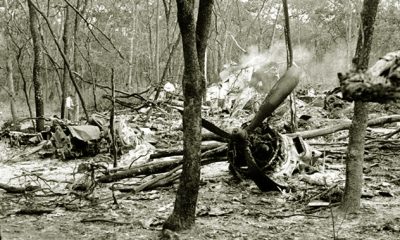
Mysterious Death of United Nations Secretary General Hammarskjöld