
Life style
Lights, cheer and quiet reflection


As the winds of Ditwah, swept across the country, Colombo responded not with retreat but with quiet resilience. The city’s festive rhythm continued to be subtle yet assured reminding that celebration in Colombo has never been about spectacle but above spirit. From Galle Face to the heart of the city, hotels and public spaces were dressed in festive splendour. Lobbies echoed with seasoned melodies, tables were laid with delicious spreads, and December air carried the unmistakable promise of celebrations.
The month of December in Colombo has always been a time of warmth beyond cool weather, fairy lights strung along palm lined roads, carols drifting from hotel lobbies, and the gentle hum of families and friends reclaiming public spaces. This year, however the celebrations arrived tempered with empathy, while the capital regained its rhythm, memories of displacement and loss in other parts of the island lingered shaping a festive mood that felt more conscious, more human
Across the city roads and public spaces were alive again. Galle Road sparkled after dusk, traffic flowed steadily and Galle Face Green was a hive of activity
where children chased kites, couples lingered over street food and the sea breeze carried a sense of collective relief.
The hospitality sector for a long time, a barometer of Colombo’s mood embraced the season with elegance and sensitivity.
At Hilton Colombo festive dining unfolded against polished interiors glowing with festive décor, while Taj Samudra offered seasonal menus that married tradition with comfort. Their newly opened Navaratne restaurant gave the diners a new Indian experience with authentic food.
At Galle Face Hotel history came alive in a series of traditions and celebrations that blended warmth, community and timeless charm.
The Cinnamon Hotels and resort trio – Cinnamon Grand, Cinnamon Red and Cinnamon Lakeside brought its own distinctive sparkle to the season, each property reflecting a different mood of celebrations after Ditwah, yet united by warmth and quiet confidence. The Courtyard by Marriott Colombo, transformed into a welcoming space where festive decor, seasonal dining came together
The city’s newest landmark, Cinnamon Life added a contemporary sparkle to Colombo’s Skyline, positioning itself as both a festive destination and a symbol of renewal. N. H. Collection in Colombo brought a sense of understated sophistication to the city’s festive narrative, appealing to travellers seeking calm luxury amidst the city’s gentle buzz. The timeless Mount Lavinia Hotel and grandeur of ITC Ratnadipa captured the festive spirit through refined luxury and contemporary sophistication. Beyond the hotels, the mood spilled on to the streets. Cafes hummed with conversations, boutiques shimmered with window displays, and families stepping out to visit their loved ones. Yet the festive mood in Colombo was layered with reflection. amid the celebrations, acts of kindness quietly took place reminding the city that compassion remains central to the season’s spirit. Charity drives, shared meals, and simple gestures of generosity combined empathy into the celebrations.
From shopping malls to pop up festive markets, Colombo’s shoppers were back browsing gifts and decorations
When the New Year approached, Colombo did not roar, it glowed.
The city stood ready to welcome 2026 not with extravagance but with strength, style and solidarity.
And so, as the year drew to a close Colombo stood luminous once more. The shadow of Ditwah has not disappeared nor has it been forgotten but it no longer defines the city. The city of Colombo slipped into the New Year dressed in resilience, compassion and understated luxury and welcomed 2026, while honouring the lessons of yesterday.
Glamour and Fashion
Fashion, a defining language in the capital, played an important part. There were many fashion shows among leading designers showcasing their festive collection, adjusting schedules and fashion spaces transformed into pockets of comfort and creativity. There was an unspoken understanding across the industry. Many designers echoed the sentiment that life has to go on.
Even in moments of disruption, there was a collective desire to keep the creativity alive, said one of the top designers.
Families gathered for festive meals; friends met over coffee rather than grand dinners.
Friends and relatives who arrived from all nooks and corners of the world enjoyed the festive season with love and fun.
Beyond fashion, Colombo’s other sectors echoed the same sentiments. From seasoned menus to ambient lighting with fairy lights, illuminated arches and seasonal décor, Colombo took on a carnival like charm. Grand discount sales, small carnivals and family get-togethers added colour to the season. Traffic moved at a festive pace, patience replacing urgency as pedestrians crossed roads to capture photos, and selfies behind glowing installations while lights lined the streets and celebrations gathered momentum.
In true Colombo spirit, celebrations were tempered with compassion. Hotels, community groups and individuals extended support, donations and solidarity, ensuring that the seasons’ warmth reached beyond decorated tables and illuminated roads.
Joy was shared, not isolated, of the flood victims from Kolonnawa.
As fireworks lighted the skyline, the city chose kindness as its final gesture of the year welcoming tomorrow without turning away from today. As the year drew to a close, Colombo stood poised between gratitude and anticipation. Wrapped in festive cheer, the city of Colombo looked ahead with hope, welcoming the New Year while holding on to the warmth of shared moments.
by Zanita Careem ✍️

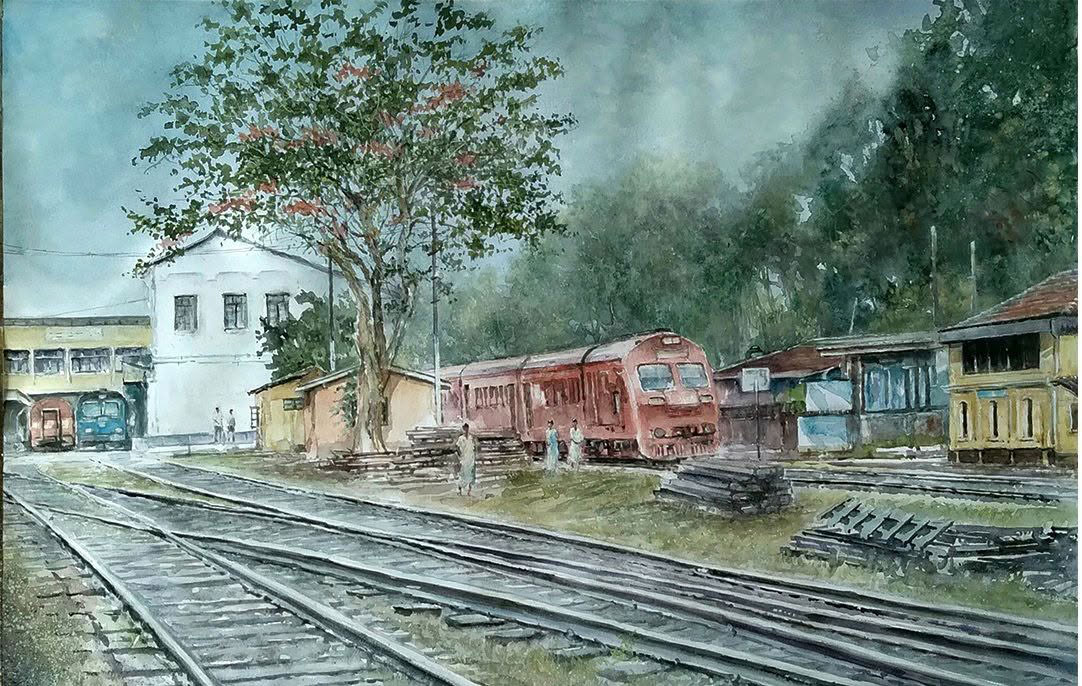
By Ifham Nizam
The boat had been travelling for hours under the relentless sun when Royden Oswald Gibbs finally reached the lighthouse.
For most people, the journey would have been enough. For Gibbs, it was only the beginning.
He opened his sketchbook and began to draw, carefully observing the structure, measuring it and recording its details. His student Wasantha Siriwardena photographed the lighthouse as Gibbs worked. The heat was punishing. Eventually, Gibbs fainted from dehydration.
But after recovering, he had only one thought.
“Let’s go and cover the other lighthouse.”
He never gave up.
That determination defined much of Gibbs’s 65-year journey as an artist – a journey that took him across Sri Lanka in search of places, landscapes, buildings and fragments of history that he believed should be preserved for those who came after him.
He travelled on foot, by bus, car and boat. Distance and discomfort rarely stood in his way. His interest in historical places and nature drew him into forests, across mountains, along coastlines and towards remote temples and lighthouses.
He painted the Sri Lanka he saw – and, unknowingly perhaps, created a record of a Sri Lanka that was already beginning to disappear.
Gibbs died on 14 July 2026, leaving behind a remarkable collection of paintings that friends and students believe should be regarded as part of the country’s cultural heritage.
His subjects included Raja Maha Viharayas, Tampita temples, forts, ambalamas, old houses, bridges, lighthouses and landscapes.
-
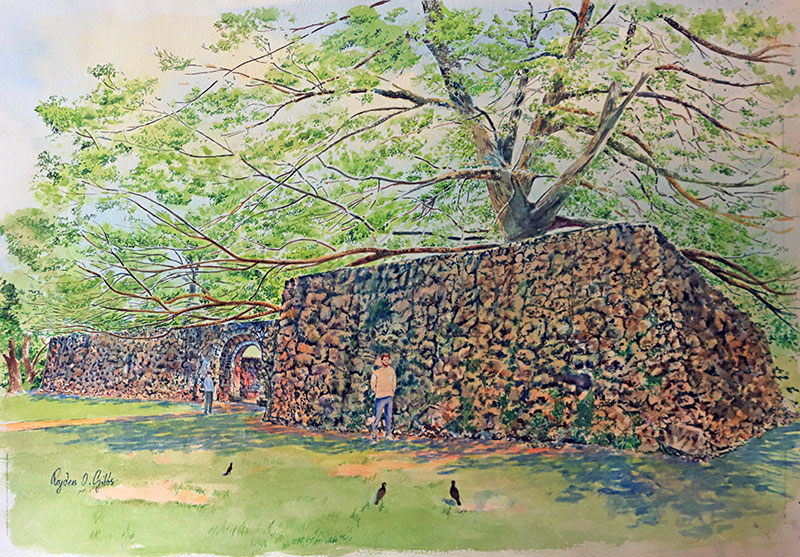
- Dutch Fort Katuwana, Matara
-
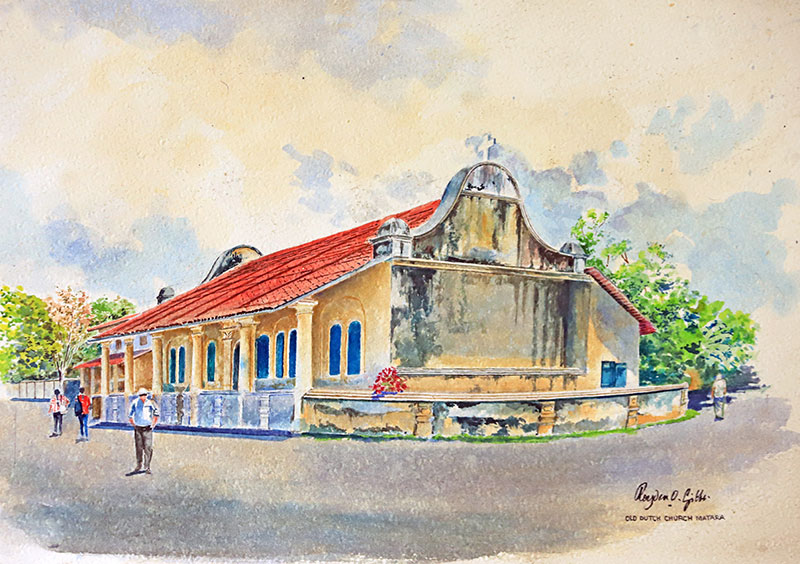
- Church Matara
Some have changed. Some have disappeared.
And some survive today principally because Gibbs thought to paint them.
Painting against disappearance
Among the most significant works in his collection is his painting of the Mullaitivu Lighthouse, which was destroyed during the civil war when the area was under LTTE control.
The painting has assumed an importance beyond its artistic value. It provides a rare pictorial record of a lighthouse that no longer exists.
The Galle Lighthouse, regarded as Sri Lanka’s first lighthouse, was also among the subjects he captured.
For Gibbs, painting was never simply about producing a beautiful picture.
“He was a patriotic person and wanted to document the historic sites, the old houses, the buildings, the Raja Maha temples, the Tampita temple, the lighthouses and the bridges – everything that was fast vanishing,” says senior environmental lawyer Dr. Jagath Gunawardena, a longtime friend of the Gibbs family.
Gunawardena believes Gibbs was thinking about generations yet to come.
“He wanted to keep a visual record of everything he had seen for upcoming generations. He didn’t think of his life or the present day. He thought of the future.”
That makes the collection particularly important today.
A painting of an old building becomes something different when the building is demolished. A landscape acquires another significance when the landscape has been transformed. A lighthouse painted in another era can become historical evidence after the structure disappears.
Gibbs’s work, therefore, occupies a space somewhere between art and memory.
A lifetime with colour
Gibbs was a student of St Peter’s College and studied painting at the Cora Abraham School of Chitra and Mudalindu, under the late Mudaliyar A. C. G. S. Amarasekara.
He began painting professionally at 16 and continued for approximately 65 years, participating in both solo and group exhibitions.
He worked in watercolour, oil, acrylic, pastel, charcoal, pencil, coloured pencil and pen and ink.
But watercolour remained particularly important to him.
“He used to always say watercolour is the most difficult medium and once you get hold of it, the others are easy,”
Gunawardena recalls. “His motto was to start off with a difficult thing and go to easy things, and not the other way around.”
Gibbs had an unusual ability to distinguish subtle variations in colour.
“He had a great ability to see even the most delicate colours,” Gunawardena says.
His artistic discipline did not diminish with experience. Even after establishing himself as a highly accomplished artist, he continued to study and experiment.
“He knew he was an excellent artist and a master, but he still went on improving,” Gunawardena says.
Gibbs kept a substantial collection of art books and believed artists should continue learning.
His advice was simple: learn from everything, but ultimately do what you like.
-
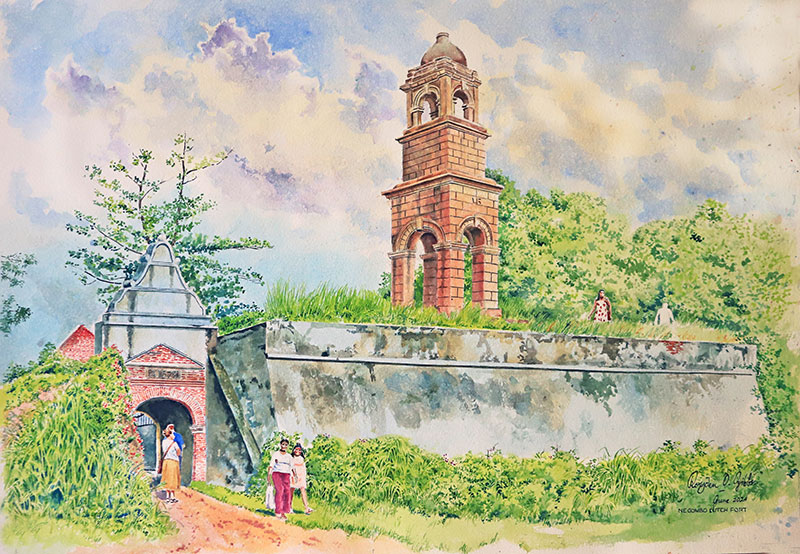
- Negombo Fort
-
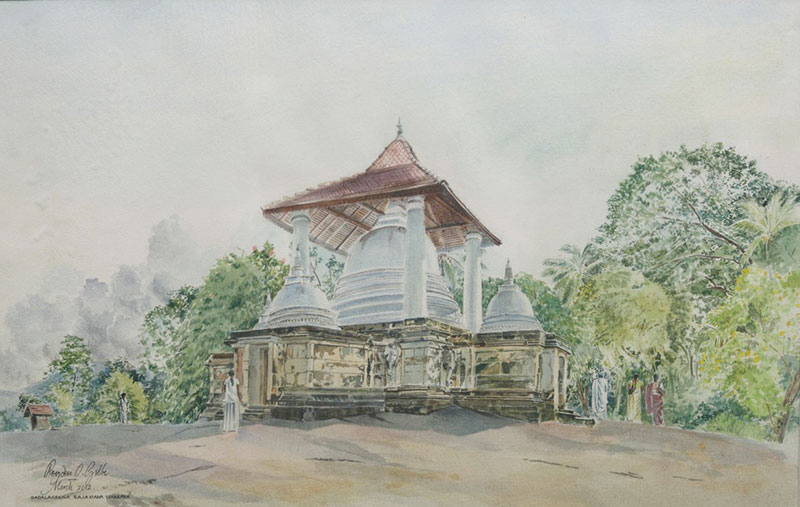
- Gadaladeniya Rajamahaviharaya
-
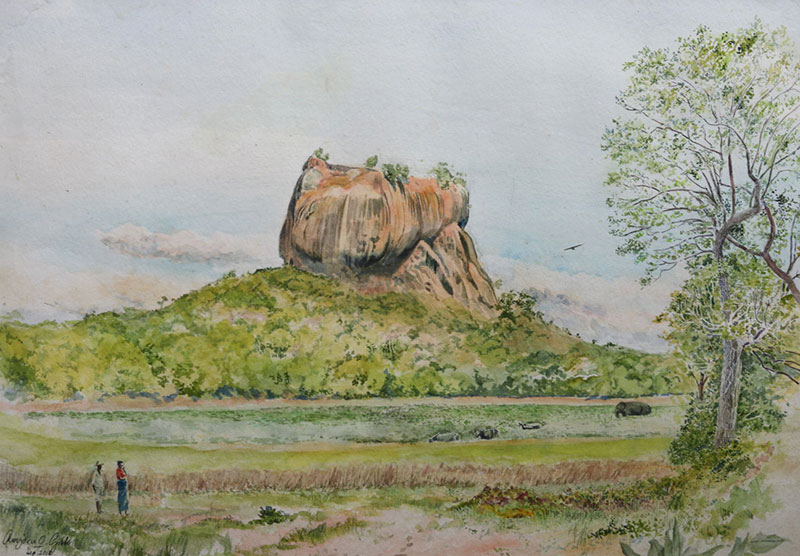
- Sigiriya
-
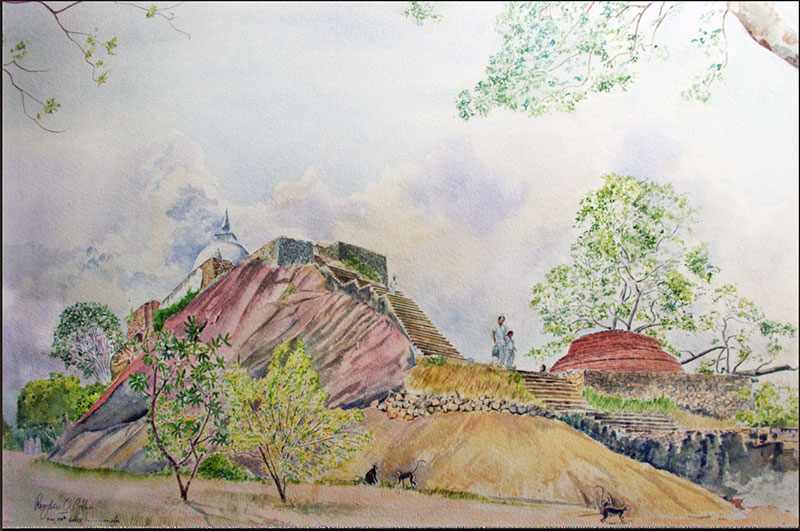
- Sithulpawwa
The teacher
For many of his students, however, Gibbs’s greatest legacy was not what he painted, but what he taught.
“He was a national treasure,” says student Dillai Joseph Rodrigo. “All he told us, as aspiring artists, was to one day leave something for the country. He, indeed, showed it by action by recording some of the places that no longer exist.”
Student Kalhari Perera remembers a teacher who demanded much more than technical ability.
“I don’t know of any artist in Sri Lanka who has travelled across the country and painted live – on mountains, oceans and temples,” she says.
Yet she believes the country did not sufficiently appreciate his contribution.
“It breaks my heart to know that we, as a country, have failed to appreciate this amazing talent. It’s a pity that art in Sri Lanka is so commercialised rather than appreciated.”
Perera had lived for about a decade down the road from Gibbs without knowing that he conducted classes.
When she eventually became his student, she discovered a demanding teacher.
“He demanded perfection, discipline, regular practice and passion.”
Gibbs was not interested in keeping students merely for the sake of numbers.
“He most often gave up on students who didn’t connect well because he never thought of money,” Perera says. “He had many ‘first-class students’, he said – the ones who never came back after the first class.”
Learning to see
Perera says Gibbs taught her something no textbook could provide.
“He was the teacher who opened my eyes to colour and how to identify my surroundings like an artist.”
She remembers listening to his stories of travelling across the country, including journeys undertaken during the war, when he would spend hours in boats, under the scorching sun, painting lighthouses.
She was also fortunate enough to paint outdoors with him.
His last live painting session was with her at Beddagana Bird Park.
Gibbs and his wife Linda became close to her.
“Sir and his sweet wife Linda were like my own mother and father,” she says. “Linda makes the best coffee in Colombo. He served that coffee to me with great pride.”
The memory is revealing of the man behind the artist.
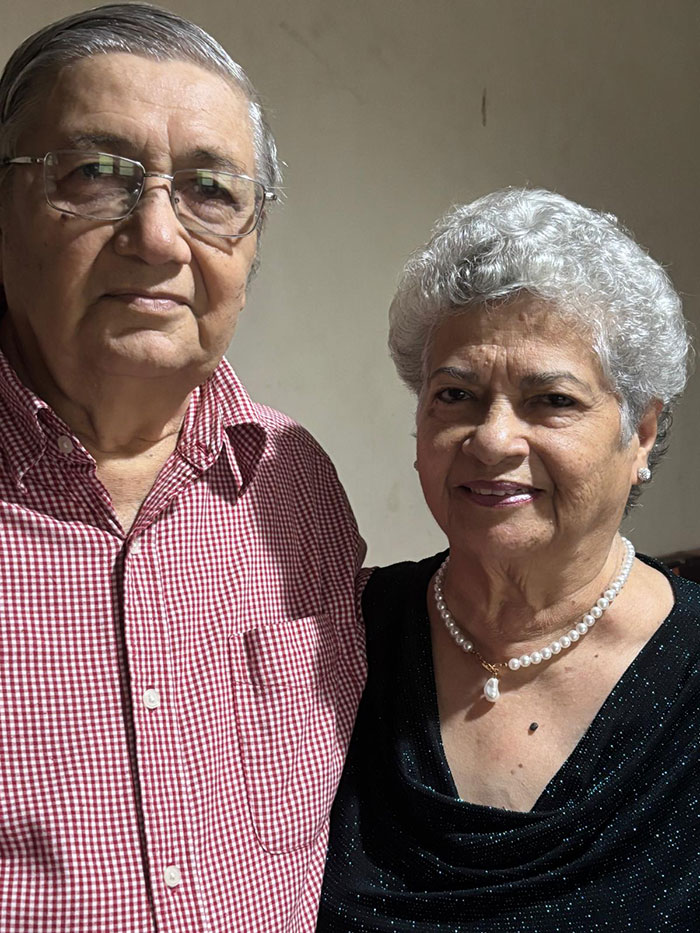
Royden and wife Linda
“He appreciated the simple things in life. He was a simple man.”
Trincomalee in the 1980s
One of Perera’s most treasured Gibbs paintings is of Trincomalee Harbour, painted in the 1980s.
Gibbs was selective about whom he sold his work to. He wanted his paintings to go to people who genuinely appreciated them.
“I gave the money I had at that time and told him to give me a painting of his that he would like me to have,” Perera says.
He gave her the Trincomalee Harbour.
“The harbour doesn’t look the same now. This I will treasure for the rest of my life.”
For Perera, the painting is also a reminder of the responsibility that comes with being his student.
“I am so fortunate to have got my foundation from him. A solid, unshakable foundation. Now I have the task of building on.”
The journeys that mattered
Wasantha Siriwardena remembers joining Gibbs on expeditions to Jaffna and Delft Island and later travelling with him to see some of the country’s most remote lighthouses.
They wanted to reach the Kirinde lighthouse and the Great Basses and Little Basses.
Few people had visited some of these locations.
They stayed overnight at Kirinde and left by boat at around 6 a.m. with the Coast Guard.
They reached the lighthouse at about 10.30 a.m.
While Gibbs sketched and measured the structure, Siriwardena photographed it.
Then Gibbs collapsed from dehydration.
After recovering, he wanted to continue.
“He never gave up,” Siriwardena says.
The same persistence was evident in his teaching.
“When he was ill, I used to drop him at the hospital. When he comes back home, he calls me and says, ‘Good evening, I am back.’ He was very energetic.”
This time, however, Gibbs did not return.
A master of many mediums
Student Chandana Illankone met Gibbs in 2020 and describes him as possibly the finest watercolour artist he had encountered in Sri Lanka.
“He may be the best in mastering watercolour in Sri Lanka. Nobody has done such type of art in watercolours in Sri Lanka.”
Pen and ink, too, was among his strengths.
“Not many people can do it. He was an expert in every medium.”
Illankone remembers Gibbs’s paintings of Raja Maha Viharayas and other historic locations.
“Some of those places have changed now. Even during the civil war he went and did his paintings.”
But recognition did not always follow achievement.
“He has done so much for the country. Sri Lanka should preserve these paintings,” Illankone says.
A threefold legacy
Gibbs was unable to attend the launch of his final exhibition of paintings by his students on 19 June 2026 because of illness.
Gunawardena attended in his absence.
“I didn’t think Gibbs would leave us so soon,” he says.
Gibbs had experienced periods of illness and recovery for several years. Yet he continued to paint, teach and travel whenever he could.
Gunawardena sees his legacy as threefold.
“A lot of paintings, a lot of techniques and a lot of students.”
His life outside painting was equally marked by curiosity.
He loved ornamental fish, their vivid colours and the pleasure of watching them spawn. He decorated the fish tank on his verandah with the same artistic imagination that informed his larger works.
He also took great pleasure in nurturing his peacock fern, watching it grow.
Perhaps this was the essence of Gibbs: he paid attention.
He looked closely at a lighthouse, an old temple, a bridge, a tree, a bird, a fish or a flower. He saw details that others might pass without noticing.
Then he recorded them.
What remains
Gibbs’s death leaves behind more than an archive of paintings.
It leaves a question.
What will happen to these works?
If they are scattered, forgotten or allowed to deteriorate, Sri Lanka risks losing not merely the work of an accomplished artist but an irreplaceable visual record of its own past.
Gibbs understood that the things he painted might not survive.
So he preserved them in colour.
His paintings now offer a glimpse of lighthouses that have vanished, landscapes that have changed, historic places that have been altered and buildings that may no longer stand as he knew them.
He travelled because he wanted to see.
He painted because he wanted others to see.
And he kept going because he believed that what mattered should be recorded.
Perhaps the finest tribute to Royden Oswald Gibbs would, therefore, be to ensure that his paintings do not become another part of the history he worked so hard to preserve.
They belong to the country he spent a lifetime documenting.
And somewhere in those colours – in the faded walls of an old temple, the distant outline of a lighthouse, the green of a forest or the blue of a harbour – is the Sri Lanka Gibbs saw, loved and quietly saved for us.

For years, Ramani Fernando has been part of Colombo Fashion Week, bringing her expertise in hair, beauty and styling to one of Sri Lanka’s most anticipated fashion platforms. From the excitement backstage to the glamour of the runway, her journey with CFW reflects the remarkable evolution and the growing importance of beauty in completing a designer’s vision. Her contribution backstage has helped shape the distinctive beauty and glamour that bring the runway to life.
(Q) You have been associated with Colombo Fashion Week for many years. What does CFW mean to you personally and professionally?
(A)Colombo Fashion Week has been a very special part of my journey, both personally and professionally. I’ve had the privilege of watching it grow and evolve, and to have been part of that journey is something I’m very proud .
For me, CFW is not just about fashion. It is about creativity, collaboration and showcasing Sri Lankan talent to the world. Every year, there is a new energy, new designers, new ideas and new ways of interpreting beauty. Being part of that is incredibly exciting.
(Q) How has your involvement with CFW evolved since the early days?
(A) When we started, the focus was very much on creating beautiful hair and makeup looks for the runway. Over the years, our involvement has become much more collaborative.
Today, we work much more closely with the designers and the CFW team to understand the overall concept and make sure the hair and makeup complement the collection rather than simply looking beautiful on their own. It has become a much more creative and considered process.
(Q) What changes have you seen in hair and makeup trends on the CFW runway over the years?
(A) There has definitely been a huge evolution. In the earlier years, runway beauty was often more glamorous and defined. Today, there is much more freedom to experiment.
We’ve seen everything, from very polished, sculpted looks to fresh, natural skin, textured hair and more unexpected creative elements. What I love is that beauty on the runway has become less about following a trend and more about telling a story and complementing the designer’s collection.
(Q) How do you translate a designer’s vision into the right hair and makeup look?
(A) The first step is always listening. I want to understand what the designer is trying to communicate through the collection—the colours, fabrics, silhouettes, inspiration and overall mood.
Then we look at how beauty can support that vision. Sometimes the right look is very minimal because you want the clothes to speak. Other times, hair and makeup become an important part of the statement. It is about finding the right balance.
(Q) What is the creative process between you, your team and the designers before the show?
(A) It is very much a team effort. We discuss the collection with the designer and the CFW team, look at references and understand the mood they want to create.
Then my team and I work on the hair and makeup direction and make sure the looks are presentable across the entire show. There is a lot of communication and, of course, a lot of testing and fine-tuning before we arrive at the final look.
(Q) What happens behind the scenes before the models walk onto the runway?
(A) There is a tremendous amount of work happening backstage that the audience never sees. Our teams are working continuously on hair and makeup while models are changing outfits and moving between different designers.
Timing is everything. Everyone has to know exactly what they are doing, because there is very little room for mistakes. It can be intense, but it is also one of the most exciting environments to work in. When the music starts and the first model walks out, all that backstage energy suddenly comes together.
(Q) What has kept you coming back to CFW year after year?
(A) The people, the creativity and the energy.
Every year brings something different. I love seeing new designers, new talent and new ideas coming through, and I also love seeing how much the platform has grown.
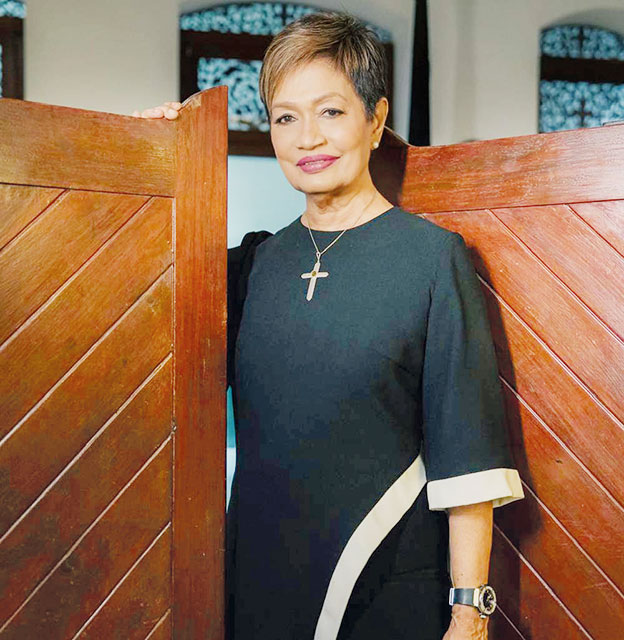
Ramani Fernando
There is a real sense of pride in being part of something that continues to give Sri Lankan fashion a platform.
(Q) How important has CFW been in putting Sri Lankan fashion on an international platform?
(A) I think CFW has played a very important role in creating visibility for Sri Lankan fashion. It has given our designers a professional platform to present their work and connect with an audience beyond Sri Lanka.
It has also shown that we have the creativity, craftsmanship and talent to create fashion that can stand confidently on an international stage. That exposure is extremely valuable for the industry as a whole.
(Q) What are the major challenges you face with hair and makeup for a major fashion show?
(A) The biggest challenge is always time. You have a large number of models, multiple designers and very tight schedules, and everything has to be perfect when the model steps onto the runway.
Then there are practical challenges—different hair textures, different skin types, quick changes between looks and sometimes completely different beauty directions within the same day.
It takes a very experienced and well-coordinated team to manage all of that, and I’m very proud of the teams we have built over the years.
(Q) What makes Sri Lankan fashion distinctive in your view?
(A) I think our biggest strength is our ability to combine our heritage with modern creativity. Sri Lanka has such a rich culture, beautiful craftsmanship, incredible textiles and so many stories to draw inspiration from.
Our designers are able to take those influences and interpret them in a contemporary way. That combination of our identity and modern design is what makes Sri Lankan fashion special.
(Q) If you had to describe your Fashion Week journey in three words, what would they be and why?
(A) Creativity. Collaboration. Evolution.
Creativity because every collection brings a new opportunity to create something different.
Collaboration because Fashion Week is never about one person. It takes designers, models, stylists, makeup artists, hairdressers, production teams and so many people working together.
And Evolution because I have been part of Colombo Fashion Week from its inception, 23 years ago. I have had the privilege of watching CFW, the fashion industry and our own beauty industry grow and change over the years. Being part of that evolution has been an incredible journey.
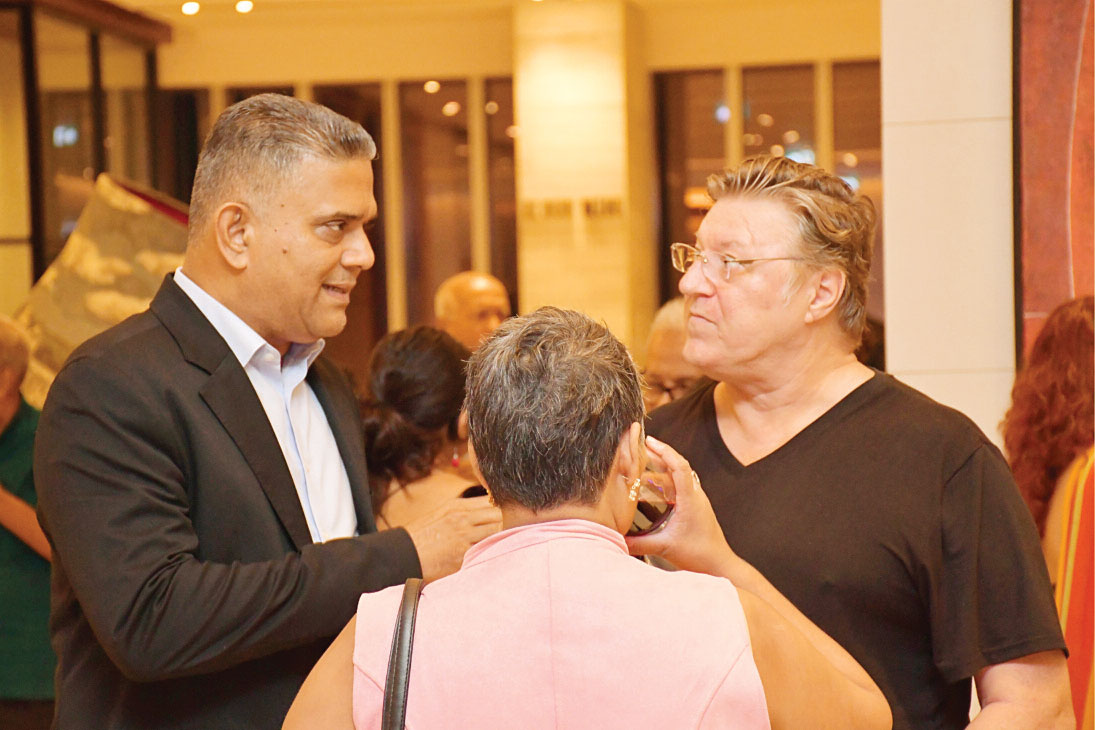
Some stories are carried in words. Others survive in gestures, images and fragments of memory passed quietly between generations. Channa Ekanayake’s What Lives Between, curated by Kasun Jayamanne, looks towards these less visible forms of inheritance, drawing on Sinhala folk poetry and the lived experiences of Sri Lankan women to consider how culture continues to shape identity.
Presented as the eighth edition of Artist Spotlight by John Keells Foundation and City of Dreams, the exhibition brings Ekanayake’s distinctive contemporary practice into a setting where art becomes part of the wider Cinnamon Life experience. His work draws from Sri Lanka’s architectural, spiritual and natural environments, translating familiar forms into compositions shaped by geometry, colour, rhythm and restraint.
Explaining the ideation behind What Lives Between, artist Ekanayake says, “The process began with an interest in memories that outlast the people, places and moments that shaped them. Sinhala folk poetry carries many of these memories, particularly stories and experiences connected to women that have travelled through generations. I wanted to explore that inheritance through a contemporary visual language, allowing the familiar to become something that can be seen and considered anew.”
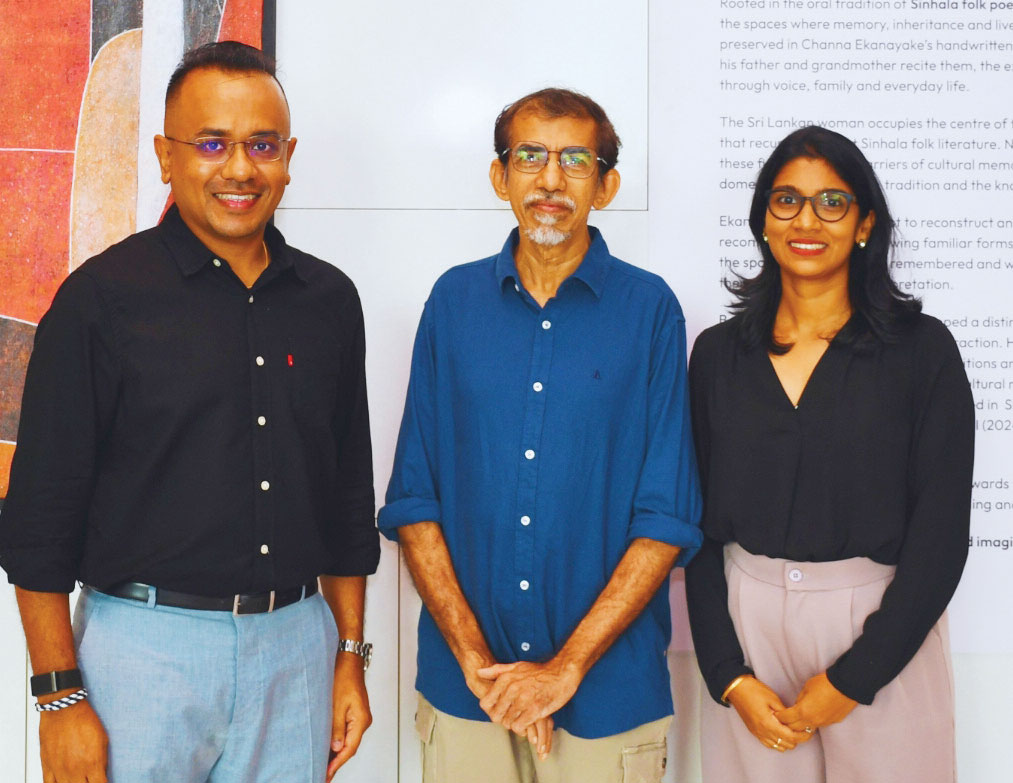
Captivated crowd gathers for Channa Ekanayake’s”What Lives Between’
That exploration extends a practice developed across more than two decades. His early solo exhibition Dwellings, in 2001, established an interest in architecture and inhabitation, while later works including Silence of the Blue and BODHI explored spirituality, environment and cultural symbolism. International presentations, such as Islanded at Aicon Contemporary in New York, further expanded his engagement with Sri Lanka’s visual and cultural landscape.
What Lives Between continues this trajectory while turning its focus towards cultural memory and Sri Lankan womanhood. Folk poetry serves as a point of departure rather than a literal source, allowing Ekanayake to simplify and reconfigure familiar references into a visual language that invites interpretation.
Kamal Munasinghe, Senior Vice President, Colombo Hotels, Cinnamon Hotels & Resorts and General Manager, Cinnamon Life at City of Dreams, says, “Art has a powerful ability to create connections, particularly when it becomes part of an environment where people can encounter it naturally. Artist Spotlight allows us to bring Sri Lankan artistic expression into the City of Dreams experience while giving artists an opportunity to engage audiences who may encounter their work for the first time.”
That philosophy places Artist Spotlight within a broader commitment to creating meaningful encounters between artists and audiences. The initiative gives Sri Lankan artists a platform to reach new audiences, collectors and art enthusiasts, while positioning City of Dreams as a living gallery where local artistic expression can be experienced alongside the hospitality and lifestyle environment.
Carmeline Jayasuriya, Head of CSR, John Keells Group, says, “Supporting artists is about enhancing space for creativity to be seen, experienced and valued by diverse audiences. Through Artist Spotlight, we hope to contribute to a stronger creative ecosystem in Sri Lanka while encouraging conversations around the stories, identities and experiences that shape our culture. As in the case of all our art-based activities, John Keells Foundation’s aim is to provide a platform that provides wider opportunities to the artist while promoting cultural understanding and appreciation through the amazing artistic talent of Sri Lanka.”
At its heart, What Lives Between is an invitation to look beyond what is immediately visible. Ekanayake’s work brings together poetry, memory and visual form to consider what survives, changes and continues to connect generations, giving audiences an opportunity to encounter a distinctly Sri Lankan story through a contemporary artistic lens.

Missiles intercepted near Riyadh after Saudi coalition hits Yemen fuel depot

MI5 chief warns of threats to UK from Russia, Iran and AI

Pope diagnosed with lung cancer but had successful surgery, Vatican says

Expedite the cleaning of Colombo’s canals and drainage systems within the next two weeks – PM instructs officials

Kusal Mendis’ unbeaten 87 hands Sri Lanka consolation win

Cabinet approves redrafting of State Assets Management Act

‘Dates have the highest sugar content to fight Coronavirus’

Sunday Island 27 December – Headlines

#SundayIsland 17th December – Headlines

Sunday Island – 28th March

Sunday Island Headlines – 21 March

Sunday Island – 21st February – Headlines
-

 Features6 days ago
The Sri Lankan who made Scottish history
-

 Sports6 days ago
Nissanka absence opens door for Sri Lanka’s young guns
-

 News5 days ago
NDB fraud Rs 60mn more than reported
-

 News7 days ago
Gnansara Thera to be assigned to prison printing section: Officials
-

 News5 days ago
Removing monk’s robes matter for Sangha to decide: Mahanayake Theras
-
 News7 days ago
OIC of FCID summoned before Maligakanda Magistrate
-
 News6 days ago
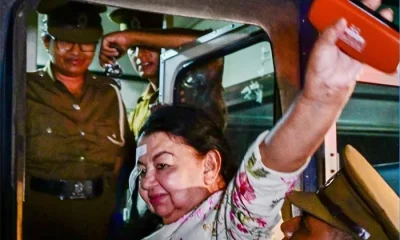
Shiranthi R remanded until 13 Oct.
-

 Features6 days ago
Future of Sri Lanka’s state university system: Should it be shut down and reopened?