
Latest News
Lewis’ 61-ball century trumps Kusal’s 19-ball fifty in 23-over shootout


After a series in which they consistently failed to get the rub of the green, the stars finally aligned for West Indies as they ended their tour of Sri Lanka with a morale-boosting win. Evin Lewis, playing his first ODI since 2021, struck an unbeaten 102 off 61 balls, as West Indies chased down a DLS-adjusted target of 195 in a rain-reduced game of 23 overs with eight wickets to spare. In fact, they got the required runs with an over to spare. It was their first ODI win in Sri Lanka following ten straight defeats, and their first win on this tour since the first T20I.
Sri Lanka, for their part, had put up a valiant effort after their innings had been cut into less than half. The first 17.2 overs had come prior to the rain intervention, and upon resumption, they were given just a further 5.4 overs to set a competitive total.
Enter Kusal Mendis, who bludgeoned an unbeaten 56 off 22 deliveries – he got the half-century off 19 balls – as Sri Lanka themselves struck 75 runs in those final 5.4 overs to end on 156 for 3, and gave themselves a fighting chance. In the end, though, a combination of a wet outfield, wet ball and a laser-focused Lewis proved too much to overcome.
Brandon King (18 off 19 balls) and Shai Hope (22 off 27) had kept Lewis company for most of the chase, but it wasn’t until Sherfane Rutherford joined him in the middle that West Indies truly took control of proceedings.
Rutherford’s brisk cameo saw him plunder 50 off just 26 deliveries, including four fours and three sixes, with his partnership with Lewis amounting to an unbeaten 88 from just 45 deliveries. It was a pivotal stand in the context of the game, as it came just as Sri Lanka might have been harbouring thoughts of a late heist.
With the required run rate at roughly 8.5 an over from the outset, West Indies had done well to just about keep up with it over the opening ten overs – there was at least one boundary in seven of the first 11 overs. But in such a short chase, even a couple of quiet overs can heighten the pressure – and so it proved to be.
Between the 11th and 17th overs, Sri Lanka gave away just 40 runs as the required rate rose to above 11.50 runs an over. Skipper Charith Asalanka had done well in this period by shuffling his pack to sneak in some cheap overs from himself and Kamindu Mendis – both of whom made up the fifth-bowler quota after Wanindu Hasaranga had struggled with controlling a wet ball.
Where Asalanka erred was in bowling himself for one over too many, which allowed Rutherford and Lewis to go after him. That 14-run over set the tone, after which the pair never looked back. The miserly Maheesh Theekshana was rinsed for 18 in the next over, while even the excellent Asitha Fernando was hounded for 26 off his final two. Dilshan Madushanka, playing his first ODI since March, went for 50 in five.
Sri Lanka, though, will have positives to take away from this game, particularly in how aggressively they approached the post-rain period, knowing that they didn’t have much time to scrounge up a competitive total. The opening 17.2 overs had seen Sri Lanka stitch together a measured start, with openers Pathum Nissanka and Avishka Fernando putting on 81.
That, though, owed much to West Indies dropping three chances – two of Nissanka and one of Avishka – inside the opening ten overs. This poor catching did not get much better after the five-hour rain delay, with Kusal also dropped twice on the way to becoming the third-quickest Sri Lanka batter to 4000 ODI runs.
It all began with the four balls left in Roston Chase’s second over, as Kusal proceeded to clatter each of them for boundaries – two precise pulls, one stunning straight drive, and finally a fortunate inside edge down to fine leg. In all, Sri Lanka struck 12 boundaries in the final 34 deliveries they faced.
The shortened game also had some knock-on effects on West Indies’ bowling plans, as the new provisos meant three bowlers were given a quota of five overs each, while two others were handed four apiece. Once Chase’s over, in which Kusal had struck four consecutive boundaries, was belatedly completed, and with Sri Lanka in raucous mood, West Indies were suddenly faced with the proposition of figuring out how Gudakesh Motie, Jayden Seales, and Alzarri Joseph – who had bowled four, four and three overs, respectively – would split the remains.
And with the economical Matthew Forde already having bowled five overs prior to the rain break, it meant only two more bowlers could bowl five; so they needed to find one more over from somewhere.
With Chase having been dispatched upon the resumption of play, it was left to Rutherford to roll his arm over, and he was duly taken for 17 runs courtesy two fours and a six. And as Kusal’s carefree innings continued in earnest, Sri Lanka eventually managed to muster up a competitive total – though it proved to be just not good enough on the day.
Brief scores: (23 overs)
West Indies 196 for 2 in 22 overs (Evin Lewis 102*, Shai Hope 22, Sherfane Rutherford 50*, Dilshan Madushanka 1-50, Asitha Fernando 1-39) beat Sri Lanka 156 for 3 in 23 overs (Avishka Fernando 34, Kusal Mendis 56*, Pathum Nissanka 56; Roston Chase 1-20, Sherfane Rutherford 1-27) by eight wickets (DLS method)
[Cricinfo]

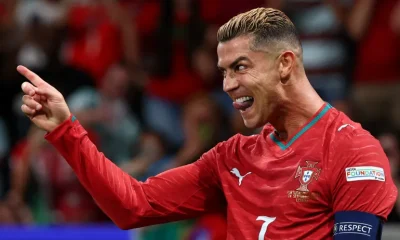




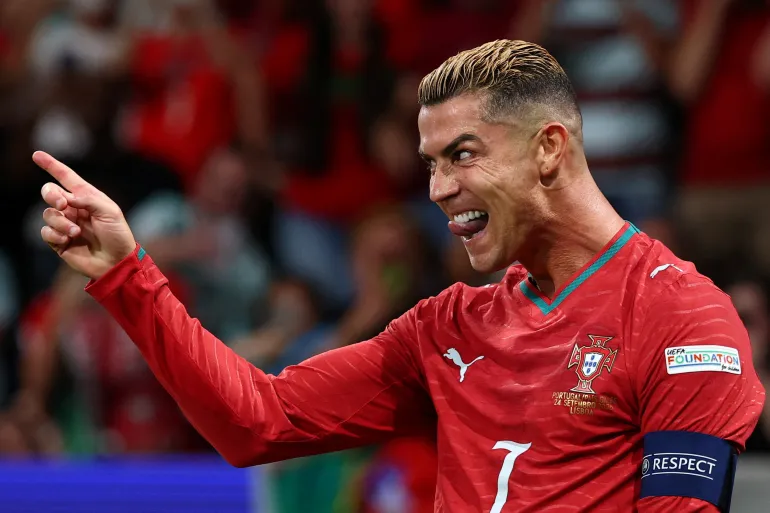
Cristiano Ronaldo has accused Portugal coach Jorge Jesus of twice breaking his word, saying a failed agreement to publicly explain his omission against Norway drove him out of the camp, but insisting he remained available after any punishment.
In a lengthy statement, the 41-year-old gave his account of the dispute that prompted his departure from Copenhagen before Portugal’s Nations League match versus Denmark last week.
Ronaldo said Jesus had agreed a plan under which the forward would miss the Norway and Denmark matches to manage his fitness. However, on the day of the Norway game, the coach told him he would play for 30 minutes.
“Everyone knows the rest. I warmed up from halftime onwards, watched the minutes tick by and wasn’t called on,” Ronaldo said.
“The manager had broken his word to me.”
Portugal’s captain and all-time leading scorer said a subsequent meeting with Jesus, attended by his club side Al Nassr’s sporting director Simao Coutinho, produced an agreement for the coach to clarify events at his next news conference.
According to Ronaldo, an eight-point document was prepared saying he had never demanded playing time, had respected Jesus’s decisions and that the coach asking him to warm up without bringing him on had been a mistake.
Ronaldo said the agreed notes did not require Jesus to apologise to him but said the coach’s public remarks bore no resemblance to their private discussion.
“It was the second time he had broken his word to me,” Ronaldo said. “I decided to leave the training camp without waiting for any further broken promises.”
The statement provided Ronaldo’s account, but on Sunday, after Portugal’s win over Norway, Jesus denied he had made any agreement with the player, nevertheless leaving the door open for his return.
The Portuguese Football Federation (FPF) did not immediately respond to a request for comment about Ronaldo’s statement.
Ronaldo apologised for failing to greet supporters after the Norway match and for leaving his teammates, accepting that his captaincy made his conduct more serious.
“The consequences of my actions must be assessed and punished by the Portuguese Football Federation,” he said.
Despite the rupture, Ronaldo said he was not limiting his international ambitions to a farewell appearance.
“If I’m physically fit, playing for my club – scoring goals, I hope – after serving whatever suspension is imposed on me, I’ll be available, as I’ve always been until now, to compete and win for our national team,” he added.
(Aljazeera)
Latest News
M. M. D. J. Senarathne, appointed Director General of the Department of National Botanical Gardens

The Cabinet of Ministers approved the resolution furnished by the Minister of Environment to appoint M. M. D. J. Senarathne, who is the senior most officer in Grade I of Sri Lanka Scientific Service se
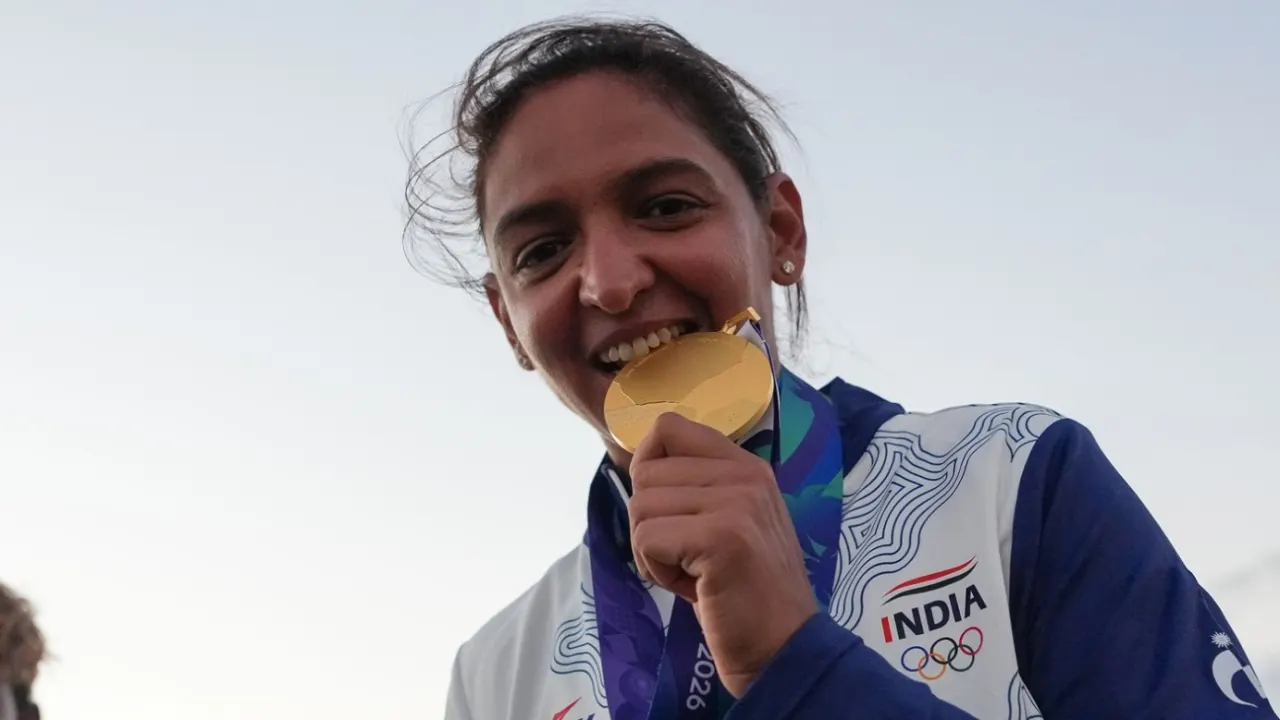
Harmanpreet Kaur, who led India to their first women’s global title at last year’s ODI World Cup, has stepped down as captain from all three international formats. She announced her decision via an Instagram post on Tuesday morning. Having given up the captaincy and left the team in a “good place”, she has said she’s now “ready to play for the love of the game again”.
Harmanpreet, 37, led India in five Tests, 51 ODIs and 155 T20Is. Her last act as captain was leading India to their second successive Asian Games gold medal, in Nisshin last month.
The decision came a day after Harmanpreet, India vice-captain Smriti Mandhana and head coach Amol Muzumdar met BCCI secretary Devajit Saikia in Guwahati to discuss the roadmap of the women’s team going forward.
“This is not an easy decision,” Harmanpreet wrote. “It carries years of memories, emotions, sacrifices, and moments that will stay with me for the rest of my life.
“I have given everything I had to this team and to Indian women’s cricket – my blood, my sweat, my time, and many times, a part of my own game and personal ambitions. There were moments when I had to put my individual performance, my own growth, and what I wanted for myself aside, because I believed the team had to come first.
“As a captain, I have had to make difficult decisions. Decisions that were not always understood, not always easy, and sometimes came at a personal cost. But every decision I made was with one intention – to make this TEAM better and to give other players the opportunity to grow, believe in themselves and become the best versions of themselves.”
Murmurs about a possible change in captaincy had been on for a while, especially after India’s second successive group-stage exit from the T20 World Cup in June this year. The selection committee, chaired by Amita Sharma, is understood to have been divided, but Harmanpreet had indicated a desire to lead India at the 2028 Olympics in Los Angeles.
“I leave the captaincy today with a heart full of emotions , but also with PEACE,” Harmanpreet said. “Because I genuinely believe My team is in a good place. A team with talent, character, belief and a future that I am incredibly excited to watch and be a part of.
“I feel I have done my duty. I gave this team everything I had. I carried the responsibility with pride, and I will always be grateful for the privilege of leading Indian women’s cricket.
“Now, it is time for me to turn the page. Captaincy may end today, but my love for Indian cricket never will. Thank you to every teammate, coach, support staff, management , BCCI , family members every single fan who stood by me through the highs and lows.”
The noise for Smriti Mandhana to take over has been getting louder in recent months. In the past six months, Mandhana has been vocal about her readiness for the top job, and has given evidence of her credentials by leading Royal Challengers Bengaluru to twin WPL titles (in 2024 and 2026).
Harmanpreet first captained the T20I team in 2012, but it wasn’t until after India’s group-stage exit from their home T20 World Cup in 2016 that she was considered a serious candidate for the role.
In 2018, she led the team to the T20 World Cup semi-finals in the Caribbean after having taken over the role in a full-time capacity from Mithali Raj, and followed it up with a runners-up finish at the T20 World Cup in Australia in 2020.
Harmanpreet’s stepping down as India captain will not, however, change her stance as far as playing the shortest format goes. She is expected to continue leading Mumbai Indians in the upcoming WPL edition as the team chases their third title.
[Cricinfo]

Ronaldo apologizes for Portugal walkout; says Jesus broke promise

Showers in the Western, Sabaragamuwa, Central, Uva, North-western and Southern provinces and in Anuradhapura and Mannar districts

Fuel crunch looms

Gnansara Thera to be assigned to prison printing section: Officials

Speaker rejects Ajith Perera’s privilege complaint

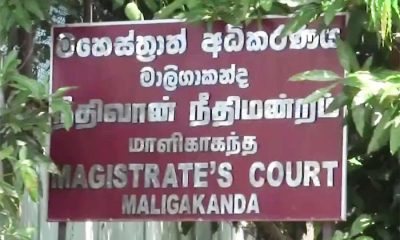
OIC of FCID summoned before Maligakanda Magistrate

‘Dates have the highest sugar content to fight Coronavirus’

Sunday Island 27 December – Headlines

#SundayIsland 17th December – Headlines

Sunday Island – 28th March

Sunday Island Headlines – 21 March

Sunday Island – 21st February – Headlines
-

 News6 days ago
US-assisted ‘Ice’ detection: NPC to examine IGP’s move to transfer drug-busting team
-

 Editorial5 days ago
Colombo Port drug bust: The plot thickens
-

 Editorial6 days ago
Drug busting, transfers and trust deficit
-

 Features3 days ago
The first woman in the foreign service or Ceylon Overseas Service it was then called
-

 Editorial4 days ago
Fuelling discontent and protest
-
 News6 days ago
Sri Lankan facing death penalty in Saudi Arabia: Mano G appeals to Crown Prince
-

 Latest News4 days ago
Tharindu Rathnayake, bowlers secure Asian Games Bronze for Sri Lanka
-

 News5 days ago
ADB-backed virtual net metering project faces policy contradiction