
Features
Let’s understand what a masterpiece is and how it originated

We watch movies and serials of different genres, we all read books, both fiction and nonfiction, and we try to read paintings. A certain part of the day most of us spend our time on Facebook, YouTube, Instagram, Wattpad, or TikTok watching or reading the contents. Whenever we come across something unusual, of course rich in creativity, on those platforms, we generally used to call or comment on them as ‘truly a masterpiece,’ ‘incredible work,’ or ‘great job,’ etc.
In a general sense, why would we call something a ‘MASTERPIECE’?
A YouTube video or an Insta reel with eye-catching content, also overlaid with a rhythmic melody or adorned with a beautiful voiceover we pass a comment saying it’s ‘a masterpiece’ because we enjoyed the content.
Sometimes a mother appreciates a piece of drawing made by her five-year-old kid by calling it ‘a masterpiece.’ Because she admires the work by her child. So, we call a work of art in any context ‘a masterpiece’ to admire the content.
On another occasion we watch a movie or read a novel with a heart-wrenching plot. And we empathise with the characters we met in those plots. We sometimes build strong emotional connections with the characters we find, and we see ourselves mirrored. So, at the end we commend the movie or the fiction as ‘a masterpiece.’ Because the plot and the characters could resonate with the emotions of the viewer or the reader. When a work of art is capable of evoking empathy in us, we unhesitatingly call it ‘a masterpiece.’
In the modern context any work of art that is enjoyed, admired, and felt deeply by the viewer or the reader could be a Masterpiece.
Is the term ‘masterpiece’ as simple as it sounds? No. It isn’t.
Does this term connote a much deeper and broader meaning? Yes, it does.
All forms of art begin with an ‘image’ conceived in the human mind.
The act of making ‘images’ in the mind is called Imagine.
The mental process that combines each image conceived in the mind, giving birth to a new idea, is called ‘imagination.’
The humans are gifted with the exceptional capacity of converting their imagination into visual, verbal, written, gestural, and melodic forms, which ultimately manifested as ‘Arts.’
Therefore, undoubtedly, imagination is the cornerstone of all forms of art.
The most important element that helps imagination to express itself through the mediums of visuals, words, texts, gestures, or sounds is creativity. The idea conceived in the mind or what is imagined cannot be embodied without creativity.
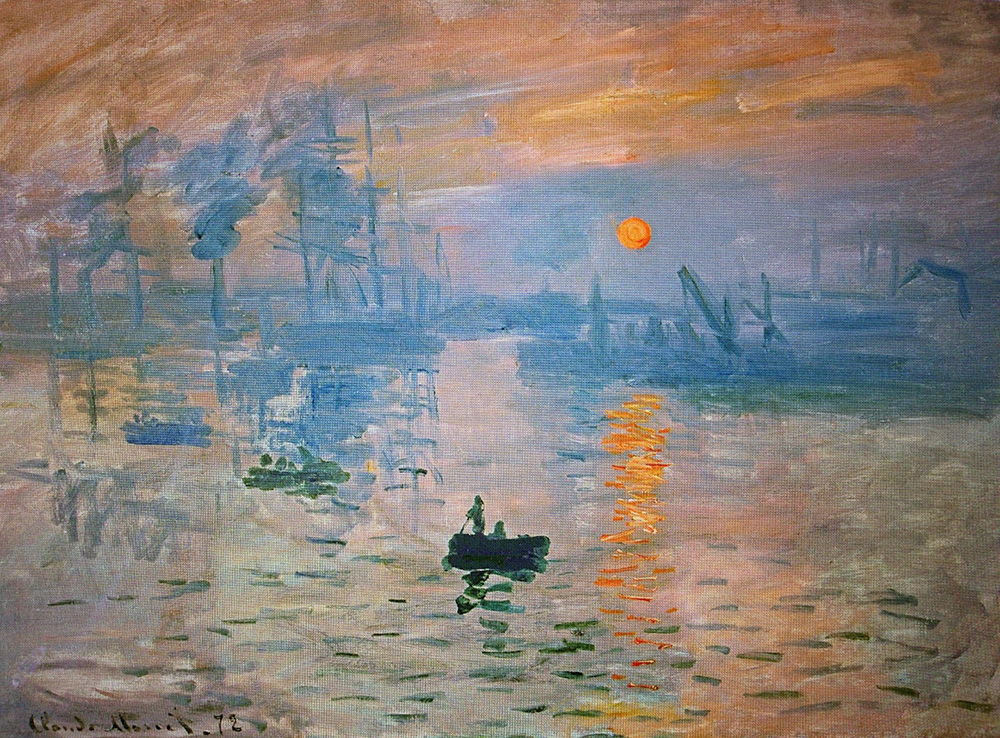
Claude Monet’s Impression Sunrise – National Gallery of Art in Washington DC
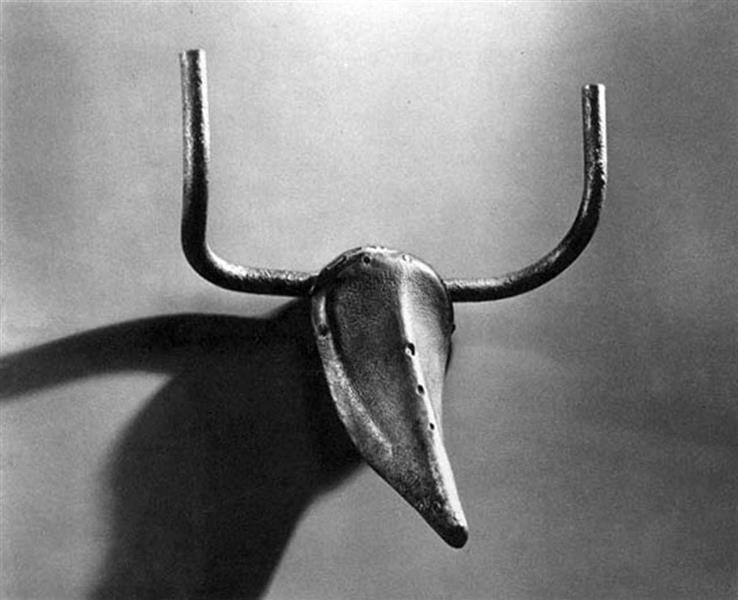
Picasso’s Bulls head (33.5 x 43.5 x 19 cm), Musée Picasso, Paris
All humans and animals on earth are born with creativity. At the onset, both species, humans and animals, harness creativity for their survival.
Animals’ creativity is propelled by their instincts, while human creativity is sparked by imagination.
Any work of art is the physical form of the mental process called imagination, manifested through creativity.
Lee. A. Jacobus, F. David Martin, in their book ‘The Humanities through The Arts,’ recognise three criteria for determining something a work of art.
1. The object or the event should be made by an artist.
2. The object or the event should be intended to be a work of art by its maker.
3. The important and recognised ‘experts’ agree that it is a work of art.
By the way, who is an Artist?
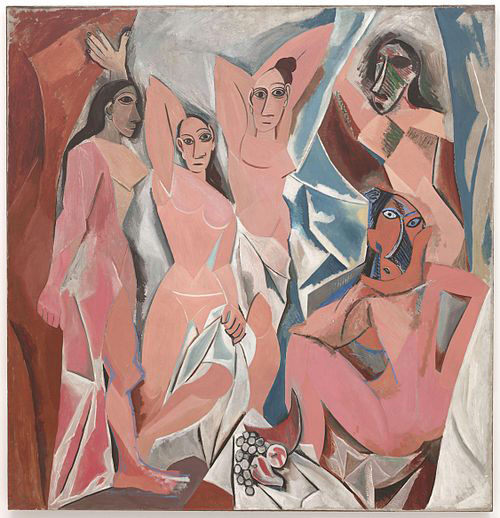
Picasso’s The Ladies of Avignon – Museum of Modern Art
We all are in some way or another. Some sing, however, on pitch or off pitch; some write poems when they are free; some sketch something on a piece of paper and say ‘painting is their hobby,’ and some autofocus their cameras and capture something and say photography is their pastime. All leisurely artistic practices are performed with a simple utility rather than a profound artistic expression.
Then what makes an artist a great one?
A great artist is someone who expresses his or her thoughts, ideas, feelings, and perspectives through various artistic mediums in a unique, authentic, and unparalleled way with an intention and purpose that extends beyond simple utility. The originality of their work not only enthralls the audiences but also sets precedent and acts as an inspiring agent for generations to come.
There is no accidental or random art. Every work of art is the physical extension of the artist’s mind, which is driven by an intention and a purpose.
The artist’s intention is to express deeper insights through the medium of arts. And the purpose is self-discovery.
An artist never creates anything with no intention. This intention of the artist is instrumental in building up the entire composition. The ‘intention’ of a great artist is always associated with their life circumstances, personal opinions, experiences, beliefs, ideologies, and emotions. All these aspects are encapsulated in profound artistic expressions.
So “art” is definitively a subjective statement. Artists develop through fascinations as well as frustrations. Some of the most fabulous works of art were born in much tormented minds plagued by disappointments, distress, and despair. In this way all works of art reflect the artist’s mind. In other words, they imbue their life into their work. That is why every great work of art is brimming with life and full of emotions.
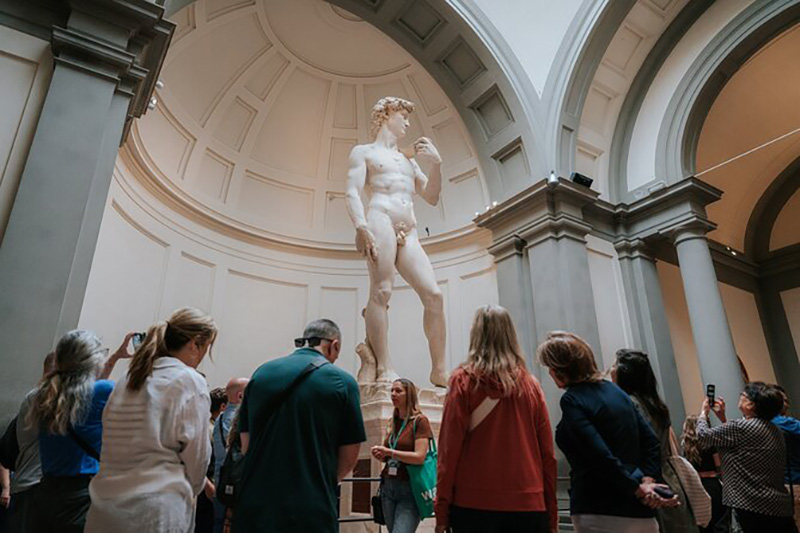
Let’s take Michelangelo for an example. The face of the Virgin Mary of Pieta, the face of ‘David,’ and the face of ‘Moses’ are full of life and full of emotions.
Whenever I see those faces, I try to read Michelangelo’s extraordinary artistic mind. I read the gestures of those sculptures. And try to understand what the artist really wanted to convey through those gestures. Whenever I look at Michelangelo’s or any other great artist’s masterpieces, I think about the mind that breathed life into the lifeless marble blocks.
Great artists do not create art for everyone. Whatever they create is for themselves or for someone who is much closer to them. They are not on the path of pleasing everyone with their work. No great artist has expectations to rise as high as the sky; instead, they go deeper. They touch their inner being, and with imagination and creativity, they bring ‘the self’ to the outer surface. The more subjective it is, the more universal it becomes.
Great artists or masters never look for instant fame or validation. When recognised ‘experts’ as well as the public embrace their work in the course of time, fame and validation come looking for the artist. The recognised ‘experts’ are referred to as art historians, connoisseurs, curators, and art critics. Their observations and judgments are universally accepted in determining the status of a work of art.
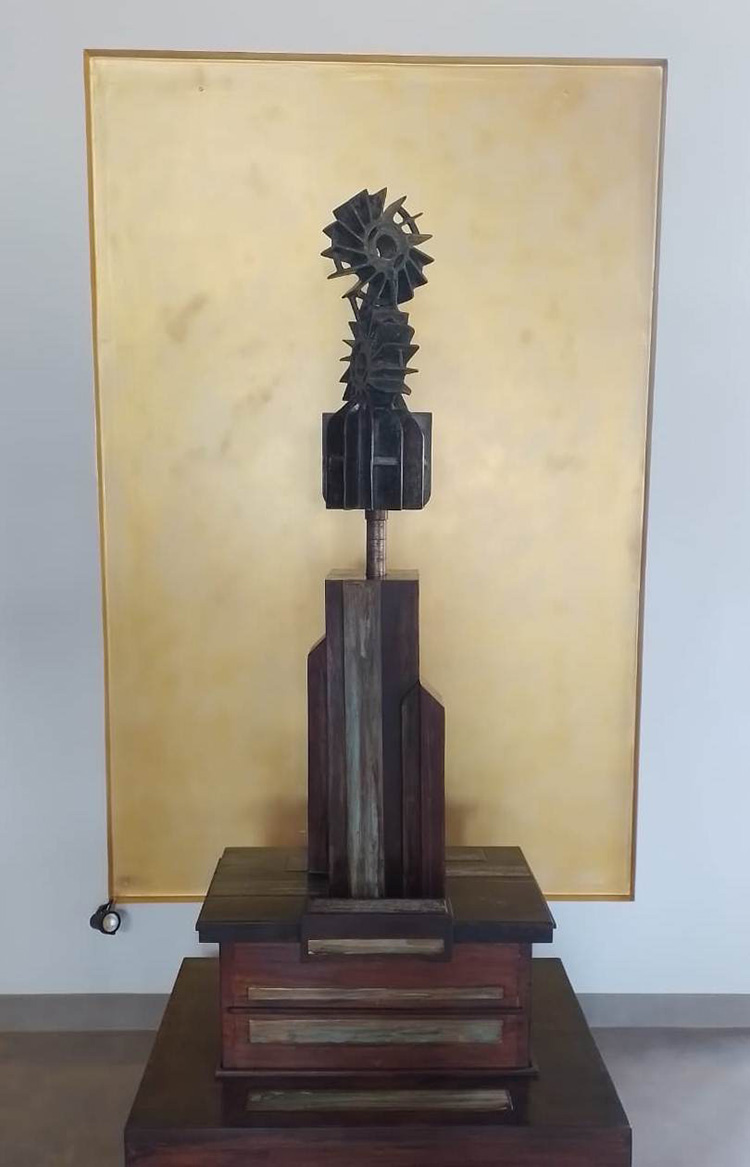
Sarath Chandrajeewa’s Motion and stillness 2023 (Height 150cm, Bronze mounted on wooden structure) – Ayuda Centre of Healing, Thalahena, Sri Lanka
How does a work of art get titled as a masterpiece?
To understand this, let’s look into the historic evolution of the term ‘masterpiece.’
The term ‘masterpiece’ first appeared in the medieval French documents in the 13th century.
This term was initially described as ‘Chef d’oeuvre’ in French and later translated to English as ‘Chief Work.’
This was primarily associated with ‘craft guilds’ in medieval Europe.
A ‘craft guild’ is a professional association for craftsmen who practiced a particular skill or craft.
European guilds started to form when the size of the towns began to expand in the 10th century.
Prior to the formation of guilds, merchants simply wandered from town to town and sold their goods in whatever market existed.
With the expansion of craft guilds, new members were trained and enrolled in the guilds through a hierarchical system.
‘Apprentice’ occupied the lowest position in the hierarchy.
Then comes the journeyman, and the master is placed on the topmost level.
A young person was to apprentice for a master for several years, working under him without being paid.
After certain skills are acquired, the apprenticeship comes to an end.
As the next step in the hierarchy, the apprentice becomes a journeyman and continues to work for the master for wages.
The goal of the journeyman was to eventually become a master.
This needed the approval of the Craft Guild.
Proving their competency, skill, and craftsmanship, it was compulsory for a journeyman to present a ‘masterpiece.’
Therefore, a masterpiece served as proof of a piece of a very high standard created by a journeyman demonstrating their craftsmanship and competence in order to gain the position as a master.
The ‘Masterpiece’ submitted by a journeyman was finally evaluated by the craft guild.
If the guild were to approve the ‘masterpiece’ presented by the journeyman, he would be elevated to the position of ‘Master.’
After becoming a ‘master,’ he is allowed to open his own workshop in line with the regulations by the Guild.
On an occasion where a journeyman’s masterpiece was rejected by the guild, he got no second chance to resubmit the work.
Crafts in which people could become masters were goldsmithing, blacksmithing, weaving, cobbling, carpentry, painting, sculpture, and confectionery-making.
Florence was said to have 21 guilds of this nature in the mid-14th century.
With the development of the Renaissance in the 14th and 15th centuries, painting and sculpture were considered art rather than a trade or a craft.
Craft guilds were gradually replaced by the emerging academies.
In Renaissance art and culture were largely dominated by elites who became the major patrons of art.
With all these transformations, a high degree of classical value was attributed to artistic creations.
And at the same time, requirements concerning masterpieces also shifted.
The technical mastery or high degree of craftsmanship was not sufficient for an artist to flourish.
Because the works of art needed to showcase not just quality, but exceptional quality.
Giorgio Vasari, who is considered to be the first art historian of Western art history, largely influenced the streamlining of the criteria in defining a masterpiece.
In his book, ‘The Lives of Most Excellent Painters, Sculptors and Architects,’ written in 1550, he created a hierarchy among artists. His aim was to separate the best artist from mediocre artists. What he meant by ‘Best Artist’ here are masters.
The role of the art maker also transformed over time.
In the time of craft guilds, ‘artisans’ were bound by the traditions and rules of the guild.
In craft guilds no individual work was promoted.
Every work of art by an ‘artisan’ was presented as a representation of the guild.
In the transition from the medieval ages to the Renaissance, the role of ‘artisan’ shifts to ‘artist.’
The ‘Artist’ was free to explore new styles and personal preferences in art.
They were no longer bound by the traditions, and the freedom of artists was established as a result.
From the 15th century, the liberty and autonomy of the artist have gradually increased up until this day.
The rigorousness of criteria that determined the status and quality of masterpieces was also relaxed in the course of time.
That is how the term ‘masterpiece’ appears much oversimplified and has become one of the most overused terms in modern discourses of art.
There is another word that goes in parallel to ‘masterpiece.’
That’s ‘Magnum Opus.’
This word is derived from Latin and translated to English as ‘Great Work.’
Magnum Opus is the ‘top moment’ of one’s artistic journey. Or it is an artist’s greatest, most influential, and most significant piece of art.
A magnum opus by an artist is undoubtedly a masterpiece, while a masterpiece by an artist could not have been his or her ‘magnum opus.’
On the contrary, there are some artists whose numerous works of art are considered to be masterpieces, yet their topmost work, or the magnum opus, remains undefinable. (To be concluded)
(Text of a lecture delivered by Bhagya Rajapakse)
Venue: Sri Lanka Archive of Contemporary Art, Architecture and Design, Jaffna.
Date: 2nd November, 2025
Duration of the Lecture and discussion: Three hours.
Tamil Interpreter: Jasmine Nilani Joseph
Special Thanks: Prof. T. Sanathanan and Prof. Sarath Chandrajeewa.



Illegal Foreign Exchange, Undiyal, Hawala and Money Laundering, A Four-Part Investigative Series
Forex Platforms, Cryptocurrency, AI and the New Financial Battlefield
THE INVISIBLE FINANCIAL EMPIRE – PART III
The Boyfriend Who Was Never Real
 Priya, a 34-year-old professional in Colombo, met “David” on LinkedIn. He claimed to work in fintech in Singapore. For six weeks they exchanged messages daily, about work, about life, about a recent trip he had taken to the Maldives. Eventually, the conversation turned, gently and naturally, to money.
“I’ve been trading on this platform, let me show you,” he said, sharing a screenshot of a sleek trading dashboard showing consistent, impressive returns.
Priya invested a small amount first, $500. Within days, her dashboard showed it had grown to $650. She withdrew $100 successfully, just to test it. It worked. Encouraged, she invested more. Then more. Over two months, she transferred a total of $42,000 into the platform.
When she tried to withdraw her full balance, the platform demanded a “regulatory release fee” of $8,000 before funds could be unlocked. She paid it. Then another fee appeared. Then the platform stopped responding altogether. “David” vanished. The trading dashboard, the customer support chat, the entire brokerage, all of it had never been real.
This is what investigators now call “pig butchering”, and, in 2026, the most disturbing development is not the scam itself, which has existed for years, but what now powers it: artificial intelligence has industrialised the entire operation.
From Manual Fraud to Machine-Generated Deception
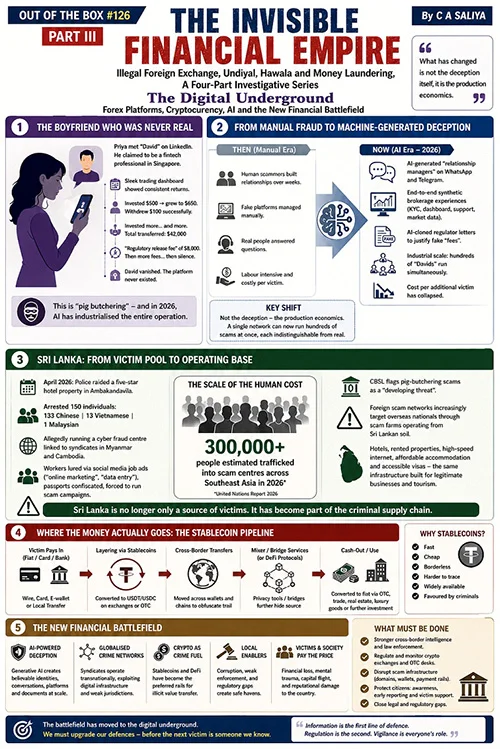 For most of the past decade, romance-and-investment scams, like the one that targeted Priya, required enormous manual labour. Scam operations, many of them staffed by trafficked workers held against their will in compounds across Myanmar, Cambodia, and Laos, needed real humans to build relationships with victims over weeks, manage fake trading platforms, and respond convincingly to questions.
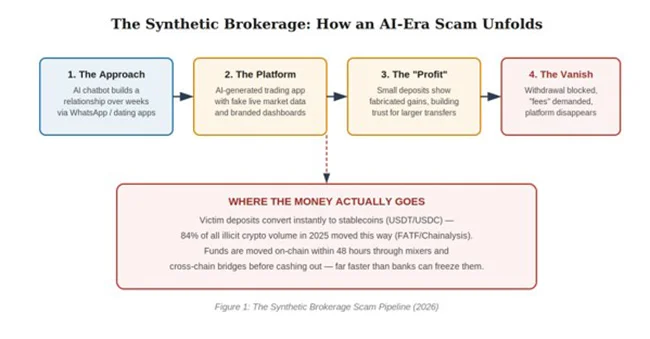
That labour-intensive model has now been substantially automated. According to financial-crime researchers tracking this shift through 2026, threat actors are standing up entire AI-generated “brokerage” experiences end-to-end, complete with KYC onboarding, branded customer-service chat, animated portfolio dashboards, and falsified live market data feeds, and operating them at industrial scale against multiple victims simultaneously. Generative-AI relationship managers now front the WhatsApp and Telegram conversations that once required real human scammers. AI-cloned regulator letters are generated on demand to justify the fake “release fees” that drain victims a final time before the platform disappears.
What has changed is not the deception itself, it is the production economics. The cost of running a credible synthetic brokerage against one additional victim has collapsed, meaning a single criminal network can now run hundreds of “Davids” simultaneously, each one indistinguishable from a genuine fintech professional until it is too late. (Figure 01)
Sri Lanka: From Victim Pool to Operating Base
Sri Lanka’s relationship to this global scam economy has shifted in an alarming direction over the past two years. The country is no longer only a source of victims, it has become an operating base for the criminal networks themselves.
In April, 2026, Sri Lankan police raided a five-star hotel property, in Ambakandavila, and arrested 150 individuals, including 133 Chinese nationals, 13 Vietnamese nationals, and one Malaysian national, allegedly running a cyber fraud centre with links to international criminal syndicates, based in Myanmar and Cambodia. Investigators say the operation followed a now-familiar regional pattern: recruiters advertise “online marketing” or “data entry” jobs on social media to lure foreign workers to Sri Lanka, confiscate their passports on arrival, and force them to operate scam campaigns under threat.
The Central Bank of Sri Lanka has formally flagged pig-butchering scams as a “developing threat,” warning that foreign scam networks are increasingly targeting overseas nationals through scam farms operating from Sri Lankan soil. A 2026 United Nations report estimated that at least 300,000 people have been trafficked into scam centres across Southeast Asia.
This is not an abstract international problem. It is unfolding in hotels and rented properties across the country, exploiting the same infrastructure, high-speed internet, affordable accommodation, accessible tourist visas, that Sri Lanka has built to attract legitimate digital businesses and tourists.
Where the Money Actually Goes: The Stablecoin Pipeline
Behind every successful pig-butchering scam sits a laundering pipeline that has been transformed almost as dramatically as the scams themselves, and the transformation has a single dominant feature: stablecoins.
According to the Financial Action Task Force’s March 2026, report, drawing on analysis from blockchain intelligence firms Chainalysis and TRM Labs, stablecoins accounted for 84% of the USD 154 billion in illicit virtual asset transaction volume recorded in 2025, the highest share ever observed, and a dramatic jump from just 15% only a few years earlier. TRM Labs separately found that illicit entities received USD 141 billion in stablecoins, in 2025 alone, the highest level observed in five years. (See Table 01)
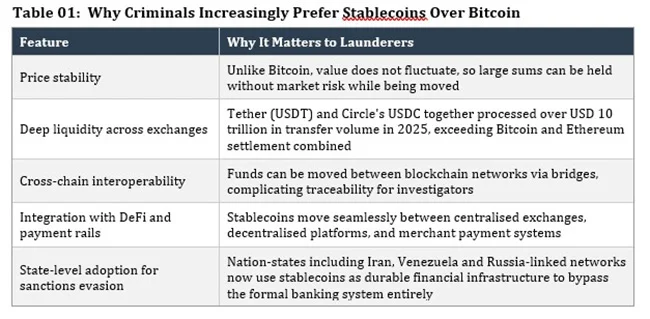
The scale of state-level abuse is striking. A Russian sanctions-evasion network built around the ruble-pegged stablecoin A7A5 processed more than USD 72 billion in total volume in 2025.
Fighting Fire with Fire: AI on the Defensive Side
The same artificial intelligence reshaping financial crime is also, out of necessity, reshaping the defence against it. Legacy anti-money laundering systems, built on static, rule-based thresholds, have proven badly outmatched by AI-generated fraud operating at machine speed. Research cited by compliance technology analysts suggests that between 90% and 95% of alerts generated by legacy AML systems are false positives, consuming enormous investigator time while genuinely suspicious activity slips through.
This is not a frictionless transition. AI models are notoriously difficult to explain to regulators and examiners in the way traditional rule-based systems are. The practical compromise emerging across the industry is a hybrid model: AI handles the initial scoring and prioritisation of risk, while documented rule-based logic still governs the final decision that must be defensible to a regulator.
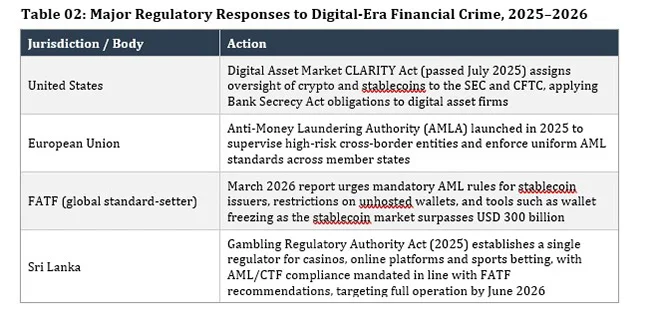
The Regulatory Response: Catching Up to the Digital Frontier
Regulators worldwide have begun moving to close the most dangerous gaps exposed by this digital transformation of financial crime. (See Table 02)
What Comes Next
We have now traced this investigation from the centuries-old mechanics of Hawala and Undiyal, through the three-stage architecture that turns criminal proceeds into apparently legitimate wealth, to the AI-generated frontier of digital financial crime reshaping all of it at machine speed.
In our concluding instalment, Part IV: “Sri Lanka at the Crossroads: Economic Consequences, Organised Crime and the Road Ahead”, we bring this series home. We examine precisely what all of this costs Sri Lanka in hard economic terms: lost remittances, exchange rate pressure, tax revenue forgone, and the 2026 FATF evaluation that will determine whether the country’s institutions can demonstrate, with evidence rather than legislation alone, that they are equal to this challenge. We close with a practical policy roadmap.
(The writer, a senior Chartered Accountant and professional banker, is Professor at SLIIT, Malabe.
Views expressed in this article are personal.)
Features
‘There are no private universities in Sri Lanka’ – some considerations for higher education reform
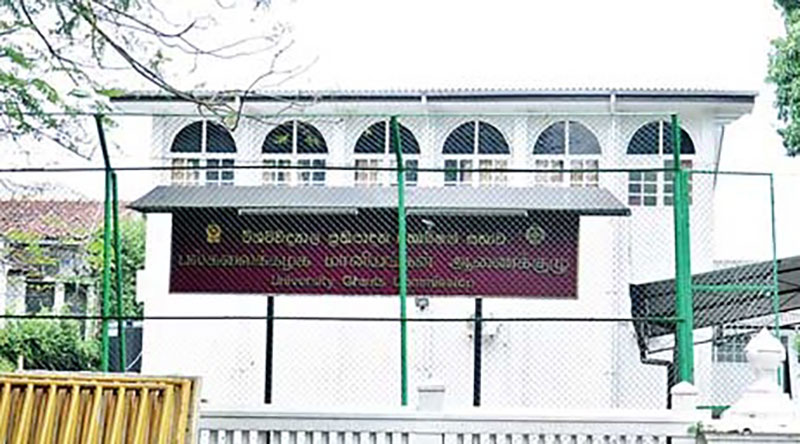
 Academics involved in education policy like to say that there is no such thing as a private university in Sri Lanka. The only ‘universities’ in the country are state universities; anything else offering degrees is a private higher education institution (HEI). This position is technically accurate. Yet, in the discourse and imagination of the public, private universities are very real – people teach in them, students register in them, families pay fees, and such degree holders enter job markets in Sri Lanka and outside.
For decades, activists concerned for public higher education have ignored or resisted looking at private HEIs, as if such scrutiny would taint them. Others have worked in both types of institutions, carrying practices from each to the other. The apex body governing state universities, the UGC, has, meanwhile, ignored the concept of conflict of interest and appointed individuals in private higher education in committees and leadership positions. It is unsurprising then that some of the ideologies informing private higher education appear in reform agendas in the state sector.
This is a good time then to consider the varying types of private HEIs around us, and to take a look at some of the issues within them in the hope that higher education reform agendas will include private, as well as state higher education.
What is a ‘private university’?
First, some clarifications. In the public imaginary, a ‘private university’ is typically an institution that provides a foreign or local degree for which the student makes a payment. But this broad classification encompasses a host of diverse institutions and types of degrees which I detail below.
The Non-State Higher Education Division (NSHE) of the Ministry of Education has recognised 295 degrees by 32 institutions. Most of these are private companies and include a handful of established, well-known private HEIs that are ‘university like’. The degrees are local degrees conferred by the institutions accredited by the NSHE Division. While private HEIs conferring local degrees must be accredited by the NSHE Division, there appears to be no legal consequence for not doing so. In addition, there are several permutations of the private degree that miss the net of this Division and the Standing Committee on Accreditation and Quality Assurance (SCAQA) that assists this Division.
For one, degrees conferred by foreign universities offered, via these same private HEIs, are not vetted by the NSHE Division. Secondly, there is a growing plethora of private HEIs which have either no physical presence locally or only a dubious presence. The University Grants Commission has notified the public, through their website, that foreign universities listed in the Commonwealth Universities Yearbook and the World Higher Education Database are recognised, but refrained from giving any other details – which degrees? Offered by what modes? These details are not known. Some of the foreign universities in the lists may be legitimate entities in their own land but the degrees conferred locally, in their name, may not adhere to curriculum or teaching specifications of the NSHE Division or the UGC.
Another troubling phenomenon is the ‘top up degree’, which appears to work on the same principle as that of a pre-paid mobile connection: if I have a Diploma or an HND of a sort, I am eligible to complete a course of study which provides me with a degree, usually from a foreign university. The idea that someone who does not initially qualify for a degree programme should be able to work their way towards one is a progressive notion. This is the concept that open and distance learning (ODL) was based on initially, but which is now sadly exploited. ODL models are expected to provide opportunity for learning for those who may be excluded from traditional learning institutions. In Sri Lanka, however, we have seen ODL become a marketplace offering easy to obtain, for-fee qualifications by institutions with little commitment to superior teaching and learning.
Finally, a perusal of the many types of private HEIs and their varied degrees bring to mind another question – how should the private degrees, provided by state institutions (that are not educational institutions), be regulated? Who should do so?
All of these create a host of problems for the public – for hopeful students and parents and trusting employers. For the higher education sector, recruitment of academic staff, too, has become difficult due to this plethora of ambiguous higher education qualifications, as I discussed in a previous Kuppi article (‘Recruiting academics to state universities’).
Some issues in private HEIs – a bellwether for change in state universities
In this second part of this article, I will discuss some aspects of work in private HEIs – albeit the more established institutions – given that such issues may appear in reform agendas in future.
Across state universities, all permanent staff of a specific category are paid according to the same criteria. The picture is not so clear when it comes to private HEIs since they are different entities legally, typically companies. Private HEIs have salary scales and financial incentives that are different to each other. The more established private HEIs reportedly have attractive renumeration packages, possibly a reason for academics of state universities migrating eagerly to such institutions during sabbatical years and on retirement. This may not of course be the case with other less established, or improperly registered HEIs of which we know little. Academic staff of these more accepted private HEIs seem to value the high financial remuneration they receive (in comparison to state universities) as something that makes their work rewarding.
Attractive remuneration is important to sustain the good life and is at times seen as the institution’s way of encouraging good work. Yet, this has implications for the future of the institution: to continue to deliver on promised financial packages, institutions must continue to have large profit margins. One strategy has been to enroll multiple cohorts of students per year, even up to three or four intakes per year. This can result in exploitative work conditions, since staff must cater to all these cohorts in that same year. If there is inadequate staff, employees are further burdened. On the other hand, if there is a sudden drop in enrolments (degrees can go out of fashion) unexpected layoffs occur. Similar to other sectors that employ short-term contract staff – including state universities – in private HEIs, too, individual teachers, who are on short term contracts that need regular renewal, can feel pressured to work under difficult or exploitative conditions.
At the same time, even in the more established private HEIs, work norms differ from those of state universities in that they include promotional work that keeps the institution’s name in the eye of the public. The Marketing (or similarly named) unit comes up in conversations as one of the most important departments. It appears to weigh in on decision-making related to the number of staff, the amount of re-sits per exams, and other pedagogically important matters. This is a worrying example of how financial rationales interfere with pedagogically or academically sound processes, resulting in problematic results in the classroom. On the plus side, junior colleagues, who had experience in both state and private HEIs, also felt that they faced less harassment in private HEIs – primarily due to the private HEIs ability to take swift action in reported cases of harassment. This is a real indictment on state institutions and their reluctance to address chronic issues of harassment in our universities.
Yet, while we hear much about problems in state universities, we hardly hear of problems that staff in private HEIs face. One rationale for a lack of public expressions by staff is that expressions of discontent might lead to trouble given the importance of reputation for private HEIs. The worry about reputational damage is a growing concern in state universities, too, as evidenced by social media policies and internal conversations on reputational damage, consequent to negative publicity. Institutional worries of reputational damage are harmful in the long run since these impact not only freedom of expression by student and staff, but also research that is possible in and about the education sector.
Some thoughts at the end…
A close look at the private higher education sector is important given its strong presence in the country. Impending reform needs to regulate this diverse array of higher education offerings in the private sector, as well as the state institutions that offer privately-funded options of higher education (a topic for a separate Kuppi on its own). It is time we carefully considered how to build a whole system of higher education out of this broken mess.
Kaushalya Perera is a senior lecturer at the University of Colombo.
Kuppi is a politics and pedagogy happening on the margins of the lecture hall that parodies, subverts, and simultaneously reaffirms social hierarchies.

Singer Nish Peiris is set to take the next big step in her music journey.
The talented vocalist, who has been seen and heard in the scene here for a short while, and was also featured with the now-defunct band, Inner Vision, has announced that she will be fully committing to her solo career, after completing her degree this year.
“I’m finishing my degree this year, and after that I’ll be fully committing to my solo music career,” Nish told The Island.
“I’ve already got a few tours lined up for next year, so I’m really excited for what’s ahead.”
Fans, no doubt, will remember Nish for her smooth voice and stage presence, and the good news is that she is now ready to chart her own path and bring new music to audiences at home and abroad.
With tours already planned for 2027, the year 2026 promises to be an exciting year for the young artiste as she steps into the spotlight on her own.
We wish Nish every success in this new chapter!

A few showers will occur in the Western, Sabaragamuwa and North-western provinces and in Kandy, Nuwara-Eliya, Galle and Matara districts

Customs asked to resume probe or face legal action

Outgoing Chinese Ambassador Qi Zhenhong bids farewell to Mahanayake Theras

Move to extend retirement age of top judges: BASL asks govt. to stop process pending meaningful consultations

Govt. mum on identities of JVP founder’s wife and children

Three high-profile alleged suicides shaping key investigations

‘Dates have the highest sugar content to fight Coronavirus’

Sunday Island 27 December – Headlines

#SundayIsland 17th December – Headlines

Sunday Island – 28th March

Sunday Island Headlines – 21 March

Sunday Island – 21st February – Headlines
-
 Features3 days ago
Two memorable excerpts from a former SLAF commander’s memoir
-

 Business3 days ago
‘Giving up was never an option’: The fisherman who fought back after losing millions in SL
-

 Latest News4 days ago
Davis cup Asia/Oceania Group IV 2026 to be held in Colombo from 20th to 25th July
-
 Features3 days ago
Erdoğan’s New Republic
-
 Life style3 days ago
Taste of the Swiss Alps comes to Colombo
-
 News4 days ago
Evidence recorded in money laundering case against Yoshitha Rajapaksa
-
 News4 days ago
Dengue outbreak gallops ahead: Infections surpasses 73,455, leaving 50 dead
-

 News5 days ago
Money laundering case against Yoshitha, fixed for pre-trial conference