
News
Lankan woman secures asylum in New Zealand citing ex-girlfriend’s death threats


A bisexual woman has been granted New Zealand asylum because she is afraid of her soldier ex-girlfriend in Sri Lanka who has threatened to shoot her mum and dog, says a report published by the NZ Herald yesterday.
The woman also fears being sent home and forced into a second arranged marriage because of her sexuality, she told a recent Immigration and Protection Tribunal hearing.
She told the hearing she began a clandestine teenage romance with her ex-girlfriend until her mum discovered them kissing in 2017.
Her “disgusted” parents then forced her into an arranged marriage with a man.
However, her girlfriend refused to accept their relationship had ended.
And – after growing up and joining the Sri Lankan army – the ex-girlfriend in 2021 forced her way into the woman’s parents’ house at gunpoint, accompanied by three army officers.
When told the woman was not home, the ex-girlfriend, only identified as A.A., became angry.
“A.A. pointed a gun at the mother’s chest and threatened to kill her … and also threatened to kill the family dog,” the tribunal was told.
The woman had earlier migrated to New Zealand, partly to escape her ex-girlfriend and partly to study, before seeking asylum.
Her first application for asylum was rejected and so she appealed to the Immigration and Protection Tribunal for another hearing.
The tribunal presiding member Larissa Wakim said that in hearing the appeal she had to decide whether the woman’s story was credible and whether the woman faced genuine risk of harm if sent back to Sri Lanka.
Wakim heard how the woman, only identified as J.F., grew up in a rural Sri Lankan town in the 1990s where she met A.A. when they were 11 years old.
The woman said she had been a bookworm, timid and never talked back.
A.A., on the other hand, was “confident, athletic and decisive”. A.A. was “always happy to argue” and could become angry and controlling over who J.F. was friends with.
Their relationship became intimate at 16, with J.F. later going on to study computer programming and A.A. joining the Sri Lankan army.
They continued their relationship but kept it a secret because they worried it was considered culturally unacceptable in their community.
But in 2017, J.F.’s mum saw them kissing.
Her mum also gave evidence to the tribunal and recounted how at that moment “she felt disgusted, sad, betrayed and worried because, in Sri Lanka, it was unacceptable and illegal to have lesbian relationships”.
The parents forced J.F. to stop seeing A.A., made her change her phone number and destroyed most of the photos of the girls together.
The parents next decided to “resolve the problem” by marrying their daughter to a man her father knew through his work, the mum told the tribunal.
But soon after A.A. drove to the family’s home and demanded J.F. be given to her, the mum said.
“A.A. behaved like a man, scolding the parents, and threatening to kill them and [J.F.],” the mum said.
A.A. then began to do slow drive-bys of the family home in her army vehicle.
Everyone became afraid of her, with J.F.’s parents moving to a rented house in a new town in 2018 to try to get away, but A.A. quickly tracked them down.
In 2021, the family celebrated the birthday of J.F’s brother at the rented home.
But A.A. showed up in her army vehicle with three army friends, thinking J.F. would be there.
Demanding to be let in, A.A. said she would shoot the home’s gate down if it wasn’t opened.
Once inside, she searched everywhere but couldn’t find J.F. Becoming enraged she threatened to shoot J.F. and her mum.
J.F.’s mum told the tribunal the moment was terrifying and that she still takes fright at the memory of it.
J.F. wasn’t there at the time because she had migrated to New Zealand in 2018 at the suggestion of the family of her husband, identified as B.B.
She said she had endured abuse and non-consensual sex as part of the marriage and agreed to go ahead to New Zealand on a student visa.
However, B.B. was not able to secure a visa to New Zealand to follow her.
By 2021, B.B. sought a divorce. He had also been hiding from A.A. and said that living apart and being unable to go to New Zealand had become too much.
In New Zealand, J.F. had troubles with her studies and dropped out. However, she now worked six days a week in a retail job.
She told the tribunal she sent one-quarter of her week’s earnings to help support her family because her dad had not had substantive work since 2017.
A medical expert also presented evidence that J.F. had bad anxiety and a major depressive disorder because of her circumstances.
J.F.’s mum also expressed fears for her daughter in Sri Lanka saying she would be vulnerable without a husband and may find it hard to get a job.
Ultimately, Wakim decided J.F.’s account had been credible, due to her giving consistent and straightforward evidence ever since first making her refugee claim.
Her story was also corroborated by other people and a medical expert, Wakim said.
Wakim believed A.A. posed a threat to J.F. and that the Sri Lankan police had already been shown as unwilling to protect J.F.’s family.
She also believed J.F. was at real risk of being forced into another arranged marriage with a man due to her personality of being unable to resist her parents’ demands.
And once in such a relationship she would be more vulnerable to abuse such as non-consensual sex, Wakim said.
She said J.F. had a right not to be forced to conceal her bisexuality or be forced into refraining from having intimate relationships to avoid persecution.The tribunal consequently found J.F. is a refugee and entitled to protection in New Zealand.

News
“Investments in Professional Education Are Investments in Institutional Strength and National Progress” – PM

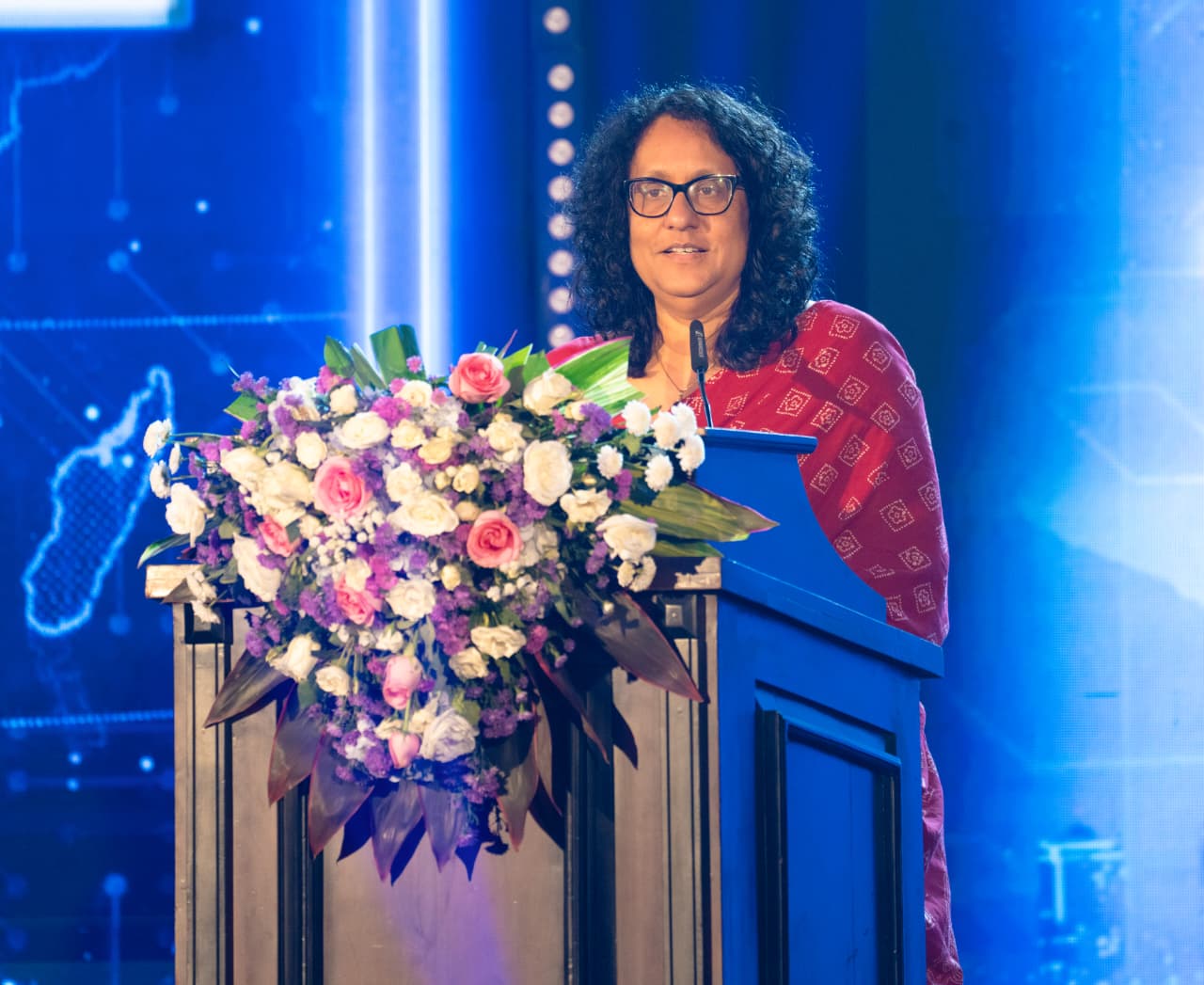
Prime Minister Dr. Harini Amarasuriya stated that strengthening Sri Lanka’s professional education framework and aligning it with internationally recognised standards is essential to building a skilled, ethical, and globally competitive workforce.
The Prime Minister made these remarks while addressing the official launch of the QS-accredited Chartered Qualification in Human Resource Management (CQHRM) at SCQF Level 11 (New Syllabus), organised by the Chartered Institute of Personnel Management (CIPM) Sri Lanka under the theme New Heights of Recognition. The event was held on Wednesday, 18 February at the Cinnamon Life, Colombo.
Emphasising the importance of expanding professional and vocational education pathways, the Prime Minister stated:
“This is of crucial importance to us in broadening our educational pathways and opportunities. We need to increase access to education that is globally recognised and that offers multiple pathways in professional and vocational fields. This aligns closely with the reform process we have initiated in the education sector and with our commitment to lifelong learning where individuals can work and learn at the same time, and where education is not limited to a particular age group but continues throughout life.”
Highlighting Sri Lanka’s national priorities, the Prime Minister further observed:
“At a time when Sri Lanka is focused on economic recovery, institutional reform and sustainable growth, the need for competent and ethical human resource leadership is clear. A competitive economy depends not only on investment and infrastructure but also on skilled professionals who can lead institutions effectively.”
The Prime Minister noted that the QS accreditation of the CQHRM qualification strengthens international recognition of Sri Lankan human resource professionals, enhances professional progression pathways, and reinforces confidence in the country’s professional education system. She also underscored the role of human resource leadership in advancing equity and inclusion within workplaces, including fair recruitment practices, safe working environments, leadership development for women, and inclusive policies for persons with disabilities and neurodivergent individuals.
Addressing the future of work, the Prime Minister stressed the importance of preparing for rapid technological transformation, including the growing impact of artificial intelligence on industries and workforce management, encouraging institutions to proactively adapt to emerging demands.
The event was attended by Deputy Minister of Industry and Entrepreneurship Development, Chathuranga Abeysinghe, along with other distinguished guests.

[Prime Minister’s Media Division]
Latest News
Advisory for Severe Lightning issued to the Western and Sabaragamuwa provinces and Nuwara-Eliya, Galle and Matara districts
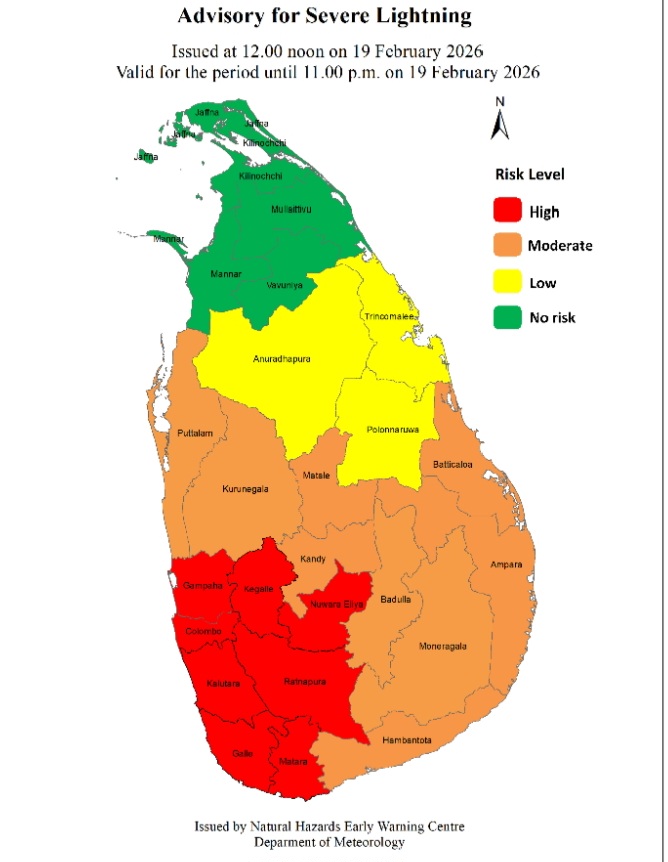
Advisory for Severe Lightning
Issued by the Natural Hazards Early Warning Centre at 12.00 noon 19 February 2026 valid for the period until 11.00 p.m. 19 February 2026
The public are warned that thundershowers accompanied with severe lightning are likely to occur at some places in in the Western and Sabaragamuwa provinces and in Nuwara-Eliya, Galle and Matara districts after 2.00 p.m.
There may be temporary localized strong winds during thundershowers.
General public is kindly requested to take adequate precautions to minimize damages caused by lightning activity.
ACTION REQUIRED:
The Department of Meteorology advises that people should:
Seek shelter, preferably indoors and never under trees.
Avoid open areas such as paddy fields, tea plantations and open water bodies during thunderstorms.
Avoid using wired telephones and connected electric appliances during thunderstorms.
Avoid using open vehicles, such as bicycles, tractors and boats etc.
Beware of fallen trees and power lines.
For emergency assistance contact the local disaster management authorities.

During operations conducted in the dark hours of 18 Feb 26, the Sri Lanka Navy and Coast Guard seized 04 Indian fishing boats and apprehended 22 Indian fishermen, while they were poaching in Sri Lankan waters north of Mannar and off the Delft Island, Jaffna.
Recognizing the detrimental effects of poaching on marine resources and the livelihoods of local fishing communities, the Sri Lanka Navy and Coast Guard continue to conduct regular operations as proactive measures to deter such activities. These efforts underscore the collective robust approach and steadfast commitment to safeguarding the nation’s marine ecosystems while ensuring the economic security and wellbeing of its citizens.
The 02 fishing boats along with the 10 fishermen held in Mannar were handed over to the Fisheries Inspector of Mannar and the remaining 02 fishing boats intercepted off the Delft Island, together with 12 Indian fishermen were handed over to the Fisheries Inspector of Myliddy for onward legal proceedings.

Zadran, Nabi star as Afghanistan bow out with a big win

“Investments in Professional Education Are Investments in Institutional Strength and National Progress” – PM

Zimbabwe stun Sri Lanka to enter Super Eight unbeaten

Ex-UK Prince Andrew arrested on suspicion of misconduct in public office

Advisory for Severe Lightning issued to the Western and Sabaragamuwa provinces and Nuwara-Eliya, Galle and Matara districts

Navy and Coast Guard seize 04 Indian fishing vessels poaching in Sri Lankan waters

‘Dates have the highest sugar content to fight Coronavirus’

Sunday Island 27 December – Headlines

#SundayIsland 17th December – Headlines

Sunday Island – 28th March

Sunday Island Headlines – 21 March

Sunday Island – 21st February – Headlines
-

 Life style5 days ago
Marriot new GM Suranga
-

 Business4 days ago
Ministry of Brands to launch Sri Lanka’s first off-price retail destination
-

 Features5 days ago
Monks’ march, in America and Sri Lanka
-

 Features5 days ago
The Rise of Takaichi
-

 Features5 days ago
Wetlands of Sri Lanka:
-

 News5 days ago
Thailand to recruit 10,000 Lankans under new labour pact
-

 News5 days ago
Massive Sangha confab to address alleged injustices against monks
-

 News3 days ago
IMF MD here