
News
Lanka ranks above Asian neighbours in air quality

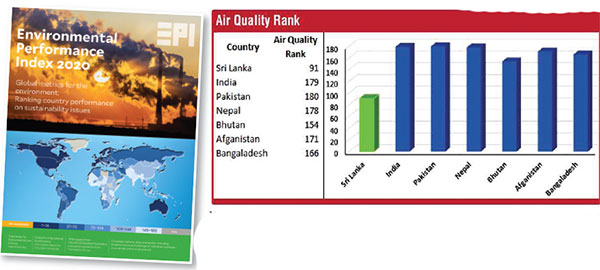
Sri Lanka has ranked above its South Asian neighbours, outperforming them in Air Quality measurement, according to the Environmental Performance Index 2020 (EPI) released by researchers at Yale and Columbia universities recently.
The prestigious index, now in its 22nd year, has become the premier metrics framework for global environmental policy analysis, ranking 180 countries on several performance indicators across a range of issue categories covering environmental health and ecosystem vitality.
Based on peer comparisons, overall Sri Lanka is ranked 109th with an EPI score of 39 out of 100, ahead when compared with its South Asian counterparts.
The Air Quality issue category measures the direct impacts of air pollution on human health in each country. It consists of three indicators: PM2.5 exposure, household solid fuels, and ozone exposure.
Sri Lanka is ranked 91 in Air Quality according to the 2020 EPI, importantly the country has over a 10-year period continued to demonstrate a positive growth when compared to the region.
In contrast, other South Asian nations lagged behind in Air Quality, notably with Bangladesh ranked 166, India 179 and Pakistan 180, resulting in millions of people suffering from dangerous levels of air pollution.
 The EPI ranks 180 countries on 32 performance indicators across 11 issue categories covering environmental health and ecosystem vitality.
The 2020 EPI features new metrics that gauge waste management, carbon dioxide emissions from land cover change, and black carbon emissions – all important drivers of climate change.
Denmark was ranked first in the world, followed by Luxembourg and Switzerland in the top 3 countries as a result of strong results across most issues and leading commitments and outcomes with regards to climate change mitigation.
The lowest scores were earned by a series of countries that are struggling broadly with weak governance, including Liberia (180th), Myanmar (179th), and Afghanistan (178th).
The index found that no country is decarbonising quickly enough. Some countries do excel in individual greenhouse gas reductions, most notably Denmark in reducing carbon dioxide emissions, the UK in methane, and Norway in fluorinated gases.
To spread best practices around the world, policymakers must pay greater attention to how climate leaders achieve success, the report noted.
The EPI is a method of quantifying and numerically marking the environmental performance of a state’s policies. This index was developed from the Pilot Environmental Performance Index, first published in 2002, and designed to supplement the environmental targets set forth in the United Nations Millennium Development Goals.



The Department of Immigration and Emmigration has decided effective from 28th February 2026, to grant a free fourteen (14) day visa extension to all tourists who are unable to leave Sri Lanka due to flight cancellations. 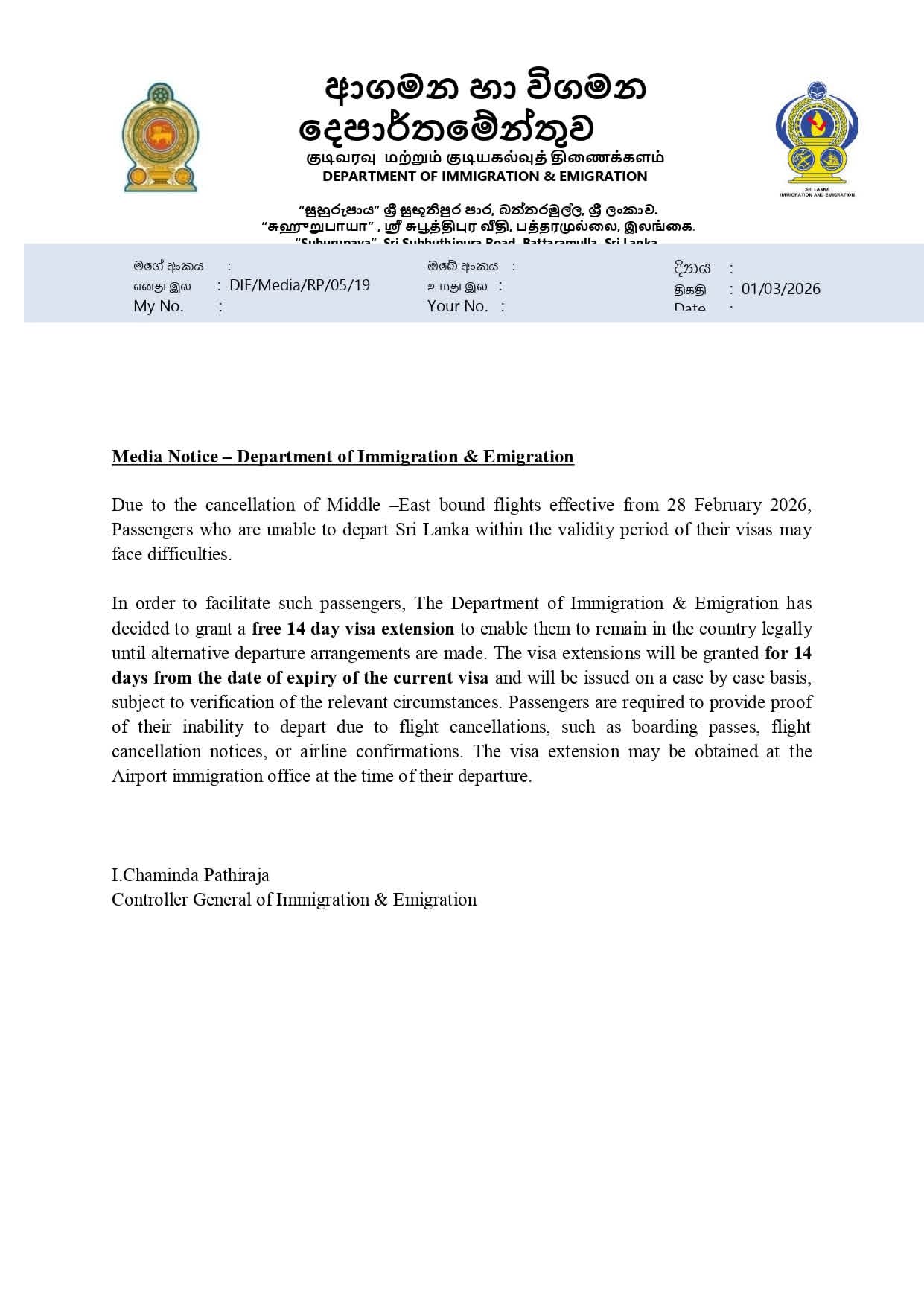
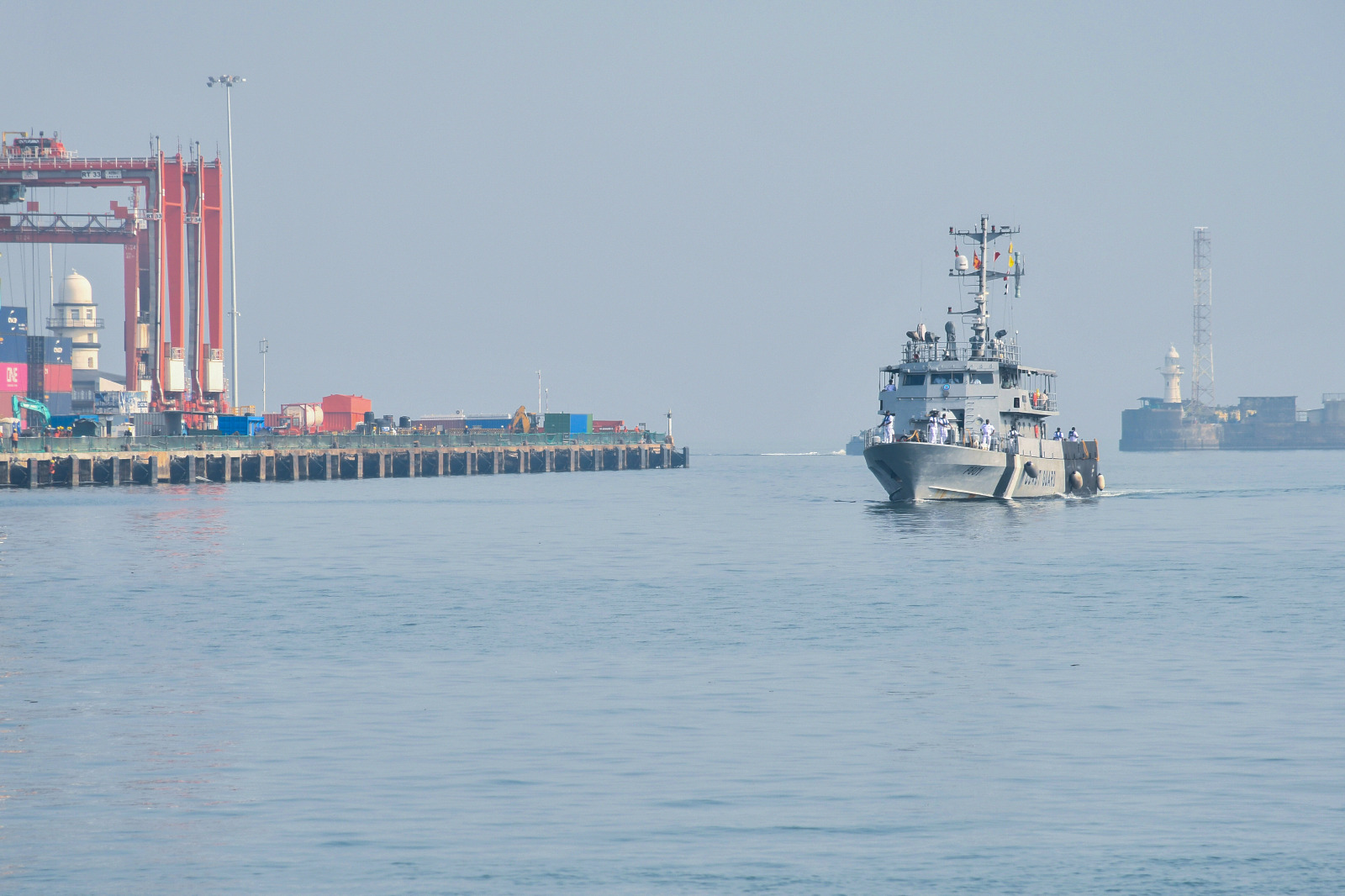
The Maldives Coast Guard Ship Huravee arrived at the Port of Colombo for replenishment purposes on 02 Mar 26. The visiting ship was welcomed by the Sri Lanka Navy (SLN) in compliance with time-honoured naval traditions.
The ship is a 48.9m long Offshore Patrol Vessel which is commanded by Lieutenant Colonel Ahmed Nafiu Mohamed.
Meanwhile, the ship’s crew is scheduled to visit several tourist attractions in the city of Colombo, during their stay in the island.
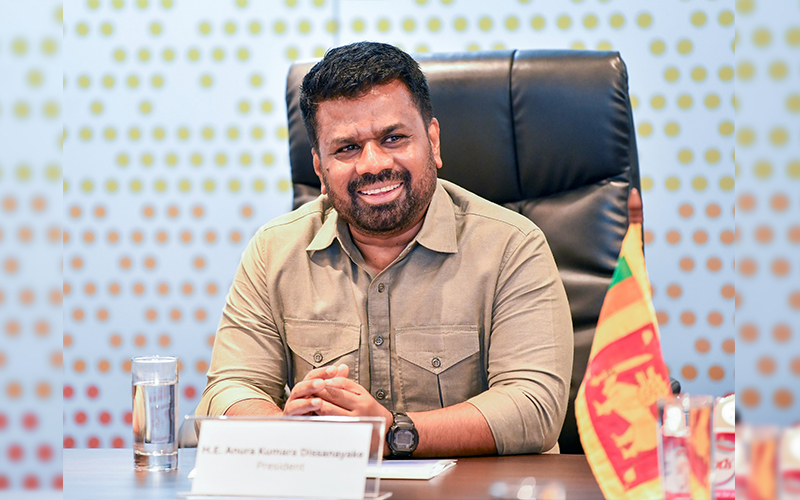
President Anura Kumara Dissanayake yesterday called for an immediate and peaceful resolution of the escalating Middle East conflict, warning that the crisis could have far-reaching repercussions on the global economy, including Sri Lanka.
Addressing Parliament, the President stressed that no military conflict benefited humanity, particularly at a time when destructive military technologies were rapidly advancing.
“Any military conflict does not create a favourable situation for any group of people,” he said, urging all parties to make urgent commitments towards peace. “As Sri Lanka, our position is that all parties involved in this war must, as soon as possible, take steps toward a peaceful world.”
He cautioned that Sri Lanka could not remain insulated from the fallout from the conflict, noting that disruptions to global oil and gas supplies, threats to migrant workers in the Middle East, and potential shocks to tourism, remittances, shipping and aviation were real concerns.
A national programme was being formulated to mitigate the impact, he said, adding that its success would hinge on broader international efforts to restore stability, the President said.
Acknowledging public anxiety shaped by past economic hardships, President Dissanayake said social stability could not be ensured through rhetoric alone but required tangible guarantees that citizens would not face another crisis.
While noting that the government had successfully navigated multiple challenges since assuming office, he described the Middle East situation as distinct due to the uncertainty surrounding its duration and outcome.
The government, he said, was closely monitoring developments. The Central Bank had conducted a review with a report on the likely economic impact expected shortly. The Ministry of Finance is also preparing an assessment of the potential effects on public life, alongside measures to ensure the uninterrupted provision of essential services locally and for Sri Lankans overseas.
“The primary responsibility for finding a path out of the crisis rests with the Government,” he said, calling on Parliament and the public to collectively confront the challenge under a unified national plan.
Providing a detailed account of the country’s energy reserves, the President said storage capacity rather than supply remained the key constraint. Excluding the Indian Oil Corporation tanks in Trincomalee, total storage capacity at Kolonnawa and Muthurajawela stands at approximately 150,000 metric tons.
Diesel stocks were currently sufficient for 33 days, with refining contributing around 1,800 metric tons daily. Petrol reserves will last 27 days, with a 35,000 metric ton shipment due on March 7 or 8 expected to extend availability to around 40 days.
Aviation fuel stocks are adequate for 49 days, supported by both daily refining and imports. Scheduled shipments include vessels from RM Parks on March 14, Sinopec on March 17, IOC on March 21 and the Ceylon Petroleum Corporation on March 28.
Crude oil supplies were sufficient to operate the refinery for 26 days, with an additional shipment expected to extend operations by a further 18 days, the President said.
“Because of this, there is no crisis regarding oil,” the President assured Parliament.

Free 14 day visa extension for visitors unable to depart Sri Lanka

US embassy in Dubai hit; Israel pounds Tehran, Beirut

Perera, Sugandika, Ranaweera take Sri Lanka to T20I series win over West Indies

Maldives Coast Guard Ship Huravee arrives in Colombo

New charges for son of Norway’s crown princess on trial for rape

US sends planes to evacuate nationals from Middle East as Iran conflict spreads

‘Dates have the highest sugar content to fight Coronavirus’

Sunday Island 27 December – Headlines

#SundayIsland 17th December – Headlines

Sunday Island – 28th March

Sunday Island Headlines – 21 March

Sunday Island – 21st February – Headlines
-

 Opinion5 days ago
Jamming and re-setting the world: What is the role of Donald Trump?
-
 Features5 days ago
An innocent bystander or a passive onlooker?
-
 Features2 days ago
Brilliant Navy officer no more
-
 Features6 days ago
Ratmalana Airport: The Truth, The Whole Truth, And Nothing But The Truth
-
 Opinion2 days ago
Sri Lanka – world’s worst facilities for cricket fans
-
 Business6 days ago
IRCSL transforms Sri Lanka’s insurance industry with first-ever Centralized Insurance Data Repository
-

 Business5 days ago
An efficacious strategy to boost exports of Sri Lanka in medium term
-

 Features3 days ago
Overseas visits to drum up foreign assistance for Sri Lanka