
News
Lanka among nations gaining $5.8M for biodiversity action

Sri Lanka is among seven countries that, with the support of the Food and Agriculture Organization of the United Nations (FAO), have obtained $5.8 million from the Kunming Biodiversity Fund (KBF) to strengthen biodiversity integration in agrifood systems and implement the Kunming-Montreal Global Biodiversity Framework (KMGBF), FAO said.
It said: The selected projects support multiple KMGBF targets on sustainable agriculture, ecosystem protection, knowledge management, the control of invasive species and the engagement of local communities – including Indigenous Peoples – in biodiversity management for food and agriculture.
FAO Director-General QU Dongyu welcomed the announcement, saying: “The Kunming Biodiversity Fund is instrumental in helping developing countries achieve global biodiversity goals through sustainable agriculture under the overarching guidance of the Four Betters, and in amplifying the central role of agrifood systems in halting biodiversity loss, promoting food diversity and providing solutions to the climate crisis.”
Launched by the People’s Republic of China in 2021 during the first part of the UN Biodiversity Conference under China’s Presidency, the KBF supports developing countries for biodiversity protection and in meeting the KMGBF’s global goals, with a focus on regions rich in biodiversity but in need of stronger capacity and resources.
The funding will target the following projects:
1. Mainstreaming biodiversity into agrifood systems to implement National Biodiversity Strategies and Action Plans (NBSAPs)
This project aims to mainstream biodiversity into agrifood systems by creating enabling conditions that accelerate the implementation of NBSAPs in Madagascar, Uganda, and Mexico. It will enhance policy alignment, strengthen institutional capacity, improve financial incentives for biodiversity-friendly practices, and promote knowledge sharing.
2. Empowering communities through knowledge management of ecosystems and species to achieve the KMGBF in the Cook Islands
By improving knowledge systems, modernizing data, and promoting sustainable practices, the project will empower communities to conserve, restore, and manage biodiversity. It will establish a national ecosystem classification, revitalize the biodiversity database, and support community-led conservation using traditional knowledge and agroecology, with a focus on women and youth.
3. Effective management of invasive alien species for ecosystem benefits in Nepal
By focusing on halting the spread and managing existing populations of invasive alien species, the project aims to reduce their impact on biodiversity and local livelihoods through community-based action, participatory approaches, and stronger institutional capacity.
4. Prevention and control of invasive alien species for enhanced biosecurity in Sri Lanka
This project will strengthen national capacity to prevent and manage invasive alien species by improving border controls, training frontline teams, and involving communities in removal efforts and awareness campaigns.
5. Strengthening ecosystem resilience and sustainable management of Lake E?irdir in Türkiye
The project will raise public awareness and promote biodiversity-friendly practices to protect the lake and its ecosystems. It will also support water-efficient agriculture and encourage sustainable livelihoods in the region.
The role of agrifood systems in implementing the KMGBF
Agrifood systems are directly linked to more than half of the KMGBF’s targets. FAO plays a key role in their implementation by fostering policy coherence, promoting best practices, and scaling up innovations to accelerate progress towards global biodiversity goals.

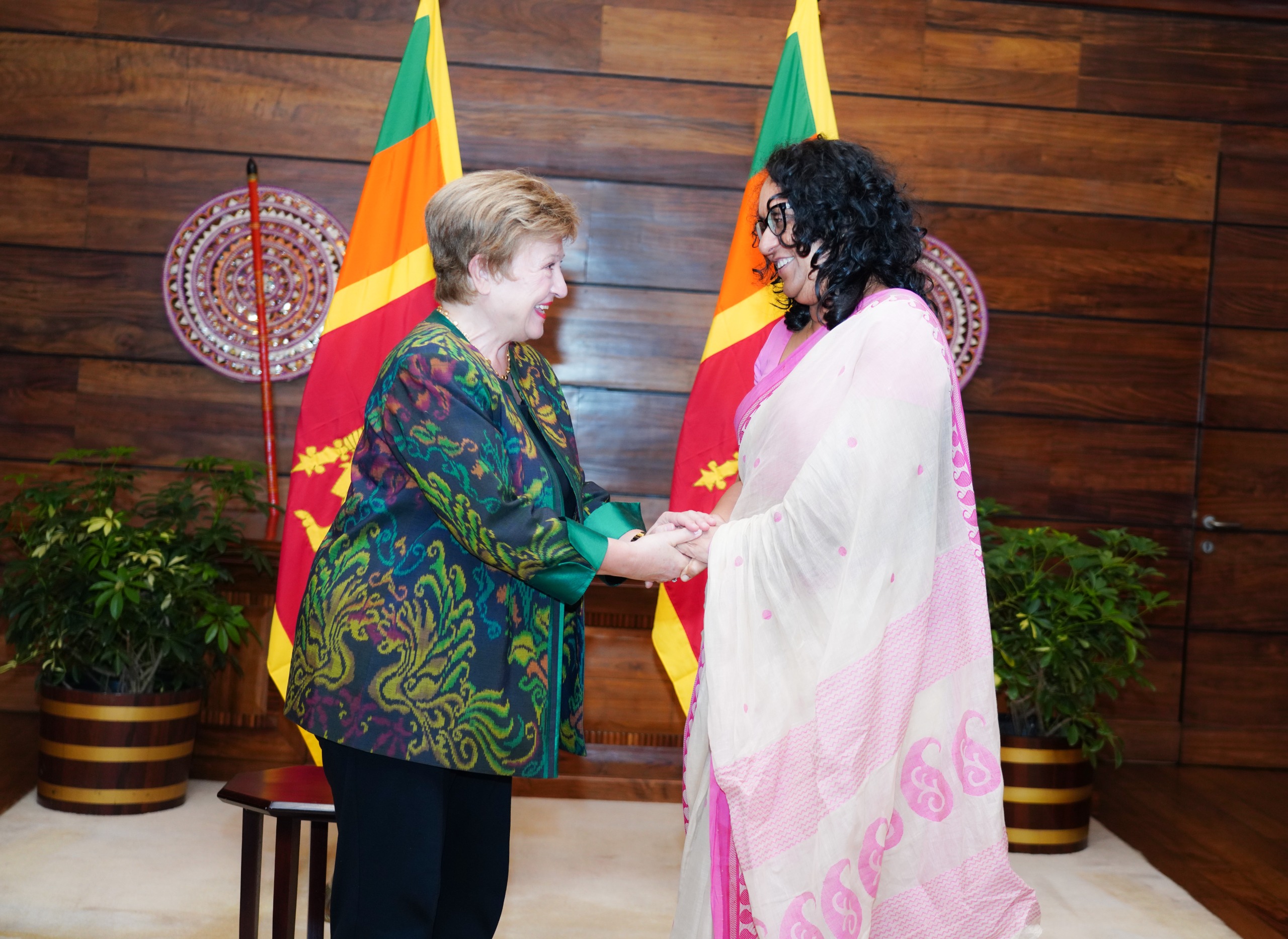
Prime Minister Dr. Harini Amarasuriya met with the Managing Director of the International Monetary Fund (IMF), Dr. Kristalina Georgieva, at Temple Tress on the 17th of February
Dr. Georgieva, commended the Government’s efforts in stabilizing the country’s economy and in managing recent economic and natural shocks. She noted that Cyclone Ditwah had caused severe impacts, especially on economically vulnerable communities, underscoring the importance of targeted support and resilience-building measures.
The Prime Minister expressed appreciation for the IMF’s continued support to Sri Lanka, particularly in the aftermath of Cyclone Ditwah. The PM further emphasized that real economic recovery and development must directly benefit the economically vulnerable groups and ensure inclusive growth, highlighting the need for Sri Lanka to attract quality and sustainable investments, particularly in the tourism sector.
The importance of reforming the education system to focus not only on knowledge acquisition but also on skills development and employability was also discussed
The meeting was attended by the Chief of Staff of the IMF Managing Director Andreas Bauer, Director, Asia and Pacific Department, Dr. Krishna Srinivasan Division Chief (Strategic Communications), Communications Department, Pierre Mejlak Resident Representative for Sri Lanka Dr. Martha Woldemichael, Governor of the Central Bank of Sri Lanka Dr. P. Nandalal Weerasinghe, and Deputy Governor Dr. C. Amarasekara, Secretary to the Prime Minister Pradeep Saputhanthri and Additional Secretary to the Prime Minister Ms. Sagarika Bogahawatta.
[Prime Minister’s Media Division]

The Cabinet of Ministers approved the resolution forwarded by the Minister of Health and Mass Media to relocate the Deniyaya Base Hospital after constructing a new hospital with a capacity of 300 beds at an estimated cost of Rupees 6,000 million.
The Southern Provincial Department of Health has acquired a plot of land in Handford estate which is approximately 03 kilometres away from the town for this purpose.
News
Cabinet nod to legally empower methodology for implementing the ‘Praja Shakthi’ poverty alleviation national movement


The Cabinet of Ministers granted approval for the resolution furnished by the Minister of Rural Development, Social Security and Community Empowerment to instruct the Legal Draftsman to draft a bill to legally empower the implementation of ‘Praja Shakthi’ (Strength of the Community) poverty alleviation national movement

IMF MD commends government’s efforts in stabilizing the country’s economy

India look to go into Super Eight stage with all-win record

Cabinet approves construction of new 300 bed Base Hospital in Deniyaya

Heavy showers about 100 mm are likely at some places in the Eastern, Uva and North-central provinces and in Matale and Nuwara-Eliya districts

Cabinet nod to legally empower methodology for implementing the ‘Praja Shakthi’ poverty alleviation national movement

NPP not under Indian pressure to hold PC polls – JVP

‘Dates have the highest sugar content to fight Coronavirus’

Sunday Island 27 December – Headlines

#SundayIsland 17th December – Headlines

Sunday Island – 28th March

Sunday Island Headlines – 21 March

Sunday Island – 21st February – Headlines
-

 Life style3 days ago
Marriot new GM Suranga
-

 Business2 days ago
Ministry of Brands to launch Sri Lanka’s first off-price retail destination
-

 Features3 days ago
Monks’ march, in America and Sri Lanka
-

 Opinion6 days ago
Will computers ever be intelligent?
-

 Features3 days ago
The Rise of Takaichi
-

 Features3 days ago
Wetlands of Sri Lanka:
-
 News3 days ago
Thailand to recruit 10,000 Lankans under new labour pact
-

 News3 days ago
Massive Sangha confab to address alleged injustices against monks