
Latest News
Kremlin plays down Zelensky talks as Trump warns Putin may not ‘want to make deal’


The Kremlin has played down talk of an imminent summit between Russian President Vladimir Putin and Ukraine’s Volodymyr Zelensky, as Donald Trump renewed his call for the two leaders to meet to discuss ending the war in Ukraine.
The push for a bilateral meeting comes after the US president met Putin in Alaska last week, and welcomed seven European leaders and Zelensky to the White House on Monday.
Trump admitted the conflict was “a tough one” to solve and conceded it was possible the Russian president was not interested in ending hostilities.
“We’re going to find out about President Putin in the next couple of weeks,” he said on Tuesday. “It’s possible that he doesn’t want to make a deal.”
Putin faced a “rough situation” if that were the case, Trump added, without offering any details.
The Russian president on Monday told Trump he was “open” to the idea of direct talks with Ukraine, but the next day Foreign Minister Sergei Lavrov watered down that already vague commitment.
Any meeting would have to be prepared “gradually… starting with the expert level and thereafter going through all the required steps”, he said, repeating a frequent Kremlin line.
Dmitry Polyanskiy, a Russian deputy representative to the UN, told the BBC “nobody [had] rejected” the opportunity for direct talks, “but it shouldn’t be a meeting for the sake of a meeting”.
On Tuesday, it was reported that Putin had suggested to Trump that Zelensky could travel to Moscow for talks, something Ukraine was never likely to accept.
The proposal may have been Russia’s way of putting forward an option so far-fetched Kyiv could not possibly have agreed to it.
Talks over the last few days appear to have given Trump a renewed understanding of the complexities of the war and the gulf between Moscow’s demands and Kyiv’s position.
The much-vaunted ceasefire he said he could get Putin to agree to has not materialised – and now the US president has said Ukraine and Russia should move directly to a permanent peace deal instead – but some headway was made in terms of security guarantees for Ukraine.
Zelensky and European leaders seem to have convinced Trump that such commitments would be paramount to Kyiv’s sovereignty in the event of a peace deal.
On Tuesday, Trump said the US was willing to help the Europeans “by air” if they provided boots on the ground in Ukraine in the event of a ceasefire or peace deal, although he ruled out deploying US troops.
The US president, however, did not go into the specifics of whether such air support may entail intelligence or the use of fighter jets and war planes.
While Trump’s commitments remain vague, the France and UK-led Coalition of the Willing said it had been working to firm up plans for a reassurance force that could be sent to Ukraine if the hostilities end.
After a virtual meeting of the group on Tuesday, a Downing Street spokesperson said the group would meet US counterparts in the coming days to “further strengthen plans to deliver robust security guarantees”.
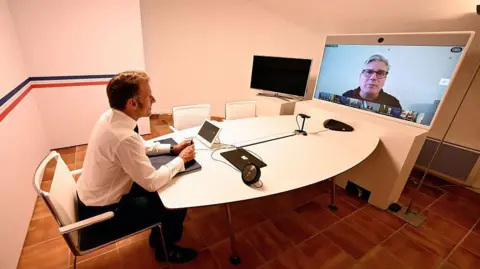
Following his summit with Putin and latest talks with Zelensky, Trump now appears to think direct talks between Ukraine and Russia could bring a peace deal closer – although he acknowledged there had been “tremendous bad blood” between the two leaders.
The last time they met was in 2019. Since then, Moscow’s war on Kyiv has resulted in tens of thousands of casualties as well as widespread destruction and ongoing aerial attacks on civilian targets.
Putin considers Zelensky illegitimate and views him as responsible for Ukraine’s growing proximity to the West. For years now, he has made baseless claims about Kyiv being ruled by a “neo-Nazi regime” and has said any ceasefire with Ukraine would need to entail a change in Kyiv’s leadership.
Russia also has little interest in agreeing to talks while its troops have the upper hand on the front line.
Still, European leaders and Zelensky have spoken out in favour of the idea of a bilateral meeting. The Ukrainian president said on Monday he was open to “any format” of meeting Putin, while the Europeans have been putting forward ideas for potential summit locations.
By enthusiastically supporting direct talks, they are likely hoping to convince Trump to revert to a tougher stance against Moscow should Putin remain unwilling to take steps to end the war.
Meanwhile, Ukraine’s European partners appear significantly less optimistic than Trump that a resolution of the conflict could be within reach.
On Tuesday, French President Emmanuel Macron called Putin “a predator, and an ogre at our doorstep” and expressed “the greatest doubt” that the Russian president was willing to work towards peace.
Finnish President Alexander Stubb said Putin was “rarely to be trusted”, adding he was sceptical about a meeting with Zelensky materialising.
More high-level talks are planned for the coming days as questions over Trump’s level of support for Europe remain.
Britain’s military chief, Admiral Tony Radakin, is travelling to Washington for discussions on the deployment of a reassurance force in Ukraine, while Nato military chiefs are expected to hold a virtual meeting on Wednesday.
[BBC]

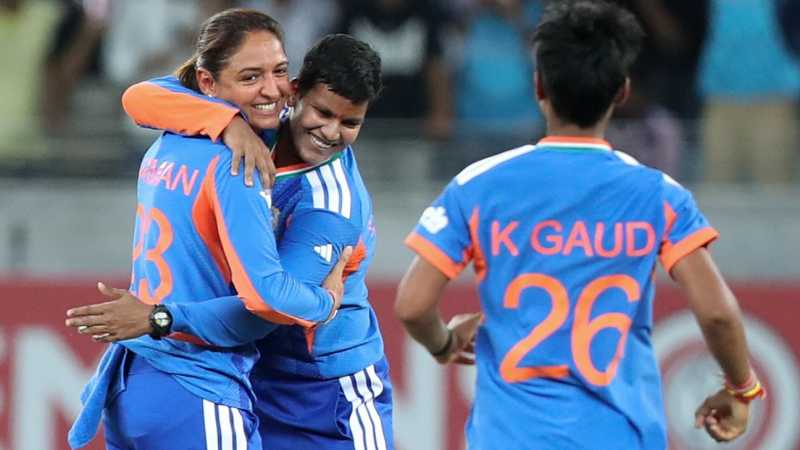
Pakistan were bowled out for 55, their lowest total in T20I cricke. A collapse where they lost six wickets for eight runs in 29 balls set them so far back that they couldn’t even bat out 20 overs. Harmanpreet Kaur, who broke new ground by becoming the first player – male or female – to lead her team 150 times in T20Is, had the time of her life celebrating each wicket and eventually scoring the winning runs as well.
Shree Charani shines
Old-fashioned left-arm spin is having a resurgence. India men have found Manav Suthar. India women already had N Shree Charanin. The No. 1-ranked T20I bowler in the world picked up two wickets in her first over on Saturday.
The flight on the ball drew Gull Feroza out of her crease. The drift in had her looking leg side. The dip and the turn resulted in a leading edge and a simple catch to point. The bowler did everything right. The batter did everything wrong. Shawaal Zulfiqar was the only Pakistan batter to put any kind of pressure on India. Charani had her lbw for 14 off 14 and from there it was a procession.
Pakistan’s batting troubles
Playing their 200th T20I, Pakistan went from 27 for 0 to 35 for 6 before the innings was halfway done. They could not find a risk-free way to score runs, absorbing long periods of dot balls and trying to get out of it by playing low-percentage shots, often against the turn, on a Dubai pitch that was offering plenty of it. Only the openers got to double digits and only Zulfiqar was able to score a run a ball.
Rawat’s support act
Prema Rawat finished with figures of 4-0-9-3. Nineteen of her 24 balls were dots. All of that is remarkable considering she is a legspinner, whose release points tend to be just shy of the perpendicular. Like Shane Warne. From there, they turn their wrist over and it can either be awesome or awful. Rawat’s release point is perpendicular, maybe even beyond it, like Rashid Khan’s. And she doesn’t turn her wrist. For the most part, she just flicks the ball out the front of her hand. This gives her better control at the cost of big turn and in T20Is, that trade-off is well worth it. Nobody could hit Rawat off her line and length and when Sadaf Shamas tried, she got bowled off her pads.
A simple enough chase
Scores:
India Women 57 for 3 in 8.4 overs (Shafali Verma 12, Harmanpreet Kaur 18*, Deepti Sharma 12*; Fatima Sana 3-17) beat Pakistan Women in 18.1 overs 55 (Muneesha Ali 13, Shawal Zulfiqar 14, Shafali Verma 1-10, Shree Charani 3-07, Deepti Sharma 2-05, Prema Rawat 3-09) by seven wickets
(Cricinfo)
Latest News
Sun directly overhead Bentota, Thiniyawala, Iththakanda, Udawalawe, and Kataragama about 12.08 noon t9day (06)

The sun is going to be directly over the latitudes of Sri Lanka from 28th of August to 07th of September due to its apparent southward relative motion.
The nearest places of Sri Lanka over which the sun is
overhead today (06) are Bentota, Thiniyawala, Iththakanda, Udawalawe, and Kataragama about 12.08 noon

Rumesh Tharanga created history in emphatic fashion, winning the men’s javelin at the Diamond League Final in Brussels to become the country’s first Diamond League champion.
The recently crowned Commonwealth champion sealed the prestigious Diamond Trophy with a superb third-round throw of 89.04 metres, producing yet another major performance on the biggest stage.
Tharanga became the first Sri Lakan to win a top position at a global competition conducted under the auspice of World Athletics.
The victory also extended Tharanga’s extraordinary run of form, giving him his 12th victory in his last 13 competitions. His only defeat during that sequence came earlier in the season, underlining the consistency that has made him one of the outstanding performers in world javelin this year.
Tharanga’s winning effort was enough to keep a determined international field at bay, with Poland’s Dawid Wegner producing a lifetime best of 87.47m to take the silver medal. Trinidad and Tobago’s Keshorn Walcott completed the podium in third place.

Shree Charani, Prema Rawat spin Pakistan out for 55 in one-sided contest

Sun directly overhead Bentota, Thiniyawala, Iththakanda, Udawalawe, and Kataragama about 12.08 noon t9day (06)

Showers above 75 mm are likely at some places in the Uva and Eastern provinces.

Tharanga creates history with Diamond League crown in Brussels

UN welcomes Lanka’s anti-graft drive, seeks end to impunity

Dispute which triggered listed company director being detained at BIA resolved

‘Dates have the highest sugar content to fight Coronavirus’

Sunday Island 27 December – Headlines

#SundayIsland 17th December – Headlines

Sunday Island – 28th March

Sunday Island Headlines – 21 March

Sunday Island – 21st February – Headlines
-

 Features6 days ago
When Sri Lankan stories find their own voice
-

 News6 days ago
BASL takes exception to Justice Ganepola being denied a place in SC
-

 News3 days ago
Denied of promotion to SC despite vacancies, justice Gurusinghe retires
-

 Latest News4 days ago
Grade 5 scholarship exam results released
-

 News3 days ago
22A: SC urged to suspend hearing, appoint full bench
-

 Midweek Review4 days ago
The local and global dynamics of Sri Lanka’s 22nd Amendment
-

 Business6 days ago
ADB-funded Thalaiyadi plant serves as blueprint for vulnerable dry zones in Sri Lanka
-

 News4 days ago
Ai-CHA expands Lankan footprint with new Negombo outlet