
Sports
Kerley leads American sweep of men’s 100m in Oregon


Chants of “USA! USA! USA!” rang out across Hayward Field on Saturday night (16) after Fred Kerley led a US sweep of the men’s 100m at the World Athletics Championships Oregon22.Kerley’s decision last year to drop down from the 400m to the 100m paid off in spectacular fashion as he powered past Marvin Bracy-Williams and Trayvon Bromell in the final strides to win the gold in 9.86 and claim the title of the world’s fastest man.Bracy-Williams and Bromell, who were both timed in 9.88, took silver and bronze respectively.
It marked the third US sweep of the 100m medals and the first since 1991, when Carl Lewis, Leroy Burrell and Dennis Mitchell went 1-2-3 at the World Championships in Tokyo.This time, the sweep came on home soil in front of a full crowd at the first World Championships held in the United States.
“We said we were going to do it and we did it,” the 27-year-old Kerley said after winning his first individual global title. “USA baby!”
“All three of us wanted the gold,” Bromell said. “I’m just happy we could get the sweep at home.”
The build-up to the final featured a flypast by two military jets, which proved to be a symbolic precursor to a super-fast race in which four of the eight athletes finished inside 10 seconds.Half of the finalists were from the host nation; the fourth US athlete was the defending world champion Christian Coleman, who finished sixth in 10.01.Kerley was in lane four, with Bracy-Williams next to him in lane three, and Coleman and Bromell on the outside in lanes seven and eight.
Coleman got off to the quickest start, but it was Bracy-Williams who quickly moved to the front and paced the field through 70m and 80m, with Bromell charging hard from the outside.But the tall, powerful Kerley built up momentum at the halfway mark, accelerated towards the line and edged in front in the final five metres, out-leaning the others at the line.Kerley waited for the result to be posted on the scoreboard, and when his name finally went up as the winner, he threw up his arms in triumph, pounded his chest and took off on a victory lap.
“The gold medal means more than anything,” he said. “It’s amazing to do it on home soil with the home crowd behind us. It’s a wonderful blessing to get a clean sweep.”
Fourth place went to 21-year-old Jamaican Oblique Seville, who ran 9.97 after clocking the fastest time in the semifinals (9.90). South Africa’s Akani Simbini was fifth in 10.01 – his fifth consecutive top-five finish at a global championships. Rounding out the field were Coleman, Japan’s Hakim Sani Brown (10.06) and Canada’s Aaron Brown (10.07).
After Kerley switched to the short sprints at the start of 2021, many experts scoffed at the decision. But he justified the move by earning the silver medal in the 100m at the Tokyo Olympics. And he has been dominant this year, clocking a world-leading 9.76 in the semifinals and 9.77 in the final of the US Championships in Eugene last month.
Kerley ran 9.79 in Friday’s heats but ran only 10.02 in winning his semifinal on Saturday – the first time in nine 100m races this year that he did not break 10 seconds.But, in the final, Kerley showed the power and determination needed to finally get an individual gold on the world stage. He earned bronze in the 400m at the 2019 World Championships in Doha and holds gold and silver from the 4x400m relay.Kerley will now focus on adding to his tally. He will be getting ready for the heats of the 200m on Monday and for the relay.
“This win means I can do 100m, 200m and 400m,” he said. “I’ve got a medal in 400m and 100m. There’s only one next.”
Winning a medal represented redemption for Bromell, who has battled injuries throughout his career and failed to make the final at the Tokyo Olympics last year after being considered the title favourite.Bromell broke down in tears on Saturday while being interviewed on the track after the US sweep.
“It’s been seven years since I got a medal through my injuries and everything I dealt with,” he said. I know so many people counted me out.”
And for Bracy-Williams, he was celebrating his first world outdoor medal on the global stage.
“It feels great to get my first medal at home and with an American sweep,” he said. “What else could I ask for? All the hard work has paid off with the injuries, the critics. This shows me I’ve got what it takes to get it done.”
Some big names failed to make the final.
Italy’s Olympic champion Marcell Jacobs pulled out before the semifinals after failing to fully recover from the hamstring injury that had sidelined him for most of the outdoor season.
“A painful choice, I am forced to stop,” Jacobs tweeted. “I am a fighter and this is why I decided to be in Eugene. Now, in order not to compromise the rest of the season by risking a more serious injury, I have to postpone the challenge. I promise I will do my best to make you dream!”
Jamaica’s Yohan Blake, the 2011 world champion and five-time national champion, missed out after finishing fourth in his semifinal in 10.12. Canada’s Andre De Grasse, the Olympic 200m champion who has struggled with injury and illness this season, was fifth in his semi in 10.21. And African champion Ferdinand Omayala of Kenya, who had made it just in time for Friday’s heats after delays in getting his US visa, was fifth in his semifinal in 10.14.But this day was about those who came through when it counted, and it was Kerley, Bracy-Williams and Bromell who showed the world that US athletes are the king of the sprints once again.
(worldathletics.org)


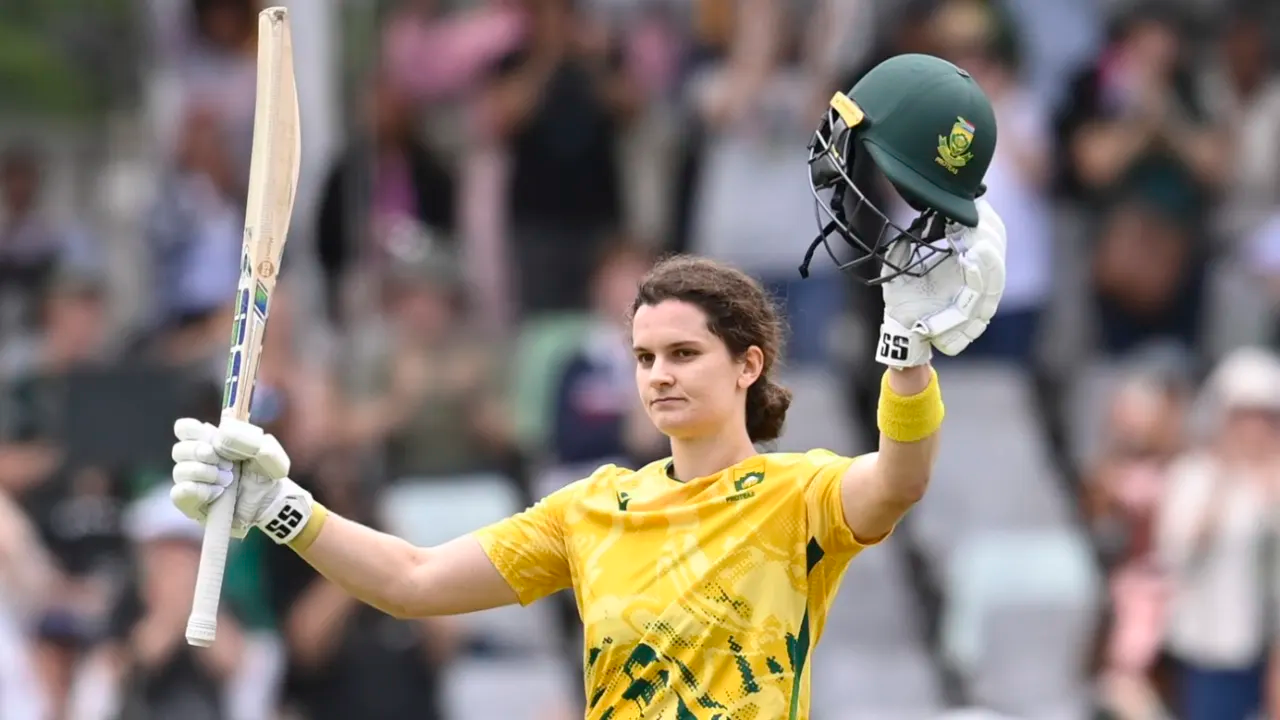
Laura Wolvaardt’s 56-ball 115 and an all-round show from Sune Luus helped South Africa beat Ireland in thefirst Women’s T20I by 105 runs, their joint third biggest win by runs, at Newlands.
Batting at No. 3, Wolvaardt scored a 52-ball century, the fastest for South Africa and the joint sixth quickest in T20Is, and was involved in a 176-run second-wicket partnership with Luus as the hosts posted their highest T20I total of 220 for 2. Having opened the batting, Luus also took the new ball and struck twice in the first over to dismiss Amy Hunter and allrounder Orla Prendergast. That effectively derailed Ireland early from what would have been an unlikely chase..
Luus and Wolvaardt got together after South Africa opted to bat and lost Faye Tunnicliffe in the second over. They started steadily before stepping on the pedal in the last two overs of the powerplay, taking 32 including a 20-run over from Lara McBride. Wolvaardt was the aggressor and she romped past fifty in just 24 balls, beating Lizelle Lee’s mark of 26 balls for the fastest T20I half century for South Africa.
Aided by plenty of misfields from Ireland, South Africa raced past 100 in the tenth over, thanks to another 20-run over, this time from Louise Little in which Wolvaardt went 6, 4, 4, 4. South Africa’s best second-wicket stand ended when Luus, on her career-best 81, tried an ungainly reverse hit against seamer Ava Canning, Ireland’s best bowler on the day, and was bowled.
That brought Dane van Niekerk, playing her first international since September 2021, to the middle. She saw Wolvaardt complete her second T20I hundred before unleashing an array of strokes to finish 21 not out of just eight balls, a strike rate of 262.50.
Only captain Gaby Lewis and Leah Paul offered a semblance of resistance for the tourists with a 42-run partnership off 39 balls. Once both of them fell in the space of 22 balls, Ireland folded quickly, losing nine wickets to spin. Luus returned as the pick of the bowlers with 4 for 22 while both left-arm spinners Nonkululeko Mlaba and Chloe Tryon took two apiece.
Brief scores:
South Africa 220 for 2 in 20 overs (Laura Wolvaardt 115*, Sune Luus 81, Dane van Niekerk 21*; Jane Maguire 1-52, Ava Canning 1-33) beat Ireland 115 in 18 overs (Leah Paul 34, Gaby Lewis 30, Laura Delany 13, Louis Little 13; Sune Luus 4-22, Nonkululeko Mlaba 2-09, Nadine de Klerk 1-13, Chloe Tryon 2-14, Nondumiso Shangase 1-13 ) by 105 runs
[Cricinfo]
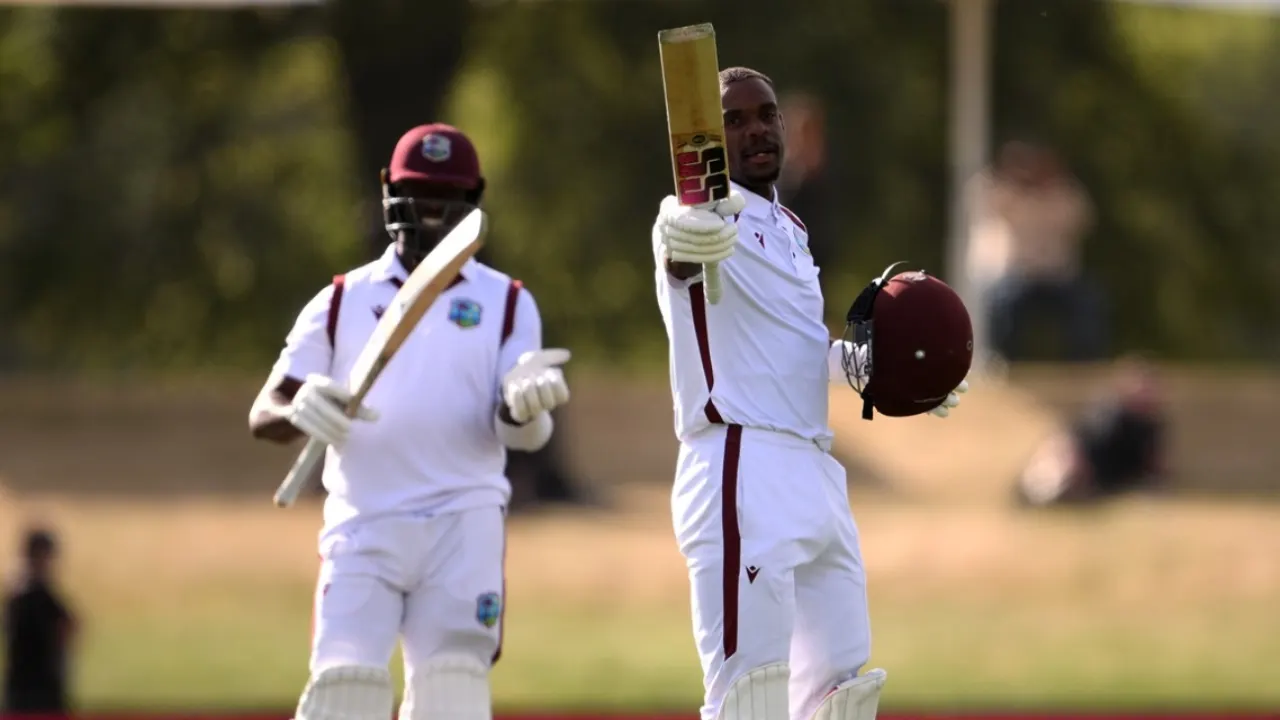
An epic stonewall from Justin Greaves had him face more than half the deliveries of his 12-Test career in this one innings alone, as West Indies pocketed their first points in their sixth Test of the 2025-27 World Test Championship cycle in Christchurch. The 163.3 overs they eventually faced is the longest fourth-innings in Tests for West Indies in 95 years.
Having played the supporting role to Shai Hope through their 196-run stand that rescued West Indies from 92 for 4 on Day 3, Greaves became the heartbeat of the innings once Hope (140) and Tevin Imlach fell in quick succession.
He brought up a stunning maiden Test double ton in the penultimate over when he sliced Jacob Duffy over backward point to pocket what was to be only his second boundary in all of the final session as his colleagues stood up to give him a standing ovation.
He finished 202 not out, having faced 388 deliveries, turning an innings that began with the typical artistic flair and flamboyance into a steely knock full of purpose and grit. Greaves wore more blows on the body than he could count, batted more deliveries than he had in his career, and reined in his natural instincts with single-minded purpose and determination.
His effort led to an astonishing turnaround from the first hour of the day, when West Indies stumbled to 277 for 6 in a mammoth chase of 531. A depleted New Zealand attack down to two weary frontline pacers in Zak Foulkes and Jacob Duffy, fancied their chances. But Greaves found an able ally in Kemar Roach, the 37-year-old veteran, who batted like his life depended on it in his comeback Test.
Roach made 58 not out – his highest first-class score – while facing 233 deliveries himself. Astonishingly, he made just 5 off the last 104 deliveries he faced during a dramatic final two hours of play even as the sun baked down hard on an increasingly docile Hagley Oval surface. Yet that should not take away from the epic rearguard from Hope, Greaves, and Roach.
The frustration of not being able to separate Greaves and Roach during the second and third sessions was evident, as New Zealand’s bowlers were ground into the dust. They would also have felt robbed when Roach appeared to have nicked Michael Bracewell to Tom Latham behind the stumps – though perhaps only having themselves to blame for burning all their reviews.
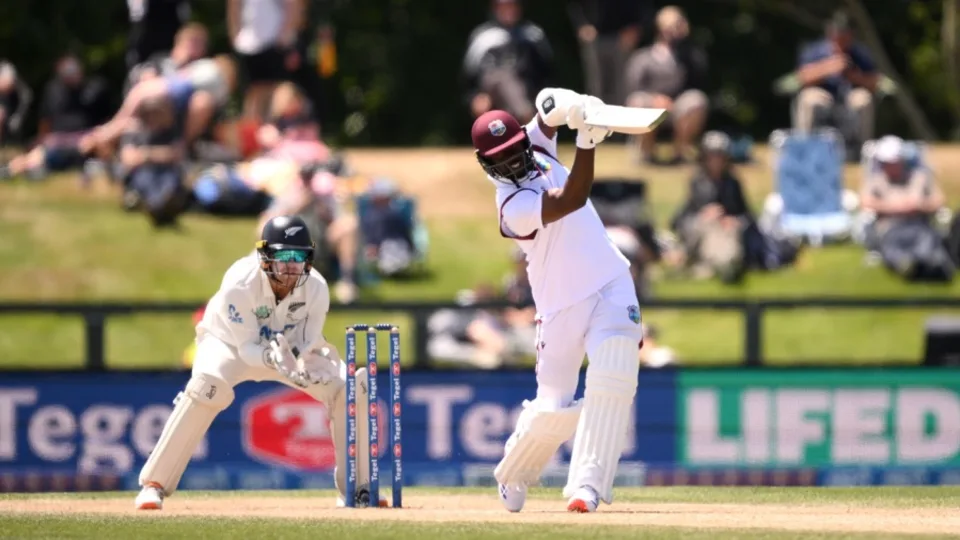
Even so, it was the thinnest of spikes that made it all the more challenging for Alex Wharf, the on-field umpire, who only a few minutes earlier made a cracking decision by turning down what everyone believed was an obvious inside-edge onto the pad to the slips, again off Bracewell. Replays showed Wharf had made a terrific call.
As admirably as Roach played, he also maximised his opportunities. On 30, he was put down by Foulkes at backward square leg when he attempted an expansive sweep off Bracewell. On 35, Blair Tickner, subbing for Matt Henry, missed a direct hit at the bowler’s end from a few yards away at short mid-on as Roach was misjudging a run.
Then on 47 came the most obvious chance, when Roach attempted to loft Bracewell had him nearly hole out to mid-on. Except, Glenn Phillips, the other sub, saw Tickner looking to intercept the ball from mid-off and palm it away.
With those three chances firmly behind him, Roach buckled down and offered a dead bat to anything that came his way against Bracewell. Foulkes and Duffy tried to ruffle him with the short ball from around the wicket, only for him to duck and weave.
Going into the final session, it became increasingly evident West Indies weren’t going to be enticed by the prospect of chasing down the 132 runs they needed in 31 possible overs. This clarity allowed them to approach the session with dead defence being the sole primary aim, even as Greaves began to tire and suffer cramps that needed medical attention at different times.
Not even the possibility of an impending double century enticed Greaves into attempting anything loose, even if Tom Latham gave him the open invitation to drive Bracewell against the turn through the covers. This wasn’t perhaps a risk not worth taking given how easily West Indies’ lower order collapsed in the first innings.
But long before a draw became the only possibility, even as New Zealand tried to attack with six fielders around the bat in the final session, Hope and Greaves pocketed runs at every available opportunity as the hosts rushed through their first six overs with part-time spin in a bid to take the second new ball quickly.
But even after they took it, there was hardly any assistance for the bowlers. Hope defended comfortably off a length with neither Foulkes nor Duffy consistently able to challenge the outside edge consistently. The occasional misfields, like – Rachin Ravindra letting one through his legs for four, or Will Young overrunning a throw while backing up – added to the sense of raggedness New Zealand had begun to feel.
A breakthrough lifted them shortly after drinks when Duffy dug in a short ball down leg, which Hope gloved behind, only for Latham to throw himself to his left and pluck a stunner from his webbing to end a marathon. Then came a second when Imlach was trapped by a nip-backer.
They may have thought then it was just a matter of time. It could’ve been had they not reprieved Roach, but those reprieves proved even more costly given they only had two fast bowlers and two part-timers available – all of them going full throttle to the limit – despite not getting much out of the surface.
In the end, the manner in which West Indies earned the draw may prove far more valuable. Above all, it was a day that reminded everyone of the slow-burn magic only Test cricket could deliver.
Brief scores:
West Indies 167 (Shai Hope 56, Tagenarine Chanderpaul 5; Matt Henry 3-43, Zak Foulkes 2-32, Jacob Duffy 5-34) and 457 for 6 (Justin Greaves 202*, Shai Hope 140, Kemar Roach 58*; Jacob Duffy 3-122) drew with New Zealand 231 (Kane Williamson 52, Michaell Bracewell 47, Jayden Seales 2-44, Kemar Roach 2-47, Ojay Shields 2-34, Justin Graves 2-35) and 466 for 8 dec (Ravindra 176, Tom Latham 145; Kemar Roach 5-78, Ojay Shields 2-74)
[Cricinfo]
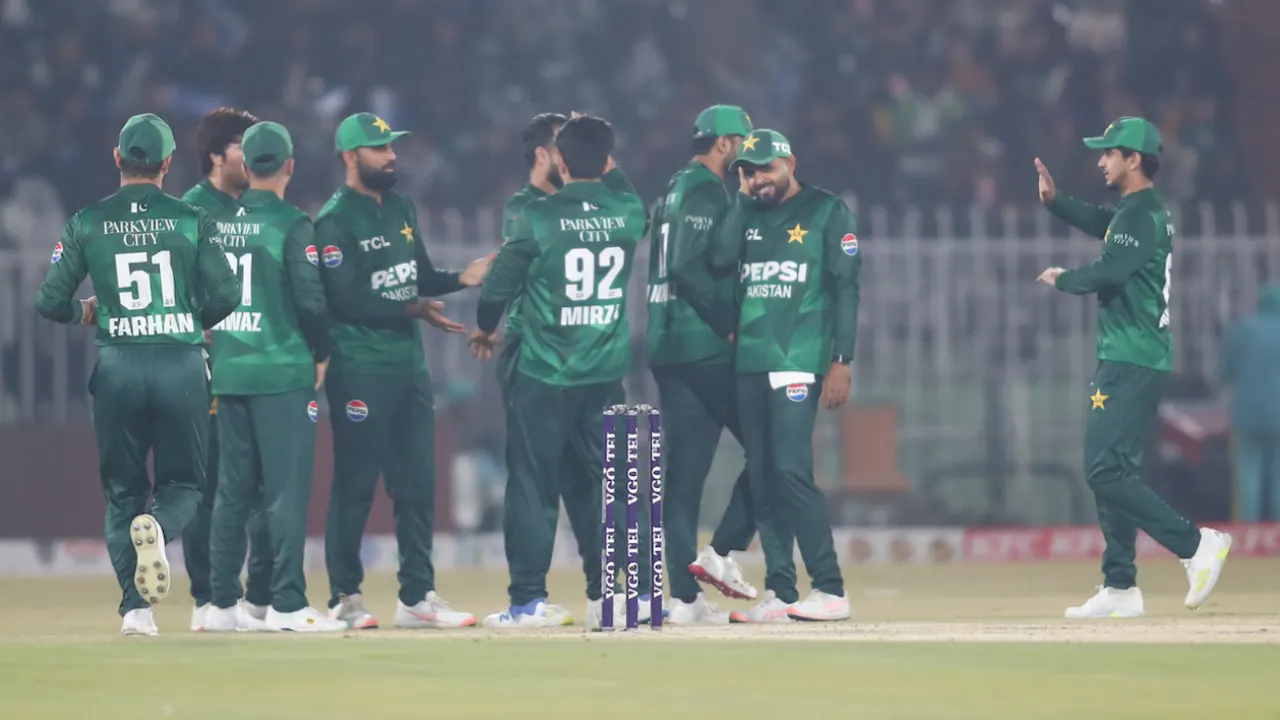
Pakistan’s Fakhar Zaman has been fined 10% of his match fee and docked one demerit point after he was found guilty of breaching level 1 of the ICC code of conduct during the tri series final against Sri Lanka on November 29.
Fakhar was found to have breached article 2.8 of the code of conduct, which relates to “showing dissent at an umpire’s decision during an international match.” He admitted to the offence and accepted the sanction proposed by the match referee, so there was no need for a formal hearing, said an ICC release.
The incident occurred in the 19th over of the final when Fakhar back-peddled from short-third, dived and seemed to have taken a stunning catch off Dasun Shanaka’s leading edge. The third umpire was called to check for the catch, and he deemed that the ball brushed the ground when Fakhar dived, and ruled it not out. Both Fakhar and the bowler, Shaheen Shah Afridi weren’t happy with the decision and made it known to the on-field umpires.
The very next ball, Shanaka swiped across the line and was clean bowled. Fakhar looked at the umpire and sarcastically appealed for the decision. Pakistan eventually won the final by six wickets as batting first, Sri Lanka collapsed in a heap, losing 9 for 30 to be bowled out for 114. Babar Azam shepherded the chase with an unbeaten 37, taking Pakistan over the line in 18.4 overs.
This was Fakhar’s first offence in a 24-month period. Level 1 breaches carry a minimum penalty of an official reprimand, a maximum penalty of 50% of a player’s match fee, and one or two demerit points.
[Cricinfo]

Wolvaardt 115*, all-round Luus set up South Africa’s thumping win over Ireland

Deadly border fighting breaks out between Pakistan and Afghanistan

Advisory for severe lightning for the Western and Sabaragamuwa provinces and Galle and Matara districts

Government briefs Diplomatic Community on recovery progress

All parties have agreed to recruit Development Officers into the teaching service through a competitive examination – PM

“Our people have shown extraordinary resilience.” – PM

‘Dates have the highest sugar content to fight Coronavirus’

Sunday Island 27 December – Headlines

#SundayIsland 17th December – Headlines

Sunday Island – 28th March

Sunday Island Headlines – 21 March

Sunday Island – 21st February – Headlines
-
 News7 days ago
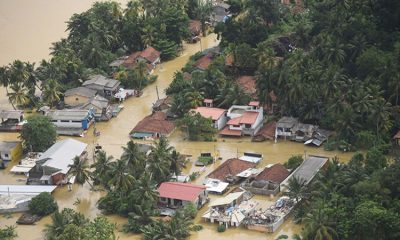
Weather disasters: Sri Lanka flooded by policy blunders, weak enforcement and environmental crime – Climate Expert
-
News4 days ago
Lunuwila tragedy not caused by those videoing Bell 212: SLAF
-
 News3 days ago
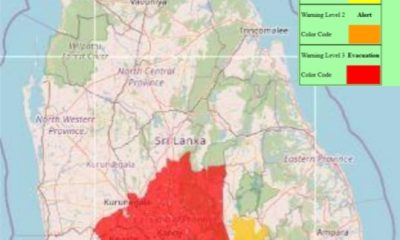
Level III landslide early warning continue to be in force in the districts of Kandy, Kegalle, Kurunegala and Matale
-
 Latest News5 days ago
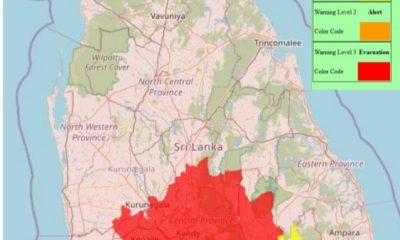
Level III landslide early warnings issued to the districts of Badulla, Kandy, Kegalle, Kurunegala, Matale and Nuwara-Eliya
-

 Features5 days ago
Ditwah: An unusual cyclone
-

 Latest News6 days ago
Updated Payment Instructions for Disaster Relief Contributions
-

 Latest News6 days ago
Landslide Early Warnings issued to the Districts of Badulla, Colombo, Gampaha, Kalutara, Kandy, Kegalle, Kurunegala, Matale, Moneragala, Nuwara Eliya and Ratnapura
-

 News17 hours ago
A 6th Year Accolade: The Eternal Opulence of My Fair Lady