
News
Kanchana’s warning to restrict fuel supplies irrelevant, all imports already disrupted-SJB

‘Pohottuwa party can’t take cover behind new Prez’
By Shamindra Ferdinando
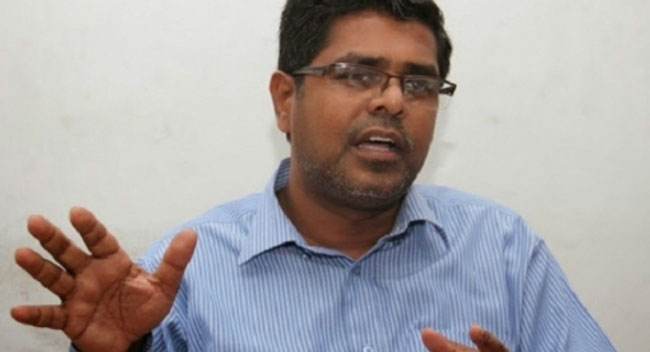
Top Samagi Jana Balavegaya (SJB) spokesperson Mujibur Rahuman MP yesterday (26) said that the Cabinet-of-Ministers owed an explanation regarding Power and Energy Minister Kanchana Wijesekera’s latest declaration that fuel imports would be restricted in the next 12 months.
Minister Wijesekera has asserted that restrictions on fuel imports would be inevitable due to unavailability of forex.
Colombo District lawmaker Rahuman pointed out that the ministerial warning was irrelevant as fuel supplies had been disrupted and regular power cuts introduced several months ago.
Further restrictions on fuel imports meant the national economy would rapidly shrink further and the so called new government lacked a strategy to meet the basic requirements, the MP said.
Newly appointed President Ranil Wickremesinghe re-appointed Wijesekera as the Power and Energy Minister.
Former UNP MP Rahuman urged the SLPP government to come out clean on the economic situation without further delay. Pointing out that as many as 4 mn vehicles had been registered so far, the MP asked whether the government was genuine in implementing the much touted fuel distribution scheme under “QR’ code.
Responding to The Island queries, lawmaker Rahuman warned that the deteriorating economic crisis couldn’t be addressed by suppressing dissent. Referring to recent media reports that coal stocks had been rapidly dwindling, MP Rahuman said that essential supplies, including LP gas were yet to be nomalized. “Are we heading for power cuts longer than current daily three hour interruption?” the MP asked.
Minister Wijesekera’s warning that fuel supplies could be further restricted reflected the actual situation regardless of silly efforts to deceive the public.
The SLPP couldn’t take refuge behind UNP leader Ranil Wickremesinghe recently elected President under controversial circumstances, lawmaker Rahuman said. The SJB official asked whether President Wickremesinghe consulted the SLPP hierarchy before he ordered large scale military-led crackdown on Galle Face protesters.
In the absence of Gotabaya Rajapaksa, the military and law enforcement apparatus carried out a coordinated attack on protesters on the day President Wickremesinghe swore in new ministers, MP Rahuman said. The Opposition MP said that those who attacked protesters at the behest of President Wickremesinghe would be held responsible.
Lawmaker Rahuman alleged that the SLPP was engaged in a desperate bid to hang onto power at any cost. The ruling coalition beset by internal strife wanted President Wickremesinghe to save them from current turmoil, MP Rahuman said.
The SJB official said that in spite of offering to form an all-party-government to address the issues at hand, President Wickremesinghe and the SLPP were obviously not serious about such an arrangement. If the government was genuine, the military wouldn’t have been unleashed on the protesters, he said. “Perhaps, the attack was meant to jeopardize proposed efforts for an all-party government. The new President and the SLPP seem to be contemplating to proceed irrespective of calls to call for early general election, the MP said.
In terms of the 20th Amendment to the Constitution, the President can dissolve Parliament.
Lawmaker Rahuman said that the SJB believed though Gotabaya Rajapaksa was not in the scene the SLPP’s agenda remained the same.
Lawmaker Rahuman said that dozens of deaths at fuel queues in various parts of the country were a grim reminder of the SLPP’s failure. No less a person than the Governor of the Central Bank Dr. Nandalal Weerasinghe has told parliamentary watchdog committees, COPE (Committee on Public Enterprises) and COPF (Committee on Public Finance) how the previous administration mismanaged the national economy. The then Finance Minister Ali Sabry, PC, and Monetary Board members, Prasanna Jayawardena, PC and Dr. Ranee Jayamaha have confirmed what Dr. Weerasinghe has said, the SJB official. It would be the responsibility of the Wickremesinghe administration to act on the disclosure made by those above-mentioned persons, he said.



Over 40 persons have been injured (some critically) as two buses one travelling from Galle to Ampara and the other from Tangalle to Matara crashed head on at Talalla Matara this morning.
The injured have been admitted to the Matara General Hospital and Bathhegama District Hospital.

Turkiye beat a heavily changed United States 3-2 with a late Kaan Ayhan winner in an action-packed dead-rubber clash that gave the 2026 World Cup cohosts their sternest test so far ahead of the knockout rounds.
Already crowned the Group D winners, the US arrived in Los Angeles seeking to extend a perfect start with a third win, but with more than an eye on next Wednesday’s last 32 meeting against Bosnia and Herzegovina.
For Turkiye, already eliminated and without even a goal after disastrous losses to Paraguay and Australia, the only objective was to restore some pride.
Despite the low stakes and substantially reshuffled lineups for both teams, a packed Los Angeles Stadium was in a deafening mood.

For the third game running, the US got off to a dream start. One of nine changes, backup centre-back Auston Trusty, was unmarked at the far post from a US corner, given time to cushion the ball with his left foot, then blast it home.
It was the Celtic defender’s first international goal, and – at just under three minutes – the second-fastest by the US at a World Cup.
But Turkiye did not surrender. Having not scored in 62 efforts across their first two games, it was the 63rd time lucky for the Turks, and their star man, Arda Guler.
The Real Madrid forward duped Mark McKenzie with a clever dummy, allowing the ball to run down the right flank to Baris Alper Yilmaz.
Yilmaz crossed it back to Guler, who smashed it past Matt Turner to equalise in the 10th minute.

With Brad Pitt and Edward Norton among the Hollywood crowd, the game threatened to become a fight club, as Turkiye’s bench rushed the field to protest a foul by the combative Sebastian Berhalter, who earned a yellow.
The Americans thought they had restored the lead, with McKenzie the second US centre-back to put the ball in the net. But his sharp response to Ricardo Pepi’s saved shot was ruled offside.
In the 31st minute, the US found themselves behind for the first time this World Cup.
Guler spotted Eren Elmali’s overlapping run, feeding it to the wing-back, who cut the ball back from the left byline to Yilmaz, who steered it beyond the keeper.
‘Captain America’ returns

The half-time break proved the perfect tonic for the US. In the 49th minute, they were back level from a long throw by McKenzie.
The ball was cleared by Turkiye only as far as Berhalter, who did well to smash his shot low into the bottom corner.
The crowd erupted again just before the hour mark as Mauricio Pochettino sent on Christian Pulisic, undoubtedly the US’s biggest star, who will shoulder much of the cohosts’ hopes of a deep run into the knockouts.
Nicknamed “Captain America”, Pulisic earned his own round of “USA” chants, having not appeared since aggravating an injury in the first half of the opening win against Paraguay two weeks ago.
Pulisic immediately looked lively, twice having his effort blocked from close range after darting runs from the left. He knew less about a ball that looped off his shin onto the post.
Turkiye began to knock on the door again. A Yildiz effort curled inches wide in the 72nd minute.
And deep into stoppage time, Ayhan spoiled the US party, slamming the ball home from close range.
Turkiye were jubilant, while the American players clustered in a circle after the final whistle, seemingly determined not to let the gut punch spoil a campaign that had been off to a flying start.

[Aljazeera]

A delegation from UNICEF, accompanied by the United Nations Special Representative of the Secretary-General on Violence Against Children (VAC), Dr. Najat Maalla M’jid, met with Prime Minister Dr. Harini Amarasuriya on Thursday [25 June] at the Parliament premises.
The discussion was focused on further strengthening cooperation and engagement with the Government of Sri Lanka on ensuring the protection and well-being of children, and efforts to prevent and respond to all forms of violence against children.
During the meeting, the Prime Minister acknowledged UNICEF’s continued support to Sri Lanka, particularly during the response to Cyclone Ditwah, as well as its longstanding contributions to reforms in education and early childhood education and initiatives aimed at preventing and addressing violence against children.
The Prime Minister noted that while Sri Lanka has made significant progress in developing policies, the challenge lies in ensuring their effective implementation. She emphasized the need to address gaps in institutional capacity and human resources, while strengthening coordination among the various parts responsible for child protection while highlighting the critical role of frontline workers in the delivery of child protection services.
During the discussion, representatives of UNICEF emphasized the importance of bringing together all relevant stakeholders to address gaps in child protection procedures and referral pathways. Particular attention was given to ensuring that children have clear and accessible mechanisms through which they can report abuse and seek assistance.
Dr. Najat Maalla M’jid highlighted the importance of strengthening the competencies of frontline professionals on psycho social support, early detection, defining direct signs, techniques of effective listening, and safeguarding privacy. The discussions also underscored the growing importance of protecting children from online violence and abuse, and the need to strengthen measures to ensure children’s safety in digital environments.
The meeting was attended by Dr. Najat Maalla M’jid, United Nations Special Representative of the Secretary-General on Violence Against Children; Ms. Emma Brigham, UNICEF Representative; Mr. Marc-André Franche, United Nations Resident Coordinator; officials from the Ministry of Foreign Affairs; and additional secretaries and officials from the Ministry of Education.
[Prime Minister’s Media Division]

Should not drop someone just to give Sooryavanshi an opportunity: Sitanshu Kotak

Hetmyer, Stoinis and Jasdeep combine to hand Freedom 88-run defeat

Row over alleged theft of donations from India’s landmark Ram temple

Over 40 persons injured in head on crash at Talalla

Turkiye beat US 3-2 with stoppage-time goal in dead rubber

Japan draw 1-1 with Sweden at World Cup to finish second in Group F

‘Dates have the highest sugar content to fight Coronavirus’

Sunday Island 27 December – Headlines

#SundayIsland 17th December – Headlines

Sunday Island – 28th March

Sunday Island Headlines – 21 March

Sunday Island – 21st February – Headlines
-

 News7 days ago
Creditor not yet paid
-
 News7 days ago
Consumers bearing 22% tax burden despite 18% VAT claim: Dr. Harsha de Silva
-

 Features6 days ago
Nanda Pethiyagoda Wanasundara as three generations of family saw her
-

 Features5 days ago
Sri Lanka developing independent hydrographic capabilities
-

 Editorial6 days ago
Fuel crisis: Beyond price debate
-
 Opinion4 days ago
Ranasinghe Premadasa: The man who would not take ‘No’ for an answer
-

 Latest News5 days ago
Sooryavanshi thumps fastest List A fifty as India A win tri-series
-

 News3 days ago
US Assistant Secretary of State for South and Central Asian Affairs meets President