
Features
Kamala Harris spanks Donald Trump harder than Stormy Daniels

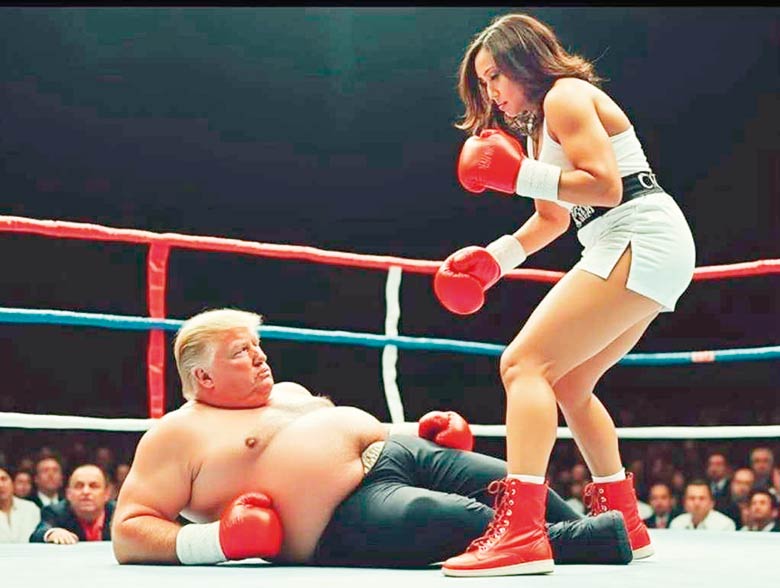
The Presidential Debate – Comrade Harris vs. Convicted Felon Trump
by Vijaya Chandrasoma
The long-awaited first and possibly only U.S. Presidential Debate was held at 9.0 p.m. EDT on Tuesday, September 10, at the National Constitution Center in Philadelphia, Pennsylvania. A historic museum in Philadelphia’s Independence Mall, devoted to the U. S. Constitution and the Liberty Bell. An appropriate venue for a momentous debate, which could well indicate the political future of the nation, whether the USA would remain the Leader of the Free World or become an authoritarian dictatorship, carrying water for the Putins and the Xis of the world.
The debate was held under the aegis of ABC, the moderators being the channel’s senior anchors, David Muir and Linsey Davis. The rules governing the debate had already been decided upon by both parties and strictly enforced during the debate, which had a TV/radio audience of over 200 million worldwide.
Incredibly, this was the first occasion on which these two presidential candidates had ever met face-to-face in their lives. While Trump is by far the more experienced debater – he has already participated in seven presidential debates: three with Hillary Clinton in 2016, three with Joseph Biden in 2020 and the seventh with Biden in June 2024, after which Biden withdrew from the race.
Although Harris has no presidential debate experience, she more than held her own during her single Vice-Presidential debate with Mike Pence in 2020. She also participated in the Democratic primaries’ debates for the presidential nomination, also in 2020. Even more importantly, she has over 30 years’ experience in the courts of California – as a Prosecutor, Deputy District Attorney and Attorney General. Add to that her two years’ experience in the U.S. Senate and nearly four years as the Vice-President of the United States. She is second only to Hillary Clinton in governing experience, as a U. S. presidential candidate.
Kamala’s opponent was the same Republican who defeated Hillary in 2016. Donald Trump won that election with a majority in the Electoral College (though a popular vote loss of more than three million votes), with the same bag of tricks like collusion with Russia and various electoral illegalities he is carrying today . But this time he has the added “attraction” of a disastrous first term with the criminal mismanagement of a pandemic which cost over 650,000 avoidable American deaths, the addition of $1.7 trillion to the national debt, an economy on the cusp of recession and two impeachments; a post-presidency record of adjudicated sexual harassment and financial fraud, 34 convicted felony charges awaiting sentencing and 57 more felony charges, including obstruction of justice, inciting an insurrection, sedition and espionage, awaiting trial.
Amazingly, in spite of all this criminal baggage, he remains the candidate of the Republican Party, newly-reconstructed in his own racist image. Such is the flailing power of white supremacy.
Recent racist Trump comments about Kamala’s ethnicity – that she had portrayed herself as a South Asian Indian until she “suddenly turned black” – she has made no secret of the fact that her father was Jamaican, mother South Indian – made me wish she would appear at the debate in a beautiful blue saree, in my Sri Lankan opinion, the most elegant of women’s dresses. She certainly has the looks to carry off such an outfit perfectly.
But she chose the outfit most certain to scare the hell out of Trump and appear as who she is – a strong, black woman. Which she did beautifully, looking most Presidential in a black power suit and a blouse with a classic lavalliere neckline, accessorized with pearl earrings. Trump looked old and tired, his usual obese self, with the floppy blue suit with overlong red tie, and the blonde weasel hairweave. Looking like the defeated, convicted felon he is.
With the polls projecting no clear win in November, Kamala and Trump have been prepping for this most consequential debate with varying strategies.
Vice-President Harris has been traveling to Pittsburgh last week for debate rehearsals, including mock debates with an adviser playing the role of Trump, adapting strategy to adhere to debate rules, which included keeping the candidates’ microphones muted when they were not speaking, focusing on presenting their policies clearly and contrasting them with Trump’s.
Trump, on the other hand, took a more casual approach. As one of his main advisors, Jason Miller said, Trump’s debate style will be unpredictable – like preparing for a fight against Muhammad Ali. You wouldn’t know at what angle he would float and how poisonous his sting would be. A pretty obese butterfly with the sting of a foul-mouthed b….
Trump assured supporters in Pennsylvania last Saturday that what seemed like incoherent ramblings were instead proof of his brilliant mind. As he explained, “I do the weave. You know what the weave is? I’ll talk about, like, nine different things that they all come back brilliantly together”. And friends of mine, like English professors, they say, “it’s the most brilliant thing I’ve ever seen”. Like when his doctors told him he had one of the finest minds in history when he aced a Dementia Test!
Timothy O’Brien, author of TrumpNation, says that the reason Trump is “now offering these convoluted explanations of his speech patterns is because he’s hyper-aware that he’s making even less sense than he used to. What we’re seeing is a reflection of someone who’s very troubled and very desperate”.
The consensus before the debate was that Vice-President Harris will win the debate just by showing up. Which, from the moment she stepped on the stage, strode confidently up to Trump and made him shake her hand, she did. As if to say, “I am Vice-President Kamala Harris and I am in charge”.
She continued with all guns firing, preempting Trump’s pet economic strategy going forward – increased tariffs resulting in increasing revenues. She correctly called these “sales taxes” as, contrary to Trump’s lies and/or misconceptions, import tariffs are paid by the American importer, not the (Chinese) exporter, who passes these on to the American consumer, resulting in inflation and high prices.
She needled Trump on his many weak positions, primarily on women’s reproductive freedom, a subject he has been all over the place in recent weeks. He had been very proud to have overturned Roe v. Wade, the Supreme Court ruling which has proved to be extremely unpopular with all women, Republican and Democrat. He has tried to weasel his way out of this very radical legislation by trying to soften his stance and accusing Democrats of late-term abortions, even executing babies after birth, a preposterous lie he has been spreading over the years. The single most powerful moment of the debate was perhaps Kamala’s emotional defense of the woman’s right to choose, declaring “I would proudly sign the protections of Roe v. Wade back into law”.
Kamala also baited him about his being fired by 81 million Americans in 2020, his obsession with crowd sizes at campaign rallies and windmills causing cancer.
Trump rambled on about how he saved the world by providing ventilators during the pandemic; the wonderful economy he created during his first term. He harped on the millions of immigrants streaming through the Southern border opened by the Biden administration, the latest fictional tragedy being Haitian immigrants eating cats and dogs, pets of the residents of Springfield, Ohio, a lie immediately denied by the Springfield Town Authority.
Kamala stated that during her travels representing the United States in her capacity of Vice-President at various international meetings and conferences, the leaders of foreign nations and traditional allies had expressed their misgivings, even fears, at the re-election of Donald Trump. She claimed that they are “laughing at Donald Trump”, calling him a “disgrace”.
Trump bristled at this claim, saying that he was the most respected leader in the world. In fact, Trump quoted Viktor Orban, the dictatorial Prime Minister of Hungary, who said, “Why is the whole world blowing up? Because you need Trump back as president. They were afraid of him. China was afraid of him. Russia was afraid of him”. Trump said he enjoyed the utmost respect of world leaders like Putin, Orban and Xi.
It’s as if Thomas Dewey, when contesting FDR in the 1944 US presidential election, gave Hitler and Mussolini as his character references!
Trump also refused to answer the question whether he wants Ukraine to win the war against Russia. It was pointed out to him that he had once said he would stop aid to Ukraine, withdraw from NATO, that Russia could do “whatever the hell Putin wants” unless the European member nations of NATO paid their fair share of their dues for the defense of Europe.
Kamala reminded him that Putin will not stop after the conquest of Ukraine. He will then cast his eyes on other Eastern European nations of the old Soviet Socialist Union like Poland, an ambition which would not sit well with the 800,000 plus Pennsylvania voters of Polish origin.
In fact, Kamala, with a little help from the moderators, was able to keep Trump babbling incoherently so efficiently that little time was left for her to answer at length questions on her own weaknesses and those of the Biden administration. Like the disastrous withdrawal from Afghanistan, the immigration problems at the Southern border, the continuing war in Gaza, inflation and her plans to improve the economy of the country. Kamala was also allowed to get away with her own meaningless word salads, her soulful little anecdotes about “when she was a li’lle girl in California” unchecked. Won’t happen again.
There is talk of a second debate. Trump has ruled out the possibility of a second debate, with the lie even his closest allies don’t believe, that he won the first debate. The reality, of course, is that he knows that Kamala will spank him again, and he will not risk a second beating. Harris’ campaign, flush from success, is supposed to be eager for another showdown. They should leave well alone. True, she set a masterful trap to which the blustering Trump succumbed completely. Kamala may have won this debate, but the problems facing her at the November election have not gone away. A second debate will only give Trump and his allies another bite at the apple. Why risk that? Let’s play their game for a change, and kick them when they are down.
We will never get another track tailored to our strengths like last Tuesday’s debate. Trump may not fall into these traps again, and Kamala may have to answer tough questions without help from the moderators. Tuesday’s convincing win, which probably clinched the November election, is all we wanted. Even Trump’s closest allies accept that. We have eight weeks to consolidate our position, making sure not only of the White House but governing majorities in Congress.
Significant Endorsements
Taylor Swift ended a long tweet after the debate, “Like many of you, I watched the debate last night…As a voter, I make sure to watch and read everything about their policies and plans for this country… I will be casting my vote for Kamala Harris and Tim Walz in the 2024 Presidential Election. I am voting for Kamala Harris because….she is a steady-handed, gifted leader and I believe we can accomplish so much more in this country if we are led by calm and not chaos… With love and hope. Taylor Swift….Childless Cat Lady”.
To many of us, an endorsement by a musical phenomenon may not seem to be a big deal. But Taylor Swift has an Instagram fan base of 283 million, with 100 million “likes” for the beautifully written endorsement. 300,000 new voter-registrations have also been listed since her endorsement. She is not just a celebrity but a role-model for the super-modern young woman in America. The teenagers of yesterday, but the voters of today!
It was first thought that Kamala’s other significant recent endorsement by former Republican Vice-President, Dick Cheney, would provide a useful, if antithetical, bookend of endorsements for the November election. Bookends of the role model for modern young women in Taylor Swift with that of Dick Cheney, the role model for the stuffiest and most cruel of old white farts in America.
On second thoughts, I feel we would be better off without the endorsement of one of the greatest war criminals of the century. So thanks, Mr Cheney, but no thanks. We will manage without your blood-stained vote.
Remembering 9/11
The day after the debate was the 23rd anniversary of the worst terror attack on the shores of the United States, when Americans came together, bonded by sadness and patriotism, to pay their respects to the nearly 3,000 Americans who lost their lives to evil on that day of devastating tragedy.
The threat of foreign terrorism has now been replaced by the evil of domestic terrorism, represented by the neo-Nazi, white supremacist violence of Donald Trump’s revamped Republican Party. This threat remains, the polls for November are still deadlocked, and the radical right movement shows few signs of abatement. Even an electoral loss may not prove to be decisive, as Trump and his cult will never concede defeat, and will resort to nation-wide post-election violence.
The complete annihilation of Donald Trump at Tuesday’s Debate was a welcome start. Presidential victory in November will be the next step, followed by capture of majorities in both Houses of Congress.
Finally, and most importantly, there is an urgent need to institute a constitutional process that the US Supreme Court will lead the Judiciary in ensuring that the Justice dispensed in the United States in the future is Fundamental Justice faithful to the Rule of Law and not venal Justice polluted by political corruption.

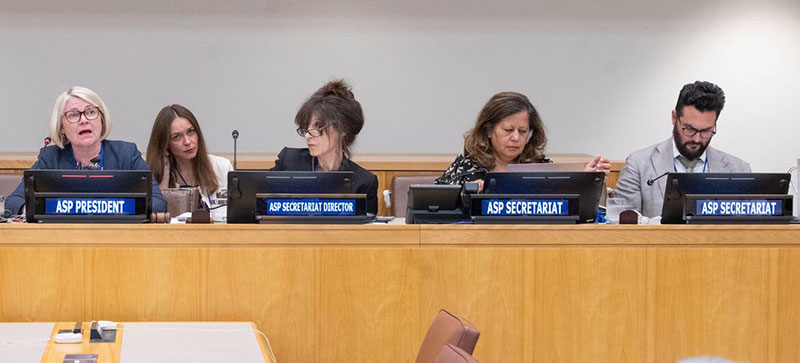
 US Secretary of State Marco Rubio’s warning to the International Criminal Court (ICC) was stark: ‘Either the ICC will end its threats, or we will end the ICC.’ It followed US central administration accusations that the court was unfairly targeting Americans on the basis of trumped-up war crimes charges.
However, a new plethora of sanctions has been clamped on the ICC by the US, which in turn has spurred accusations by sections of the world that the latter has unleashed an ‘assault’ on the international legal order.
What some of the sanctions would mean for the ICC was outlined by Rubio: ‘We will ban transactions with this rogue court, cutting off their resources and crippling their ability to operate against us.’
The ICC has shown consistency of purpose over the years. Despite some operational constraints it has indicted a large number of political strongmen from around the world, accused of war crimes and other governance excesses that come under its purview. Two such recent figures are: Russian President Vladimir Putin and Israeli Prime Minister Benjamin Netanyahu.
Rather than enjoy a mere nominal presence in the world community, the ICC has proved its effectiveness by detaining and bringing to justice scores of VIP politicians and others of their ilk who have been found guilty of human rights abuses and kindred excesses that come within the terms of reference of the ICC.
Accordingly, the international justice system would be stymied considerably as a result of the ICC being dis-empowered, particularly financially. Needless to say, potential and real perpetrators of the species of crime coming under the jurisdiction of the ICC would stand to gain most from such anarchic tendencies. That is, political repression globally would be enabled to enjoy a new lease of life.
A detailing of the types of crime coming under the purview of the ICC provides an idea of what it would cost the international community if the ICC’s operations are gravely hampered. They are mainly: genocide, war crimes, crimes against humanity and the crime of aggression.
That is, the part of the world to be worst affected would be the global South, since the latter is awash with the mentioned crimes. Needless to say, a chronically-disaffected South will sooner rather than later undermine the well being of the world dangerously. The world is already being put through these paces.
At the time of writing, ‘illegal migrants’ from the South, for example, are aggravating many a Western economy’s woes, besides creating for them acute law and order issues. The fact that these migrants’ presence goes on to become a virtual test of the migrant receiving states’ ability to forge domestic social inclusion in the face of jingoistic protests by mainly white supremacist groups is evidence of the latter. As is known, the US, to take just one example, has been up against this crisis for quite a while.
Accordingly, it will be in the best interests of the West if ‘illegal’ migrant arrivals on their shores are stemmed. If the socio-political and economic problems assailing the South are effectively managed through North-South collaborative, ‘trouble-shooting’ efforts the causes leading to ‘illegal’ migration and connected issues could be resolved at source as it were. For, it is the aggravation of the South’s material questions that lays the basis for the emergence of repressive and anti-democratic regimes in the hemisphere.
Until such time that the aforementioned issues in North-South relations are visited afresh and addressed urgently, a vibrantly functioning ICC would be needed. For, the latter would prove a deterrent to Southern political and military strongmen, highly prone to power abuse and like excesses, from coming into being in the wake of the South’s chronic material woes and the wars and conflicts that result from them.
It stands to reason then that the US would be acting in its own interests by enabling the ICC to perpetuate its mandate without hindrance. For a crop of issues that impinges negatively on internal law and order would be defused.
Meanwhile, there needs to be a meeting of minds among the rest of the West to put back in place a North-South dialogue process aimed at reducing some of the economic pressures that are weighing on the South.
Since economics usually drives politics it will be in the interests of the world community to scrutinizingly re-visit North-South issues of the past and put in place economic relief packages for Southern publics that would enable them to tide over their material hardships rather than permit the latter to aggravate into social disaffection and eventually armed militancy. It is the latter juncture that paves the way for the emergence of authoritarian rulers in the South who then go on to be a blight on their publics.
Accordingly, the Southern-based global development thinking of the past that envisaged a more equitable world economic order needs to be seen as an urgent need. That is, NAM’s international development paradigms need to be resuscitated to the extent possible.
It is unlikely that rightist governments of the West, such as the current Republican administration in the US, would find these projects feasible, but democratic states of Europe, led by perhaps the UK, are likely to think otherwise. For it would not be beneficial for the democratic world to be having on their hands repressive governments in the South who would be gravitating towards the major military and economic actors of the South, such as Iran and North Korea, who tend to be in constant power struggles with the West.
However, until such time that the mentioned, pro-people initiatives are given serious thought the ICC would need to be enabled by the international community to be in place comfortably and carry on with its mandate of bringing repressive rulers to book. Besides the ICC should pave the way for the peoples of the developing world to enjoy some substantial respite from the political repression and even terror which tend to be their lot.
Meanwhile, the wars of West Asia are relentlessly aggravating the economic hardships of people everywhere, driving the point home to enlightened sections that there is no alternative to peacemaking. A challenge is to convert the US under President Trump to this line of thinking.
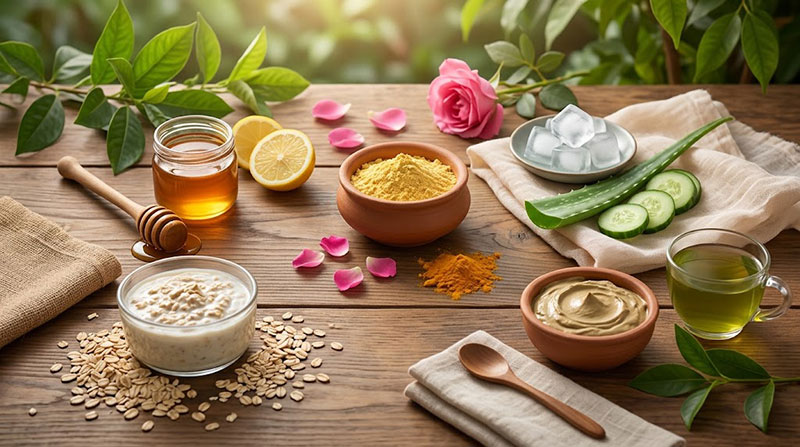
 This week, I give you five simple, time-tested homemade remedies that help reduce the appearance of blemishes, control excess shine and leave your skin feeling softer and smoother.
The Honey and Lemon Brightening Dab:
For stubborn blemish marks, this is a classic. Mix one teaspoon of pure bee honey with three to four drops of fresh lemon juice. Apply gently, only on the affected spots, and leave for 10 minutes before rinsing with lukewarm water. While honey soothes and softens, lemon helps to brighten naturally. Use twice a week in the evening.
Besan and Rose Water Oil-Control Pack:
An ideal remedy to combat shine, especially on the T-zone. Take two teaspoons of besan (gram flour) and mix with sufficient rose water to form a smooth paste. Add a pinch of turmeric for its antiseptic goodness. Apply evenly, keep for 15 minutes and wash off. It absorbs excess oil without over-drying, leaving a beautiful matte finish.
Aloe Vera and Cucumber Ice Soother:
Blend fresh aloe vera gel with the juice of a grated cucumber and freeze the mixture in an ice tray. Each morning, wrap one cube in a soft muslin cloth and gently rub over a cleansed face for 30 seconds. It calms, tightens pores and imparts a baby-soft smoothness.
Oatmeal and Curd Gentle Polish:
Roughness and old blemish marks need gentle exfoliation. Combine one tablespoon of finely powdered oatmeal with one tablespoon of fresh curd (yoghurt). Massage very gently, in circular motions, for one minute, leave for five minutes and rinse. It removes dead cells and unveils softer, clearer skin.
Multani Mitti and Green Tea Magic Mask:
Brew some green tea and allow it to cool completely. Mix one and a half teaspoons of Multani Mitti (Fuller’s Earth) with the tea water to make a fine paste. Apply for 10 to 12 minutes – do not let it dry and crack completely – and wash off. It draws out impurities, fades blemishes and bestows a fresh, shine-free glow.
A Gentle Reminder:
As with any natural remedy, always do a patch test on your inner arm first. For those with oily or combination skin, avoid heavy coconut oil application and harsh scrubbing, as they tend to aggravate shine and blemishes.

 Dream of performing on a world stage? Well, here is your unique, golden opportunity!
The World Championships of Performing Arts (WCOPA) — the one and only official “Talent Olympics” — is the world’s premier global platform for aspiring singers, dancers, actors, models, instrumentalists, etc., to compete, shine and be discovered!
And, yes, this world stage is open to YOU, Sri Lankans living in Sri Lanka and overseas!
Held annually in glittering Las Vegas, WCOPA brings together over 70 countries, all competing for Gold, Silver and Bronze Medals, just like the traditional Olympics.

Lakisha Bernard: Will represent Team Sri Lanka at WCOPA 2027
Outstanding performers vie for the coveted titles of Junior and Senior Grand Champion Performer of the World, with winners and standout participants awarded over $500,000 in scholarships, cash awards and prizes to catapult their education and careers!
Sri Lanka is already making waves! At WCOPA 2026, Natharie Wickramasinghe, representing Team Sri Lanka, made the nation proud by winning a Bronze Medal in the Ethnic/Folklore Dance category!

Lakisha: Accomplished freelance Model and Fashion Design graduate
Recruitment for this prestigious competition is handled through a system of scouts and licensed National Directors — and this is where our very own Chris Rajendra, now based in Las Vegas, and National Director for Team Sri Lanka, comes into the scene.
If you are a singer, dancer, actor, model, instrumentalist — if you have talent burning inside you — contact Chris Rajendra today for registration and, who knows, you may find yourself in Las Vegas, and proudly draped in the Sri Lankan flag, at WCOPA 2027!
The contact address is: Chris Rajendra, wcopa.nationaldirector.sl@gmail.com
or chris.rajendra@gmail.com
Meanwhile, a star is born for 2027, in the form of Lakisha Bernard who is all set to represent Team Sri Lanka at WCOPA 2027.
Originally hailing from the sun-drenched coastal city of Colombo and now carving out her creative career in Canada, 22-year-old Lakisha is stepping into the international spotlight.
This accomplished freelance Model and Fashion Design graduate has officially been appointed as the Team Sri Lanka Promoter for Canada as she prepares to represent Team Sri Lanka at WCOPA in Las Vegas.
Lakisha brings a unique blend of high-fashion sensibility, captivating camera presence and expert garment design to the Team.
Having built her career, from local college shoots to high-glamour concepts, Lakisha’s inspiring journey embodies the true spirit of cultural bridge-building and creative resilience, bringing immense pride and recognition to Sri Lanka on the global stage.
WCOPA 2027 will be held at the legendary Westgate Hotel & Casino, Las Vegas, from 12th to 20th July – the very same iconic arena where the late, great Elvis Presley himself performed!
Your moment is now. Your stage is Las Vegas, so hurry and contact Chris Rajendra.

AgriConnect Sri Lanka’ to be launched on 30 October to Modernise the Agricultural Sector Through Digitalisation

57th Annual Saints’ Quadrangular Tournament on Saturday and Sunday

Showers or thundershowers will occur at most parts of the island

Prison rules to be revised over monks’ attire

AC President recuses himself from hearing prison attire case pertaining to Gnanasara Thera

Court orders steps to obtain INTERPOL Red Notice against Basil

‘Dates have the highest sugar content to fight Coronavirus’

Sunday Island 27 December – Headlines

#SundayIsland 17th December – Headlines

Sunday Island – 28th March

Sunday Island Headlines – 21 March

Sunday Island – 21st February – Headlines
-

 News7 days ago
NDB fraud Rs 60mn more than reported
-

 News7 days ago
Removing monk’s robes matter for Sangha to decide: Mahanayake Theras
-

 News5 days ago
Sri Lanka escalates anti-graft drive with Shiranthi’s jailing
-

 News6 days ago
NPP govt. reminded of its responsibilities as US warship leaves Colombo
-
 Latest News6 days ago
Farhan, Sadaqat help Pakistan ace 183 chase to go 1-0 up
-
 News7 days ago
BHC, Colombo: “LTTE remains a proscribed org. in the UK”
-

 Latest News4 days ago
Farhan and Sadaqat help Pakistan seal series in style
-

 News5 days ago
Iranian ships stranded, Lanka fears US sanctions