
Latest News
Justin Greaves 202*, Kemar Roach 58* anchor West Indies to epic draw

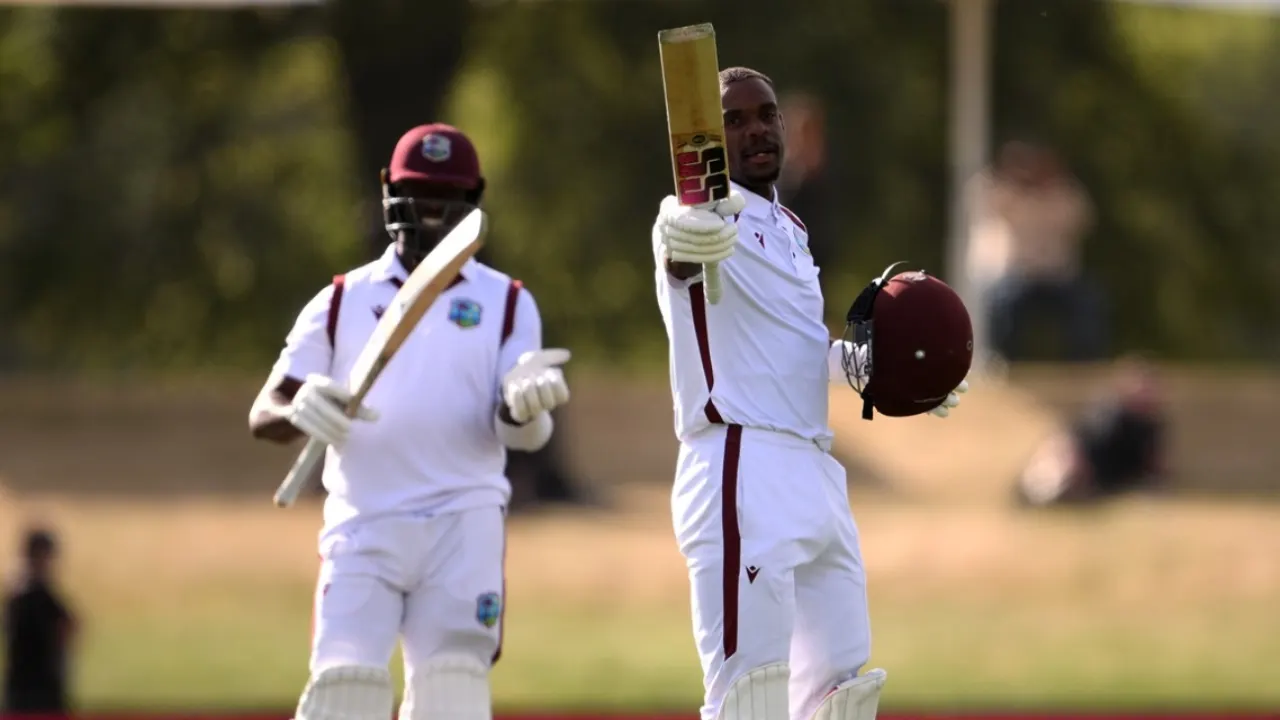
An epic stonewall from Justin Greaves had him face more than half the deliveries of his 12-Test career in this one innings alone, as West Indies pocketed their first points in their sixth Test of the 2025-27 World Test Championship cycle in Christchurch. The 163.3 overs they eventually faced is the longest fourth-innings in Tests for West Indies in 95 years.
Having played the supporting role to Shai Hope through their 196-run stand that rescued West Indies from 92 for 4 on Day 3, Greaves became the heartbeat of the innings once Hope (140) and Tevin Imlach fell in quick succession.
He brought up a stunning maiden Test double ton in the penultimate over when he sliced Jacob Duffy over backward point to pocket what was to be only his second boundary in all of the final session as his colleagues stood up to give him a standing ovation.
He finished 202 not out, having faced 388 deliveries, turning an innings that began with the typical artistic flair and flamboyance into a steely knock full of purpose and grit. Greaves wore more blows on the body than he could count, batted more deliveries than he had in his career, and reined in his natural instincts with single-minded purpose and determination.
His effort led to an astonishing turnaround from the first hour of the day, when West Indies stumbled to 277 for 6 in a mammoth chase of 531. A depleted New Zealand attack down to two weary frontline pacers in Zak Foulkes and Jacob Duffy, fancied their chances. But Greaves found an able ally in Kemar Roach, the 37-year-old veteran, who batted like his life depended on it in his comeback Test.
Roach made 58 not out – his highest first-class score – while facing 233 deliveries himself. Astonishingly, he made just 5 off the last 104 deliveries he faced during a dramatic final two hours of play even as the sun baked down hard on an increasingly docile Hagley Oval surface. Yet that should not take away from the epic rearguard from Hope, Greaves, and Roach.
The frustration of not being able to separate Greaves and Roach during the second and third sessions was evident, as New Zealand’s bowlers were ground into the dust. They would also have felt robbed when Roach appeared to have nicked Michael Bracewell to Tom Latham behind the stumps – though perhaps only having themselves to blame for burning all their reviews.
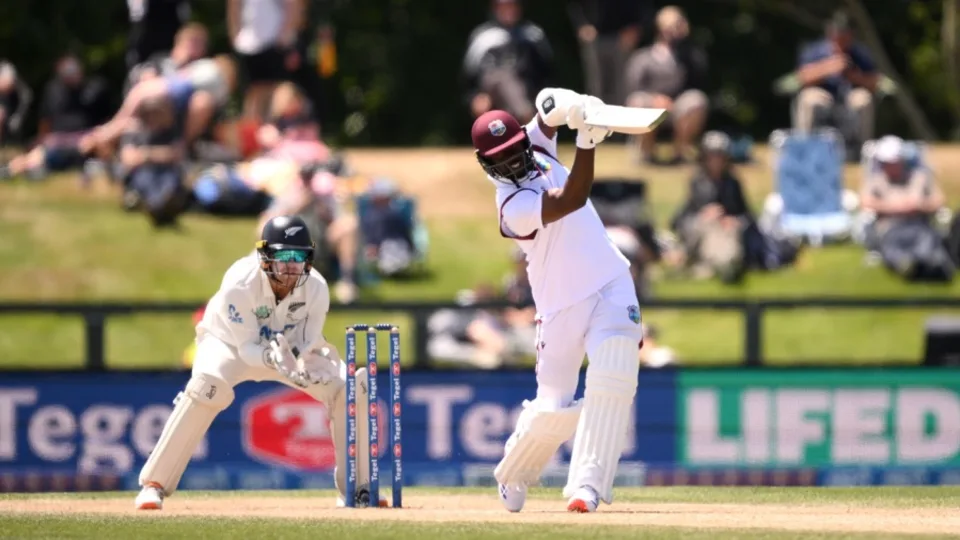
Even so, it was the thinnest of spikes that made it all the more challenging for Alex Wharf, the on-field umpire, who only a few minutes earlier made a cracking decision by turning down what everyone believed was an obvious inside-edge onto the pad to the slips, again off Bracewell. Replays showed Wharf had made a terrific call.
As admirably as Roach played, he also maximised his opportunities. On 30, he was put down by Foulkes at backward square leg when he attempted an expansive sweep off Bracewell. On 35, Blair Tickner, subbing for Matt Henry, missed a direct hit at the bowler’s end from a few yards away at short mid-on as Roach was misjudging a run.
Then on 47 came the most obvious chance, when Roach attempted to loft Bracewell had him nearly hole out to mid-on. Except, Glenn Phillips, the other sub, saw Tickner looking to intercept the ball from mid-off and palm it away.
With those three chances firmly behind him, Roach buckled down and offered a dead bat to anything that came his way against Bracewell. Foulkes and Duffy tried to ruffle him with the short ball from around the wicket, only for him to duck and weave.
Going into the final session, it became increasingly evident West Indies weren’t going to be enticed by the prospect of chasing down the 132 runs they needed in 31 possible overs. This clarity allowed them to approach the session with dead defence being the sole primary aim, even as Greaves began to tire and suffer cramps that needed medical attention at different times.
Not even the possibility of an impending double century enticed Greaves into attempting anything loose, even if Tom Latham gave him the open invitation to drive Bracewell against the turn through the covers. This wasn’t perhaps a risk not worth taking given how easily West Indies’ lower order collapsed in the first innings.
But long before a draw became the only possibility, even as New Zealand tried to attack with six fielders around the bat in the final session, Hope and Greaves pocketed runs at every available opportunity as the hosts rushed through their first six overs with part-time spin in a bid to take the second new ball quickly.
But even after they took it, there was hardly any assistance for the bowlers. Hope defended comfortably off a length with neither Foulkes nor Duffy consistently able to challenge the outside edge consistently. The occasional misfields, like – Rachin Ravindra letting one through his legs for four, or Will Young overrunning a throw while backing up – added to the sense of raggedness New Zealand had begun to feel.
A breakthrough lifted them shortly after drinks when Duffy dug in a short ball down leg, which Hope gloved behind, only for Latham to throw himself to his left and pluck a stunner from his webbing to end a marathon. Then came a second when Imlach was trapped by a nip-backer.
They may have thought then it was just a matter of time. It could’ve been had they not reprieved Roach, but those reprieves proved even more costly given they only had two fast bowlers and two part-timers available – all of them going full throttle to the limit – despite not getting much out of the surface.
In the end, the manner in which West Indies earned the draw may prove far more valuable. Above all, it was a day that reminded everyone of the slow-burn magic only Test cricket could deliver.
Brief scores:
West Indies 167 (Shai Hope 56, Tagenarine Chanderpaul 5; Matt Henry 3-43, Zak Foulkes 2-32, Jacob Duffy 5-34) and 457 for 6 (Justin Greaves 202*, Shai Hope 140, Kemar Roach 58*; Jacob Duffy 3-122) drew with New Zealand 231 (Kane Williamson 52, Michaell Bracewell 47, Jayden Seales 2-44, Kemar Roach 2-47, Ojay Shields 2-34, Justin Graves 2-35) and 466 for 8 dec (Ravindra 176, Tom Latham 145; Kemar Roach 5-78, Ojay Shields 2-74)
[Cricinfo]


Five members of the Iranian women’s football team have been granted humanitarian visas in Australia after their elimination in the Asian Cup, the government in Canberra says.
Immigration Minister Tony Burke said the women “were moved to a safe location” by Australian police. He said other squad members had been told they are welcome to stay in the country.
The women had been due to fly home, but supporters had raised fears for their safety after the team declined to sing the national anthem ahead of their match against South Korea last week.
This prompted criticism in Iran, with one conservative commentator accusing the team of being “wartime traitors” and pushing for harsh punishment.
Australia’s humanitarian visa programme grants permanent protection to refugees and people in humanitarian need. Visa holders can live, work and study in the country.
Speaking early on Tuesday, Burke said the five players were happy for their names to be confirmed as Fatemeh Pasandideh, Zahra Ghanbari, Zahra Sarbali, Atefeh Ramazanzadeh, and Mona Hamoudi.
“They want to be clear they are not political activists. They are athletes who want to be safe,” he said, adding that talks had been going on over several days.
He said that on Monday “it was made clear that there were five women who wanted to be able to stay in Australia”.
The group left their hotel the same day and were moved to a safe location by police.
Burke said he met the women at that location and then signed off for their applications to go onto humanitarian visas – a process completed at about 01:30 local time on Tuesday (15:30 GMT Monday).
“I say to the other members of the team, the same opportunity is there. Australia has taken the Iranian women’s soccer team into our hearts. These women are tremendously popular in Australia.
“But we realise they are in a terribly difficult situation with the decisions that they’re making,” the Australian minister said.
Australian Prime Minister Anthony Albanese later confirmed that the five players had been given humanitarian visas.
On Sunday evening, hundreds of supporters surrounded the Iranian Lionesses’ coach as it left the stadium on the Gold Coast, with chants of “save our girls”.
On Monday, the BBC witnessed dramatic scenes inside the team’s five- star hotel when several players left the lobby in a group after speaking to activists.
Shortly after they departed, a second group – including a translator and the head coach – burst in looking panicked, and rushed through the hotel before returning to their rooms.
A family member of one of the women – speaking on condition of anonymity – told Australian news site ABC they were being protected by police, and intended to claim asylum.
“I want to kiss the hands of everyone who helped,” the unnamed relative told ABC.
On Monday, US President Donald Trump took to his Truth Social platform to demand action.
Australia should “give asylum” to the women, Trump said in his initial post. “The US will take them if you won’t,” he added.
Around an hour later, Trump posted again to say he had spoken to Australia’s Prime Minister Anthony Albanese and “five have already been taken care of, and the rest are on their way”.
Trump’s post appeared to also suggest some of the team feared for the safety of their families back in Iran and so felt they must “go back”.
“In any event, the Prime Minister is doing a very good job having to do with this rather delicate situation. God bless Australia!” Trump said.
The Trump administration put all asylum decisions on hold at the end of last year, and has stopped issuing immigrant visas for citizens from dozens of countries including Iran. It has said the administration wants to bring “an end to the abuse” of the system.
Last year, two groups of Iranians – including people whose asylum applications had been unsuccessful – were deported from the US back to Iran. The groups reportedly included members of the LGBT community,who face severe legal and social repercussions in Iran.
[BBC]
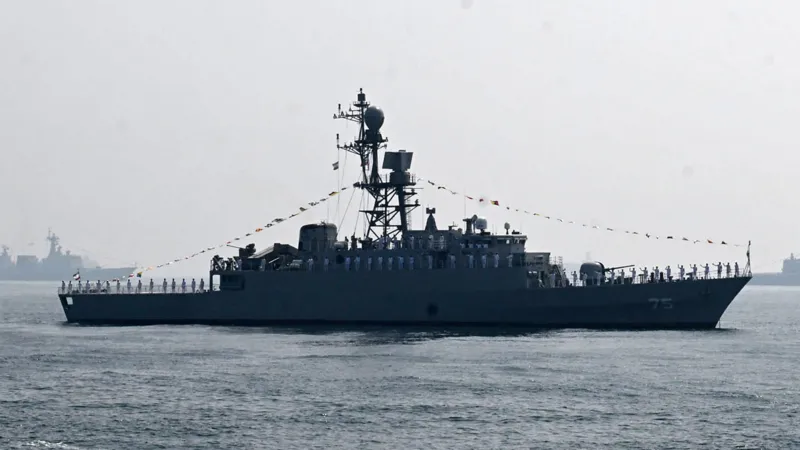
The Iranian warship Iris Dena was given permission by India to dock three days before it was torpedoed by a US submarine, India has said.
Foreign Minister S Jaishankar said Iran had sought permission for three of its ships to dock at Indian ports on 28 February – the day the US and Israel began a war on Iran – and permission was granted by India on 1 March.
The ships’ movements between 1 and 4 March are not clear and nor is why only one of them made it to India.
The sinking of the Iris Dena, with 130 sailors on board, in international waters off Sri Lanka’s southern coast on 4 March marked a dramatic widening of the war – and raised questions about India’s authority in its backyard.
It was the first military strike outside the Middle East since the US and Israel launched their war on Iran. President Donald Trump has said destroying Iran’s navy is one aim of the assault.
The three Iranian ships – Iris Dena, Iris Bushehr and Iris Lavan – had all participated in a military exercise hosted by India between 15 and 25 February in the coastal city of Visakhapatnam.
They left Indian waters on 25 February and were likely to have been in international waters on 28 February – when the US and Israel began attacking Iran.
“The Iranian side had requested permission on 28 February for three ships in the region to dock at our ports. This was accorded on 1 March,” Jaishankar told parliament on Monday. “Iris Lavan actually docked on 4 March in Kochi. The crew is currently in Indian naval facilities. We believe that this was the right thing to do.”
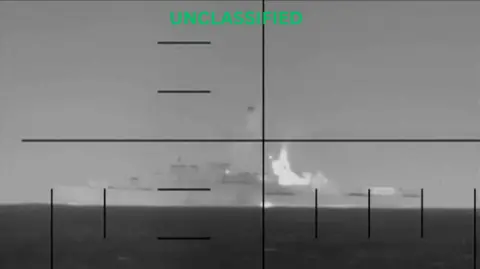
On 4 March, Iris Dena sank after being hit by a torpedo fired from a US submarine, killing at least 87 of its crew members.
According to the Indian Navy, the Iris Dena was operating about 20 nautical miles – roughly 23 miles (37km) – west of Galle in waters that fall under Sri Lanka’s designated search-and-rescue zone on the day it was struck.
The US tracks vessels across the world’s oceans, and a quarter of its submarine fleet of 65-70 is at sea at any given time, according to analysts.
Iran’s Foreign Minister Abbas Araghchi said last week the US had “perpetrated an atrocity at sea, 2,000 miles away from Iran’s shores” and that the warship was “struck in international waters without warning.”
Later, Sri Lanka said it had provided sanctuary for Iris Bushehr on 5 March, a day after it requested for docking following an engine malfunction.
Eventually, India also confirmed that Iris Lavan was docked in its southern city Kochi.
The BBC has written to the Iranian embassy in India and India’s external affairs ministry seeking clarification on the movements of the three Iranian naval vessels after Delhi granted them permission to dock.
US Defence Secretary Pete Hegseth has touted the attack on Iris Dena as an example of America’s military prowess, claiming it was “the first sinking of an enemy ship by a torpedo since World War Two”.
While it is the first time since 1945 that an American submarine has sunk an enemy ship this way, the UK and Pakistan have both sunk vessels using torpedoes since then.
The Iris Dena was one of about 20 Iranian navy vessels destroyed since Israel and the US launched co-ordinated strikes on Iran.
[BBC]

The white ball series between Afghanistan and Sri Lanka, scheduled to be held in the UAE from March 13 to 25, is likely to be postponed indefinitely due to the ongoing military conflict in West Asia.
While neither ACB nor SLC has issued an official statement, ESPNcricinfo has learned that both boards have agreed the series cannot take place in the UAE, keeping the ongoing crisis in mind. While both boards are still discussing alternatives, the bilateral series is unlikely to be shifted elsewhere due to logistical challenges.
The series comprising six white-ball matches was scheduled to start on March 13 starting with the three T20Is. The T20I leg was scheduled in Sharjah – on March 13, 15 and 17 – while the three ODIs were scheduled in Dubai on March 20, 22 and 25.
The series was set to be Afghanistan’s first under Ibrahim Zadran’s leadership, with the opener taking over the reins from Rashid Khan after a group-stage exit in the World Cup.
Last week, six matches of the ICC Men’s Cricket World Cup League 2 in Nepal involving Oman, UAE and the hosts were postponed because of the conflict.
The travel plans of several teams that were in India and Sri Lanka for the men’s T20 World Cup have also been disrupted owing to airspaces being closed or limited in West Asia.
Despite being knocked out over the last week, the contingents from West Indies and South Africa have been stuck in Kolkata, and received clarity only on Sunday, that they will be flying out on Tuesday.
[Cricinfo]

Five Iranian footballers granted Australian visas after anthem protest

Prime Minister on official visit to Manila, Philippines

It is the government’s responsibility to ensure women’s rights are realized in everyday Life, and are not confined merely to Laws – PM

North Korea cancels Pyongyang Marathon for ‘some reasons’

Canadian officials rescue 23 people who floated away on ice sheet

India offered sanctuary to Iranian ship three days before US sank it

‘Dates have the highest sugar content to fight Coronavirus’

Sunday Island 27 December – Headlines

#SundayIsland 17th December – Headlines

Sunday Island – 28th March

Sunday Island Headlines – 21 March

Sunday Island – 21st February – Headlines
-

 News4 days ago
University of Wolverhampton confirms Ranil was officially invited
-

 News5 days ago
Legal experts decry move to demolish STC dining hall
-

 News4 days ago
Female lawyer given 12 years RI for preparing forged deeds for Borella land
-

 News3 days ago
Peradeniya Uni issues alert over leopards in its premises
-

 Business5 days ago
Cabinet nod for the removal of Cess tax imposed on imported good
-

 News4 days ago
Library crisis hits Pera university
-

 News3 days ago
Wife raises alarm over Sallay’s detention under PTA
-

 Business6 days ago
War in Middle East sends shockwaves through Sri Lanka’s export sector