
Features
Jungles, ruins and shipwrecks

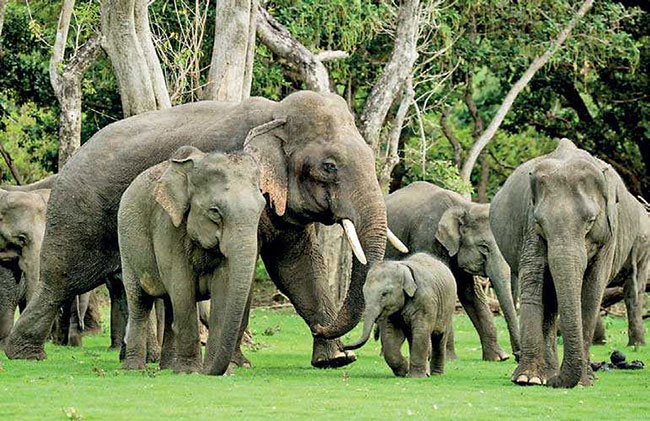
by Somasiri Devendra
Jungles fascinate me. It was a fascination that had been kindled by my father, as well as John Still, both of whom were archaeologists and writers. But, somehow, I never became one who trod the forest ways regularly. The jungle spoke to me in a different idiom – to my heart rather than my head.
Father, a teacher before turning archaeologist, became our teacher in English literature. Our text was John Still’s The jungle tide and, from the beginning, both the teacher and the author held the class spellbound. The slow progress made through the opening chapter describing a rain forest only served to stamp more deeply in my mind the world that was the jungle.
Years later I read Leonard Woolf’s haunting description of the dry zone jungle in Village In The Jungle. I always think of these two kinds of jungle – rain forest described by Still and secondary scrub by Woolf – in their words.
Trips with an archaeologist
Not long after he interpreted Still to us, father joined the Archaeological Survey of Ceylon, as it was then. He loved the work and found every excuse to go on circuit, leaving his desk. Each time he came back, he was brimful of experiences and what we learnt from him round the dining table was more than anything a university could teach.
His interests were eclectic and the tale would flit effortlessly from treasure hunters at a ruined dagoba, to a dung beetle at work, the cult of Aiyanar, a bungalow-keeper’s encounter with a wild elephant, the migrant birds, the gaemi-kavi of village pilgrims seeking male progeny from Kalu Devatha Bandara (the guardian-deity of the Sri Maha Bodhiya), and the man who manufactured sarvagna dhathu.
Being then in the class preparing for an examination, I could go with him only occasionally, but even that was wonderful. Striking inland from Puttalam, on the way to Anuradhapura, the road was, in season, bordered by weera trees in bearing and we would stop to break down the most reachable branches and strip off all the berries. He would nonchalantly remark that this was elephant country and they, too relished these berries.
Passing through the Kurunegala route, we never went past the Aiyanar jungle shrine, a mere tree, without plucking off a twig and offering it to this mysterious deity. The tree-shrine, thankfully, is still there.
Ambitious development schemes were afoot and father went to inspect work at Gal Oya, where bulldozers were turning back the jungle tide. The impact of these behemoths must have made a strong impression on him: I still have his photographs of trees being pulled down. Perhaps, it was this that prompted him to induct us into our fast disappearing cultural and environmental heritage.
Veddha songs
He took us to see the Veddahs, who were old men in the late 1940s. They sang us their songs swaying to a rhythm of their own. It was hardly music to our ears but, definitely, a far cry from what is touted as Veddah music today. Among father’s favourite verses were a gaemi kaviya in praise of Sorabora Wewa (which Seligman attributed to the Veddahs, though this is unlikely).
The verses begin with –
Paalu rata-i Vanni-ye etha-nin oha ta
Golu gene panithi veli-hinniyo aenga ta
Seru avith dive-kelinaa sonde ruwa ta
Yaa-lu thopith giyado horabora weva ta?
“It’s waste land in the Vanni from here onwards, Screaming, the she-bear will pounce on you
And the seruwas sport in the water, pleasing the eye And you, friend, have you, too, been to Sorabora lake?”
and end thus:-
Horabora waevey weva degodey vananrata rey
Kapaa gal kaanu egodata eliya ke ley
Nelaa mal pahan veherata eganthe rey
Horabora wewa n
udutu aes motada pin ke ley?
“Deep in the forest on either bank
Sluices cut in the rock tap the water.
You offer flowers and light lamps at the shrine on the other bank
But of what use is merit to you, you eyes that have not seen Sorabora lake?”
Rantembe
Another jungle trek in Veddah country was from Aluthnuwara, through the jungle to Rantembe. All this must be under water now with the construction of the Rantembe resovoir, but it was thick jungle then and we had to go in single file. If the nade gura or leader found a rock on the path he warned galak (stone), and the one behind him repeated the warning. which went drawn the single file till it reached the last man, our driver, who duly repeated it to whoever was behind him, hoping nobody was!
The rapids of Rantembe were worth every aching muscle to see. The sheer power, the roar of the Mahaveli forced into a narrow gorge was reward enough. You cannot see any of this now: so our induction to the vanishing loveliness of Lanka was something worthwhile.
“Elephant” at Tantirimalai
Another day, we were following a footpath to Tantirimale, a temple in the jungle which was famous for its unfinished reclining Buddha statue, pre-historic drawings in a cave and an ancient bo tree growing out of a crack in a slab of rock.
We were about to climb up an incline, which was really the bund of an abandoned tank, when we suddenly saw a man on a bicycle atop the bund. He was wearing sunglasses in the jungle gloom. Seeing us, he let out a yell, dropped his bike and took to the trees! When we had rescued him still trembling, he had an explanation to offer: “I thought your jeep was an elephant”. Therein lay the moral: do not wear sunglasses in the jungle!
Farewell circuit
The year I graduated from Peradeniya and started work as a teacher at Kegalle father gave me HCP Bell’s Kegalle report to make me get my historical bearings. He also decided that he would retire from the Department – though not archaeology. He set about planning a long circuit, a final good-bye to all his beloved sites, as well as to follow up reports of some new finds. This time, I went with him.
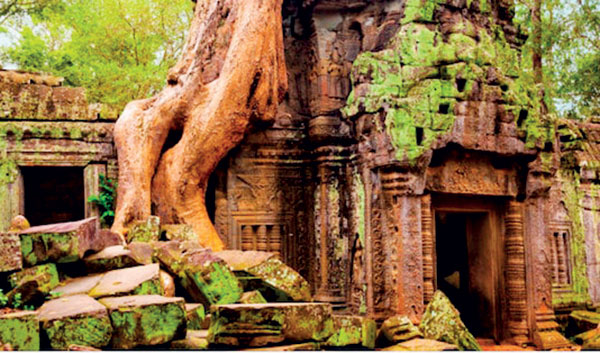
Again, I remember the barely cleared monastic site of Arankele with its long, long sakinan-maluwa (pathway for meditation). On the way we stopped at a living forest hermitage, Ruwangirikanda, where we saw many a hermit and understood what moved a man to seek the solitude of the forest. Near Arankele was Gala-pica-gala (rock-upon-a-rock) where I learnt the principles of wind erosion. And so we went from one jungle ruin to another.
Off Polonnaruwa, we went towards Dimbulagala, which was dubbed Gunner’s Quoin by sailors at sea who used to take their bearings from it. On the way we trekked to a group of boulders entirely surrounded by forest, but not yet excavated. This was Pulligoda Gal-ge (gal-ge = cave). On one of its sides was a beautiful fresco of a group of celestial beings. I was told that these were either the earliest or the only examples – I forget which – of the use of the halo on beings other than the Buddha.
Walking back to where we had parked the car, we came upon a site called Kos-gaha Ulpotha. It was a jungle spring of beautifully clear water.
At Dimbulagala, a man seeking a place for meditation had come to live in a cave. His mission was to destroy the paintings. He would comb the forest for buffalo dung and, in the nights dissolve it in water into a paint-like consistency and using a broomstick as a brush, paint over all the ancient paintings. By the time his act became known, it was impossible to remove the offending layer without destroying the paintings under it. The chemists were yet working on the problem. We saw the damage, but what could one do?
A lucky escape
I had another adventure in those parts. It was twenty years or so later, when I was working in Trincomalee. Kantalai was fully colonized by then. One day, friends visiting my brother, then the Government Agent, offered me a ride to Colombo. Gallantly, they gave me the front seat of the absolutely new car. We had passed Kantalai tank and the light was beginning to fade. There was a wide curve in the road and Joe, who was driving, asked me to switch off the tape-recorder so that he could switch on the lights.
I did not know how to do it, so he leaned over and did it. At that moment, an elephant thundered out of the jungle, where people were clearing a chena, and ran across the road. Joe promptly stood on the brakes but, before he could bring the car to a dead halt, another elephant, only about six6 to seven feet in height, ran in front of us. We hit him broadside, between the front and hind legs.
Caught in mid stride, he fell over; legs rolling up under the impact. Joe did a quick gear change and we took off like a rocket, swerving round the prone animal, just as the rest of the herd ran out of the jungle behind us. We kept going at top speed for about ten minutes, before getting out to assess the damage The radiator grill had caved in but, luckily the headlight and radiator itself were unharmed and we could go on. We reported the incident at the Habarana Police Station and carried on.
Flood relief
In 1958, we had torrential rains and floods in the country, including the least expected areas in the dry zone As was usual in such instances, all and sundry began collecting contributions for the flood victims and we teachers at Ananda College, too collected a sizeable stock. We were advised not to hand over the money but to adopt one of the affected villages and rehabilitate it. Our village was Hiriwadunna, some miles before reaching Habaran from Colombo. Apart from looking after the immediate needs of the villagers, we teachers in the upper forms used the village as a field laboratory, taking groups of student on various surveys that brought to life history, geography, botany, and the way of life in a village. What an experience it turned out to be! Probing old men’s memories turned out to be a great learning adventure.
Something the villagers said would have made eminent sense today. They were able to trace the water that came to their tank from its source: “When a tank overflowed, that water came to another tank, and when that too overflowed, it went to a third” and so on, tracing the route traversed by the water in their own tank from the beginning to the very end.
Decades later, when the cascade system was understood by our irrigation engineers, I related this concept to some of them and they admitted that they had never tapped the villagers’ reservoir of oral history.
When I asked the old folk whether there were ruins in the jungle around them, they undertook to show them to me. So I trekked with them to a thickly forested spot not far away, and came upon the remains of a small monastery. There were columns and slabs pushed aside by the living trees as they grew, and yet untouched by the archaeologist. I could not find any inscription to copy, but came upon a stone cistern, made of four slabs of stone, about waist high. Three of these were still upright, forming three sides of a square, and the fourth was lying flat on the ground. It showed two grooves chiseled for the other slabs to fit in snugly. This fit was good enough to last many centuries. I wonder how many ruins, like this one, are hidden in the forest.
Pooneryn
In the 1960s when I was in the Navy, we were called upon to open a new camp in an area totally unknown to us, but which is familiar to many now. There was an operation on to combat illicit immigration from India to Sri Lanka.
The Navy went to reinforce the Army and the sector allocated to us was Pooneryn, off Vavuniya. It was a forested, sparsely populated area just beyond an old Dutch Fort. The base camp, which was a collection of aluminium sheds, was set up in a clearing. We had a string of small outposts along the seashore to watch for incoming boats. Small groups of men would patrol those lovely, lonely beaches. There was only the main road, but none leading to the outposts until jeeps crashed through the undergrowth making tracks that later became roads.
So little was happening there and game was plentiful, that everyone became a hunter or fisherman. Driving through the open villu, we often came upon jackals, who were not in the least perturbed by us, peacocks and elephants. I remember seeing my first Ceylon magpie. The open stretch near base camp was like a slate on which was freshly written every night the tracks of all kinds of animals which had wandered there.
The outposts had to be visited day and night. During the day, we found it easier to drive along the beach from one point to another. There was no sign of anybody else or animals, but there was plenty of bird life. The most intriguing animals were fish, which swam in the very foam of the waves. As we roared and skidded along the beach, we could see before us fish after fish diving back to the deeper waters as they sensed our approach.
At night we kept to the roads. Driving through patches of arching forest alternating with open villu, one could predict which of the two he was passing through with his eyes shut. The skin was the sensory organ, for one felt warm while traversing forests and cold in the villu. It was exhilarating to go from warmth to coldness, from bright moonlight to “tunnels of green gloom”. As always, it is the sights, sounds, smells and other physical phenomena that spell “jungle” to me.
Elephants were plentiful. We had unknowingly built one post under a large tree the elephants used to scratch their backs on. The entire tree would start shaking in the night and the human inhabitants would seek refuge on the beach! One night I remember driving back along an abandoned tank bund, which was blocked by branches torn down by elephants. There was no way of reversing, so we had to get down and clear the way. Steaming piles of elephant droppings were around us and we could hear the culprits pulling more branches. But they were not worried by our presence and both animal and man went their separate ways peacefully. Pooneryn was a wonderful place then.
Mansions of the sea
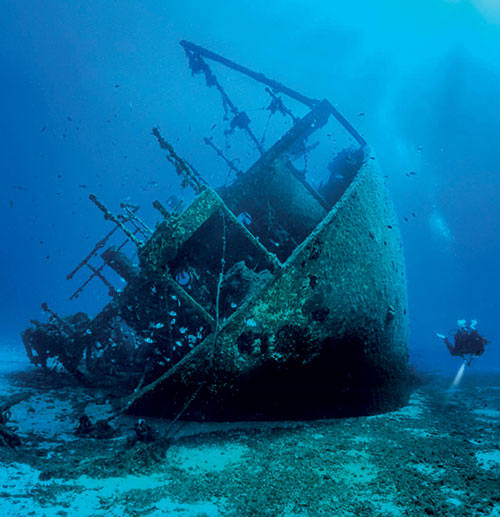
The year was 1930. The scene was Dodanduwa, the last home of the traditional three-masted sailing ships of the Sinhalese, the yathra dhoni or maha-oruwa. The occasion was the launching of a ship. Two friends, one an entrepreneur and the other a seaman, had joined forces to build and launch this vessel that, though no one knew it at the time, was fated to be the last of her breed.
Kariyavasam Patuvata Vithanage Don Siyadoris de Silva, land owner, and Punchi Sinno Marakkalaehe, mariner, hoped that their freighter, by now named Amugoda Oruva, would do brisk business with South India and the Maldives. To mark her maiden voyage to Male, verses were composed, among which was:-
Gaman yanna naekatin oruva baa geney
Saman deyiyanta puda panduru baenda geney
Viman sagarey kanu mul soya geney
Apit yamuva haema deviyanta vaenda geney
“Auspiciously have we launched our vessel
And made our offerings to the god of Adam’s Peak
Let us now worship all the gods and go In search of the mansions of the sea.”
No god, alas, heard their pious prayers and the proud ship foundered on the reefs of Male, leaving those left behind in Dodanduwa to sing her dirges:
Metaenin oruva baa laa gati varaayata
Diyamba porn sata divve tharangataya
Kopamana ruval aedalaa divvat sondata
Amugoda oruva tava naeta aave gamata
“From here was the vessel taken to the port
And many a league did she race along under sail,
But however many sails were hoisted, and however fair she sailed
Amugoda Oruva never made home again.”
Sixty years or so later I was in Galle, organizing an international group of maritime archaeologists who were training a clutch of our young archaeology undergraduates and, at the same time, compiling a data base of shipwrecks in Galle Bay. Among the group was Tom Vosmer, an Australian boat ethnographer, with whom I discussed the Amugoda Oruwa and the large 100-year old model of a yathra dhoni at Kumarakanda Pirivena, Dodanduwa, that I had been privileged to photo record.
Tom was enthusiastic, for this was the last of a type of large outrigger-equipped sailing ships which could be traced back to the time of Borobudur. Days were spent in examining the model, and measuring, photographing and making detailed drawings of structural details. Built by the young son of a ship-owner, around 1890, it had been awarded a gold medal by the Governor. Tom considered that its accuracy, both in scale and detail, made it a fairly reliable source for (????????)




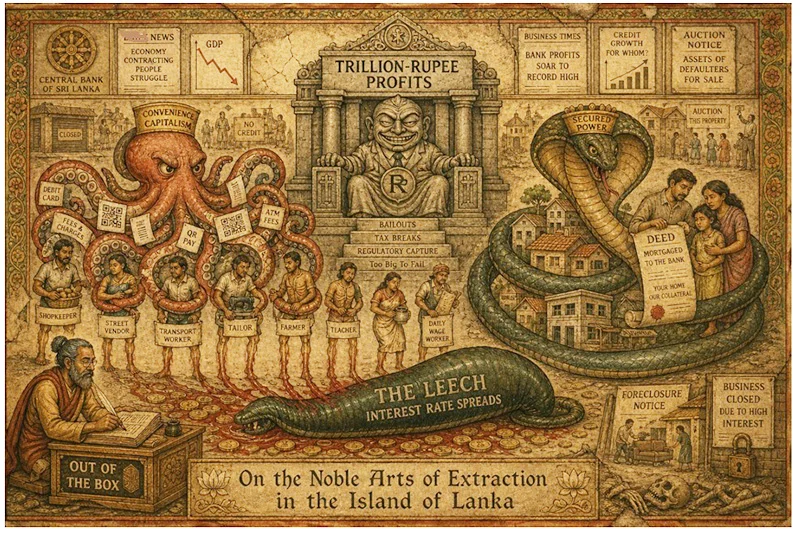
 Open any business newspaper in Sri Lanka on any given weekend and the headlines read like a celebration. Bank A’s assets have crossed Rs. 3 trillion. Bank B has reached the Rs. 2 trillion asset milestone. Bank C has posted a profit after tax of Rs. 6 billion in the first quarter of 2026 alone. Bank E has reported a profit before tax of Rs. 2 billion. Bank E has cleared Rs. 1.5 billion in pre-tax profit. Bank F revealed a profit after tax of Rs. 4 billion. The numbers are staggering in a country where per capita income remains fragile, the economic crisis of 2022 has left deep scars, and some 300,000 small and medium entrepreneurs are reportedly at risk of losing the roofs over their heads, and their businesses.
So, the question must be asked, loudly and without apology: how do Sri Lankan banks manufacture such colossal profits, and who, precisely, is paying for them?
The arithmetic of extraction
The answer lies in a three-digit spread that most depositors and borrowers never see printed side by side. Sri Lanka’s Central Bank has held its Overnight Policy Rate (OPR) at 7.75%, the mid-point of a corridor bounded by a Standing Deposit Facility Rate of 7.25% and a Standing Lending Facility Rate of 8.25%; a policy spread of a mere 1%. This is the rate at which banks lend to and borrow from the Central Bank overnight. It is the peg around which monetary policy turns. What happens when that peg meets the market is another story altogether.
A depositor walking into a Sri Lankan bank today will be offered somewhere between 6% and 9% on a fixed deposit, the rate varying by tenure, bank, and whether you qualify as a “senior citizen.” Average savings account rates sit between 2% and 5%, while fixed deposits offer 6% to 10%. Yet, the same bank will charge that depositor’s neighbour, who runs a hardware shop, a garment workshop, or a small hotel, between 14% and 24% to borrow. Credit cards carry rates at the upper end or beyond that range. The arithmetic is unambiguous: an interest spread of 8 to 14 percentage points, engineered on top of a policy rate corridor of just 1%.
A key driver of lending interest rates is the lending-deposit interest spread, which captures the efficiency with which banks allocate society’s savings to its most productive uses. High lending rates and spreads pose a challenge for policymakers: they can affect monetary policy transmission, hinder private investment and job creation, inhibit financial development and inclusion, and can ultimately compromise financial stability.
Sri Lanka’s spreads fail every one of those tests.
An international comparison that should shame regulators
To understand the scale of this extraction, one need only look at comparable economies. In India, the Reserve Bank’s repo rate stands at 6.5%, and commercial bank lending rates to prime borrowers average around 9–11%, yielding a spread of roughly 3–4 percentage points. Thailand and Vietnam, both developing Asian economies with nominal policy rates in the 2–4% range — maintain bank lending-deposit spreads consistently below 5 percentage points. Many countries in East Asia had average spreads of 5% or less during the 2010–2017 period, including China, South Korea, Japan, Myanmar, Thailand, and Vietnam.
Nepal, whose financial system is frequently and condescendingly compared unfavourably to Sri Lanka’s, reported a bank lending rate of 7.66% in late 2025, a figure that would be considered a floor, not a ceiling, in Colombo. Bangladesh records a lending rate of under 8%. Even Pakistan, whose policy rate touched 22% during a period of acute macroeconomic crisis, has since brought it down sharply, and its spread has never structurally embedded itself at the levels Sri Lankan banks now consider normal.
Move to advanced economies and the contrast becomes almost surreal. Japan’s policy rate remains effectively at zero; bank lending rates for business borrowers sit between 1% and 2.5%. Australia’s Reserve Bank rate stands at 4.35%, with commercial lending to small businesses typically in the 6–8% range, a spread of 2–3 points at most. New Zealand, Canada, and the United States operate within similar parameters: policy-to-lending spreads that are measured in single digits and that tighten competitively as banking markets mature.
Sri Lanka’s banks, by contrast, operate as if competition does not exist, and as if SMEs have nowhere else to go. They are largely correct on both counts.
The three creatures: A taxonomy of bank behaviour
A financial analyst, speaking in a podcast that has circulated widely among the Sri Lankan business community, offered a metaphor that deserves wider currency. Sri Lankan banks, he argued, behave with a three-stage predatory logic.
First, they are the Octopus, embracing customers tightly, wrapping tentacles around every financial transaction, every salary account, every utility payment, every insurance product. The bank becomes indispensable. It is everywhere. Cross-selling, bundling, and lock-in are the tools of this phase. The small businessman who secures a loan quickly finds that his current account, his trade finance, his letter of credit, and his overdraft are all with the same institution. He is held, firmly, from all sides.
Then, once the embrace is complete, comes the Leech, the slow, persistent extraction of blood. The interest rate spread does its patient work over months and years. A loan taken at 18% for a business generating 12% returns is a slow death sentence, mathematically guaranteed. Fees compound on fees. Penal interest accrues on unpaid interest. The CRIB record, Sri Lanka’s Credit Information Bureau system, locks the borrower in place: miss a payment, and no other institution will touch you. The leech feeds undisturbed.
And then, when the blood runs dry, when the business can no longer service its debt and the collateral has been fully leveraged, comes the Snake. Sri Lanka’s Parate Execution Law, enacted under the Recovery of Loans by Banks (Special Provisions) Act No. 4 of 1990, gives licensed commercial banks a power possessed by almost no other creditor class in any comparable jurisdiction: the right to seize and auction mortgaged property without any court order, without any judicial oversight, and without any independent valuation requirement.
Parate Execution is deeply ingrained in Sri Lanka’s legal system and has been a crucial tool for banks in recovering debts. The Cabinet-of-Ministers’ approval for a temporary suspension until December 2024 reflects a response to economic challenges, particularly for small and medium-sized enterprises. In 2023 alone, over 1,750 properties belonging to SMEs were auctioned under the law. These were not abstract balance sheet entries. They were factories, workshops, warehouses, family homes pledged as collateral, and the accumulated savings of a lifetime. Around 10 SME associations are collectively pushing for the continued suspension of parate executions, warning that nearly 300,000 entrepreneurs risk losing their assets if the law is enforced without reforms.
The snake, once it strikes, leaves nothing.
The Gates Prediction and the clever adaptation
Bill Gates, in his 1997 book ‘Business at the Speed of Thought’, famously observed that banking is necessary but banks are not, that the dinosaur institutions of the financial world would be swept aside once the Internet captured the transaction infrastructure that sustains them. A quarter of a century later, the banks are still here, and in Sri Lanka they are more profitable than ever. Gates underestimated the octopus’s adaptability.
Sri Lankan banks did not resist digital disruption; they absorbed it and charged for it. Sri Lankan banks have a genuine claim to technological pioneering. They were among the earliest institutions in the world to deploy automated teller machines and some have argued that the island served as a live testing ground for ATM technology before the technology was ready for larger markets.
Internet banking reduced their branch costs while preserving their pricing power. Mobile apps deepened the lock-in. The spread, the core engine of extraction, was never threatened by technology because technology cannot dissolve a regulatory monopoly or a CRIB record. The dinosaur learned to code.
What did not adapt was the relationship between bank profit and productive economic activity. In a functioning market, high bank profitability should signal efficient intermediation, savings being channelled productively into investment, employment, and growth. In Sri Lanka, it signals the opposite: a structural transfer of income from the productive economy, particularly from small businesses, to the financial statements of financial institutions that operate with insufficient competitive pressure, inadequate regulatory oversight of pricing, and a legal recovery toolkit that would be considered extraordinary in almost any other jurisdiction.
The SME crisis: When the host dies
The damage falls most heavily on small and medium enterprises, the sector that, in Sri Lanka as in every economy in the world, provides between 60% and 80% of all employment and generates the majority of entrepreneurial activity outside the formal corporate sector.
The International Monetary Fund has called for the reinstatement of parate execution, warning that prolonged suspension hinders banks’ ability to manage non-performing loans and price credit risks, potentially destabilizing the financial system. The IMF’s concern is legitimate in principle but perverse in practice. Non-performing loans in Sri Lanka’s banking system did not emerge from borrower profligacy. They emerged from a combination of historically high interest rates, a catastrophic economic crisis that was itself partly the product of fiscal and monetary mismanagement, and a forced-sale recovery mechanism that, when applied during a downturn, a double blow, destroys the very collateral value it claims to protect. When 1,750 properties are auctioned in a single year, supply floods a distressed market and prices collapse, damaging the bank’s recovery as much as the borrower’s livelihood.
What must change
The case for structural reform is not a case against banking or against profitable financial institutions. It is a case against a system that has substituted regulatory capture for competitive discipline, and legal coercion for constructive engagement.
Three reforms are overdue and increasingly urgent
.
First, the interest rate spread must be subject to transparent regulatory oversight. The Central Bank publishes the Average Weighted Prime Lending Rate and related statistics, but there is no binding ceiling on the spread between what banks pay depositors and what they charge borrowers for equivalent-risk instruments.
Second, the Parate Execution Law requires comprehensive reform, a genuine rewriting that introduces judicial oversight, mandatory independent valuation, and a structured mediation requirement before any forced sale can proceed.
Third, SME credit must be deliberately repriced. A development banking framework, should offer structured SME lending at regulated spreads, with the Central Bank providing concessional refinancing. Several peer economies have such mechanisms. Sri Lanka has the institutional capacity to build one; what it has lacked is the political will to confront the banking lobby that benefits from the current architecture.
The parasite and the host
There is an ecological principle that even the most effective parasite must learn: if it kills the host, it dies, too. Sri Lanka’s banking sector has not yet killed its host economy, but the symptoms of dangerous over-extraction are visible in every gazette notice of a parate auction, in every shuttered workshop in Pettah, in every garment factory whose owner defaulted not due to bad management but due to the mathematics of an 18% loan in a 12% return environment.
The banks will continue to announce their trillion-rupee asset milestones and their billion-rupee profits. The newspapers will continue to celebrate. And the octopus will continue its embrace, the leech its quiet work, and the snake will wait, patient, unhurried, for the moment to strike. Unless someone intervenes.
(The writer, a senior Chartered Accountant and professional banker,is a professor at SLIIT, Malabe. Views expressed in this article are personal.)
Features
Winged guardians of Sri Lanka’s natural heritage: Featured birds highlight biodiversity richness ahead of World Biodiversity Day
As the world prepares to observe the International Day for Biological Diversity, commonly known as World Biodiversity Day, on May 22, Sri Lanka stands as a vivid example of how a relatively small island can hold an extraordinary concentration of life.
The annual observance serves as a global reminder of the importance of protecting ecosystems and the rich variety of life forms that sustain the planet.
This year’s observance comes amid increasing international concern over biodiversity loss driven by habitat destruction, climate change, pollution, invasive species and unsustainable development. Scientists warn that the disappearance of species affects not only wildlife but also food security, water resources, livelihoods and ecological stability.
For Sri Lanka, World Biodiversity Day carries particular significance.
Despite occupying less than 0.03 percent of the Earth’s land surface, Sri Lanka possesses remarkable ecological richness and has earned global recognition as one of the world’s biodiversity hotspots.
The island’s forests, wetlands, rivers, mountains and coastal ecosystems support an extraordinary range of species, many of which are found nowhere else on Earth.
Among the most visible and fascinating representatives of this natural wealth are birds — creatures that fill forests and gardens with colour and song while performing critical ecological functions. Birds pollinate flowers, disperse seeds, regulate insect populations and serve as important indicators of environmental health.
Conservation Biologist Rajika Gamage of the Tea Research Institute says birds often provide the earliest signals of environmental changes taking place within ecosystems.
“Birds are among the most important indicators of habitat quality. Changes in bird populations can reveal ecological disturbances long before they become visible to people,” Gamage said.
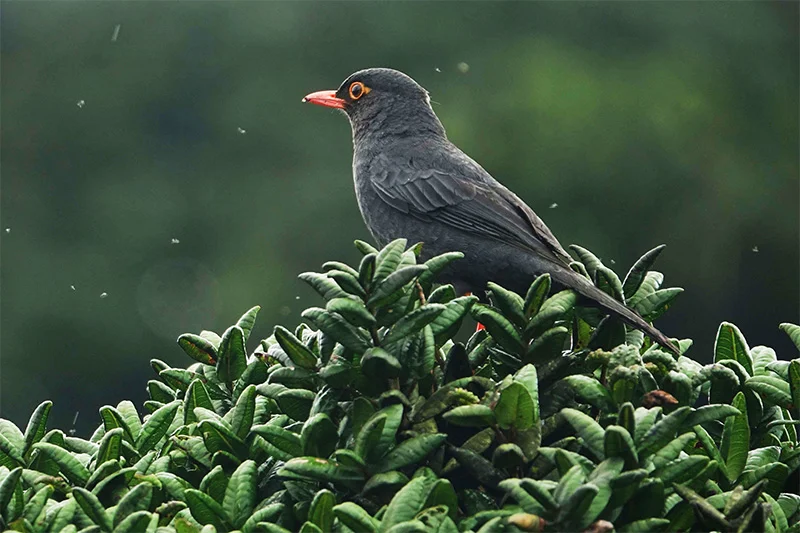
Black bird
As Sri Lanka reflects on biodiversity conservation, five remarkable bird species — the Yellow-fronted Barbet, Crimson-fronted Barbet, Sri Lanka Hanging Parrot, Tawny-bellied Babbler and Blackbird — illustrate not only the beauty of the country’s avian diversity but also the interconnected nature of ecosystems.
Sri Lanka’s biological richness is exceptional by global standards. The island contains a high percentage of endemic species among amphibians, reptiles, freshwater fish, mammals and birds. The country’s geographical isolation, varied elevations and diverse climatic conditions have shaped unique evolutionary pathways over millions of years.
Its wet zone rainforests, dry zone forests, montane cloud forests, grasslands and agricultural landscapes collectively create a mosaic of habitats capable of supporting diverse life forms.
Gamage notes that biodiversity conservation extends far beyond protected areas.
“People often think biodiversity exists only inside national parks and forests. But biodiversity is supported through connected landscapes that include home gardens, agricultural lands, tea plantations, wetlands and village ecosystems,” he explained.
Research in plantation landscapes has demonstrated that tea-growing regions with habitat diversity and natural vegetation can support substantial bird populations, including endemic and ecologically important species.
Among the featured birds, the Yellow-fronted Barbet stands as one of Sri Lanka’s most recognisable endemic species.
The bird, with its bright green plumage, yellow forehead and blue facial markings, often remains hidden among dense foliage despite its loud repetitive calls echoing through gardens and forests.
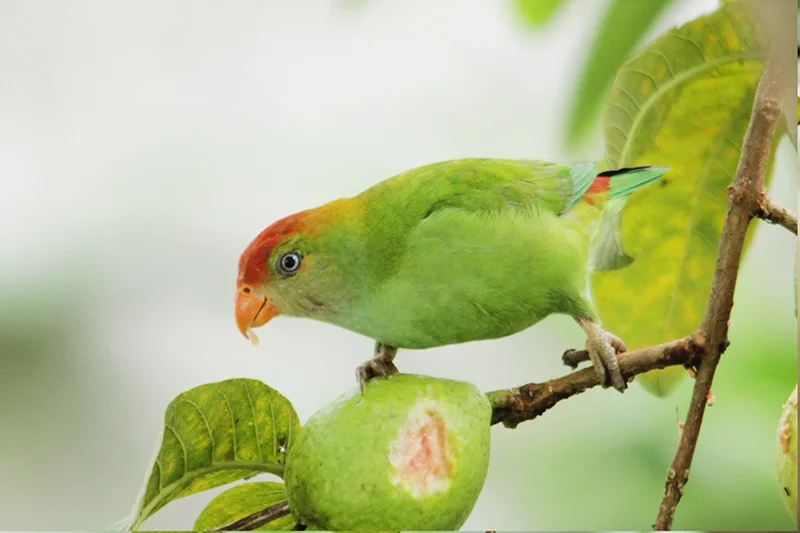
Sri Lanka Hanging Parakeet
While many people hear its calls every day, few realise its importance within ecosystems.
The species feeds heavily on fruits and berries, becoming an important seed disperser. Seeds consumed by the bird are transported and deposited elsewhere, helping natural forest regeneration.
“Many birds function as ecological engineers without people realising it,” Gamage said. “Seed-dispersing species contribute directly to maintaining forest diversity.”
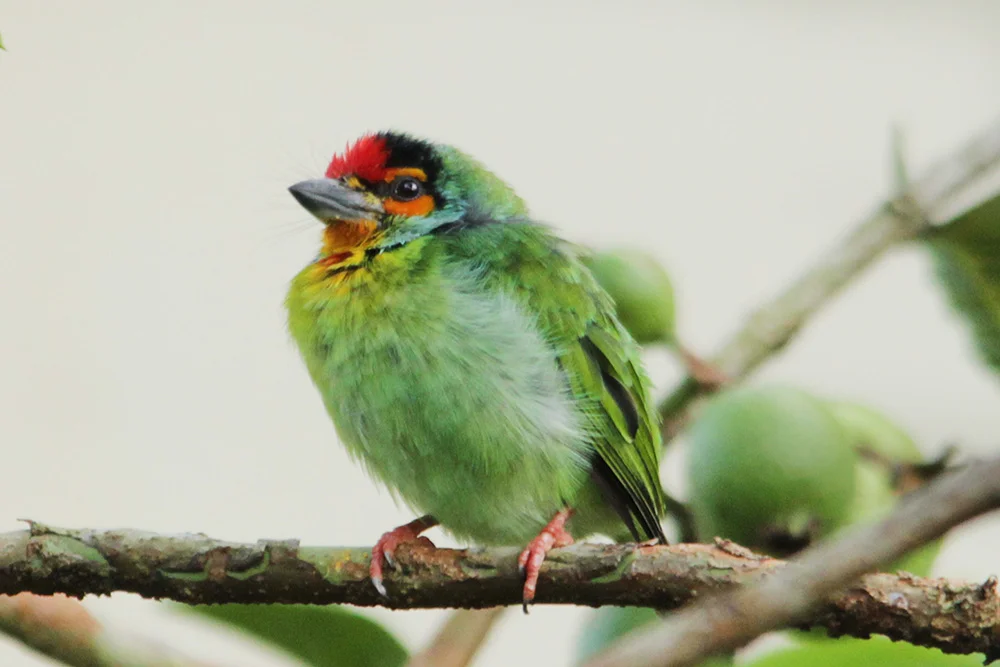
Equally colourful is the Crimson-fronted Barbet.
Distinguished by its vivid crimson forehead against green plumage, this endemic bird inhabits forests and tree-rich landscapes within wetter parts of Sri Lanka.
Like the Yellow-fronted Barbet, it performs a critical ecological function through seed dispersal.
The species often serves as an indicator of healthy vegetation and suitable habitat structure. Its ability to survive in modified landscapes with sufficient tree cover also demonstrates the importance of preserving green corridors beyond forests.
Another unique representative of Sri Lanka’s avian heritage is the Sri Lanka Hanging Parrot.
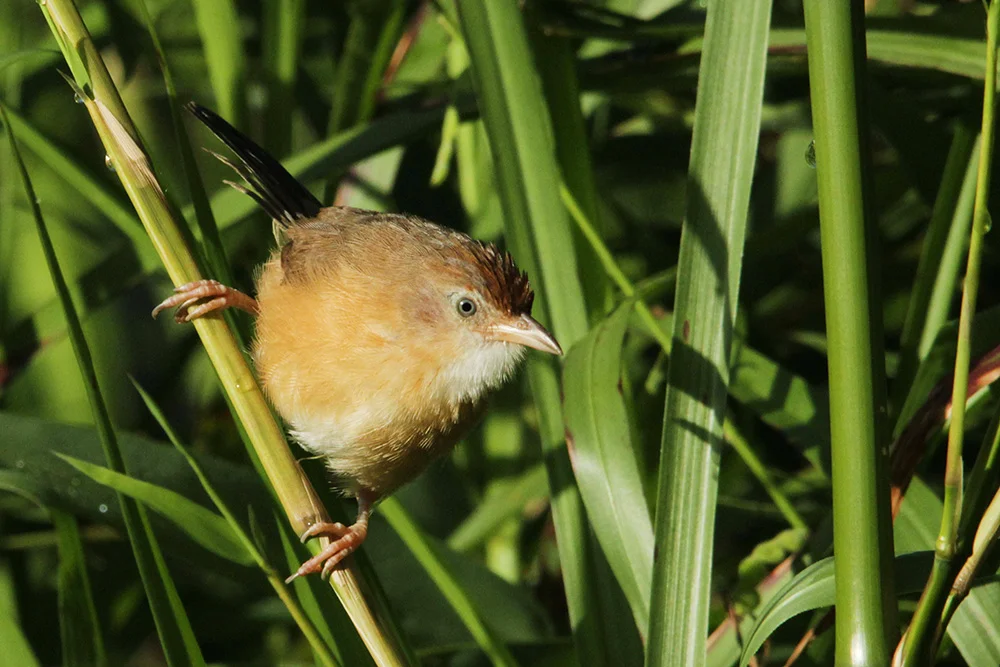
Tawny Bellied Babbler
Small, energetic and brightly coloured, the bird is famous for its unusual habit of sleeping upside down while hanging from branches.
Its striking appearance makes it popular among birdwatchers, but its ecological significance extends beyond aesthetics.
Feeding on fruits, flowers and nectar, the Hanging Parrot acts both as a pollinator and seed disperser.
As it travels among plants and trees, it assists natural reproductive processes essential for maintaining healthy ecosystems.
“Pollination and seed dispersal are among the foundations upon which ecosystems function,” Gamage explained.
Less conspicuous but equally valuable is the Tawny-bellied Babbler.
Often moving quietly through shrubs and undergrowth in pairs or small groups, the species spends much of its time searching for insects and other small invertebrates.
Unlike fruit-eating birds, the Tawny-bellied Babbler contributes to ecological balance through natural pest control.
Its feeding behaviour helps regulate insect populations, particularly within agricultural landscapes.
Birds that naturally reduce insect numbers provide ecological services that may reduce reliance on chemical pest-control methods.
The Sri Lanka Blackbird occupies yet another important ecological niche.
Found mainly in montane forests and cooler highland environments, the species reflects environmental conditions within sensitive mountain ecosystems.
Scientists often monitor highland bird populations because changes in their distribution or numbers can indicate broader environmental changes, including habitat degradation and climate impacts.
As World Biodiversity Day approaches, experts stress that conservation challenges continue to grow.
Habitat fragmentation, pollution, deforestation and climate-related pressures increasingly threaten ecosystems around the world, including Sri Lanka.
Yet conservationists emphasise that solutions frequently begin at local levels.
Protecting trees in home gardens, restoring degraded habitats, conserving wetlands and promoting biodiversity-friendly agricultural practices can all contribute significantly to preserving ecological balance.
Gamage believes that public understanding remains central to future conservation efforts.
“People should understand that biodiversity is not separate from human life. Clean water, fertile soils, pollination, climate regulation and ecological stability all depend upon biodiversity,” he said.
The songs of Sri Lanka’s birds may appear ordinary to casual listeners, but behind those sounds lies a story millions of years in the making.
The call of a Yellow-fronted Barbet from a village garden, the bright flash of a Hanging Parrot moving across a forest edge, the quiet movements of a Tawny-bellied Babbler beneath dense vegetation, or the presence of a Blackbird in cool mountain forests are all reminders of the extraordinary natural heritage the island possesses.
As Sri Lanka marks World Biodiversity Day alongside the global community, these winged ambassadors become more than beautiful wildlife species.
They represent the fragile yet complex web of life that sustains ecosystems — and ultimately sustains humanity itself.
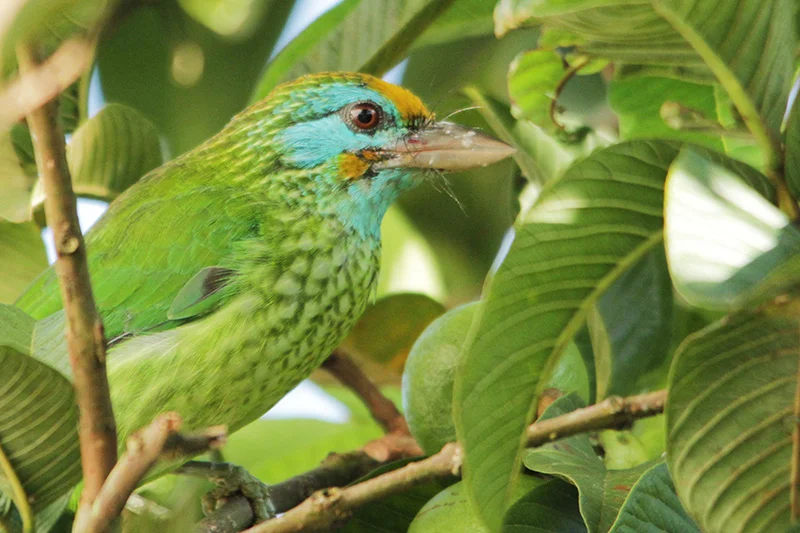
Yellow Fronted Barbet
By Ifham Nizam
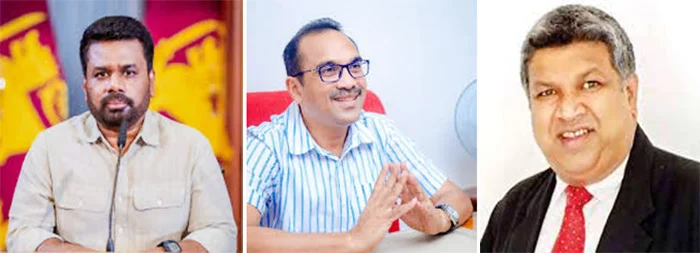
Time, it is said, is the great healer. But there are some wounds that will not heal with time. They need specific and focused treatment. The dates May 18 and 19, the two final days of Sri Lanka’s three decade long war, are less in the consciousness of the people than before. But the continuation of the untreated and unhealed wounds of the war continues to be seen in the many groups of people who gather to remember their loved ones on these days. In Colombo, a group of victim families and committed activists from different communities gathered at Wellawatte beach and lit lamps. These gatherings are also a political statement that the wounds of the war remain untreated and unhealed.
One of the key features of May 18 and 19 has been the polarised positions taken by Tamil and Sinhalese groups. Tamil groups mourn those who perished in the war, especially in the last battles, on May 18 while many Sinhalese commemorate the military victory on May 19. Since 2015 there has been a diminishing of tensions due to the more nuanced way successive governments have marked the end of the war. This was especially the case during the governments led by Ranil Wickremesinghe and is now also true of the government headed by President Anura Kumara Dissanayake.
The present government has done much to mitigate the sense of polarisation between the state and the ethnic and religious minorities. The government’s insistence that it will treat all citizens equally and not support extremism in any form is appreciated by minorities who have often felt marginalised and viewed with suspicion in the past. But the government cannot afford to rest on its laurels merely because it is better than previous governments. It needs to take specific and focused action to heal the wounds of the past. Symbolic gestures and inclusive rhetoric are important, but they are not enough in themselves to deal with the consequences of a protracted ethnic conflict.
The unresolved issues are well known. They surface repeatedly in the resolutions on Sri Lanka passed at the UN Human Rights Council in Geneva. In 2015 Sri Lanka co-sponsored UN Human Rights Council Resolution 30/1 which called for reconciliation, accountability and constitutional reform including power sharing arrangements. This resolution and the ones that preceded it emerged from the demands of war affected communities and found resonance within the international human rights community. They include the issues of missing persons, disappeared persons, political prisoners, military occupation of civilian lands and accountability for alleged wartime abuses.
Most Capable
Under the NPP government, Tamil people have felt they can attend events commemorating those who died in the war in large numbers. This is evidence that the country is changing in the direction of reconciliation. State institutions too have cooperated in this process in creating a conducive climate for memorialisation. But despite the passage of 17 years since the end of the war, the emblematic issues remain unresolved although the government appears sincere in its desire to resolve them. Indeed, the government has deployed some of its most capable leaders to deal with these challenges.
President Dissanayake himself has taken on the task of reshaping public consciousness through speeches that emphasise unity rather than division. Minister of Justice and National Integration Harshana Nanayakkara has responsibility for institutions dealing with missing persons, reparations and reconciliation. Leader of the House Bimal Rathnayake has been entrusted with accelerating economic development in the north. Economic development is essential. The north and east require investment, jobs, infrastructure and opportunities for young people. Poverty and unemployment affect all communities and development can reduce feelings of exclusion. But economic development alone cannot resolve the deeper roots of ethnic conflict.
Protracted ethnic conflicts are rarely caused only by economic grievances. They are also about identity, dignity, historical memory and political power. This is where many governments in Sri Lanka have failed. They have believed that rapid development, highways, buildings and investment would be sufficient to overcome decades of mistrust. But communities that feel politically marginalized do not simply abandon their aspirations because roads are built or markets expand. Human beings seek recognition of who they are and a meaningful share in the decisions that govern their lives. Language is particularly important. In Tamil majority districts, the government secretariats continue to be staffed by those who are only Sinhala-speaking. This is a constant reminder to Tamil speakers that they are not equal to Sinhalese in their dealings with the state.
Academic research on divided societies has shown that constitutional arrangements can either exacerbate conflict or reduce it. Countries such as Belgium and Northern Ireland provide examples where systems of power sharing have enabled communities with different identities to coexist peacefully within a common state. In Northern Ireland, peace became sustainable only when political institutions ensured that both communities had a guaranteed role in governance rather than leaving one side permanently subordinate to the other. Sri Lanka’s own efforts at political reform have focused largely on territorial power sharing through the 13th Amendment to the Constitution and the provincial council system.
More Belonging
The fact that the government leadership is now saying that provincial council elections will be held this year is therefore a positive development. It would restore democratic participation at the provincial level after years of delay and neglect. However, reforms need to go further. Provincial councils have remained weak institutions with inadequate powers and finances. Successive governments have hesitated to fully implement the provisions of the 13th Amendment, especially regarding land and police powers. These laws, including the language law, need to be fully implemented. The reluctance or incapacity of successive governments to do so, including the present one, has reinforced minority perceptions that promises of devolution are made but never sincerely implemented.
A new national narrative for Sri Lanka must therefore go beyond non racism and economic development. True reconciliation requires accepting diversity not as a threat but as the foundation of a united and peaceful country. Power sharing should not be viewed as a concession extracted under pressure. It should be understood as a democratic necessity in a plural society. The purpose of power sharing and giving equal rights to Tamil language speakers is not division but inclusion. It gives all communities a stake in the state and reduces the fear that political power will permanently remain in the hands of one community alone.
Sri Lanka has had leaders in the past who understood this reality. Prime Minister S W R D Bandaranaike attempted to reach a political settlement through the Bandaranaike Chelvanayakam Pact of 1957. Today the political context offers another opportunity. The nationalist forces that dominated politics for many years have lost credibility due to their association with corruption, economic collapse and political mismanagement. But where they did the right thing they are remembered positively as the late State Minister of Plantation Industries and Mahaweli Development in Sri Lanka Lohan Ratwatte still is in Batticaloa for having heeded the Tamil cattle farmers and appointing a Tamil officer to deal with their problems. The government has a two thirds majority in Parliament and enjoys significant public goodwill. This creates space for courageous leadership.
The time has therefore come for the government, opposition and minority political parties to put aside their bitter political feuds and engage with each other sincerely to arrive at a consensual political solution embedded within the Constitution. Sri Lanka has tried military victory, centralized rule and development centred approaches. None by themselves have resolved the ethnic conflict. The lesson of the past is that non racism and economic development are necessary, but they are not sufficient. Lasting peace in Sri Lanka requires power sharing, trust building and a political settlement that gives every community a sense of belonging to a country they all feel is home.
by Jehan Perera

China’s Xi Jinping, Russian President Vladimir Putin hold talks in Beijing

Politics is not something separate from development. It shapes every choice we make in governance – PM

Taijul takes six as Bangladesh complete 2-0 sweep

At least 10 dead as huge floods sweep southern and central China

Ebola outbreak may be spreading faster than first thought, WHO doctor warns

Sooryavanshi’s stunning 93 takes Rajasthan Royals closer to IPL playoffs

‘Dates have the highest sugar content to fight Coronavirus’

Sunday Island 27 December – Headlines

#SundayIsland 17th December – Headlines

Sunday Island – 28th March

Sunday Island Headlines – 21 March

Sunday Island – 21st February – Headlines
-

 Features4 days ago
Sri Lankan Airlines Airbus Scandal and the Death of Kapila Chandrasena and my Brother Rajeewa
-
 News5 days ago
Lanka’s eligibility to draw next IMF tranche of USD 700 mn hinges on ‘restoration of cost-recovery pricing for electricity and fuel’
-

 News4 days ago
Kapila Chandrasena case: GN phone records under court scrutiny
-
 News4 days ago
Rupee slide rekindles 2022 crisis fears as inflation risks mount
-

 Opinion7 days ago
Electricity tariffs have skyrocketed: Can further increases be prevented?
-
 Business4 days ago
Expansion of PayPal services in Sri Lanka officially announced
-
 Features6 days ago
Mysterious Death of United Nations Secretary General Hammarskjöld
-

 News4 days ago
Court orders further arrests in alleged USD 42 Mn NDB fraud case