
News
Jugglery alleged in Constitution making process: SJB, Gevindu make strong case against jumbo Cabinet


By Shamindra Ferdinando
Opposition and Samagi Jana Balavegaya Leader, Sajith Premadasa, says that the current economic crisis shouldn’t be exploited to form a jumbo Cabinet, under any circumstances.
“The national economy is in such a pathetic state that those struggling to make ends meet shouldn’t be burdened further,” the Colombo district MP said. The growing opposition to further expansion of the Cabinet-of-Ministers is quite understandable, the former UNP Deputy Leader said, urging the government to drop the relevant provisions.
The Opposition Leader said so when The Island sought his opinion on the provisions, pertaining to the formation of a National Government, in terms of the proposed 22 Amendment to the Constitution. Declaring his party has absolutely no intention of joining the government, lawmaker Premadasa warned the public would revolt if the limits on the number of Cabinet Ministers and Deputies/State Ministers were violated.
The SJB leader emphasized that whoever is in power should adhere to the limit of 30 Cabinet Ministers and 40 non-Cabinet rankers.
Lawmaker Premadasa said that political stability and economic revival couldn’t be achieved by expanding the Cabinet-of-Ministers.
SLPP National List MP Gevindu Cumaratunga last week strongly condemned, in Parliament, what he called controversial provisions pertaining to the National Government. Cumaratunga told The Island that he took up the issue at a recent party leaders’ meeting. The provision for Parliament to decide the number of ministers and Deputies/State Ministers would be abused, the leader of civil society group Yuthukama said.
Referring to the inclusion of provisions pertaining to a National Government, in the 19th Amendment that had been endorsed in 2015, lawmaker Cumaratunga said that the proposed 22 Amendment interpreted National Government as an administration formed by the recognized political party or the independent group which obtains the highest number of seats in Parliament, together with the other recognized political parties or the independent groups.
The first time entrant to Parliament said that this should be examined, taking into consideration the strength of political parties represented in Parliament. Of the 225 MPs in Parliament, a total of 199 were elected: the SLPP (145/17 National List seats) and SJB (54/07 National List seats)) ticket. The third largest grouping in Parliament belonged to the Illankai Thamil Arasu Kadchi (ITAK/01 National List seat), the MP pointed out. The powers that be owed the public an explanation how the SLPP backed President Ranil Wickmesinghe intended to form the National Government without having a formal agreement with the second largest party in Parliament.
MP Cumaratunga recalled how the then UPFA MP Vasudeva Nanayakkara, at the Committee Stage of the 19th Amendment, asked the then Justice Minister Wijeyadasa Rajapaksa, PC, for an interpretation of national government and was told national government meant formation of an administration by the party securing the largest block of seats and the party with the second highest number of seats. Vasudeva Nanayakkara declared that they wouldn’t support the 19th Amendment unless the government provided an interpretation of the National Government.
However, what had been put to the Speaker for approval was very much different from the assurance given in Parliament, MP Cumaratunga said. The MP pointed out that the difference was instead of the union of party with the highest number of seats and the second highest being the national government, the gazette referred to the party with the highest number of seats and other parties in Parliament as the national government. The section in question is 46 of the 19th Amendment.
Lawmaker Cumaratunga said that the 2015 wrongdoing had been repeated.
Parliament website posted the 19th Amendment with the original clause given below: “If at the conclusion of the General Election held immediately after the coming into force of this Article, the recognized political party or the independent group obtaining the highest and the recognized political party or the independent group obtaining the second highest number of seats in Parliament agree to form a Government of national unity, then, notwithstanding the provisions of paragraph (1), the number of Ministers of the Cabinet of Ministers and the number of Ministers outside of the Cabinet of Ministers and the Deputy Ministers, may be increased up to forty-five and fifty-five, respectively, if Parliament agrees to such increase, within two weeks of the first sitting of such Parliament.”
MP Cumaratunga said that finally the limits had been done away with for obvious reasons. Responding to another query, the Yuthukama leader said that the change of provisions, pertaining to the National Government, surreptitiously could be compared with the jugglery in manipulating the relevant Parliamentary Select Committee’s recommendations as regards the National List appointees.

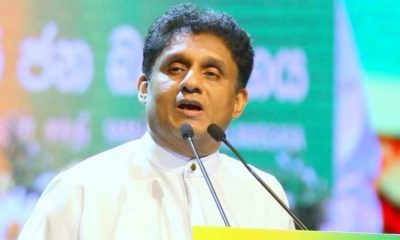


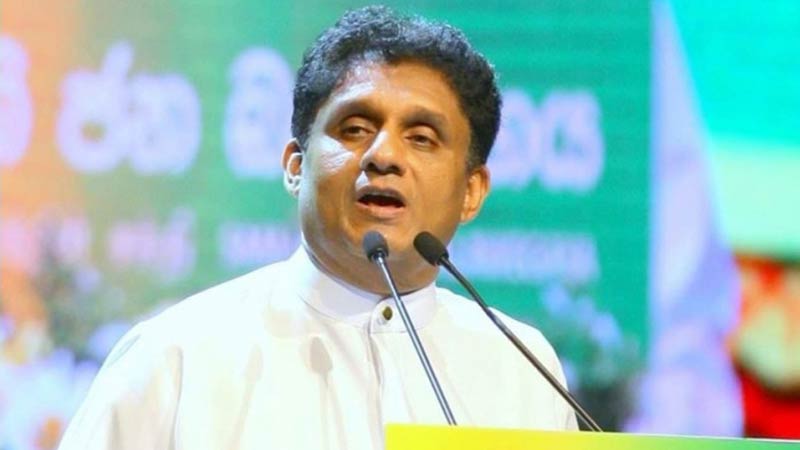
Alleging that the Public Utilities Commission of Sri Lanka (PUCSL) has shifted the massive losses, caused by the coal scam, to the hapless public, Opposition and SJB Leader, Sajith Premadasa, has questioned the conduct of the regulator, noting that it is mandated to protect the interests of both the service provider and the consumers.
Premadasa alleged that the PUCSL ignored the representations made by the SJB on behalf of local industries.
Premadasa said that the PUCSL had authorised the latest 18% increase, in response to the request made by the recently established National System Operator (Pvt) Ltd (NSO), on behalf of the NPP government.
The PUCSL was established in terms of the Public Utilities Commission of Sri Lanka Act, No. 35 of 2002. Although the PUCSL was supposed to function as a multi-sector regulator for electricity, water services and petroleum industries, successive governments refrained from bringing water services and petroleum industries under its purview.
The Opposition leader alleged that the PUCSL did the bidding of the government.
Since January this year, PUCSL has increased electricity tariffs on three occasions. The latest came into operation on 11 May.
The PUCSL consists of Prof. K. P. L. Chandralal (Chairman), Engineer Piyal Henanayake (Deputy Chairman), Dr. M.C.S. Fernando, and Lilantha Samaranayake, PhD.
Premadasa said that instead of taking tangible measures to recover the unbearable losses caused by the coal scam, the government burdened the entire country through the PUCSL.
“Don’t forget that the government is shielding its henchmen responsible for the coal scam at the expense of the country,” MP Premadasa said, pointing out that there couldn’t have been any dispute over their culpability, after the National Audit Office (NAO) found fault with the Energy Ministry for granting the tender for the supply of coal for the 2025/2026 season to a company not qualified even to participate in the tender process.
The SJB leader declared that the resignation of Energy Minister, Kumara Jayakody, and its Secretary, Prof. Udayanga Hemapala, in the immediate aftermath of Parliament defeating a no-faith motion against the Minister was meant to protect the ruling party.
The PUCSL has stated that the NSO received Rs 15 bn from the government to grant relief to 95% of the consumers. “How could the PUCSL justify unbearable electricity tariff increases for the remaining 5% of the consumers, knowing very well that it will destabilise key sectors in the economy?” a power sector expert said.
By Shamindra Ferdinando
News
Rains bring relief to debt-ridden CEB as reservoirs fill; one dead, 62 families affected by adverse weather
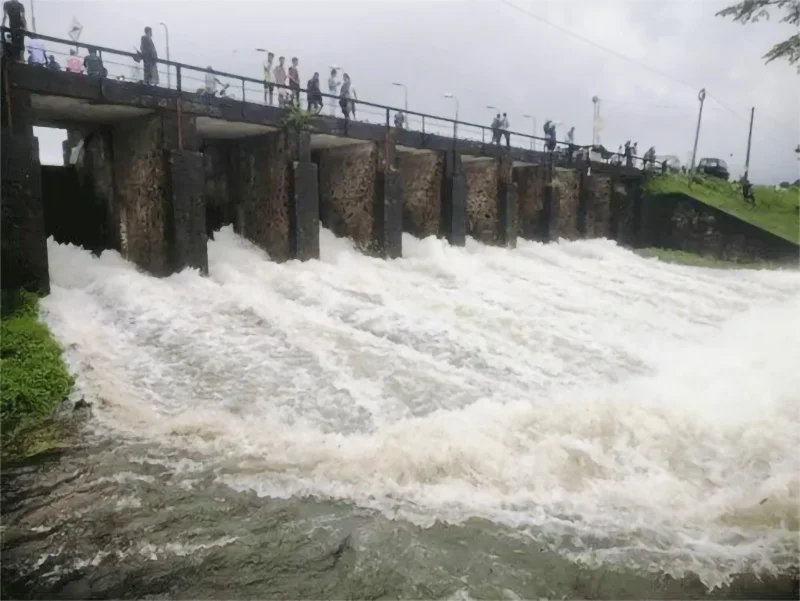
The widespread torrential rains currently experienced countrywide are expected to provide significant financial relief to the debt-ridden Ceylon Electricity Board (CEB) by sharply increasing hydroelectric power generation and reducing dependence on costly thermal and coal-powered electricity generation, power sector officials said yesterday.
Senior engineers of the CEB told The Island the rapid rise in water levels in major catchment areas and reservoirs had already strengthened hydropower generation capacity across the country.
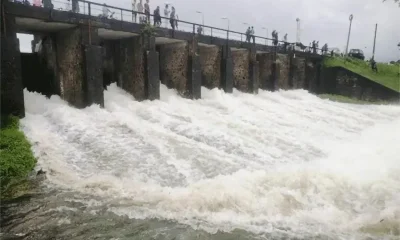
Officials of the Irrigation Department confirmed that 33 reservoirs are presently spilling following continuous heavy rainfall over several parts of the island.
Among the major reservoirs spilling are Rajanganaya, Lunugamwehera, Weheragala, Deduru Oya, Nalanda and Wemedilla reservoirs, while several spill gates have been opened to release excess water due to heavy inflows into the catchment systems.
An Irrigation Department engineer said catchment areas linked to the Mahaweli, Kala Oya and southern river basins had received exceptionally heavy rainfall over the past several days.
“The inflows are extremely high. Reservoir capacities are increasing rapidly and this is highly beneficial for irrigation, water supply and hydroelectric generation,” the official said.
CEB engineers explained that the increase in reservoir storage levels would enable the Board to maximise hydroelectricity generation from major hydropower stations linked to the Mahaweli and Laxapana systems.
A senior CEB engineer said hydropower remained the cheapest electricity source available to Sri Lanka.
“Hydro generation costs are minimal compared to thermal generation. Once reservoirs fill up, we can considerably reduce expensive oil-based thermal generation,” the engineer said.
According to power sector estimates, hydroelectricity generation costs remain below Rs. 5 per unit, whereas coal-fired electricity generation costs range between approximately Rs. 18 and Rs. 25 per unit depending on international coal prices and exchange rate fluctuations.
Diesel and furnace oil-powered thermal generation are significantly more expensive, costing between Rs. 40 and Rs. 70 per unit.
CEB officials said the prevailing rainy conditions were therefore producing enormous savings for the financially-strained utility.
Daily electricity demand currently fluctuates between 45 million and 50 million units. One unit equal 1 kWh. One million units 1 GWh.
Energy sector estimates indicate that if hydropower generation replaces between 10 million and 15 million thermal-generated units daily, the CEB could save between Rs. 350 million and Rs. 900 million per day depending on the displaced fuel source.
Even replacing coal-powered generation alone could save between Rs. 150 million and Rs. 300 million daily.
“The present rains have arrived at a critical time for the CEB. Higher hydro generation means lower fuel imports, reduced thermal dispatch and major savings for the utility,” another senior engineer said.
Meanwhile, the prevailing adverse weather has also caused fatalities and damage in several districts.
The Disaster Management Centre (DMC) said one person had died while 62 families in four districts had been affected by the severe weather conditions.
The fatality was reported from the Koralai Pattu South Divisional Secretariat Division in the Batticaloa District.
According to the latest DMC situation report issued at 10.00 p.m., 17 Divisional Secretariat divisions across four districts have been affected by the disaster situation caused by the severe weather.
Some 203 persons belonging to 62 families have been affected so far, while 17 people are currently being accommodated at safe shelters.
The DMC further stated that 39 houses had been damaged due to the prevailing adverse weather conditions.
Meanwhile, the Department of Meteorology issued a red warning for heavy rains in several parts of the country.
The Met. Department said the prevailing showery conditions were expected to continue further due to the low-pressure area in the vicinity of Sri Lanka.
Very heavy showers exceeding 150 mm are likely at some places in the Western, Sabaragamuwa, Central and Northwestern provinces and in the Galle and Matara districts.
Heavy showers of about 100 mm are also likely at some places elsewhere across the island.
The Disaster Management Centre yesterday urged the public to take adequate precautions to minimise damages caused by heavy rain, strong winds and lightning during thundershowers.
By Ifham Nizam
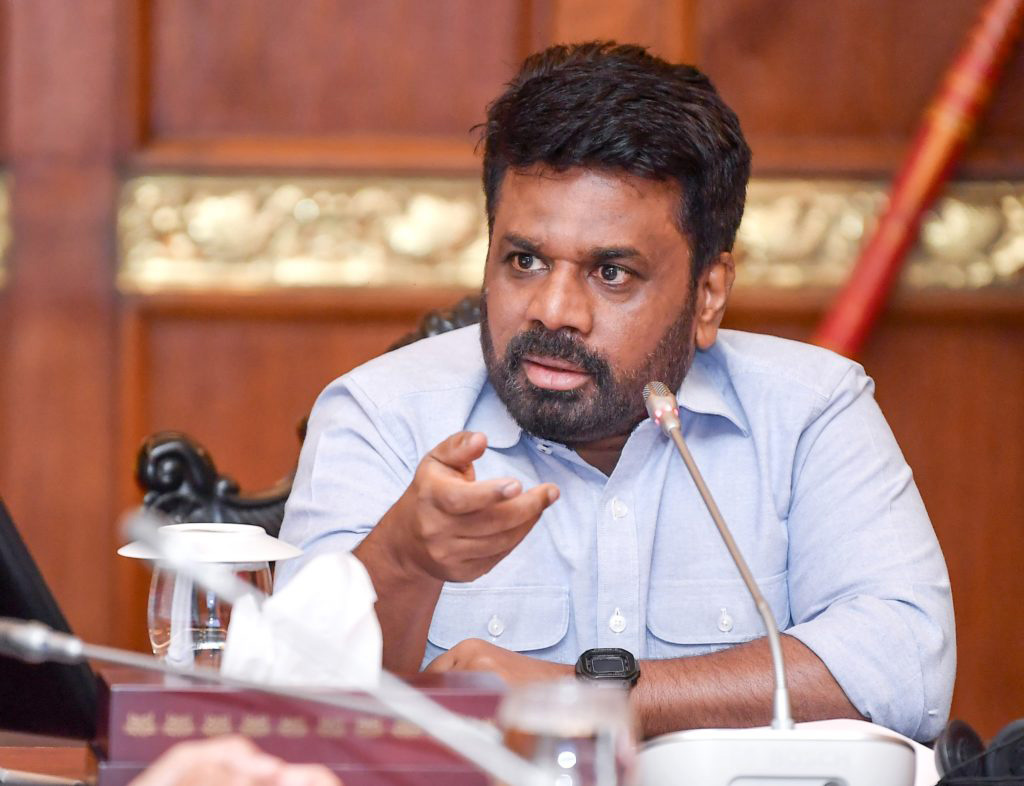
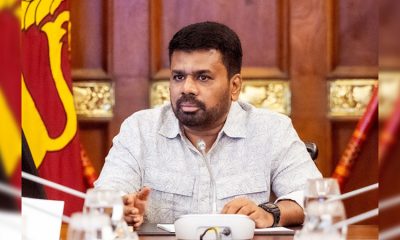
President Anura Kumara Dissanayake directed officials to fast-track the completion of the resettlement process for people in the Kandy District who lost their homes due to the recent Ditwah disaster. Speaking at a Special District Coordinating Committee meeting held at the Kandy District Secretariat on the 12th, the President reviewed the progress of land acquisition for resettlement at the Divisional Secretariat level.
The President emphasised the urgent need to resolve existing administrative hurdles and ensure that affected families are provided with permanent housing solutions without further delay.
During the session, the President individually consulted Divisional Secretaries on the progress of compensation for the 12,169 houses reported as partially damaged within the district. According to official data, while 4,488 families are currently eligible, only 3,038 have received compensation thus far. The President also highlighted the status of 1,583 high-risk houses requiring full resettlement and thousands of others awaiting NBRI technical reports. He instructed officials to expedite the remaining payments and clear the backlog of inspections to ensure all victims receive their due relief.
Addressing the long-term safety of the community, President Dissanayake noted that it was the government’s primary responsibility to prevent residents from returning to identified high-risk zones. The discussion focused on identifying new lands for relocation, with special attention paid to the plantation community living on private estates. Plans were discussed to reclaim government lands currently managed by private companies to facilitate these housing projects.
Additionally, the President addressed the construction of retaining walls for houses where land stabilisation is necessary and promised a solution within the coming week regarding the fluctuating prices of construction materials and compensation for business losses.
The high-level meeting was attended by a distinguished gathering, including Minister of Agriculture K.D. Lalkantha, Central Province Governor Professor Sarath Abeykoon, and Deputy Ministers Hansaka Wijemuni and Prasanna Gunasena. Several Members of Parliament, including Jagath Manuwarna and Riaz Farouk, also participated alongside the Mayor of Kandy, the District Secretary, and various heads of state departments and security forces. The collective presence of these officials underscored the government’s commitment to a coordinated and swift recovery effort for the Kandy District.
By S.K. Samaranayake

SJB flays PUCSL for shifting coal scandal losses to electricity consumers

Rains bring relief to debt-ridden CEB as reservoirs fill; one dead, 62 families affected by adverse weather

President orders acceleration of Ditwah relief programmes

CEA urges public to avoid polythene and plastic during Vesak season

Heroes’ Day commemoration to be held on 19 May

Veteran sports administrator Prema Pinnawala passes away

‘Dates have the highest sugar content to fight Coronavirus’

Sunday Island 27 December – Headlines

#SundayIsland 17th December – Headlines

Sunday Island – 28th March

Sunday Island Headlines – 21 March

Sunday Island – 21st February – Headlines
-

 News4 days ago
Lanka Port City officials to meet investors in Dubai
-
 News1 day ago
Ex-SriLankan CEO’s death: Controversy surrounds execution of bail bond
-
 News5 days ago
SLPP expresses concern over death of former SriLankan CEO
-

 Editorial6 days ago
The Vijay factor
-
 News5 days ago
Police inform Fort Magistrate’s Court of finding ex-CEO of SriLankan dead under suspicious circumstances
-
Features2 days ago
High Stakes in Pursuing corruption cases
-
 Features2 days ago
When University systems fail:Supreme Court’s landmark intervention in sexual harassment case
-
 Features6 days ago
Palm leaf manuscripts of Sri Lanka – 1