
Midweek Review
JRJ’s racism, cold war posturing and the Indian debacle

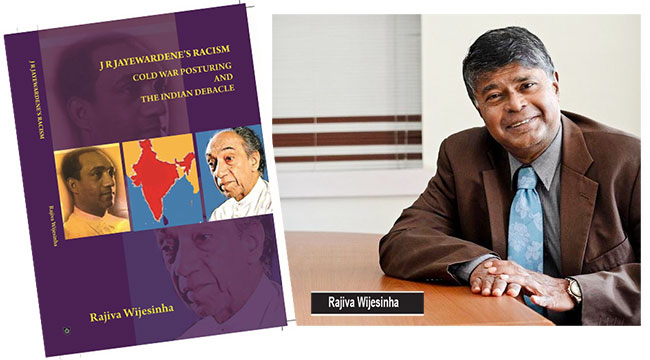
New biography:
In addition to his political biography of J R Jayewardene, Godage & Bros published last month another book of travel by Rajiva Wijesinha. Around and About the Mediterranean covers journeys over half a century to Southern Europe, Northern Africa, and the Levant from Jordan up to Turkey. It also includes travel to the Balkans, Yugoslavia in 1972 and then the separate countries of the former Yugoslavia in the last five years.
Bringing together the Classical and the Christian and the Islamic cultures of the region makes for a fascinating read for it shows the intermingling that has made the Mediterranean so productive of ideas as well as artefacts. In addition, the book shares with readers the sheer joy of travel, the wonders seen and the pleasure of strenuous exploring followed by relaxation in scenic surroundings. There are several colour pictures as well as black and white ones to illustrate each section.
By Shamindra Ferdinando
An opportunity to peruse Prof. Rajiva Wijesinha’s critical biography of Sri Lanka’s first executive President (not elected), titled ‘J.R. JAYEWARDENE’S RACISM, COLD WAR POSTURING AND THE INDIAN DEBACLE’, couldn’t have been received at a better time.
The country is in turmoil with a wave of protests, with farmers’ now leading the way over the SLPP government agricultural policy, a simmering dispute with China regarding a ship carrying allegedly contaminated carbonic fertiliser consignment entering Sri Lankan waters, unprecedented balance of payment crisis, and a deepening disagreement with SLPP constituents over a deal with the US company New Fortress Energy, as well as foreign policy issues.
Can Sri Lanka’s current predicament be blamed on the executive presidential system, failure on the part of Parliament and the judiciary – the three pillars on which the country’s political system is based? Academic, administrator and ex-lawmaker who had represented the utterly corrupt SLFP and UNP-led political groupings (2010-2015 in Parliament), Prof. Wijesinha has launched this devastating attack on the late UNP leader JRJ but, overall, the JRJ biography seemed an extremely harsh critique on the political setup he established. But, the irony is the author himself had been part of the two major political groupings after having performed an immensely valuable role as the Secretary General of the Secretariat for Coordinating Peace Process (SCOPP) in addition to being the Secretary to the Disaster Management and Human Rights Ministry.
The writer really appreciate an opportunity to review ‘J.R. JAYEWARDENE’S RACISM, COLD WAR POSTURING AND THE INDIAN DEBACLE’ against the backdrop of The Island celebrating its 40th anniversary at a time the country is experiencing an unprecedented financial crisis. Prof. Wijesinha has basically dealt with the period The Island and its sister paper, Divaina played a critically important role.
Before delving into Prof. Wijesinha’s quite useful analysis, it would be pertinent to mention that as a UPFA National List MP, the academic, in spite of strong opposition from a section of his Liberal Party, voted for the dictatorial 18th Amendment to the Constitution that was passed on Sept. 18, 2010. The 18th Amendment that had been brought in at the expense of the 17th, introduced during Chandrika Bandaranaike Kumaratunga’s tenure as the President, literally placed the executive, the legislature and the judiciary under the President’s thumb. The judiciary cannot absolve itself of the responsibility for protecting and nurturing the Constitution if/when the executive or Parliament violated the Constitution, or both did, simultaneously. The UPFA initiated impeachment proceedings, close on the heels of the Supreme Court having deemed actions taken against then CJ Shirani Bandaranayake constitutional. Bandaranayake was accused of financial impropriety and interfering in legal cases among other allegations- all of which she denied, but her husband was involved in some banking shenanigans and he was convicted.
Wijesinghe, as an MP, however abstained from backing the impeachment motion against then C J Bandaranayake in early January 2013. A year later, Prof. switched his allegiance to a high profile yahapalana political project, spearheaded by the late Ven. Maduluwawe Sobitha Thera and Ven. Atureliye Rathana, MP (now NL MP of Ape Jana Bala Pakshaya) that facilitated the break-up of the powerful UPFA and the emergence of long standing SLFP General Secretary Maithripala Sirisena as the Opposition presidential candidate.
With Sirisena taking over as the President in January 2015, Prof. Wijesinha received appointment as State Minister of Higher Education. However, Prof. Wijesinha resigned on Feb 17, 2015 opposing the then Premier Ranil Wickremesinghe’s move to secure executive powers for himself as the Prime Minister. Prof. Wijesinha declared the move to gazette the 19th Amendment to the Constitution and transfer of executive powers to the Prime Minister was both ill-timed and a wrong decision, thus, he could no longer be a part of the yahapalana government.
Prof. Wijesinha alleged in Parliament the transfer of executive powers to the Prime Minister was extremely dangerous when one considered the way the UNP leader was conducting himself. Prof. Wijesinha certainly didn’t receive public appreciation for shifting of allegiances from various political alliances within a very short period, first to the short-lived Sirisena–Wickemesinghe combination, and then declare support for Sirisena, at the expense of Wickremesinghe, and finally ending up with those who he abandoned in 2014. Sirisena, who led the charge against the Rajapaksas, had ended up among the same group whom he accused earlier of planning to assassinate him.
Jeyaraj’s arrest in the wake of Indo-Lanka Accord
Prof. Wijesinha dealt with how the JRJ government arrested the then The Island journalist David Buell Sabapathy Jeyaraj over the reportage of the Indian Army offensive in the Jaffna peninsula. The former parliamentarian reproduced an apt section of Jeyaraj’s report that discussed the ground situation in the peninsula. Having joined The Island, in June 1987, the writer remembers the subsequent developments that paved the way for Jeyaraj to leave for the US. The versatile writer ended up in Canada. New Delhi continuously interfered with print media coverage of the violence in the Northern and Eastern parts where the Indian Peace Keeping Force waged a bloody campaign to tame the Liberation Tigers of Tamil Eelam (LTTE) after it turned its wrath against them.
Once the Criminal Investigation Department (CID) sleuths visited The Island editorial to question Norman Palihawadana over his coverage of atrocities committed by the Indian Army in the Eastern theatre of operations. Jeyaraj left the country in Sept 1988, two years before after India ended its disastrous military mission here. The prolific writer for the first time returned to Sri Lanka in Oct 2013 – four years after the military eradicated the LTTE completely.
The section on the Provincial Council legislation, when examined with how JRJ handled the judiciary, is thought-provoking and is evidence the legislature lacks the strength to counter overwhelming executive (dictatorial) powers, regardless of opposition by some lawmakers. The resignation of the late much respected Gamani Jayasuriya over the passage of Provincial Council legislation is a case in point.
‘J.R. JAYEWARDENE’S RACISM, COLD WAR POSTURING AND THE INDIAN DEBACLE’ published by S. Godage and Brothers should be made available in the library of the Parliament .The author should consider getting the book translated to Sinhala and Tamil, too, for the benefit of lawmakers unable to make use of the JRJ biography. The writer brought the new book to the attention of the Chief Librarian of Parliament and the pivotal importance of making it available to the lawmakers, over the last weekend.
Prof. Wijesinha discussed how JRJ brazenly amended and manipulated the Constitution, suppressed internal dissent and if the dictator had his way he would have deprived Ranasinghe Premadasa of an opportunity to contest the 1989 presidential election. At the onset of his new book, Prof. Wijesinha pointed out how JRJ brought in his first amendment to the Constitution to subvert a judgment of the courts.
Corruption becomes way of life
Prof. Wijesinha boldly discussed the impact the absolutely corrupt political system in place as a result of deterioration of parliamentary norms is having on the country. The latest JRJ autobiography has contradicted those who published hagiographies of the former President. Prof. Wijesinha compared the late JRJ with Ranil Wickemesinghe whom he described as JRJ’s spiritual heir. Having referred to their strategies in dealing with Tamil speaking people, Prof. Wijesinha repeated his long standing claim of Wickremesinghe bribing SLMC leader Rauff Hakeem in 2014 to win over his support ahead of the 2015 presidential election. Wijesinha first made the accusation in a widely watched Sirasa ‘Pathikada’ programme anchored by the late Bandula Jayasekera, one-time presidential spokesman and the writer’s colleague at The Island editorial. Prof. Wijesinha says Muslim politicians continue to cross up and down, depending on what they are offered.
Prof. Wijesinha publicly alleged years before the launch of JRJ biography how the Commission to Investigate Allegations of Bribery or Corruption (CIABOC) sat on his complaint on the bribery accusation. The academic declared that the UNP received money to engineer a crossover of over a dozen People’s Alliance lawmakers in 2000 from businessman Nahil Wijesuriya.
Referring to the Rubber-Rice pact with China finalised in 1952 and the despicable role played by JRJ, Prof. Wiejsinha briefly examined the 99-year-old lease on the strategic Hambantota port in 2017. Prof. Wijesinha blamed the then President Sirisena, Premier Wickremesinghe and International Trade Minister Malik Samarawickrema for the Hambantota sell-out to varying degrees. The author quite rightly faulted an influential section of the media for continuously attacking the Rajapaksas for selling family silver to the Chinese whereas the UNP-led administration pushed through the deal.
The incumbent government has had no option but to accept the controversial Hambantota deal. Interestingly, the government is now under fire for giving into the US strategy to take over Sri Lanka’s energy security. The author of the JRJ biography may not agree with the writer, but the undeniable truth is all governments since the advent of UNP at the 1977 parliamentary election contributed to the deterioration of democracy and sovereignty. The 20th Amendment enacted in Oct 2020 with a 2/3 majority is a case in point. With the advent of the 20th Amendment, the much discussed abolition of the executive presidency or curbing of its powers will not be subject to discussion though some may make some statements opposed to the executive presidential system.
Perhaps Prof. Wijesinha should have discussed how Wickremesinghe received the premiership in January 2015 in the aftermath of Sirisena’s victory. JRJ’s political strategy has been exploited by interested parties to deceive the public that victory at the presidential election provided a mandate for them to take over the government. Sirisena and Wickremesinghe did exactly that. If not for the manipulation of the system, Wickremesinghe wouldn’t have received the premiership in January 2015. Prof. Wijesinha wouldn’t have to resign in Feb 2015 and Treasury bond scams would not have been perpetrated.
JRJ biography in three parts
The civil society, the diplomatic community, the media and the general public can benefit from Prof. Wijesinha’s incisive thinking. In part I, the author discussed (a) overview of JRJ’s political perspectives (b) Tamil parties (c) much amended Constitution (d) election and having ministers at his whim and fancy (e) 1982 Referendum. Basically, part 1 dealt with the building up of the colossal power base. Part 11 discussed (a) alienation of Tamils (b) riots after killing of 13 soldiers in Jaffna (c) slide towards concessions (d) Indian interventions and (e) Indian military deployment. This section was aptly titled ‘A slow but relentless decline.’
The final part titled ‘And the Fall’ dealt with (a) Indo-Lanka Accord (b) India’s war against the LTTE (c) elections and increasing violence and (d) a new President.
The writer found Chapter 5 that examined the 1982 Referendum meant to prolong the life of Parliament regardless of consequences. JRJ introduced the 4th Amendment which Prof. Wiejsinha described as the worst of the then UNP leader’s constitutional amendments that paved the way for his party to rule the country from 1977 to 1989. The JRJ strategy ruined the country. The second JVP inspired insurgency, India inspired Tamil terrorism and trade union disputes wrecked the country during this period. Prof. Wijesinha lucidly explained how the then Attorney General Siva Pasupathy, who subsequently threw his weight behind the LTTE and Chief Justice Neville Samarakoon reacted to the controversial move.
Prof. Wijesinha called Pasupathy an obsequious man who had no qualms in his ‘pernicious bidding’ and Samarakoon as JRJ’s handpicked man was truly forthright. Prof. Wijesinha coverage of the judiciary’s response to a despicable move to extend the life of Parliament provides an opportunity for those interested in contemporary history to understand how the executive, the legislature and the judiciary collectively caused irreparable damage to the democratic system.
The assassination of actor-turned politician Vijaya Kumaratunga in Feb 1988 should be examined taking into consideration Prof. Wijesinha’s comment on the UNP strategy meant to politically destroy the much loved man. Having had categorised Kumaratunga as a Naxalite, the UNP imprisoned him during the dubious 1982 Referendum campaign. Let me reproduce verbatim what Prof. Wijesinha stated on alleged Naxalite plot: “Gamini Dissanayake, who was then firmly under JR’s thumb, also got in on the act and claimed that ‘the leader of the Naxalites is Vijaya Kumaratunga’ and his assistant Chandrika. Meanwhile, The Sunday Times, which was then fully controlled by the government, with the easily intimidated Rita Sebastian as its editor, published a list of eight Naxalites, namely, in order (1) Vijaya Kumaratunga (2) Chandrika Kumaratunga (3) Ratnasiri Wickramanayake (4) Hector Kobbekaduwa (5) T.B. Illangaratne (6) K.P. Silva (General Secretary, Communist Party), (7) G.S.P. Ranaweera (Editor, Aththa) and (8) Jinadasa Niyathapala.
Prof. Wijesinha commented on the media, including the birth of the Upali Newspapers Limited (UNL) and the disappearance of its founder Upali Wijewardene in the wake of Ranasinghe Premadasa thwarting JRJ’s move to field the top entrepreneur to contest the Kalawana electorate. The UNL received Prof. Wijesinha’s appreciation for opposing the Referendum, though mildly, whereas the state-owned media and Dawasa Group threw their full weight behind JRJ’s despicable move. The government engaged in violence in support of its political project. The author discussed how JRJ unashamedly used sections of the media and selected journalists for the project that gave his party the opportunity to govern the country for a period of 13 years, sans parliamentary elections.
A bizarre strategy
Prof. Wijesinha explained how JRJ adopted bizarre political strategies. Having undated letters of resignation from his MPs is one such shameful tactic. JRJ played politics with the system to restrict the number of by elections (remember, this was before the introduction of the PR system in 1989). The section titled ‘Flexing muscles in 1983’ under Chapter 5: Referendum underscored how JRJ consolidated unbridled power at the expense of Parliament and the Judiciary. JRJ ruined institutions at will. Parliament was among them. During a recent interview on ‘Siyatha’ , one-time President Maithripala Sirisena explained how successive Presidents brought in Amendments to consolidate their power at the expense of the people. Sirisena, quite rightly claimed that he was the only President to give up power by way of introducing the 19th Amendment to the Constitution in 2015. However, the irony is Sirisena, in his capacity as the SLFP leader, allowed his parliamentary group to vote for the 20th Amendment that neutralised the 19th. Lawmaker Sirisena quite conveniently refrained from voting for the 20th Amendment having explained his predicament to President Gotabaya Rajapaksa. Having accused the Rajapaksas of planning to bury him, Sirisena, who has been named in the Easter Sunday Commission report for possible prosecution for dereliction of duty, ended up as an SLPP lawmaker.


Sri Lanka’s disastrous tour of Australia in 2022 (09 Oct. to 13 Nov.) caused widespread anger among the cricket community and the cricket loving public. The Auditor General’s special report that dealt with that tour revealed significant financial irregularities regarding the SLC executive committee’s visit there for the 2022 T20 World Cup. In spite of heavy media focus on the AG’s report in the run-up to the World Cup debacle in India, the government lacked the political will to deal with the developing situation. The then Auditor General W.P. C. Wickramaratne stood by his report. The top official, who retired in April 2025, reiterated the serious revelations but the Parliament conveniently discarded it.
Former parliamentarian Eran Wickramaratne’s unexpected move jolted the Samagi Jana Balawegaya (SJB). In spite of being aware of covert moves to bring in Wickramaratne as chief of the corruption-riddled Sri Lanka Cricket (SLC), in place of Shammi Silva, the SJB never really believed it could succeed as it was considered a literal goldmine. But when President Anura Kumara Dissanayake pushed the deal through on 29 April, a furious SJB General Secretary Ranjith Madduma Bandara, however, tried to save face by merely declaring it as a political appointment. The veteran politician said so when the media sought his reaction to Wickramaratne’s move at the P.D. Sirisena grounds, Maligawatte, the venue of SJB May Day rally.
Earlier, in response to Wickramaratne’s declaration that he quit the SJB’s Working Committee and Management Committee to pave the way for him to accept the top SLC post, Madduma Bandara asked Wickramaratne to give up the party membership, too.
President Dissanayake’s move caught the main Opposition party, as well as the Sri Lanka Podujana Peramuna (SLPP), by surprise. The vast majority of parliamentarians, representing the Janatha Vimukthi Peramuna (JVP)-led ruling National People’s Power (NPP), couldn’t have been aware of the operation executed by President Dissanayake.
There hadn’t been a previous instance of the NPP accommodating an ex-parliamentarian from a rival party in any capacity. The top NPP leadership always indicated that those who represented other political parties in Parliament wouldn’t be welcome. Ex-lawmaker Field Marshal Sarath Fonseka threw his weight behind the JVP/NPP on numerous occasions, during Aragalaya and the post-presidential polls. Although some expected the war-winning Army Commander to receive an invitation from the NPP, it never materialised. Then, what really made the NPP extend an invitation to Wickramaratne, who first entered Parliament on the UNP National List at the 2010 general election. Wickramaratne contested Colombo at the 2015 general election on the UNP ticket and was appointed Deputy Minister of Investment Promotions and Highways. Widely regarded as one of UNP leader Ranil Wickremesinghe’s favourites, Wickramaratne switched his allegiance to Sajith Premadasa in early 2020 and contested the Colombo district on the newly registered SJB and served as a lawmaker till 2024. Wickramaratne failed to regain his seat in the 2024 general election.
Wickramaratne had been one of the leading proponents of Yahapalanaya (2015-2020) that perpetrated Treasury bond scams in February, 2015, and March, 2016, and a key member of the 106 parliamentary group. As a SJBer, he represented a much smaller parliamentary group that consisted of 54 lawmakers.
What made the former banker, Wickramaratne, accept the daunting challenge of restructuring the utterly corrupt SLC, the country’s richest sports body, embroiled in wasteful practices? As a key member of the SJB, during the 2020-2024 period, Wickramaratne knew how SLC manipulated Parliament and proceeded with its agenda during Shammi Silva’s leadership.
The SJB spearheaded a vigorous campaign, targeting SLC, though it never managed to overwhelm the sports body that enjoyed unprecedented backing of the executive. In spite of the Parliament unanimously adopting a joint resolution calling for the removal of the SLC management, including its Chairman Shammi Silva, that board remained. President Dissanayake executed an operation that replaced Shammi Silva with Eran Wickramaratne. That brought Wickramaratne’s affiliation with the SJB to an unceremonious end. Ex-MP Wickramaratne made his move at the expense of the SJB parliamentary group, now down to 40 in the current Parliament.
The NPP secured an extraordinary 159 seats at the last parliamentary election. That tally included 18 National List slots.
The second largest party in Parliament consists of 40 including five NL slots. The remaining seats in the 225-member Parliament were shared by Ilankai Tamil Arasu Kadchi (ITAK/8), New Democratic Front (NDF/5), Sri Lanka Podujana Peramuna (SLPP/3), Sri Lanka Muslim Congress (SLMC/3), Sarvajana Balaya (SB/1), United National Party (UNP/1), Democratic Tamil National Alliance (DTNA/1), All Ceylon Tamil Congress (ACTC/1), All Ceylon Makkal Congress (ACMC/1), Jaffna – Independent Group 17 (IND17-1) and the Sri Lanka Labour Party (SLLP/1).
A surprising move
The NPP brought in Wickramaratne ostensibly to clean up SLC at a time the current dispensation, plagued by various allegations, is under heavy fire. Many eyebrows were raised over the calculated move that eased pressure on the government. Obviously, the former investment banker had no qualms in joining the government, amidst the continuing controversy over (1) release of 323 red-flagged containers from the Colombo port, without mandatory physical checks; (2) resignation of Energy Minister Punykumara aka Kumara Jayakody, after the release of the damning National Audit Office (NAO) report on the coal-scam, in the wake of the unsuccessful SJB No-Confidence Motion (NCM), the first since the 2024 September presidential election; (3) massive Rs 13.2 bn fraud at the National Development Bank in which Eran served as the Chief Executive Officer in 2001 (4) staggering USD 2.5 mn heist at the Treasury that devastated the government.
It would be pertinent to mention that he resigned from the NDB to enter Parliament on the UNP National List at the 2010 parliamentary poll, close on the heels of the re-election of Mahinda Rajapaksa for a second presidential term.
Within 24-hours after Wickramaratne accepted the NPP offer, the Treasury scam took an absolutely unexpected turn when an Assistant Director at the External Resources Department of the Finance Ministry, Ranga Rajapaksa, who had been interdicted over the alleged theft, was found dead, under suspicious circumstances, just outside his residence in Kuliyapitiya.
In spite of a panel of Judicial Medical Consultants, appointed to conduct the post-mortem examination on the body of Ranga Rajapaksa, concluded that all injuries were self-inflicted and that the death was due to suicide, the SJB questioned the circumstances of the death.
The SJB felt betrayed by Eran’s move at a time the Opposition was making headway, though the NPP enjoy an unchallengeable 2/3 majority in Parliament. Confident that corruption allegations, particularly the USD 2.5 mn affair and the suicide of top Finance Ministry official eroded public confidence, the SJB challenged the NPP to hold the long-delayed Provincial Council polls. The challenge was issued at the May Day rally held at P.D. Sirisena grounds, Maligawatta. SJB leader Sajith Premadasa declared if President Dissanayake accepted his challenge the next May Day will be held with SJB Chief Ministers in charge of the PCs.
The man is definitely no saint either as he once got caught campaigning with a group of his supporters in Moratuwa during the moratorium on canvassing just before an election.
Eran Wickramaratne, whatever said and done in his defence, will find it extremely difficult to explain why he switched his allegiance to the NPP, particularly against the backdrop of serious allegations. The ongoing parliamentary probe into the container affair, as well as the growing energy crisis due to the West Asia conflict, and low quality coal supplied to the country’s only coal-fired power plant, Lakvijaya at Norochcholai, and threat to the banking sector, obviously failed to deter Wickramaratne from switching sides. The former Deputy Minister obviously risked his principled stand throughout his political career against corruption.
However, like all other UNP and SJB politicians, Wickramaratne cannot, under any circumstances, absolve himself of the UNP’s culpability in Treasury bond scams, perpetrated under Prime Minister Ranil Wickremesinghe’s watch. Perhaps, over a decade after the first Treasury bond scam, many people still do not know that the Central Bank had been under Wickremesinghe at the time when then Central Bank Governor, Singaporean Arjuna Mahendran, struck. Wickramaratne remained loyal to the party though, unlike Sujeewa Senasinghe (current member of SJB parliamentary group), he didn’t launch a booklet in defence of Mahendran.
In the wake of Sajith Premadasa’s defeat at the 2019 presidential election, the party split, with the majority of members of the UNP group in the Yahapalana parliament switching allegiance to Sajith Premadasa. The SJB never explained its stance on Treasury bond scams that ruined the administration, at the very onset of its much-touted 100-day programme. The SJB needs to at least acknowledge its responsibility for its conduct, during that time, as some of those who shielded the bond thieves represent the party in Parliament now.
Widely referred to as the “footnote gang” the group has been accused of inserting footnotes into a COPE committee report on the Central Bank Treasury bond scams, literally challenging its findings. Key members often highlighted include Harsha de Silva, Sujeewa Senasinghe, Ajith P. Perera, Harshana Rajakaruna, Hector Appuhamy, Ashok Abeysinghe, Abdul Maharoof, Wasantha Aluvihare, and Ravindra Samaraweera.
Shammi vs Roshan
In the wake of Sri Lanka’s humiliating exit from the 2023 ICC Men’s Cricket World Cup following a massive 302 run-defeat inflicted by India at Wankhede Stadium, Mumbai. Australia won the tournament played in India from October 05 to November 19, 2023.
Sports Minister Roshan Ranasinghe, who also held the Youth Affairs and Irrigation portfolios, pounced on the opportunity to oust Shammi Silva’s cricket administration. The Polonnaruwa District MP, as well as those who wanted to see the back of Shammi Silva, who had been at the helm, since February, 2019, felt that they wouldn’t get a better chance. The SJB threw its full weight behind the Sports Minister’s project though he represented the SLPP that reached a consensus with Ranil Wickremesinghe, regarding post-Aragalaya administration. For the SJB, the Sports Minister’s move presented an opportunity to rock the administration struggling to cope up with growing economic woes.
Within days after India thrashed Sri Lanka, Ranasinghe sacked the cricket administration and brought in a committee, headed by Arjuna Ranatunga, the skipper of 1996 World Cup winning team. Inclusion of Jayantha Dharmadasa in the Ranatunga-led interim committee caused controversy though, as a whole, the public approved the move. But, Shammi hit back hard. Within 24 hours, SLC challenged the Minister’s action.
The Court of Appeal quashed the Sports Minister’s decision to sack the country’s crisis-ridden cricket board and restored the expelled officials, pending a full hearing. Shammi had the unconditional backing of the Indian Cricket board and, most importantly, the protection of the executive. Wickremesinghe had no qualms in shielding Shammi and his team, though Sports Minister Roshan was elected to Parliament on the SLPP ticket.
An irate Sports Minister revealed in Parliament how Wickremesinghe demanded that he rescind the decision to sack the cricket administration. Wickremesinghe wanted Shammi back at the helm of the SLC whatever the allegations directed at him. The Sports Minister disclosed in Parliament how he refused to carry out Wickremesinghe dictatorial directive and challenged him to do whatever he desired.
The resolution, unanimously adopted by the Parliament on 09 November, 2023, to get rid of the cricket administration, had no impact on Wickremesinghe. Eran Wickramaratne had been a member of that Parliament though he now quietly contributed to a strategy that enabled the NPP government to replace Shammi without causing any unnecessary issues.
When Roshan declined to reinstate what he repeatedly described as corrupt cricket administration, Wickremesinghe sacked him from the Cabinet of Ministers. Perhaps, the UNP leader had the tacit support of the top SLPP leadership to drop the ‘Pohottuwa’ man from the Cabinet. The SLPP never really took up that issue as Wickremesinghe, in consultation with his Chief of Staff Sagala Ratnayaka, plotted a controversial course.
The sacked Sports Minister hit back hard at Wickremesinghe and Sagala Ratnayaka, in and outside Parliament. Alleging that his life was in danger, Roshan said that in case of any harm caused to him, Wickremesinghe and Ratnayake should be held responsible. The lawmaker urged the Speaker not to expunge his statement from Hansard.
During the war of words, between Roshan and the SLC in November, 2023, the latter lodged a complaint with the Commission to Investigate Allegations of Bribery or Corruption (CIABOC) accusing him of misappropriation of funds made available by them to the National Sports Fund. There had never been a similar case in which the Cricket Board/SLC moved CIABOC against the subject Minister.
Shammi proved again that with right connections challenges could be successfully neutralised. But, his feat remains extraordinary as he thwarted the unanimous resolution adopted against him in Parliament. There had never been an instance where the Parliament took such a stance in respect of an individual or a particular body. Wickremesinghe, in spite of the Parliament, at that time, represented by only one National list MP from the UNP (defeated Galle District candidate Wajira Abeywardena) without hesitation sacked a Cabinet Minister appointed by his predecessor Gotabaya Rajapaksa.
Wickremesinghe’s actions underscored how the executive could undermine Parliament, regardless of consequences. Shammi emerged far stronger and proceeded with his agenda.
A visit to Mandaitivu
Having backed the SJB-led November 2023 move in Parliament against SLC, perhaps the electorate believed the first elected post-Aragalaya government would swiftly move against the powerful cricket administration. However, that issue took a back seat as the NPP confronted other challenges. By then previously mentioned issues, particularly the coal scam that exposed the NPP’s duplicity, grabbed media attention, and SLC was conveniently forgotten.
Then suddenly, on Shammi Silva’s invitation, President Dissanayake visited Mandaitivu island, situated about three kms off Jaffna town and is connected to the peninsula, via a causeway.
On September 1, 2025, Dissanayake laid the foundation stone there for what the SLC called Jaffna international cricket ground, on 48 acres, featuring 10 centre wickets with boundary distance extending up to 80 meters, exceeding international standards. The SLC declared the proposed seventh international stadium would have a spectator capacity of 40,000, positioning it as a premier cricket destination in the region.
The SLC couldn’t complete the work before the end of December, 2025, due to Cyclone Ditwah, and other reasons, including the absence of an Environmental Impact Assessment (EIA) report. The Chairman of the Central Environmental Authority, Professor Tilak Hewawasam, is on record as having said in late February this year that instructions were issued to halt the construction work under way at the Jaffna International Cricket Stadium until SLC secured environmental impact assessments to permit them to grant formal approval.
The launch of the Mandaitivu project was in line with the overall plan to create a 138-acre sports city in the Jaffna district. Those who opposed the project have alleged that it would be an ecological disaster and Mandaitivu should never have been considered for an international cricket stadium. It would be interesting to see how the new SLC chief addressed this issue alone, leaving aside all else.
Some of the criticism directed at the Jaffna sports city project is political. Northern Province-based politicians and other interested parties, not with the NPP, feel the proposed project may further erode their support base. Their concerns have to be addressed, taking into consideration President Dissanayake’s success in winning both the Northern and Eastern electoral districts at the presidential and parliamentary polls in 2024. The NPP created political history when it defeated the Illankai Thamil Arasu Kadchi (ITAK) in predominantly Tamil speaking regions thereby proving that the party could be overwhelmed.
Although the ITAK regained some respectability at the Local Government polls in 2025, the NPP still enjoys overwhelming superiority in the North and East but the actual situation can be ascertained only if President Dissanayake accepted the SJB’s challenge to conduct Provincial Council polls soon.
Wickramaratne now faces an extraordinary challenges, a situation he never experienced during the time as a UNP MP from 2010 to 2020 and then SJB lawmaker from 2020 to 2024. It wouldn’t be easy as many interested parties, including those antagonised by his move whatever the consequences of Mandaitivu environmental issues, would be out to target him. In case Wickramaratne failed in his capacity as the SLC chief to take remedial measures, he would have to face the consequences. The NPP, too, will be at the receiving end for obvious reasons.
While a section of the SJB asserted that Wickramaratne’s actions were treacherous, given his role in the party, some believe that the invitation extended to the former parliamentarian revealed that the NPP lacked suitable persons among them to take such a high profile assignment. The question is whether Wickramaratne can pull it off or himself be overwhelmed by an utterly corrupt system that progressed over the years with the connivance of politicians.
Shammi Silva couldn’t have retained SLC leadership without contest for just over seven years sans heavy political backing. That is the undeniable truth. The latest ‘arrangement’ that compelled him to give up the hot seat about 11 months before the end of his term enabled the controversial figure to avoid investigations into past affairs. Bringing in Wickramaratne, too, seems to have the approval of Shammi Silva who proved his mettle as a shrewd negotiator.
By Shamindra Ferdinando

 As almost the whole country knows by now, a group of 22 Buddhist monks were arrested on 25 April 2026, by the Police Narcotics Bureau at the international airport in Katunayake carrying approximately 112 kilograms of Kush, a high-grade, potent strain of cannabis and Hashish with a street value of over LKR 1,100 million. It is supposed to be the largest drug haul of this kind at the airport and has made global news too.
Locally, and particularly on social media, it has opened a very vocal debate with two main streaks. One has already judged the monks as guilty, purely based on information and stories in free circulation on the internet. The other claims that these are not even monks, but are imposters planted to bring disrepute to Buddhism while some articulations within this streak even go to the extent of claiming government culpability, without offering an iota of evidence. Almost none of these discusses in any serious manner what this means in terms of the law of the land and its applicability to Buddhist monks, and why this level of criminality has occurred from within the clergy in the first place. Such reflection, however, is the only sensible thing that should come out of this unfortunate incident which had considerably dangerous consequences for society if the narcotics went undetected.
The law in our country seems to apply differently or at least very slowly when it comes to Buddhist monks. This suggests that they occupy some kind of undefined but privileged status above citizenship and its constituent responsibilities. People may have noticed that Buddhist monks do not stand when the national anthem is being sung even though it is standard etiquette across the world including in our country to do so. But this exception in practice does not seem to apply to other religious leaders.
When as a schoolboy in the 1980s, I asked one of my teachers, a Buddhist monk, whom I still hold in high esteem, why this was the case, his answer was, this was the tradition since the time of the Buddha. My classmates and I pointed out to him that at the time of the Buddha, there were neither nations nor national anthems, and this question would not have even arisen. But there are stories from Buddhist history and literature that might be interpreted as monks being treated differently and elevated in status even above rulers due to their spiritual attainment. But today, we are not dealing with remnants of a distant history and belief, but the present in vastly transformed social and legal conditions.
Obviously, this is a tradition born out of wrongful and selective interpretation of respect and veneration, and not a formal legal exemption. Partly, that veneration comes from narratives in Buddhist literature, such as the incident involving Emperor Asoka and the seven-year-old novice monk, Venerable Nigrodha, who it is said to have sat on the emperor’s throne, when invited to be seated. Whatever the actual sources of this veneration are, what it does in contemporary times, is to set apart Buddhist monks symbolically from other citizens with the indication that the law of the land applies differently to them and that too, favourably. In practice, unfortunately, this becomes a cover within which errant individuals can hide from the long arm of the law as well as common sense and ethics that apply to all others.
The cultural and political logic behind this practice assumes that Buddhist monks are beyond and above the law, which is meant for the laity, and that such noble individuals will not do anything wrong. But even in the time of the Buddha itself, this was not a fact as Buddhist history explains well. It is precisely this cultural logic that led some commentators to use two interesting words to describe the 22 monks arrested at the airport and another who was arrested later who was to be the recipient of the drugs. One word is chiwaradhaarin,
literally meaning those wearing robes without implying their possible belonging to any local ecclesiastical order. In contemporary usage, it is also a somewhat insulting term. The other word is, bhikshu prathirupakayin, literally meaning people masquerading as monks. The whole point here was to delink these errant monks from monkhood and therefore from Buddhism itself because the alleged crime was too serious.
The Mahanayaka Theras of the Siyam, Amarapura, and Ramanna chapters issued a statement on 26 April 2026, just one day after the arrests, referring to the arrested as bhikshu prathirupakayin (people masquerading as monks) who were misusing the robe and noted these acts were against Buddhism and called for the suspects to be duly punished and prosecuted to the fullest extent of the law. On 28 April, the President met the Mahanayaka Theras and other senior monks to discuss the fallout and possible future action including closer supervision of monks within the order. Ideally however, neither this statement nor the meeting with the President was necessary if monks were treated as a matter of routine like normal citizens when they violate the law of the land. It is precisely based on this principle that the police arrested them in the first place. But there is no doubt they receive special treatment everywhere in the country, including in the airport.
It is this sense of privilege under the law that needs to end. When I say this, I am not talking of individual respect to monks people might have, based on their knowledge of the dhamma, including myself. That is a matter of individual preference. I also do not mean disciplinary supervision, investigation of institutional malpractices and disciplinary or vinaya breaches and punishments which can be carried out by the religious organisations themselves if they have a workable system. But if monks, like any other citizen, violate the law of the land whether it is drug trafficking, rape, child abuse, financial irregularities, instigating violence and so on, then, they cannot be offered special treatment or leniency. They must be held accountable and prosecuted, but fairly, like all of us deserve. No exceptions can be made.
The sheer noise of the local debate also has not posed yet another pertinent question that is important in this context. That is, how has it become possible for monks to engage in such obviously illegal acts with massively negative consequences for the society which they are supposed to serve selflessly? What has gone wrong, where and why?
Ven. Gurugoda Siriwimala made the following observations in a Facebook post in Sinhala on 27 April, which outlines the prevailing situation very rationally and clearly:
“The Bhikkhu Sasana (The Buddhist Monastic Order) in Sri Lanka is part of the country’s own decline. When a nation falls into decay, it is impossible for one specific segment within it to remain unaffected. The most tragic aspect of this is that in a country like Sri Lanka, where the cultural fabric is heavily built upon religion, the clergy—who ought to be the ultimate role models—have descended into such a state of degeneration.
The Monastic Order in Sri Lanka has become mere puppets of political parties and the media. For ordinary monks like us—who travel in public buses and subsist on the alms provided by ordinary people—it has become a matter of such shame that we feel like we must hide our faces. But these are not issues to monks who hardly walk in the streets, who constantly hold press conferences and utter foolhardy things from political stages.
Political parties in Sri Lanka have divided the clergy among themselves, maintaining a group of prominent monks who would act according to party agendas. We see even at this very moment how they are being manipulated like puppets. A group of hollow, senseless fools with no spiritual sensibility whatsoever are making a mockery of themselves in front of the whole country by holding press conferences morning and night. These monks lack education; they possess no understanding—either at a national or international level—of the subjects they speak about …”
Ven. Siriwimala’s articulation is the clearest explanation of what is happening in the Buddhist monastic order that I have read in recent times. What is even more important is that it has come as a self-reflective critique from within. The drug-carrying monks are not an unusual occurrence or an anomaly when it comes to drug trafficking in the country in general or reported malpractices involving some other monks on numerous other occasions. According to publicly available reports, some monks have repeatedly insulted minority religious practices and sentiments. One example of this is the current case in which indictments have been served against one of these monks for a case from 12 years ago. His discourses of violence are matters of public record as are the records of others. Sexual violence and child abuse involving some other monks have also come to the forefront on and off including the case of a monk who was found guilty of multiple counts of sexual assault by the Isleworth Crown Court in London in 202 and placed on the UK Sex Offenders Register for life even though he is running a school close to Colombo. There are many such cases circulating in public discourse, but not all of these have been prosecuted. Much has been silenced by inaction.
As Ven. Siriwimala has rightly pointed out, many monks have become problematic mouthpieces for political parties and political interests. Even the manner of their public articulation and behaviour as well as the nature of political involvement have become shameful, to put it mildly. But almost none have faced consequences within the ecclesiastical order of institutional Buddhism.
What this overall situation has done is to bring the Buddhist ecclesiastical order into needless disrepute. And much of this has happened due to the unfortunate silence of the Mahanayaka Theras and other senior prelates when they should have campaigned for reform within their monastic orders and paved the path towards prosecution in the same way they have done in the context of the recent drug interdiction. Seen in this sense, the present issue is nothing new. It is merely one of the more visible examples of a much deeper malaise.
Whenever I hear of these issues and the relative silence from within the monastic order, I am constantly reminded of the Buddha’s own words in Aṅguttara Nikāya (Numerical Discourses) and particularly in Anāgatabhaya Sutta (Discourse on Future Dangers). The ‘future dangers’ that would lead to the corruption of the Sangha and the disappearance of the Saddhamma (True Dhamma) the Buddha articulated include the following, all of which have to do with monks: 1. Lack of training and discipline among monks and the resultant consequences; 2) consequences of monks stopping paying attention to the profound teachings of the Dhamma; 3) monks focusing on excessive materialism and luxury and distancing themselves from practices such as meditation and seeking liberation; 4) the emergence of conflict and factionalism as a result of which monks becoming argumentative and using the Dhamma as a weapon to attack one another rather than as a means to liberation; 5) all this would finally lead to the corruption of the teachings of the Buddha and monks would end up teaching what is not the Dhamma but present it as the Dhamma and will teach what is not the Vinaya but present it as the Vinaya.
Is it not this that is happening today? Aren’t the kind of examples of malpractices I have outlined above indicative of this situation which the Buddha himself foresaw in his own lifetime? If the April 2026 drug bust is to serve a purpose for the future, it should happen at two levels: 1) the government and the laity should not treat monks as privileged when they engage in wrong-doing and violate the law of the land. The government should make it very clear formally that the law enforcement and judicial systems must fully prosecute violators of the law without any exceptions; 2) Leaders within the Buddhist monastic order including the Mahanayaka Theras and other senior prelates as well as their lay supporters should establish and empower an urgent system of internally addressing issues within their own orders and organisations, which should include the identification of wrong doers on the basis of specific ecclesiastical or legal violations and their expulsion from their monastic orders. There should not be any exceptions.
If this bare minimum can be achieved without delay and that too with honesty, then, we can imagine a more sanguine future where Buddhism can play the role it is supposed to. If it cannot be done, then, the future will be what the Buddha has already predicted.

A Small, cheery wayside bakery,
A sought-after oasis by the needy,
Is now empty, barred and bolted,
Leaving its workers helpless and aghast,
While the eatery is up for grabs it seems,
And townsfolk are given to understand,
That soaring rentals caused its demise,
And all this came to pass just a day after,
The Red-shirted gentry from grandstands,
Pledged timely lifelines to the underclass,
But ground-level facts proclaim otherwise;
The Dignity of Labour is an orphaned cause.
By Lynn Ockersz

Ahmedabad to host IPL 2026 final on May 31

Man charged with attempted Trump assassination indicted for assaulting Secret Service officer

Vivek Ramaswamy wins Republican nomination for Ohio governor

Trump says US to pause operation to guide vessels through Strait of Hormuz

Samson, Kartik, spinners set up Chennai Super King’s clinical win

State Banquet Hosted by the President for the Maldivian President and Delegation

‘Dates have the highest sugar content to fight Coronavirus’

Sunday Island 27 December – Headlines

#SundayIsland 17th December – Headlines

Sunday Island – 28th March

Sunday Island Headlines – 21 March

Sunday Island – 21st February – Headlines
-

 News7 days ago
Rooftop Solar at Crossroads as Sri Lanka Shifts to Distributed Energy Future
-
 News2 days ago
CJ urged to inquire into AKD’s remarks on May 25 court verdict
-
 News6 days ago
“Three-in-one blood pressure pill can significantly reduce risk of recurrent strokes”
-
 News3 days ago
USD 3.7 bn H’tota refinery: China won’t launch project without bigger local market share
-

 News6 days ago
Alarm raised over plan to share Lanka’s biometric data with blacklisted Indian firm
-
 News5 days ago
Ten corruption cases set for court in May, verdict ordered in one case – President
-
 News4 days ago
Easter Sunday Case: Ex-SIS Chief concealed intel, former Defence Secy tells court
-
 News6 days ago
USD 2.5 mn fraud probe: Interdicted MoF official found dead at home