
News
Israel resumes attacks as Iran vows to avenge supreme leader’s death

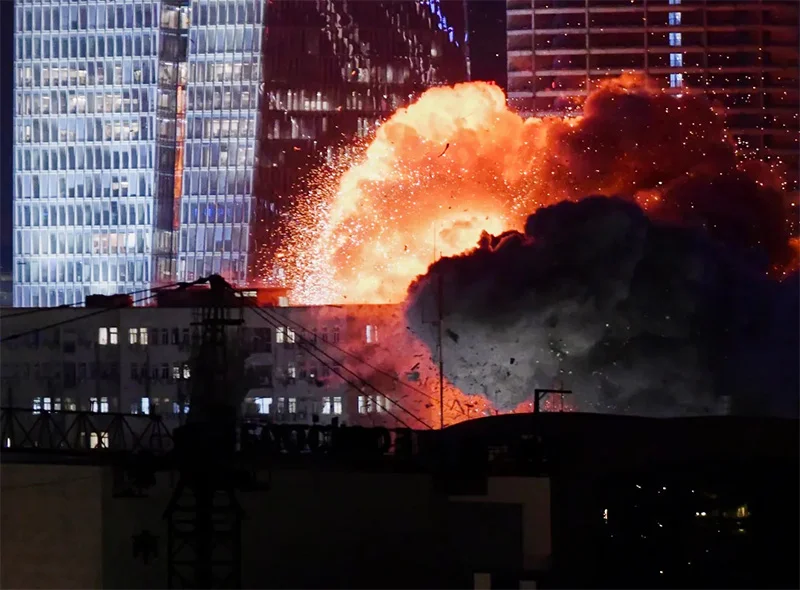
* Iran begins 40-day mourning after Khamenei killed in US-Israeli attack
* President Pezeshkian condemns killing as ‘a great crime’
Iran has begun 40 days of mourning after Supreme Leader Ayatollah Ali Khamenei was killed in ongoing attacks by the United States and Israel, according to Iranian state media.
Top security officials were also killed in Saturday’s strikes, along with Khamenei’s daughter, son-in-law and grandson. The killings mark one of the most significant blows to Iran’s leadership since the 1979 Islamic revolution Al Jazeera has reported.
Iranian President Masoud Pezeshkian condemned the killing as “a great crime”, according to a statement from his office. He also declared seven days of public holidays in addition to the 40-day mourning period.
Reporting from Tehran, Al Jazeera’s Tohid Asadi said people were pouring into the streets of the capital following the news of Khamenei’s killing.
“There will be expected ceremonies,” he said, noting they would likely take place amid continuing bombardment across the country.
Protests denouncing Khamenei’s killing were also reported elsewhere, including Shiraz, Yasuj and Lorestan.
“There will be expected ceremonies,” he said, noting they would likely take place amid continuing bombardment across the country.
Footage aired by Iranian state media showed supporters mourning at the shrine of Imam Reza in Mashhad, with several people seen crying and collapsing in grief, according to Al Jazeera.
The killing also led to protests in neighbouring Iraq, which declared three days of public mourning. In Baghdad, protesters confronted security forces in the heavily fortified Green Zone, which houses Iraqi government buildings and foreign embassies.
Videos verified by Al Jazeera showed demonstrators waving flags and shouting slogans, with witnesses saying some were attempting to mobilise towards the US Embassy. Footage also showed protesters blocking vehicles at a roundabout near one of the entrances to the area.
There was also a protest in the Pakistani city of Karachi, where footage, verified by Al Jazeera, showed people setting fire to and smashing the windows of the US consulate.
However, there have also been reports of celebrations in Iran, with the Reuters news agency quoting witnesses as saying some people had taken to the streets in Tehran, the nearby city of Karaj and the central city of Isfahan.
Meanwhile, the official IRNA news agency reported that a three-person council, consisting of the country’s president, the chief of the judiciary, and one of the jurists of the Guardian Council, will temporarily assume all leadership duties in the country. The body will temporarily oversee the country until a new supreme leader is elected.
Ali Larijani, the head of Iran’s Supreme National Security Council, accused the US and Israel of trying to plunder Iran, in an interview aired on state TV.
He also called on Iranians to unite. “Groups seeking to divide Iran should know that we will not tolerate it,” he added.
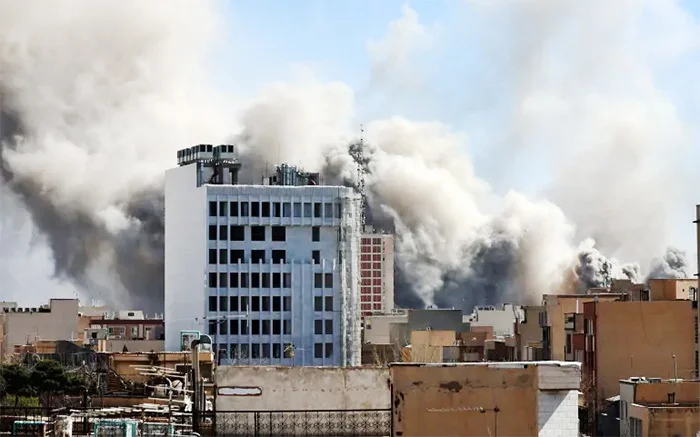
Smoke rises over central Tehran following ongoing U.S.–Israeli strikes on Iran yesterday.[EPA]
Khamenei assumed leadership of Iran in 1989 following the death of Ayatollah Ruhollah Khomeini, who had led the Islamic revolution a decade earlier.
While Khomeini was regarded as the ideological force behind the revolution that ended the Pahlavi monarchy, Khamenei went on to shape Iran’s military and paramilitary apparatus, strengthening both its domestic control and its regional influence.
Meanwhile, the Islamic Revolutionary Guard Corps (IRGC) pledged revenge and said it had launched strikes on 27 bases hosting US troops in the region, as well as Israeli military facilities in Tel Aviv.
Explosions have continued to be reported in Qatar and the United Arab Emirates, while security alerts are in place in several countries across the region.
US President Donald Trump, in a social media post on Sunday, warned Iran that it would be hit “with a force that has ?never been seen before” if it retaliated.
Iran’s retaliatory attacks since Saturday have targeted Israel and US assets across multiple Middle East countries, including Qatar, the UAE, Kuwait, Bahrain, Jordan, Saudi Arabia and Iraq.
Harlan Ullman, chairman of the strategic advisory firm Killowen Group and an adviser to the Atlantic Council in Washington, DC, said the US may have made a “big mistake” by killing Khamenei.
“Decapitation only works when you get all the leaders, and I don’t think that we got all the leaders,” Ullman said, adding that the US should not expect Iran’s leadership to enter negotiations in the immediate aftermath.
Iranian state media reported on Saturday at least 201 people have been killed in the joint US-Israeli attacks across 24 provinces, citing the Red Crescent. In southern Iran, at least 148 people were killed and 95 wounded in a strike on an elementary girls’ school in Minab on Saturday, with the toll continuing to rise, according to state media.







The Department of Immigration and Emmigration has decided effective from 28th February 2026, to grant a free fourteen (14) day visa extension to all tourists who are unable to leave Sri Lanka due to flight cancellations. 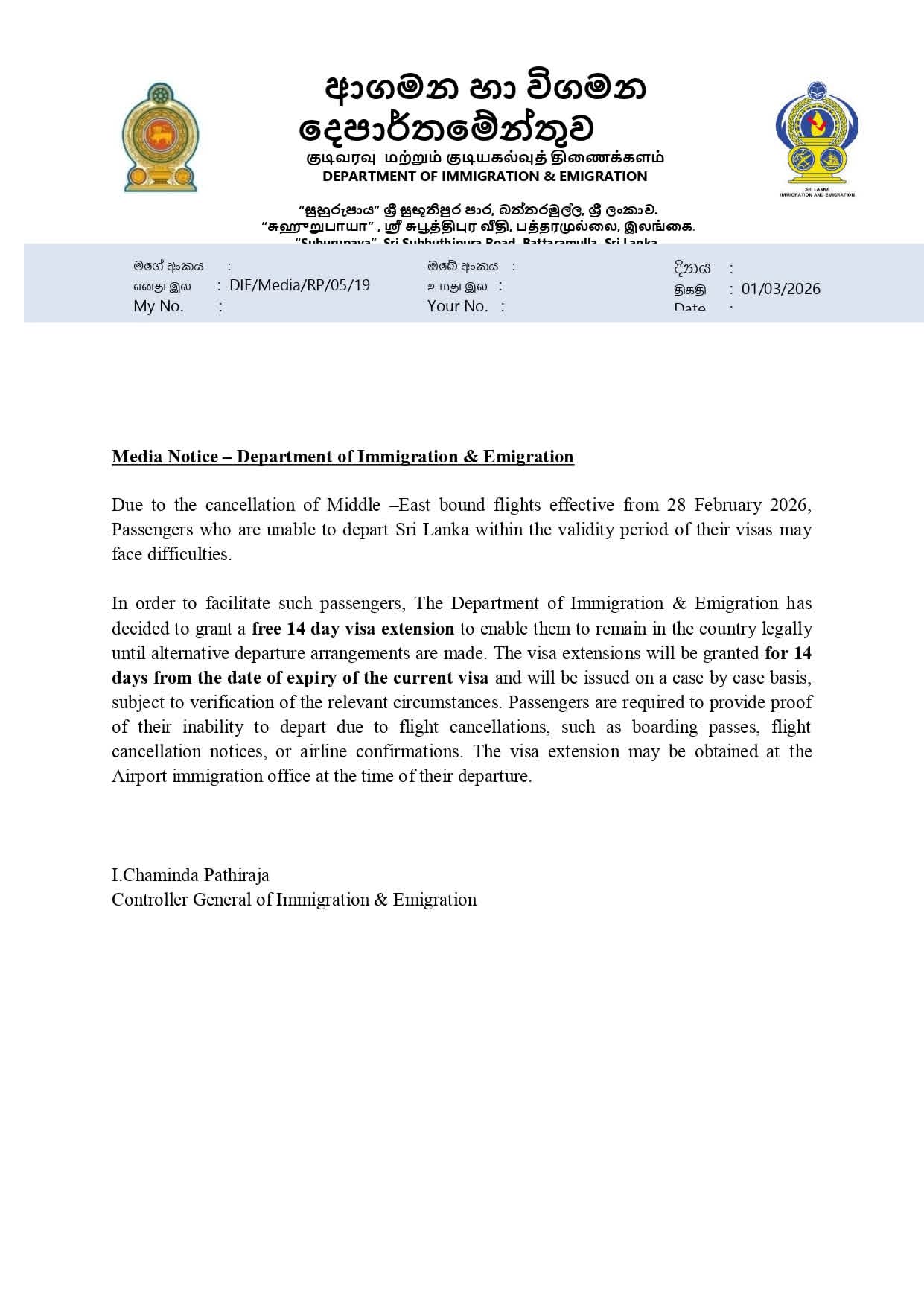
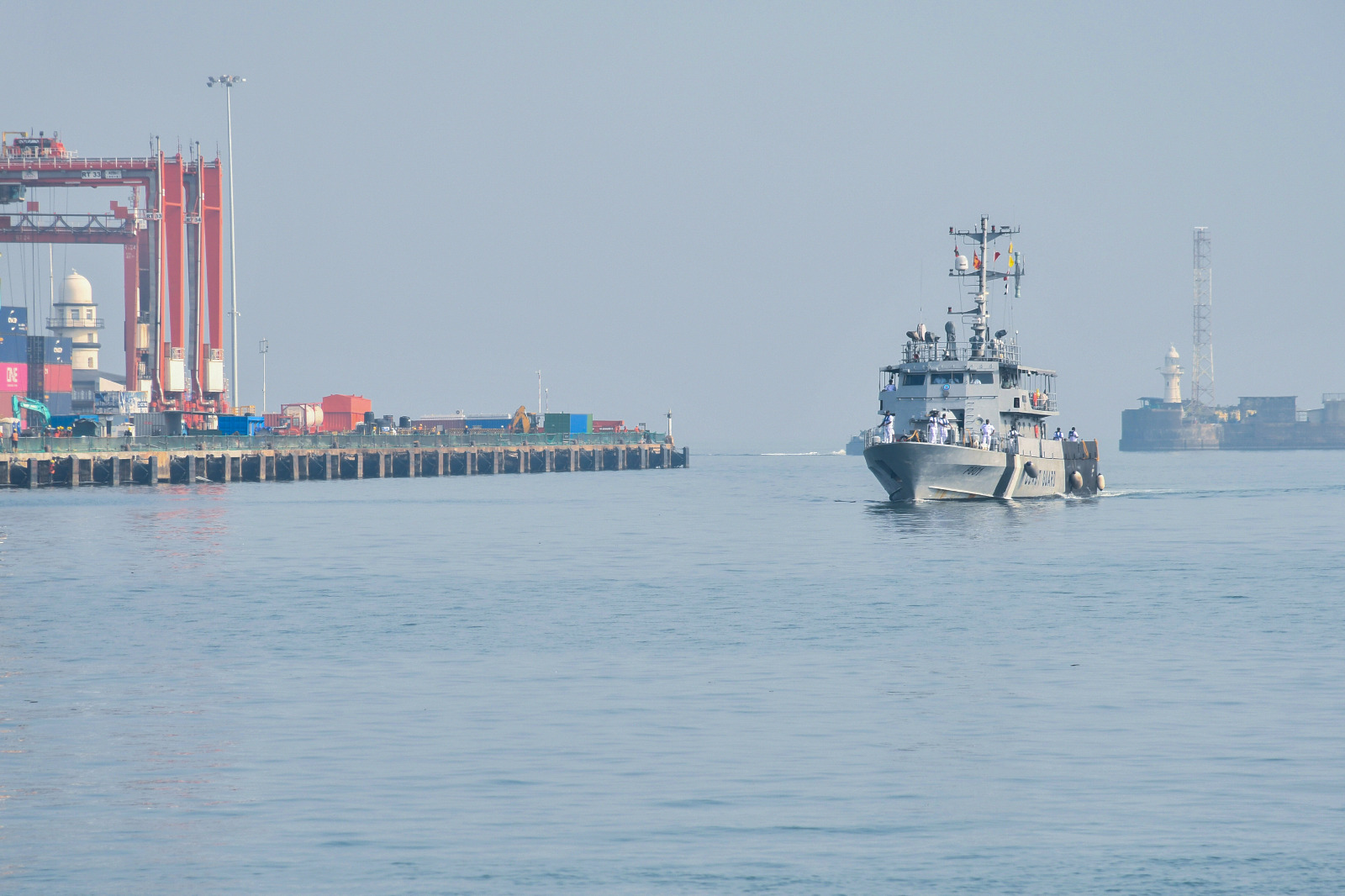
The Maldives Coast Guard Ship Huravee arrived at the Port of Colombo for replenishment purposes on 02 Mar 26. The visiting ship was welcomed by the Sri Lanka Navy (SLN) in compliance with time-honoured naval traditions.
The ship is a 48.9m long Offshore Patrol Vessel which is commanded by Lieutenant Colonel Ahmed Nafiu Mohamed.
Meanwhile, the ship’s crew is scheduled to visit several tourist attractions in the city of Colombo, during their stay in the island.
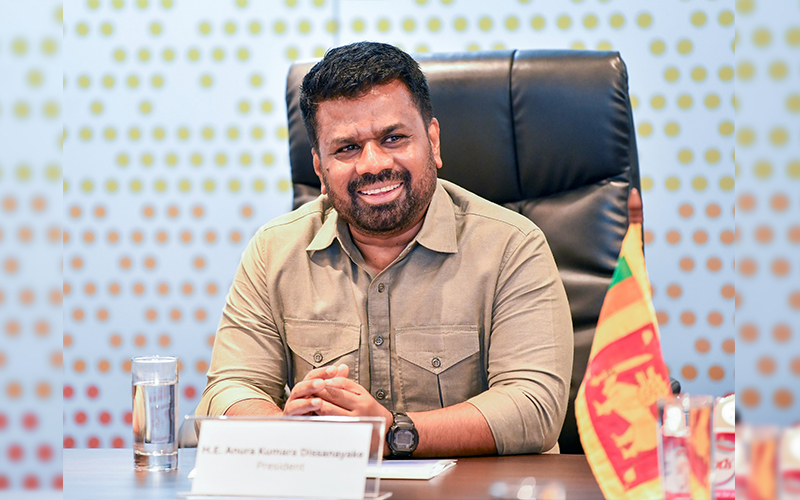
President Anura Kumara Dissanayake yesterday called for an immediate and peaceful resolution of the escalating Middle East conflict, warning that the crisis could have far-reaching repercussions on the global economy, including Sri Lanka.
Addressing Parliament, the President stressed that no military conflict benefited humanity, particularly at a time when destructive military technologies were rapidly advancing.
“Any military conflict does not create a favourable situation for any group of people,” he said, urging all parties to make urgent commitments towards peace. “As Sri Lanka, our position is that all parties involved in this war must, as soon as possible, take steps toward a peaceful world.”
He cautioned that Sri Lanka could not remain insulated from the fallout from the conflict, noting that disruptions to global oil and gas supplies, threats to migrant workers in the Middle East, and potential shocks to tourism, remittances, shipping and aviation were real concerns.
A national programme was being formulated to mitigate the impact, he said, adding that its success would hinge on broader international efforts to restore stability, the President said.
Acknowledging public anxiety shaped by past economic hardships, President Dissanayake said social stability could not be ensured through rhetoric alone but required tangible guarantees that citizens would not face another crisis.
While noting that the government had successfully navigated multiple challenges since assuming office, he described the Middle East situation as distinct due to the uncertainty surrounding its duration and outcome.
The government, he said, was closely monitoring developments. The Central Bank had conducted a review with a report on the likely economic impact expected shortly. The Ministry of Finance is also preparing an assessment of the potential effects on public life, alongside measures to ensure the uninterrupted provision of essential services locally and for Sri Lankans overseas.
“The primary responsibility for finding a path out of the crisis rests with the Government,” he said, calling on Parliament and the public to collectively confront the challenge under a unified national plan.
Providing a detailed account of the country’s energy reserves, the President said storage capacity rather than supply remained the key constraint. Excluding the Indian Oil Corporation tanks in Trincomalee, total storage capacity at Kolonnawa and Muthurajawela stands at approximately 150,000 metric tons.
Diesel stocks were currently sufficient for 33 days, with refining contributing around 1,800 metric tons daily. Petrol reserves will last 27 days, with a 35,000 metric ton shipment due on March 7 or 8 expected to extend availability to around 40 days.
Aviation fuel stocks are adequate for 49 days, supported by both daily refining and imports. Scheduled shipments include vessels from RM Parks on March 14, Sinopec on March 17, IOC on March 21 and the Ceylon Petroleum Corporation on March 28.
Crude oil supplies were sufficient to operate the refinery for 26 days, with an additional shipment expected to extend operations by a further 18 days, the President said.
“Because of this, there is no crisis regarding oil,” the President assured Parliament.

Free 14 day visa extension for visitors unable to depart Sri Lanka

US embassy in Dubai hit; Israel pounds Tehran, Beirut

Perera, Sugandika, Ranaweera take Sri Lanka to T20I series win over West Indies

Maldives Coast Guard Ship Huravee arrives in Colombo

New charges for son of Norway’s crown princess on trial for rape

US sends planes to evacuate nationals from Middle East as Iran conflict spreads

‘Dates have the highest sugar content to fight Coronavirus’

Sunday Island 27 December – Headlines

#SundayIsland 17th December – Headlines

Sunday Island – 28th March

Sunday Island Headlines – 21 March

Sunday Island – 21st February – Headlines
-
 Opinion5 days ago
Jamming and re-setting the world: What is the role of Donald Trump?
-
 Features5 days ago
An innocent bystander or a passive onlooker?
-
 Features2 days ago
Brilliant Navy officer no more
-
 Features6 days ago
Ratmalana Airport: The Truth, The Whole Truth, And Nothing But The Truth
-
 Opinion2 days ago
Sri Lanka – world’s worst facilities for cricket fans
-
 Business6 days ago
IRCSL transforms Sri Lanka’s insurance industry with first-ever Centralized Insurance Data Repository
-

 Business5 days ago
An efficacious strategy to boost exports of Sri Lanka in medium term
-

 Features3 days ago
Overseas visits to drum up foreign assistance for Sri Lanka