
Business
ISMM International Seminar on October 24, 2022 at the Shangri-La

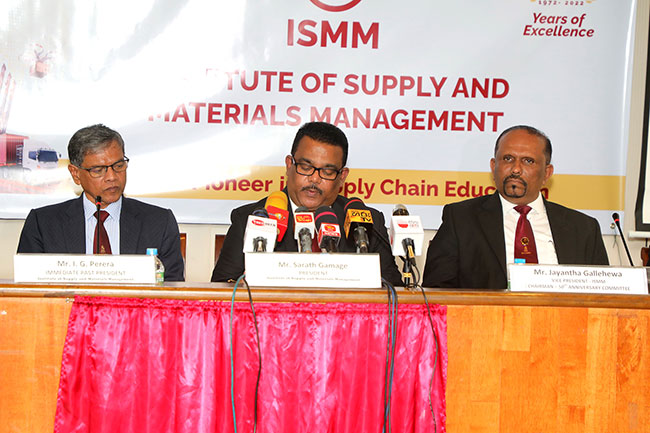
The Institute of Supply and Materials Management (ISMM) came into being on 24th October 1972. Accordingly, we are celebrating our 50th Anniversary on 24th October 2022 and to coincide with this event ISMM will be organizing a Full Day International Seminar on 24th October 2022 at the Shangri-La Hotel, Colombo, where eminent scholars in the supply chain profession, both local and foreign are scheduled to attend. The theme selected for the Seminar is “Elevating the economy through innovative and sustainable supply chain solutions”.
The Institute of Supply and Materials Management (ISMM) is the only national body in Sri Lanka in the field of supply chain management. ISMM was incorporated by Act of Parliament No. 03 of 1981 on 29th January 1981. In 1980 ISMM was affiliated to the International Federation of Purchasing and Supply Management (IFPSM) based in UK. IFPSM is the world body encompassing 45 National Associations having over 250,000 Supply Chain Management professionals engaged in different sectors and levels. In recognition of its expertise the ISMM was able to obtain the membership of the Organization of Professional Associations of Sri Lanka (OPA) on 3rd September 1976. Since then, ISMM plays a vital role in OPA activities. ISMM is also registered under the Tertiary and Vocational Education Commission (TVEC) under reference P01/0160. In 2001, ISMM was affiliated to the International Trade Centre (ITC) and licensed to conduct its MLS-SCM programmes in Sri Lanka and in 2014 ISMM was able to obtain the ISO 9001 Quality Management System Certificate from the Sri Lanka Standards Institution (SLSI).
ISMM has been the Diploma awarding National Body for the last three decades awarding Graduate Diploma and Advance Diploma, in addition to conducting other Professional Courses namely Certificate and Management Courses adding more than 10,000 professionals to the profession of Supply Chain Management in Sri Lanka on a national scale including the government sector, tri forces and police. In 2010, ISMM launched the 3-year Graduate Diploma in Purchasing and Supply Chain Management (GDPSCM) programme with a dissertation. This Programme contains 120 Credits, and it is designed equivalent to a Special Degree. As at present, ISMM conducts the following courses at the operational, supervisory middle and senior management levels:
Graduate Diploma in Purchasing and Supply Chain Management (English)
Advance Diploma in Logistics and Warehouse Management (Sinhala & English).
Advance Diploma in Purchasing and Logistics Management (Sinhala & English).
International Diploma in Supply Chain Management (English).
Course in Stores Management (Sinhala & English).
Course in Purchasing Management (Sinhala & English).
Course in Shipping, Air Cargo and Containerization (English).
Certificate Course in Project Management for Supply Chain Professionals (English).
Certificate Course in Government Tender Procedure (Sinhala)
Certificate Course in Import and Export Procedures (English)
Certificate Course in Storekeeping (Sinhala)
In recognition of the increasingly crucial role played by ISMM in the development of the supply chain profession in Sri Lanka, the Department of Public Administration by its Circular No 46/09 (1) of 20.06.1994 recognizes the Corporate Membership of the ISMM as equivalent to a First or Second Class Degree in the field of Supply and Materials Management awarded by a recognized University in the recruitment and promotional process.
ISMM’s main thrust of activities from the inception was the training of supplies personnel at all levels. ISMM has trained more than 10,000 practitioners in the field of procurement and supply chain management. There are more than 1,000 Diplomates who have successfully completed Diploma Courses conducted by ISMM which enjoys a wide recognition in all sectors having a heavy input of procurement and supply chain activity. Training is also given at grassroots level and over 10,000 Stores personnel, including Storekeepers, Stores Managers and over 6,000 officers engaged in Purchasing, Inventory Control, Import & Export Trade, Shipping and Clearance work have successfully undergone training so far.
The extensive range of services rendered by ISMM include the up-to-date training programmes, seminars, workshops, conferences, discussions, members days, lectures, consultancy services and annual get-togethers. ISMM is strengthened by a professional membership who has wide knowledge on Supply Chain Management. President, Office Bearers and Council Members are selected by the members at the Annual General Meeting. Council of Management includes the Past Presidents of the Institution. In its recognition of the education and experience in the field of Supply Chain Management, ISMM membership is awarded to the professionals and Institutions in the following sequence:
Fellow Members
Life and Corporate Members
Associate Members (Non-voting members)
Affiliate Members (Students)
Institutional Members (Institutions)
Supply Chain Management is a fast-developing field of management, having a major influence on economic development and trade both at domestic and international levels. Globalization and regionalization are taking pride in international trade and development of competition is taking precedence over other factors as the driver of business. The benefits of Supply Chain Management are immense and to name a few; higher productivity, reduce cost, raise output, raise efficient/effective levels, boost cooperation, lowers delay in processes and enhances the effectiveness of Supply Chain Networks.
It is pivotal that Supply Chain Management has taken an imperative role with the Sri Lankan Government development plan to procure and manage scares resources wisely with limited money available. As it is leading private sector organizations in Sri Lanka has employed most of our highly skilled professionals to manage the high spend of the organisation by understanding the importance of the effective and efficient management of Supply Chain. The impact of supply chain will be felt in all activities and no institution could carry on with its activities devoid of material resources. As a result, the role of purchasing and Supply Chain Management is assuming a strategic role for the progressive development of the country.
ISMM Office and the Training Directorate is housed at the Organisation Professional Association Premises, Professional Centre, No. 275/75, Prof. Stanley Wijesundara Mawatha, Colombo 07, and for further information you can visit the website www.ismmsrilanka.com


The Ceylon Motor Traders Association (CMTA) has highlighted the fact that Sri Lanka’s vehicle import framework requires urgent recalibration to ensure fairness, transparency, and the protection of state revenue. The CMTA states that one of the most critical issues that must be addressed is the automatic 15 per cent reduction applied to the CIF value of used vehicle imports when calculating import duties. The CMTA maintains that duty calculations should be applied uniformly across all importers, whether the vehicle is brought in through an authorised agent as brand new or through a dealer as a used import.
For example, if an authorised agent imports a 2026 zero-mileage vehicle of a particular brand at a CIF value of USD 50,000, the full value is used for duty assessment. However, if a dealer imports the exact same 2026 model, also zero mileage and identical in specification, but registered and subsequently de-registered prior to shipment, the CIF value for duty purposes is reduced by 15% to USD 42,500. This concession is granted solely because the vehicle is technically classified as “used” due to prior registration, despite there being no practical difference in mileage, condition, or specification between the two vehicles.
The CMTA believes this practice creates a structural imbalance in the market and results in a significant erosion of import duty revenue to the State. When two identical zero-mileage vehicles are assessed at different CIF values purely on the basis of a procedural registration classification, it distorts competition, disadvantages compliant authorised agents, and undermines equitable tax collection. The Association therefore calls for a uniform valuation approach that reflects the true transacted value of the vehicle, regardless of its registration status prior to export.
Compounding this issue is the widespread application of a 15% depreciation adjustment, which further distorts declared values. When combined with under-declared transaction prices and manipulated valuations, duty is calculated on figures that are significantly lower than actual market value. These reduced values are then reflected across various online platforms and price-tracking websites, creating a distorted reference market that reinforces undervaluation and normalises non-compliant pricing behaviour.
One of the most pressing issues confronting the State is the growing misuse of VAT-free trade-ins which certain car sales are supposed to be practicing within the used vehicle business. These transactions, often structured as vehicle-for-vehicle or vehicle-for-asset exchanges in selling an unregistered vehicle and bypass standard VAT mechanisms and obscure the true transacted value of imports. Such practices often allow vehicles to enter the market with lower invoice values, directly impacting the calculation of import duties and other applicable taxes.
The absence of structured, enforceable processes to accurately define and verify transacted value has created an environment where valuation practices vary widely and lack accountability. Evaluations are frequently conducted at lower price points that do not reflect genuine purchase consideration, enabling systemic revenue leakage for the Government. While mechanisms exist in principle to address these discrepancies, their inconsistent application has rendered them ineffective.
Vehicle imports through CMTA members which operate within clearly defined and auditable frameworks, demonstrate that transparent valuation and predictable tax collection are both achievable and sustainable. These channels provide the State with accurate invoicing, traceable foreign currency outflows, and reliable duty and VAT collection, while limiting the scope for malpractices.
The CMTA believes that consumer safety cannot exist in isolation. The association believes that authorities have a responsibility to ensure that all businesses within the automotive industry operate ethically and within the law. When certain segments of the market are permitted to circumvent regulation, consumer safety is compromised and businesses committed to lawful operations and sustained customer support are placed at an unfair disadvantage.
Therefore, the association urges the relevant authorities to rigorously enforce existing laws and regulations to mitigate malpractices and ensure a level playing field for all participants in the industry and ensure proper collection of tax revenue for the nation. Fair enforcement will not restrict consumer choice; it will enhance it by promoting transparency, safety, and accountability across the market.(CMTA).

This article is part of a collaborative series by the CFA Society Sri Lanka, Securities and Exchange Commission of Sri Lanka (SEC) and the Colombo Stock Exchange (CSE) which aims to enhance financial literacy and empower individuals with the knowledge and tools to make informed financial decisions and build long-term financial security. This week, we present the third article from our series: Understanding Fixed Income, authored by Keshawa Perera, CFA.
Fixed income investments, commonly known as bonds, provide regular interest payments and return your original investment at the end of a fixed term. When you buy a bond, you’re lending money to a government or company, and in return, you receive fixed interest payments (the “coupon”) and your principal at maturity. Bonds are valued for their stability and predictable income, making them a foundation for conservative investors and retirees seeking steady yet lower-risk returns.
How Bonds Work:
The Basics
A bond is a legal agreement between a borrower (issuer) and a lender (investor). The issuer promises to pay back the principal (face value) and make regular interest payments at a set rate (coupon rate) on specified dates (coupon dates) until the maturity date. Bonds are categorized by their maturity:
Short-term:
Up to 3 years
Medium-term:
3–10 years
Long-term:
Over 10 years
While bonds pay fixed interest, their value can fluctuate in the secondary market, where bonds are bought and sold after being issued. In the secondary bond market, bond prices and interest rates move in opposite directions. When interest rates fall, existing bonds with higher fixed interest rates become more attractive to investors, so their prices go up. Conversely, when market interest rates rise, older bonds offering lower interest rates become less valuable, causing their prices to drop. If you sell a bond before maturity, you may receive more or less than you paid, depending on market interest rates. Accrued interest (the interest earned since the last payment), is added to the bond’s sale price.
What determines the interest rates on bonds
Central bank policy rates and expectations: Short-term market rates are guided by Central Bank policy rtaes, which act as the benchmark for market interest rates. In addition, expectations about future policy decisions (such as rate hikes or cuts) can significantly influence how market interest rates move.
The Issuer: Bonds are issued by both the government ( such as Treasury bills and bonds) and private companies (known as debentures). The higher the risk that an issuer may not meet its interest payments, the higher the interest rate offered. Credit ratings are independent assessments issued by rating agencies such as Moody’s, S&P and Fitch Ratings, that measure how likely a government or company is to repay its debts. They help investors understand default risk, ranging from safer “investment grade” to riskier “speculative” grades. However, credit ratings are only opinions,not guarantees,so they should be considered together with your own analysis.
Term to Maturity: Longer maturities carry more uncertainty and so investors demand a higher interest rate (known as a term premium) to compensate for this risk
Liquidity: If a bond is not traded often, it can be harder to sell quickly. To make up for this, such bonds usually pay a higher interest rate, called a liquidity premium.
How Investors Earn Returns
from Bonds
1. Interest Income (Coupon Payments):
Most bonds pay regular interest, typically every six months.
Example:
If you invest LKR 100,000 in a Treasury Bond with a 12% coupon, you receive LKR 6,000 every six months until maturity.
2. Discounted Instruments (Treasury Bills):
Treasury Bills (short-term securities issued by governments) don’t pay periodic interest. Instead, you buy them at a discount and receive the full-face value at maturity.
Example:
Buy a 364-day T-Bill for LKR 92,000 (discounted price); at maturity, you receive LKR 100,000 (face-value), your return is LKR 8,000. The interest rate is 8.7%.
3. Capital Gains or Losses:
If you sell a bond before maturity, you may make a profit (capital gain) or loss, depending on market interest rates.
Example:
If you buy a corporate debenture at LKR 100,000 with a 10% coupon and sell it for LKR 105,000 after rates fall, you gain LKR 5,000 plus interest received.
Bonds vs. Stocks:
Understanding Risk and Stability
Shares and bonds serve different roles. Shares offer ownership in a company and the potential for high returns, but with greater volatility and risk. Bonds are loans to companies or governments, providing stable, predictable income and lower risk.
Predictable Income:
Bonds pay fixed interest, unlike shares, where dividends are not guaranteed.
Priority in Liquidation:
Bondholders are settled before shareholders if a company fails and is liquidated.
Defined Maturity:
Bonds have a set end date for repayment; shares do not.
Sri Lankan Experience:
From 1994–2024, the ASPI index averaged 14.57% annual nominal returns with 37.10% volatility. Treasury bills in comparison averaged 11.34% returns with no principal losses. Bonds provided stability while shares offered higher long-term returns but with greater risk.
Risks of Bond Investing
Bonds are generally less risky than shares, but not risk-free. Key risks include:
Interest Rate Risk:
When interest rates rise, bond prices fall. This is more pronounced for longer-term bonds.
Credit (Default) Risk:
The risk that the issuer fails to pay interest or principal. Typically this risk is higher with Corporate bonds or high-yield junk bonds with weak credit ratings. Government bonds usually are safer with lower credit risk, but Sri Lanka’s 2022 sovereign default shows that even these can be affected by economic crises. (Note: investors holding Sri Lankan government rupee bonds were not directly affected by the 2022 default, which mainly impacted external debt or foreign currency bonds. However local government bond holders experienced indirect impacts through high inflation and sharp interest-rate movements and policy uncertainty.)
Inflation Risk:
Rising inflation reduces the real value of fixed interest payments, thereby decreasing the ability to buy goods and services over time.
Liquidity Risk:
Some bonds, especially corporate debentures, may be hard to sell quickly in the secondary market, without a price discount.
Role of Credit Ratings
The Sri Lankan Bond Market:
An Overview
Government Securities:
Issued by the Central Bank of Sri Lanka (CBSL), these are considered highly reliable and are available in “scripless” (electronic) form.
Investors can buy new issues through licensed intermediaries called Primary Dealers or licensed commercial banks (minimum LKR 5 million in the primary market) or in smaller amounts in the secondary market. All transactions are electronic and managed by the LankaSecure System, providing security and liquidity.
Corporate Debentures:
Companies issue debentures to raise funds, usually listed on the Colombo Stock Exchange (CSE).
Maturity:
Typically, around five years
Interest: Fixed or floating rates (e.g., 12.5% per annum or linked to T-Bill rates)
Payment Frequency:
Annually, biannually, or quarterly
Security:
Often unsecured, with varying priority in liquidation
Purpose: To strengthen capital or business expansion
Sustainable Bonds (GSS+):
Recent regulatory changes allow Green (money is borrowed for environmentally friendly projects), Blue (focused on marine and freshwater conservation projects), Social, and Sustainability-Linked Bonds. These raise funds for environmental or social projects and attract investors focused on ESG (Environmental, Social, Governance) criteria.
Bonds in Your Portfolio:
Why They Matter
Bonds are a key part of a diversified investment strategy. They provide:
Stability:
Lower volatility than shares, especially during market downturns.
Predictable Income:
Regular interest payments, useful for budgeting and retirement.
Risk Reduction:
Help offset potential losses from riskier assets like shares.
Portfolio Balance:
The right mix of bonds and shares depends on your age, risk tolerance, and financial goals. Younger investors may hold fewer bonds, while those nearing retirement may increase bond allocations for stability and income.
Conclusion:
The Role of Bonds for Sri Lankan Investors
Bonds offer a reliable way to grow and protect your savings, providing stable income and reducing overall investment risk. While generally safer than shares, they are not entirely risk-free,interest rates, inflation, and credit events can affect returns. The Sri Lankan market offers a range of government and corporate bonds, including innovative sustainable options. By understanding how bonds work and the risks involved, investors can use fixed income securities to build a more resilient and balanced portfolio.
Business
American Premium Water redefines hydration with industry-first loyalty programme and mobile application


American Premium Water, an industry pioneer and market leader with over 30 years of experience in trusted and sustainable hydration, celebrated the launch of its Loyalty Programme and mobile application. The launch, held on 16th February 2026 at Cinnamon Lakeside, Colombo, marked a significant milestone as the first of its kind within Sri Lanka’s bottled water industry, reaffirming the company’s consistent commitment to product and service excellence.
Designed to promote healthier lifestyles, the American Premium Water Loyalty Programme rewards customers while encouraging regular hydration to support overall wellness. The programme features a quarterly reward scheme for Corporates, Small and Medium enterprises (SMEs), and Households, recognising and motivating commitment to healthier routines.
Launched alongside the Loyalty Programme, American Premium Water’s mobile application offers a convenient way for customers to track their daily hydration, monitor consumption patterns, receive real-time delivery updates, and manage payments efficiently. To further support healthy routines, customers who download and use the app for more than two months are eligible to have their monthly bill waived.

Advisory for Heavy Rain issued for the Central, Uva and Sabaragamuwa provinces and in the Ampara, Batticaloa and Polonnaruwa districts

Ranaweera’s four-for leads Sri Lanka to tense win over West Indies

How photography helped the British empire classify India

Atmospheric conditions are favorable for thundershowers over most parts of the island

Trump brings in new 10% tariff as Supreme Court rejects his global import taxes

Ravi demands full disclosure on Lanka’s usable reserves, flags forex leakages

‘Dates have the highest sugar content to fight Coronavirus’

Sunday Island 27 December – Headlines

#SundayIsland 17th December – Headlines

Sunday Island – 28th March

Sunday Island Headlines – 21 March

Sunday Island – 21st February – Headlines
-

 Life style7 days ago
Marriot new GM Suranga
-

 Business6 days ago
Ministry of Brands to launch Sri Lanka’s first off-price retail destination
-

 Features7 days ago
Monks’ march, in America and Sri Lanka
-

 Features7 days ago
The Rise of Takaichi
-

 Features7 days ago
Wetlands of Sri Lanka:
-

 News7 days ago
Thailand to recruit 10,000 Lankans under new labour pact
-

 Latest News1 day ago
ECB push back at Pakistan ‘shadow-ban’ reports ahead of Hundred auction
-

 Latest News24 hours ago
Tariffs ruling is major blow to Trump’s second-term agenda