
Business
Insurance industry looks at Bionic Insuring in a ‘new normal’


COVID-19 has disrupted most businesses globally and the insurance industry is no exception. Given the restrictions imposed by the pandemic, insurers have been compelled to accelerate their digital journeys and holistically digitize their operations. In this regard, the Insurance Association of Sri Lanka (IASL) hosted a webinar on ‘What does it mean to be a truly bionic insurance company?’ with Boston Consulting Group (BCG) as its knowledge partner, on February 23.
Prateek Roongta, MD & Partner, BCG facilitated the event and Pallavi Malani, MD & Partner, BCG delivered the keynote presentation, which was followed by a panel discussion comprising Thushara Ranasinghe, MD / CEO of Ceylinco Life Insurance Limited, Sanjeev Jha, MD and CEO of Fairfirst Insurance, and Pranay Mehrotra, MD & Senior Partner, BCG. The panel discussion was moderated by Chilman Jain, Principal, BCG Colombo.
Pallavi Malani of BCG, while addressing 60+ CXOs from Sri Lanka’s insurance industry, explained what being ‘bionic’ means and outlined the imperatives for becoming a bionic insurer in the post-COVID-19 world. In order to achieve bionic outcomes, insurers need to integrate human elements with technology and not replace one with another. “There is a need to empower talent and enhance efficiencies by leveraging the right tech stack and data. However, businesses will still have to engage with new talent pools and create agile teams to effectively make the shift to bionic ways of working”, she said.
Pallavi further discussed the five archetypes within which distinguished bionic players fall – i) Sales digitizers, ii) Data players, iii) Operations optimizers, iv) Innovators, and v) Digital natives. The discussion was made real with the example of PingAn, the largest Life Insurance company in China. Despite a salesforce of 1.3 million agents, PingAn has a ‘digital attacker agency distribution’ model and boasts of approximately 40% higher productivity than the second largest player in China. It has progressed from leveraging traditional technologies to mobile internet, to now using artificial intelligence (AI) across agent recruitment, training, agent management, sales model, and services. “PingAn has truly been a pioneer in digitizing its entire sales force, at scale,” shared Pallavi.
Pranay Mehrotra, Managing Director & Senior Partner, BCG emphasized on the need to use data as a differentiator. Data players are creating value by building digital foundations, developing new technology capabilities, implementing use case driven transformation, and improving overall data governance.
In his opening remarks, Thushara Ranasinghe, MD/CEO of Ceylinco Life Insurance Limited said, “In 2019, the Sri Lankan insurance industry grew by 10.5% and in 2020, it grew by an estimated 16%. Despite the lockdown, insurers were able to witness steep growth, proving that adversity reveals genius”. He stated that the pandemic took everyone by surprise and rendered all business continuity manuals irrelevant. Nevertheless, Ceylinco was able to quickly adapt to the changing situation and recover from the initial shock by installing proper infrastructure in place.
Sanjeev Jha of FairFirst Insurance said, “COVID-19 has taken away our choice to invest in digital initiatives or data optimization. Bionic is the need of the hour. Insurance companies typically are data intensive and cognizant of risks. Organizations that don’t become digitally sensitive would miss the race.”
In line with this chain of thought, Pranay from BCG emphasized the importance of transforming the agency channel. “COVID-19 is expected to accelerate digitization of the agency channel. Omni channel is expected to be a norm in the future. While it hasn’t happened in the last 12 months, a war for talent is imminent. Digitally evolved companies will be better positioned to capture, share, and create value as opposed to their traditional counterparts,” he said.





Business
Mercantile Investments strengthens foundation for growth with oversubscribed Rs. 1.1 Bn Rights Issue


Mercantile Investments & Finance PLC (MI Finance) has successfully concluded its Rights Issue, raising Rs. 1.1 billion in new capital. The Issue was oversubscribed, demonstrating a resounding confidence in the company’s strategy, performance, and long-term growth prospects, a company news release said.
As applications outpaced the initial share offering, the strong shareholder participation provided a firm endorsement of MI Finance’s direction and strengthened the foundation on which the company will build its next phase of growth.
The new fund infusion reinforces MI Finance’s capital base, enhances financial flexibility, and supports the company’s regulatory capital position. It also expands MI Finance’s capacity to serve customers and drives growth and expansion plans within Sri Lanka’s financial services sector.
With steadfast focus on long#term value creation, MI Finance is strongly positioned to seize new opportunities, continuing to deliver meaningful returns for customers, shareholders, and the economy.
Gerard Ondaatjie, Managing Director, MI Finance, expressed his appreciation for the continued trust and support placed in the organisation. He said “The strong response to our Rights Issue highlights confidence our shareholders place in MI Finance’s strategy and long-term vision. With a stronger financial foundation, we are well positioned to pursue new opportunities and deliver sustainable growth and lasting value for all stakeholders.”
The successful completion of the Rights Issue showcases MI Finance’s financial strength, the trust it commands and the commitment to sustainable, long-term growth as a stable and progressive financial institution.
First Capital Advisory Services (Pvt) Ltd acted as Advisor and Manager to the Issue, while SSP Corporate Services (Pvt) Ltd served as Registrar to the Issue.
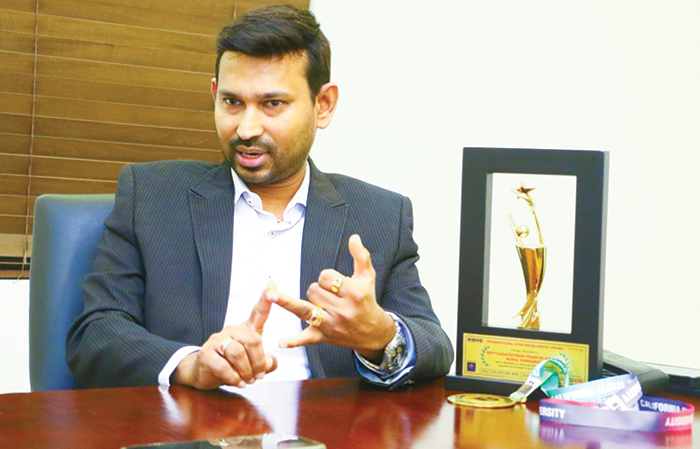
“Maximise value of existing assets rather than build new infrastructure”
By Saman Indrajith ✍️
Hettiarachchige Francis Adhista Sonal Fernando, who recently received an Honorary Professorship in Aviation Management from the University of California, Berkeley (Global), becoming the first Asian and reportedly one of only five recipients worldwide, says Sri Lanka should prioritise aviation technology, airline development and tourism over costly airport expansion projects.
In an interview with the Sunday Island, Prof. Fernando, a former Director of Airport and Aviation Services (Sri Lanka) and an aviation professional with more than two decades of experience, outlined what he described as a more strategic approach to developing the country’s aviation sector.
Having worked across a broad spectrum of aviation disciplines including passenger services, cargo operations, flight Operations, Training, airline management and airport administration, Prof. Fernando said Sri Lanka’s future success depended less on constructing new infrastructure and more on maximising the value of existing assets.
Prof. Fernando said the honorary professorship was awarded in recognition of his contributions to the aviation industry and initiatives undertaken during his tenure at Airport and Aviation Services (Sri Lanka).
“My career has taken me through almost every department of the aviation industry, from checking in passengers and handling cargo to serving as a Pilot captain, flight instructor, chief executive officer and Director of Airport and Aviation Services (AASL). That breadth of experience is relatively uncommon in the industry,” he said.
According to Prof. Fernando, Sri Lanka’s aviation sector recovered rapidly following the COVID-19 pandemic because of efforts to develop specialised aviation services rather than relying solely on passenger traffic.
He said one of the key proposals negotiated during his tenure was the establishment of an air cargo hub at Mattala International Airport, which had the potential to transform the facility into a regional logistics centre.
Another initiative involved plans to establish an international aviation training centre at Jaffna’s Palaly Airport.
Prof. Fernando said discussions had been held with the Royal Jordanian Air Academy, which he described as one of the world’s leading aviation training institutions, to establish operations in Jaffna with several aircraft and a multi-million-dollar investment.
“The project had the potential to attract students from South India, Singapore and other countries while generating valuable foreign exchange earnings for Sri Lanka,” he said.
Prof. Fernando expressed reservations about current proposals for extensive airport expansion projects, arguing that existing airport infrastructure was adequate to meet the country’s needs for the foreseeable future.
“Based on current trends, our airport capacity is sufficient for the next 20 to 25 years. Before spending billions on additional infrastructure, we need to focus on developing the airline industry itself,” he said.
Drawing comparisons with global aviation success stories, he pointed to Qatar’s strategy of first building a strong national carrier before undertaking major airport expansion.
“Resources would be better invested in strengthening SriLankan Airlines, improving tourism infrastructure and enhancing security and discipline across the country,” he said.
Prof. Fernando also criticised what he described as the increasing “militarisation” of civil aviation administration, arguing that airports should provide a welcoming and passenger-friendly environment.
“Civil aviation should be open and stress-free. Airports are the first impression visitors receive of a country, and the experience should reflect that,” he said.
He said efforts had previously been made to create a more accessible and less intimidating atmosphere at the country’s main international airport.
The aviation expert also raised concerns about the Harassment and Humiliation treatment to some outbound travellers, particularly passengers who are travelling on a visit and holiday,
According to Prof. Fernando, passengers who possess valid travel documents should not be prevented from travelling based on assumptions regarding their intentions.
“If a traveller has a valid passport, visa and ticket, the authority to stop that person lies with airline staff and Immigration. Decisions should not be based on appearance or social background,” he said.
On tourism, Prof. Fernando said Sri Lanka should avoid attempting to replicate the models adopted by destinations such as Dubai and instead develop an identity rooted in its own strengths as an island nation.
“We cannot simply copy Dubai. The Maldives has succeeded not only because of its airport infrastructure but because of its discipline, security and the importance it places on visitors,” he said.
He argued that tourism promotion campaigns should focus more heavily on attracting high-spending travellers by showcasing the country’s premium tourism offerings.
“We should be promoting our luxury hospitality sector, gems, business-class travel and other high-value experiences. That is how we attract visitors who contribute significantly to the economy,” he said.
Looking ahead, Prof. Fernando said investment priorities should centre on advanced aviation technologies rather than additional buildings.
He cited Category III-C (CAT III-C) landing systems as an example of technology capable of significantly enhancing operational efficiency by enabling aircraft to land safely even in extremely poor visibility conditions.
“Such technology can improve airport performance and international competitiveness far more effectively than constructing another terminal building,” he said.
Prof. Fernando said the long-term success of Sri Lanka’s aviation industry would depend on informed leadership and strategic planning.
“What the industry needs are leaders who understand aviation and are committed to its development, rather than viewing it solely through the lens of construction and infrastructure projects,” he said.
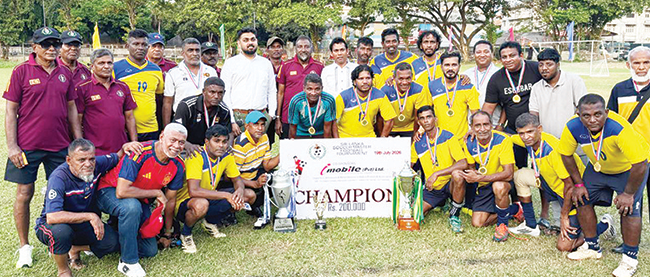
Super Stars VFC emerged champions of the 21st consecutive nine-a-side football tournament organised by the Sri Lanka Soccer Masters’ Association, while Galle Legends FC finished as runners-up in the veteran football competition held recently at the Shalika Grounds, Narahenpita, and Campbell Park, Borella.
Association President Irshad Haq said the annual tournament attracted 34 teams from across the country and featured a total of 71 matches, underscoring the continued popularity of veteran football in Sri Lanka.
He noted that the tournament provided a competitive platform for former footballers to remain actively involved in the sport while fostering camaraderie among veteran players. Haq added that many former national-level footballers and recently retired players participated in the event, enhancing the quality of competition and offering spectators an opportunity to witness traditional football skills displayed at a high standard.
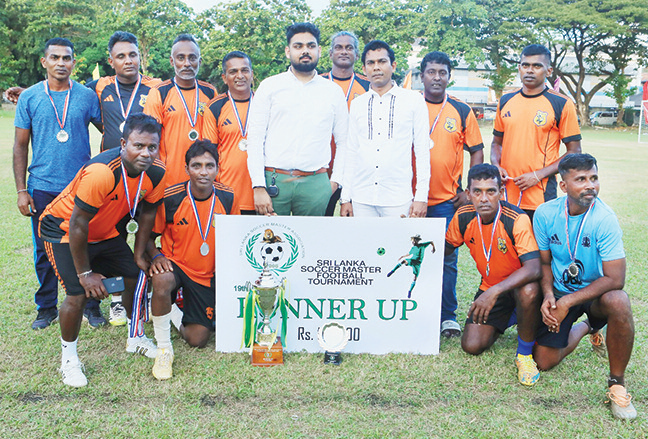
Runners up team with the Chief Guest
General Secretary Yoga Cruze said the tournament has become a landmark event on the local football calendar and continues to celebrate the contributions of former players to the sport. He said the Association remains committed to promoting veteran football and preserving the legacy of past football greats.
Tournament Committee Chairman P.G.P. Pieris said prize distribution and several special events were held during the tournament finale. The champions received cash awards together with a permanent trophy and the coveted challenge trophy, while the runners-up were also presented with cash prizes.
A special attraction at the event was an exhibition match involving veteran footballers over the age of 60. The match ended in a draw and the winner was decided by a coin toss.
Pieris said the tournament was organised not only to maintain competitive football among veterans but also to honour past legends of the game while providing fans with an entertaining and high-quality sporting spectacle.
Champions – Super Stars VFC: YML Jayathunga, Mohamed Iqbal, LAP Lakshitha, JR Pradeep Perera, M Mohamed Asmeer, SR Susil Pradeep, Mohamed Rikas, PR Sanjeewa Perera, MKJ Priyantha Perera, K Aruna Sampath, HMVR Perera (goalkeeper), RT Imtiyaz Raheem and WE Sarath de Alwis. Team Manager: Nazar Mohideen.
Runners-up – Galle Legends FC: PHN Pushpakumara, WA Nishantha, MS Fargan, BG Shiwanka, BPD Sudesh, MP Pradeep, HLR Jayalath, K Sirantha Kumara, ADD de Silva, AKR Priyanga and GAMA Indrajith.

Typhoon Noul makes landfall in China, with hundreds of thousands evacuated

Colombo Kaps down Dambulla Sixers by 21 runs

Kandy Royals win by 11 runs
Showers will occur in the Western, Sabaragamuwa and North-western provinces and in Galle, Matara, Kandy and Nuwara-Eliya districts

Govt. launches EPF, ETF shake-up

SLPI concerned over the proposed Chartered Institute of Media Professionals of Sri Lanka

‘Dates have the highest sugar content to fight Coronavirus’

Sunday Island 27 December – Headlines

#SundayIsland 17th December – Headlines

Sunday Island – 28th March

Sunday Island Headlines – 21 March

Sunday Island – 21st February – Headlines
-
 Midweek Review4 days ago
Three high-profile alleged suicides shaping key investigations
-

 News1 day ago
Fort Magistrate orders arrest of MP Archchuna
-

 Editorial1 day ago
An indictment of all parties
-

 News4 days ago
Customs asked to resume probe or face legal action
-
Editorial5 days ago
Welcome bid to tackle rolling death traps
-

 Opinion2 days ago
Ukraine’s power struggle spills on to the streets
-

 News1 day ago
National-level cybersecurity facility Lab established
-

 News6 days ago
Merchant Shipping Secretariat probes bribery scandal