
News
Indian Ocean temps vary from side to side

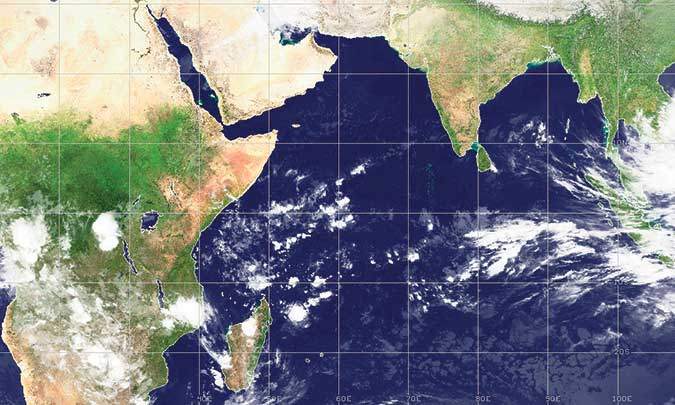
New research on the Indian Ocean dipole shows how melting ice water from massive glaciers can ultimately lead to droughts and flooding in East Africa and Indonesia.With a new analysis of long-term climate data, researchers say they now have a much better understanding of how climate change can cause sea water temperatures on one side of the Indian Ocean to be so much warmer or cooler than the temperatures on the other—a phenomenon that can lead to sometimes deadly weather-related events like megadroughts in East Africa and severe flooding in Indonesia.
The analysis, described in a new study in Science Advances, compares 10,000 years of past climate conditions reconstructed from different sets of geological records to simulations from an advanced climate model.
The findings show that about 18,000 to 15,000 years ago, as a result of melted freshwater from the massive glacier that once covered much of North America pouring into the North Atlantic, ocean currents that kept the Atlantic Ocean warm weakened, setting off a chain of events in response. The weakening of the system ultimately led to the strengthening of an atmospheric loop in the Indian Ocean that keeps warmer water on one side and cooler water on the other.
This extreme weather pattern, known as a dipole, prompts one side (either east or west) to have higher-than-average rainfall and the other to have widespread drought. The researchers saw examples of this pattern in both the historical data they studied and the model’s simulation. They say the findings can help scientists not only better understand the mechanisms behind the east-west dipole in the Indian Ocean, but also one day help to produce more effective forecasts of drought and flood in the region.
“We know that in the present-day gradients in the temperature of the Indian Ocean are important to rainfall and drought patterns, especially in East Africa, but it’s been challenging to show that those gradients change on long time-scales and to link them to long-term rainfall and drought patterns on both sides of the Indian Ocean,” says James Russell, a study author and professor of earth, environmental, and planetary sciences at Brown. “We now have a mechanistic basis to understand why some of the longer-term changes in rainfall patterns in the two regions have changed through time.”
In the paper, the researchers explain the mechanisms behind how the Indian Ocean dipole they studied formed and the weather-related events it led to during the period they looked at, which covered the end of the last Ice Age and the start of the current geological epoch.
The researchers characterize the dipole as an east-west dipole where the water on the western side—which borders modern day East African countries like Kenya, Ethiopia, and Somalia—is cooler than the water on eastern side toward Indonesia. They saw that the warmer water conditions of the dipole brought greater rainfall to Indonesia, while the cooler water brought much drier weather to East Africa.
That fits into what is often seen in recent Indian Ocean dipole events. In October, for example, heavy rain led to floods and landslides in Indonesian islands of Java and Sulawesi, leaving four people dead and affecting over 30,000 people. On the opposite end, Ethiopia, Kenya, and Somalia experienced intense droughts starting in 2020 that threatened to cause famine.
The changes the authors observed 17,000 years ago were even more extreme, including the complete drying of Lake Victoria—one of the largest lakes on Earth.
“Essentially, the dipole intensifies dry conditions and wet conditions that could result in extreme events like multi-year or decades-long dry events in East Africa and flooding events in South Indonesia,” says Xiaojing Du, a postdoctoral researcher in the Institute at Brown for Environment and Society and Brown’s department of earth, environmental and planetary sciences, and the study’s lead author. “These are events that impact people’s lives and also agriculture in those regions. Understanding the dipole can help us better predict and better prepare for future climate change.”
The dipole the researchers studied formed from the interactions between the heat transport system of the Atlantic Ocean and an atmospheric loop, called a Walker Circulation, in the tropical Indian Ocean. The lower part of the atmospheric loop flows east to west across much of the region at low altitudes near the ocean surface, and the upper part flows west to east at higher altitudes. The higher air and lower air connect in one big loop.
Interruption and weakening of the Atlantic Ocean heat transport, which works like a conveyor belt made of ocean and wind currents, was brought on by massive melting of the Laurentide ice sheet that once covered most of Canada and the northern US. The melting cooled the Atlantic and consequent wind anomalies triggered the atmospheric loop over the tropical Indian Ocean to become more active and extreme. That then led to increased precipitation in the east side of the Indian Ocean (where Indonesia sits) and reduced precipitation in the west side, where East Africa sits.
The researchers also show that during the period they studied, this effect was amplified by a lower sea level and the exposure of nearby continental shelves.
The scientists say more research is needed to figure out exactly what effect the exposed continental shelf and lower sea level has on the Indian Ocean’s east-west dipole, but they’re already planning to expand the work to investigate the question. While this line of the work on lower sea levels won’t play into modeling future conditions, the work they’ve done investigating how the melting of ancient glaciers impacts the Indian Ocean dipole and the heat transport system of the Atlantic Ocean may provide key insights into future changes as climate change brings about more melting.
“Greenland is currently melting so fast that it’s discharging a lot of freshwater into the North Atlantic Ocean in ways that are impacting the ocean circulation,” Russell says. “The work done here has provided a new understanding of how changes in the Atlantic Ocean circulation can impact Indian Ocean climate and through that rainfall in Africa and Indonesia.”
The study had funding from the Institute at Brown for Environment and Society and the National Science Foundation.



The Sri Lanka Navy successfully recovered its Fast Attack Craft P 4447 following a successful salvage operation, bringing a multi-stage emergency response to a close.
The craft, which ran into distress during a routine patrol on 15th August 2026 off Angulana, was brought to the surface on 11th September, from a depth of approximately 80 feet. It was
subsequently towed to the Colombo Dockyard premises.
The initial phase of the operation immediately following the incident focused on search and rescue. A joint effort involving the Navy, Air Force, Police, and local fishermen from Angulana
resulted in the rescue of 11 crew members. The search and rescue phase drew to a close with the recovery of the remains of the Second in Command of the craft, on 4th September.
Following the search and rescue phase, specialized Navy diving and salvage teams launched a dedicated recovery phase against rough sea conditions and underwater challenges, adhering to
strict safety protocols. The Navy’s marine, hull, electrical, and electronic engineering teams utilized specialized technical know-how and equipment to raise the vessel in stages.
Thus, the salvage operation marked an outstanding achievement attained through the professionalism, technical expertise of Navy divers, and coordinated contribution of all
engineering and technical branches of the Sri Lanka Navy. Technical support and specialized expertise were also extended by the Sri Lanka Ports Authority and Colombo Dockyard PLC.

By Shamindra Ferdinando
The Opposition should intensity its focus on the forthcoming selection of a member of the Commission to Investigate Allegations of Bribery or Corruption (CIABOC) and remain vigilant as Speaker Dr. Jagath Wickremaratne, MP, the head of the Constitutional Council (CC) tasked with making the relevant recommendation, is under investigation by the CIABOC, sources familiar with the ongoing inquiry told The Island.
Chethiya Goonasekara, PC, is expected to complete his three-year term on Dec 31, 2026. Sources pointed out that CIABOC Commissioners are appointed by the President on the recommendation made by the 10-member Constitutional Council.
The CIABOC initiated the investigation following a complaint lodged by suspended Chief of Staff and Deputy Secretary General of Parliament Chaminda Kularatne in early February this year. Sources said that as Goonasekera is scheduled to complete his term toward the end of 2026, the CC would have to call applications soon to choose the successor.
Goonasekara received his appointment from President Ranil Wickremesinghe in January 2024. A Justice W. M. N. P. Iddawala was appointed Chairman of the CIABOC. The other commissioner is K. Bernard Rajapakse.
Asked whether Iddawala and Rajapakse, too, would complete their terms soon, sources said that in terms of the Anti-Corruption Act No 09 of 2023, the Chairman of CIABOC would hold office for a period of five years, second commissioner (K. Bernard Rajapakse) for four years and the third commissioner (Chethiya Goonasekara) for a period of three years.
Sources said that the Opposition as well as civil society representatives in the CC should take up the issue of Speaker facing an investigation by the CIABOC taking part in the forthcoming selection process. Responding to queries, sources emphasized that the issue was whether in terms of Section 107 of the Anti-Corruption Act the participation of the Speaker in the selection process amounted to a violation of the Act itself.
The current members of the CC are Dr Jagath Wickramaratne, Speaker and Chairman of the Constitutional Council, Dr. Harini Amarasuriya, Prime Minister, Sajith Premadasa, Leader of the Opposition, Bimal Rathnayake, MP, Aboobucker Athambawa, MP, Ajith P. Perera, MP, Sivagnanam Shritharan, MP, Austin Fernando, Civil society representative, Prof. Wasantha Seneviratne, Civil society representative and Ranjith Ariyaratne, Civil society representative.
Sources pointed out that in spite of the sensitivity of the case, the CIABOC recorded Kularatne’s statement in the second week of August, six months after he lodged the complaint.
The CIABOC on 3, 8 and 10 Sept recorded the statements from the Transport Officer, Deputy Director, Administration and Assistant Director, Finance regarding the use of facilities by the Speaker, those assigned to his staff and other relevant matters.
The NPP named Dr. Wickramaratne as the Speaker after Asoka Ranwala resigned over controversy regarding his higher education qualifications.
SJB lawmaker Dayasiri Jayaskera has repeatedly raised the issues concerning the Speaker with the focus also on the Speaker using two government-managed residences, relevant staff in addition to expenditure on food, transport and fuel provided to the Speaker’s private secretary.
Political sources said that trouble erupted after the Parliamentary Staff Advisory Council in late January sacked Kularatne accusing him of providing false information to secure his appointment. Before being appointed as the Deputy Secretary-General of Parliament in 2023, Kularatne held several high-ranking positions, including Secretary to the Chief Government Whip, Additional Secretary to the President, Additional Secretary to the Prime Minister, and Additional Secretary to the Leader of the Opposition.
The SJB declared in Parliament that Ranwala should be brought back as the Speaker as they have no faith in Wickramaratne. MP Mujibur Rahuman jokingly told parliament that the Opposition wouldn’t raise Ranwala’s educational qualifications.

The Government Medical Officers’ Association (GMOA) has stressed the need to conduct a comprehensive countrywide cadre revision urgently.
GMOA spokesman Dr. Lasitha Dhammika told The Island that the failure on the part of successive governments to conduct cadre revision caused the deterioration of the public sector health services. Due to the absence of required statistics, they hadn’t been able to fully comprehend the situation on the ground and to ascertain the requirements of the public.
Dr. Dhammika pointed out the expansion of the services without supporting statistics and the need to initiate an immediate cadre revision. According to him, the GMOA had raised this issue with successive governments without success. The GMOA spokesman said that they also sought relevant information from the Health Ministry in terms of the Right to Information (RTI) Act two weeks ago but was yet to receive response.
(SF)

Fast Attack Craft P 4447 recovered in successful salvage operation

Showers above 100 mm are likely at some places in the Western, Central, Sabaragamuwa, Southern, North-central and North-western provinces

Shafali, Mandhana power India to eighth Asia Cup title

Tharanga wins Ultimate Javelin title

CIABOC member’s appointment: Controversy over Speaker under probe heading selection process

GMOA: Countrywide cadre revision not done since 2015

‘Dates have the highest sugar content to fight Coronavirus’

Sunday Island 27 December – Headlines

#SundayIsland 17th December – Headlines

Sunday Island – 28th March

Sunday Island Headlines – 21 March

Sunday Island – 21st February – Headlines
-

 Sports4 days ago
DDS set to lose Test captaincy
-
 News7 days ago
Thailand shuts door on undesirables from Sri Lanka
-

 News4 days ago
Sri Lanka faces new grid challenge as rooftop solar surges: former CEB GM
-

 Latest News4 days ago
Shafali, Deepti power India into sixth T20 Asia Cup final
-

 Business7 days ago
CEB successor company breaks into top three in competitive BESS tender
-
 Opinion6 days ago
Navigating Sri Lanka’s Israeli Dilemma
-

 Latest News3 days ago
Sri Lanka thwart Fatima Sana challenge to secure Asia Cup final spot
-
 Features5 days ago
Lost for 90 years: Rare Goby resurfaces in Jaffna