
News
India maintains ‘loud silence’ on Taiwan crisis, its ‘One China’ policy


SL too on agenda
BY S VENKAT NARAYAN
Our Special Correspondent
NEW DELHI, August 6: India is maintaining a studied “loud silence” on the tensions between China and the United States and the developments in the Taiwan Straits in the wake of US House Speaker Nancy Pelosi’s controversial visit to Taipei last week. The decision to say nothing on the raging issue is deliberate to avoid controversy, say officials and experts.While other countries in the region reiterated their One China policy, India chose to say nothing on the subject either. In fact, India has stopped talking about it since at least 2008.
India has omitted any mention of the growing crisis over Taiwan even in the talks External Affairs Minister Dr Subrahmanyam Jaishankar has held on the sidelines of the meeting of the Association of SouthEast Asian Nations (ASEAN) in Cambodian capital Phnom Penh.On Thursday, Jaishankar attended the ASEAN-India summit, and held talks with US Secretary of State Antony Blinken, as well as Foreign Ministers of Australia, Sri Lanka and Vietnam.
Jaishankar called the talks with Ministers “productive” and “warm”, and said he had discussed a number of issues with ASEAN countries including the “Indo-Pacific, UNCLOS, connectivity, COVID-19, terrorism, cybersecurity, Ukraine and Myanmar”, without referencing the Taiwan situation.
The US State Department said in its readout of the Jaishankar-Blinken meeting: “The two exchanged views on global and regional issues, including Russia’s brutal aggression against Ukraine and the implications it has had on food insecurity around the world.”
They also discussed “Sri Lanka’s economic crisis and promoting accountability for the [Myanmar] regime’s atrocities,” it added.Officials and experts said India’s decision not to comment on the situation unfolding after Pelosi’s visit to Taipei, followed by China’s sharp reaction, military exercises and missile tests, is a “carefully decided” one. It is aimed at ensuring that India does not wish to cause a controversy with China at a sensitive time in Sino-Indian border talks. New Delhi does not wish to claim allegiance to the “One China policy” either. Said a former senior official, now retired: “A loud silence is probably the best response to the situation.”
India has indeed followed the One China policy since 1949. It does not recognize any government other than the one in Beijing. India only conducts trade and cultural ties with Taiwan.New Delhi stopped mentioning the so-called One China policy in official statements and joint declarations after 2008. According to officials at the time, the government had taken the decision after a series of Chinese statements claiming Arunachal Pradesh as a part of the Chinese territory, renaming Arunachal towns with Mandarin names, and issuing “stapled visas” to Indian citizens who were residents of Jammu and Kashmir and Arunachal Pradesh.
In 2010, during meetings with President Hu Jintao in Brasilia, and Premier Wen Jiabao, joint statements with Prime Minister Manmohan Singh did not refer to the One-China principle. One senior retired Indian official explained, “The thinking was: Why is there a need to reiterate the One-China policy when China was not taking our sensitivities into account?” It was not a change in policy but a decision to not repeat it.
“We conveyed that if the Chinese side desired India to state the One-China policy, then it should respect a One-India principle,” said another former official.
Officials confirmed that in 2014, then External Affairs Minister Sushma Swaraj had endorsed the decision, too.However, in separate statements issued last week, ASEAN Foreign Ministers as well as countries in the region like Sri Lanka, Bangladesh and Pakistan had pointedly affirmed their commitment to the “One-China policy.”
Sri Lanka’s President Ranil Wickremesinghe on Thursday affirmed the island nation’s commitment to the ‘One China Policy’ and asked countries to “refrain from provocations” in a message apparently directed to the United States.
“Pakistan is deeply concerned over the evolving situation in the Taiwan Strait, which has serious implications for regional peace and stability,” said the Pakistani Foreign Office’s statement. It added that Pakistan “stands by” the One-China principle. Bangladesh’s Foreign Ministry reiterated its “firm adherence” to the One-China policy as well.
The ASEAN statement “reiterated member-states’ support for their respective One-China Policy.” It also warned that destabilisation in the region could spark “miscalculation, serious confrontation, open conflicts and unpredictable consequences among major powers”.
Even G-7 countries, that include the United States and Japan, said there was “no change in the respective One-China policies, where applicable, and basic positions on Taiwan of the G7 members”.
However, the statement strongly criticised the People’s Republic of China (PRC) for its “threatening” and “escalatory” response to the Pelosi visit, which prompted Chinese Foreign Minister Wang Yi to cancel his meeting with the Japanese Foreign Minister in Phnom Penh.

Latest News
IMF Executive Board approves US$206 Million in Emergency Financial Support for Sri Lanka


The IMF Executive Board approved emergency financing under the Rapid Financing Instrument (RFI), providing Sri Lanka with immediate access to SDR 150.5 million (about US$206 million,
equivalent to 26 percent of quota) to help Sri Lanka address the urgent needs arising from the catastrophic Cyclone Ditwah and preserve macroeconomic stability.

In response to severe weather impacts, the Sri Lanka Navy conducted a diving and technical assistance operation on Friday (19 Dec 25) to clear major debris obstructing vital infrastructure.
Heavy rainfall caused a significant rise in the water level of the Mahaweli River, washed large quantities of debris, including logs and bamboo, downstream. These remain lodged in the Diyakapanathota in Gatambe, Peradeniya and Lewella bridges, obstructing the smooth flow of water.
Acting promptly upon request, a Navy diving team executed a coordinated operation in collaboration with the Road Development Authority. The team removed the accumulated debris, restoring normal water flow through the bridges.
Latest News
Landslide early warnings issued to the districts of Badulla, Kandy, Kurunegala, Matale and Nuwara-Eliya extended till 8AM on Sunday (21)
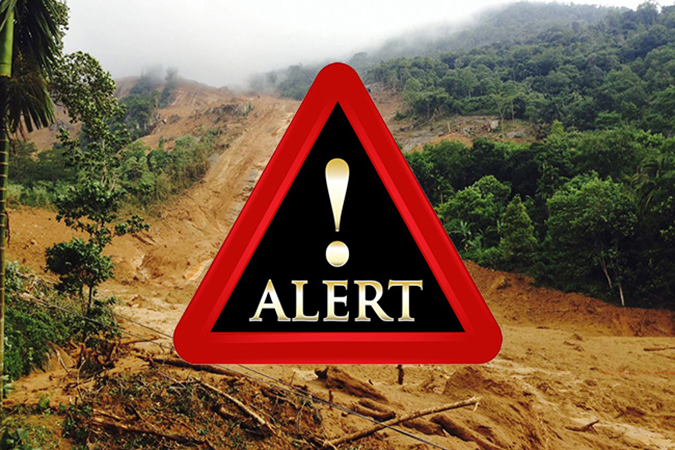
The Landslide Early Warning Centre of the National Building Research Organization (NBRO) has extended the Landslide Early Warning issued to the districts of Badulla, Kandy, Kurunegala, Matale and Nuwara-Eliya till 08:00AM on Sunday (21st December 2025)
The LEVEL III RED landslide early warnings issued to the Divisional Secetaries Divisions and surrounding areas of Medadumbara, Doluwa, Ududumbara and Minipe in the Kandy district, and Nildandahinna, Hanguranketha, Mathurata and
Walapane have been extended.
LEVEL II AMBER landslide early warnings have also been issued to the Divisional Secetaries Divisions and surrounding areas of Soranathota, Hali_Ela, Passara, Meegahakivula, Badulla, Lunugala and Kandeketiya in the Badulla district, Thumpane, Harispattuwa, Udapalatha, Kundasale, Akurana, Poojapitiya, Udunuwara, Pathadumbara, Pasbage Korale, Gangawata Korale, Hatharaliyadda, Yatinuwara, Ganga Ihala Korale, Panvila, Pathahewaheta and Deltota in the Kandy district, Rideegama in the Kurunegala district, Ukuwela, Naula, Matale, Ambanganga Korale, Rattota, Pallepola, Wilgamuwa, Yatawatta and Laggala Pallegama in the Matale district, and Nuwara-Eliya in the Nuwara-Eliya district.
LEVEL I YELLOW landslide early warnings have been issued to the Divisional Secetaries Divisions and surrounding areas of Uva Paranagama, Welimada, Haputhale, Haldummulla, Ella and
Bandarawela in the Badulla district, Alawwa, Mallawapitiya,
Polgahawela and Mawathagama in the Kurunegala district, and Kothmale East, Ambagamuwa Korale, Kothmale West, Thalawakele and Norwood in the Nuwara-Eliya district.

IMF Executive Board approves US$206 Million in Emergency Financial Support for Sri Lanka

Navy clears major bridge obstructions in Peradeniya and Lewella

Landslide early warnings issued to the districts of Badulla, Kandy, Kurunegala, Matale and Nuwara-Eliya extended till 8AM on Sunday (21)

Trump says US launched large-scale attacks on ISIL in Syria

Showers will occur in the Eastern, Western, Sabaragamuwa, Southern, Uva and Central provinces and in Polonnaruwa district

PM says govt. will introduce a new Constitution to abolish executive presidency

‘Dates have the highest sugar content to fight Coronavirus’

Sunday Island 27 December – Headlines

#SundayIsland 17th December – Headlines

Sunday Island – 28th March

Sunday Island Headlines – 21 March

Sunday Island – 21st February – Headlines
-

 Midweek Review4 days ago
How massive Akuregoda defence complex was built with proceeds from sale of Galle Face land to Shangri-La
-

 Features7 days ago
Why Sri Lanka Still Has No Doppler Radar – and Who Should Be Held Accountable
-

 News3 days ago
Pakistan hands over 200 tonnes of humanitarian aid to Lanka
-

 News3 days ago
Pope fires broadside: ‘The Holy See won’t be a silent bystander to the grave disparities, injustices, and fundamental human rights violations’
-
 Latest News7 days ago
Landslide early warnings in force in the Districts of Badulla, Kandy, Kegalle, Kurunegala, Matale, Nuwara Eliya and Ratnapura
-

 News4 days ago
Burnt elephant dies after delayed rescue; activists demand arrests
-

 Features7 days ago
Srima Dissanayake runs for president and I get sidelined in the UNP
-

 Editorial4 days ago
Colombo Port facing strategic neglect