
Latest News
India crowned champions after pipping New Zealand in a tense final


Despite the stiff challenge posed by New Zealand, India clinched the ICC Champions Trophy 2025 by a four-wicket margin, marking the third time they won this title. Chasing 251 in the final on a tricky surface in Dubai, India were put under pressure both with the bat and ball but they managed to put in a collective effort that saw them get over the line to go through the tournament unbeaten, and add a seventh ICC senior trophy to their cabinet.
India got off to a rollicking start in the chase led by skipper Rohit Sharma. In a 105-run opening stand, Rohit dominated contributing 69 off 63 and setting the tone early. With the conditions favouring spin, both teams targeted the pacers well with Rohit’s assault nearly making a mockery of the chase. The first eight overs bowled by New Zealand’s pacers, sans their injured spearhead Matt Henry, saw Rohit race off to 47 in a team score of 59.
It forced Mitchell Santner to bring himself on but by and large the openers were able to keep the run-rate up even while toning down the aggression. Reaching 106 by 19 overs, India were firmly in the driver’s seat before New Zealand pulled things back.
Santner had Shubman Gill caught splendidly at cover by a leaping Glenn Phillips, who added to his highlights reel of eye-popping catches, while Michael Bracewell struck with his first ball turning one past Virat Kohli’s flick to trap him LBW for one. Losing two wickets in the space of four balls put the pressure back on India and New Zealand’s spinners began to apply the choke. Even a well-set Rohit had to cut the risks out while Shreyas Iyer settled in.
This brought about a phase of 11 dot balls in a row before Rohit gave charge to Rachin Ravindra only to be stumped. At 122/3, the game was tilting back to parity with India in need of another partnership.
Axar Patel and Shreyas Iyer mixed caution with aggression to push things back. The latter got a life early on when Will Young made a valiant attempt at the deep mid-wicket boundary to take a catch but stepped onto the ropes while tossing it back into play.
Iyer and Patel went about a sedate stand but added 62 crucial runs with Kyle Jamieson dropping a sitter at long on when Iyer was on 44. But that did not prove too costly as Iyer took on Mitchell Santner soon after in an attempt to clear short fine leg only to be taken by Rachin Ravindra. With the asking rate hovering around the run-a-ball mark, KL Rahul came in and lofted Santner for a six early on easing some nerves. But there was another twist on course as a well-set Patel miscued a loft off Bracewell to hole out to long off.
Needing 48 in as many balls, the final was still firmly in balance. But Rahul and Hardik Pandya got boundaries ever so often at the back-end to keep India well within the asking rate. Pandya’s 18-ball 18 was ended by a bouncer from Jamieson but India needed only 11 off 15 by this point. Some smart batting from Jadeja and Rahul thereafter saw India home staving off a stiff fight from New Zealand.
Just as they did with the ball, New Zealand had made sure that India wouldn’t run away with the game with the ball as well. Despite a sustained effort from India’s spinners, they managed to get to a competitive total.
Daryl Mitchell fought his way to a 101-ball 63 as he absorbed and tried to revert the pressure exerted by India’s spin quartet. The four of them had not only dragged the game back in India’s favour after a rapid start in the powerplay but changed the colour of the innings overall on a slow surface sticking to straight lines largely.
Early on, it was New Zealand that did all the running thanks to an attacking Rachin Ravindra at the top. The leading run-scorer of the tournament showcased the form he was in with some delectable shots off the pacers. Hardik Pandya was picked up for 16 in an over while Mohammed Shami too was flicked elegantly making Rohit Sharma turn to his spin weapon earlier than at any point previously in the tournament.
Varun Chakaravarthy started with a googly that went for four byes first up but created the chance that India was after with Ravindra top-edging a slog-sweep. But Iyer, running across from deep midwicket, could not hold on to the opportunity. Ravindra now had two chances put down in as many overs with Shami failing to latch on to a tough return chance before. But Chakaravarthy still managed to break a 58-run opening stand in that over trapping Will Young plumb LBW while missing a flick. After 10 overs, Ravindra was looking in ominous form hitting 37 off the 69 they had raced to.
But Kuldeep Yadav turned the innings on its head with his first delivery of the game – a wrong ‘un that sneaked past Ravindra’s dab. He pulled things further towards India in his following over when he deceived Kane Williamson in the air and accepted a simple return-catch.
At 75/3, New Zealand were now made to take the foot off the accelerator as they risked a crash and burn. Both Tom Latham and Daryl Mitchell went the conservative way even as the boundaries dried up against the spinners. Ravindra Jadeja and Axar Patel kept the pressure up through the middle overs allowing no freebies even when there was no extravagant turn on offer. The final saw India’s spinners being required to bowl more than they did in any game in the tournament, and that they managed to collectively bowl within stump lines for 37% of the time meant that New Zealand’s risk-taking always came with a greater threat than usual.
Their 33-run stand off 66 balls contained only one boundary before Latham missed a sweep to be LBW against Jadeja. Mitchell, however, did not deviate from the template that he had for himself and stitched together another dour 57-run stand with Glenn Phillips for the fifth wicket. Both batters were also dropped once each against an uncharacteristically poor day on the field for India’s catchers. But Phillips couldn’t make the most of it as he was bowled by a googly from Chakaravarthy for 34.
Mitchell, meanwhile, brought up a hard-fought fifty and began to switch gears alongside an adventurous Michael Bracewell. Their 45-run stand powered New Zealand past 200 but just when they were sizing up for a big finish, Mitchell ended up spooning Shami to cover. But Bracewell was able to keep the momentum going with some smart batting against the pacers in the death overs. He brought up his fifty in the final over and dragged New Zealand past the 250-mark with 35 coming in the last three overs bowled by pace.
Brief Scores:
New Zealand 251/7 in 50 overs (Daryl Mitchell 63, Michael Bracewell 53*; Varun Chakaravarthy 2-45, Kuldeep Yadav 2-40) lost to India 254/6 in 4 overs (Rohit Sharma 76, Shreyas Iyer 48) by 4 wickets
[Cricbuzz]


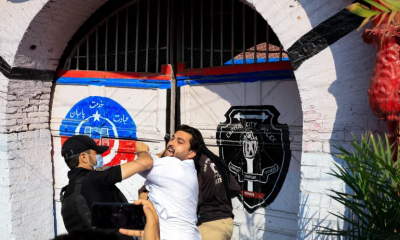




The Pakistan Tehreek-e-Insaf party of jailed ex-Prime Minister Imran Khan is planning to legally challenge the federal government’s Sunday takeover of Khyber Pakhtunkhwa, a province that the party governed.
Sheikh Waqas Akram, the PTI’s central information secretary, told Al Jazeera that the party would challenge the imposition of emergency laws — suspending civil liberties — and governor’s rule in the province in court on Tuesday. A petition had been drafted by a legal committee headed by PTI secretary general Salman Akram Raja, but Akram did not say whether it would be filed in the Supreme Court or the Federal Constitutional Court.
The federal government’s moves have emerged as Pakistan’s latest political flashpoint, with competing narratives from the government and the PTI, at a time when the party was in the middle of a delayed march towards Islamabad, aimed at pressuring authorities to release former PM Khan, who has been in incarceration for more than three years.
Interior Minister Mohsin Naqvi on Monday justified the government’s moves by arguing that federal rule in Khyber Pakhtunkhwa was needed for Pakistan to effectively combat “terrorism” in the province that shares a porous border with Afghanistan.
“No war can be won, however many resources you bring, whatever you do, until the government there leads it,” Naqvi said in Peshawar on Monday.
On Sunday, President Asif Ali Zardari imposed emergency rule and governor’s rule, suspending the PTI government in the northwestern province. The party has governed Khyber Pakhtunkhwa since 2013.
[Aljazeera]

Pathum Nissanka’s return to the red-ball fold provides a downtrodden Sri Lanka with a timely boost, while debuts are also in the offing for wicketkeeper Anjala Bandara and seamer Eshan Malinga after both were named in Sri Lanka’s 15-man squad for the upcoming two-Test series against Pakistan.
The 22-year-old Bandara is tipped to make the playing XI following Kusal Mendis’ promotion to captain, with the longtime Test keeper now likely to play solely as a specialist batter. Malinga’s inclusion is less certain, with Asitha Fernando, Lahiru Kumara, Milan Rathnayake and Dilshan Madushanka – who returns to the squad having been omitted from the one named for the second Test against India – all in line to make up Sri Lanka’s pace contingent. Dinesh Chandimal, who missed the second India Test with an injury, is also in the squad.
Making way are Kamil Mishara and Sahan Arachchige – both of whom had drafted in for the second Test against India – as well as Lahiru Udara, Niroshan Dickwella and Vishwa Fernando.
Malinga’s inclusion comes as Sri Lanka’s red-ball fast-bowling stocks had been waning. Former skipper Dhananjaya, who has been retained in the squad, had been vocal during the India tour of Sri Lanka’s need for more express seamers in the playing XI – aside from Lahiru Kumara, who is capable of clocking speeds in the 140kph range, most other options tend to veer around the low 130s. Malinga is certainly capable of matching Kumara on the speed gun, and that could point towards a potential first Test cap.
Bandara has been a player of genuine promise since making his debut in 2022, with his 31 first-class matches fetching 2239 runs at an average 65.85. There had been a clamour among fans for The Colombo CC keeper to be included in the squad to face India, but that spot was eventually taken by Dickwella.
The rest of the squad pans out as expected, with Nissanka’s return the headline. Pasindu Sooriyabandara, who made his debut earlier this year against India, retains his place ahead of the more experienced Udara. However if Bandara does take up wicketkeeping duties as expected, it Dhananjaya could be the odd man out, with Chandimal, Kamindu Mendis, Sonal Dinusha and Kusal Mendis all assured a spot in the playing XI. Sri Lanka have two spin bowling options in Prabath Jayasuriya and Keshara Nuwantha.
The first Test will take place in Rawalpindi on November 9.
Sri Lanka squad for Pakistan Tests
Pathum Nissanka, Pasindu Sooriyabandara, Dinesh Chandimal, Kamindu Mendis, Sonal Dinusha, Kusal Mendis (capt), Dhananjaya De Silva, Anjala Bandara, Keshara Nuwantha, Prabath Jayasuriya, Milan Rathnayaka, Lahiru Kumara, Asitha Fernando, Dilshan Madushanka, Eshan Malinga
[Cricinfo]

Former Zimbabwe fast bowler and umpire Sarah Dambanevana passed away in Harare on Monday. She was 36.
A Zimbabwe Cricket release said Dambanevana was in hospital receiving care since undergoing a medical procedure in March.
Her senior international umpiring career began on 2 September 2023, and she went on to officiate at the Women’s T20 World Cup 2024 in the UAE and the Women’s ODI World Cup 2025 in India and Sri Lanka, where she was part of the tournament’s historic all-female panel of match officials.
Prior to that, Dambanevana officiated in the final between India and England at the 2023 Under-19 Women’s T20 World Cup in South Africa, becoming the first Zimbabwean woman to umpire a World Cup final.
Overall, she officiated in 63 senior internationals, comprising 42 women’s T20Is, 11 women’s ODIs and 10 men’s T20Is, alongside her assignments in domestic cricket and global youth tournaments.
Dambanevana also represented Zimbabwe as a player between 2009 and 2014, including at the World Cup Qualifier in 2011. She joined the ICC development panel of umpires in 2022.
“Sarah served Zimbabwe with distinction, first as a player and then as an umpire whose ability earned her a place on the world stage,” ZC chairman Tavengwa Mukuhlani said. “Watching her stand in a World Cup final was a moment of immense pride for our cricket community and our country. She showed young Zimbabwean women that they belong at the highest levels of the game, including in roles where opportunities had long been limited.
“Through her achievements, she opened doors and gave others the confidence to pursue their own ambitions. We will remember her dedication, her professionalism and her willingness to help others grow. Her passing leaves a painful void in our cricket family, but the example she set will continue to inspire those who follow in her footsteps.”
(Cricinfo)

Obtaining financial facilities for the Water Supply and Sanitation Improvement Program (Sub-program 2) from the ADB

Delegation from Korean Volunteer Association meet Secretary to the President

Imran Khan’s PTI braces to fight federal takeover of Khyber Pakhtunkhwa

Nissanka’s return headlines Sri Lanka’s Test squad against Pakistan

HRCSL issues recommendation on seizure of four books by B. Piratheepan by Sri Lanka Customs

Former Zimbabwe player and umpire Sarah Dambanevana dies aged 36

‘Dates have the highest sugar content to fight Coronavirus’

Sunday Island 27 December – Headlines

#SundayIsland 17th December – Headlines

Sunday Island – 28th March

Sunday Island Headlines – 21 March

Sunday Island – 21st February – Headlines
-

 Features6 days ago
The Sri Lankan who made Scottish history
-

 Sports6 days ago
Nissanka absence opens door for Sri Lanka’s young guns
-

 News5 days ago
NDB fraud Rs 60mn more than reported
-
 News7 days ago
Gnansara Thera to be assigned to prison printing section: Officials
-

 News5 days ago
Removing monk’s robes matter for Sangha to decide: Mahanayake Theras
-

 News7 days ago
OIC of FCID summoned before Maligakanda Magistrate
-

 Features6 days ago
Future of Sri Lanka’s state university system: Should it be shut down and reopened?
-
 News6 days ago
Shiranthi R remanded until 13 Oct.