
Business
Importance of GSP for apparel sector


An apparel worker
By Jeevith Senaratne
Sri Lanka’s apparel industry – which accounts for 47 per cent of the nation’s exports and 15 per cent of industrial employment – is critical to our national economic health and well-being. Therefore, ensuring that the industry remains strong and resilient should be very high on our list of national priorities.
Given this backdrop, managing Sri Lanka’s relationships with key trading partners becomes highly significant, especially the few that we have preferential trading relationships with. A case in point is the European Union (EU).
The Generalised System of Preferences (GSP) or GSP, a preferential tariff system of the EU, one of our main export markets, plays a key role in Sri Lanka’s export competitiveness – and in the apparel industry’s success story. We cannot afford to lose access to our second largest export market, but the risk of that happening is real.
Here’s a situational summary: the European Parliament asked the European Commission (EC) to consider suspending Sri Lanka’s GSP+ status (explained a few paragraphs below), which it had restored in 2017 after first revoking it in 2010. The EC’s decision-making processes are however, grounded in economic rationale, and different from the calculus of the European Parliament, whose considerations are primarily political.
The timing is significant; the current GSP regulations will expire on 31st December 2023, and the renewal of the scheme is under review at present. This matters for another important reason: two other markets that the Sri Lankan apparel industry hopes to enter – Japan and Australia – also have GSP schemes, modelled on the EU. The EC’s actions could – potentially – affect those plans.
There are other reasons GSP+ access needs to be protected; look at the economic benefits that the apparel industry has contributed, the jobs it has created, its impact on economic development across the country, the reduction between rural and urban incomes that it has enabled and how it has empowered women by dramatically increasing their participation in the workforce.
Apparel accounted for 59 per cent of our country’s merchandise exports in 2020: $4.4 billion out of $7.7 billion, and just a shade under 5.5 per cent of GDP. It employs 350,000 people directly, and roughly twice that number indirectly. Women are 78 per cent of the industry’s employees, compared to the national average of 34 per cent for female participation in the workforce.
A 2018 study by the data analytics and insights company Kantar found that employees in the apparel industry were proud of being part of it; women felt empowered and glad to have economic independence. Additionally, earnings of people moving from rural to urban apparel industry jobs, boosts incomes in rural Sri Lanka, reducing rural poverty substantially.
A brief explanation of what GSP is, and how it works will help understand why retaining it is important. In essence, GSP+ is a special incentive arrangement aimed at sustainable development and good governance in vulnerable, low and lower-middle income countries. Vulnerability is assessed based on a country’s imports and economic diversification.
GSP+ countries – there are 7 others apart from Sri Lanka – have to implement 27 core international conventions on human rights, labour rights, protection of the environment and good governance. The EU reduces customs duties for the products under the general GSP arrangement to 0 per cent for GSP+ countries. GSP+ benefited roughly $1.9 billion of Sri Lanka’s exports to EU countries in 2019.
In its 2019 annual report, the EU said apparel accounted for 48 per cent of the 184 billion Euro under GSP+. This number highlights how vital being eligible for GSP+ is to remain competitive in accessing the European market.
Since we import a little over half the raw materials used in the apparel industry, we cannot, under current EU rules, get zero duty benefits on the full value of apparel exports to the EU, which were $1.2 billion in 2019. Zero duties were allowed on $586 million, or roughly 42 per cent.
That’s because we use a large part of imported content in our apparel. GSP+ has conditions called ‘country of origin’ rules, whereby you can only benefit from zero duty if the product was made from fabric that originated from a SAARC country.
The upcoming fabric processing park at Eravur gains additional importance in light of this. This fabric park is a project that has been under consideration for a long time; and when completed, it will add to our raw material processing capacity and enable import substitution. The decision by the GoSL to expedite this park will be a major boost to the Sri Lankan apparel manufacturer as it will allow for a greater utilization of GSP+. The zone will have a central wastewater treatment facility which is of significant value to investors in a fabric park.
In layman terms, at least in apparel, the loss of GSP+ would on average make Sri Lankan exports to the EU 9.5% more expensive than it is in the status quo. This “surcharge” would come on the back of Sri Lankan apparel already being more “expensive” than that of our competitors.
Rather than being cost-competitive like some competitor nations, our apparel industry focuses on value addition, estimated at close to $2.4 billion on $5.3 billion of apparel exports in 2019 (after deducting costs of raw material imports), or 52 per cent. With strategic initiatives like the fabric park in Ervaur, we can aim towards 65% value addition within Sri Lanka in the not-too-distant future. However, the viability of ventures such as the fabric park hinge on investors being able to reap the full reward presented through the existence of preferential trade agreements.

Business
David Pieris Group expands global footprint with investment in Dubai-based Navire Logistics


The David Pieris Group continues to strengthen its international presence with the acquisition of 50% ownership in Navire Logistics Services L.L.C, (www.navirelogistics.com) a reputed logistics company based in Dubai and Oman. This strategic move marks a significant milestone in the Group’s journey towards expanding its operations beyond Sri Lanka and positioning itself in the international markets.
In Sri Lanka, the Group’s logistics arm, D P Logistics (Private) Limited (DPL), has already established itself as a comprehensive logistics solutions provider — covering warehousing, transportation, freight forwarding, project logistics, inland distribution and custom house brokering.
DPL currently ranks among the top ten players in warehousing and 3PL operations and holds one of the largest container fleets amongst the logistics companies in the country. Despite operating in a highly fragmented freight forwarding market, DPL continues to capture a growing share, reinforcing its reputation as one of the very few local companies with expertise across all logistics disciplines.
David Pieris Group also acquired in 2022, Pulsar Shipping Agencies (Pvt.) Limited, the shipping arm of Expolanka Holdings PLC to expand its Logistics & Shipping Cluster into ship agency, husbandry services and marine logistics.
Leveraging this strong domestic foundation, DPL has now extended its capabilities to the international stage through its partnership with Navire Logistics Services L.L.C. The company’s expertise in custom house brokering, freight forwarding, cargo consolidation, warehousing, and transport solutions will be integrated into Navire Logistics’ operations, enhancing service quality and efficiency across the Middle East and South Asia.
The investment also extends to operations in Oman through a fully owned subsidiary, with further expansion plans already underway to establish operations in Saudi Arabia, Thailand, and India — strengthening the Group’s regional logistics network.
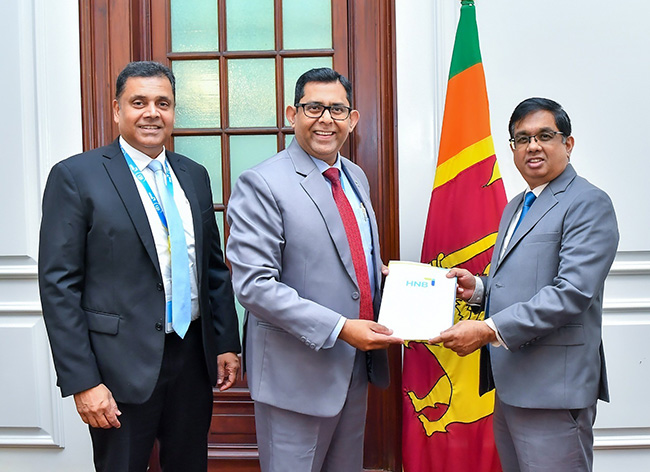
HNB PLC has contributed of Rs. 100 million towards the Rebuild Sri Lanka Fund, reinforcing its commitment to national recovery efforts following the devastation caused by Cyclone Ditwah.
“On behalf of HNB, I wish to convey our solidarity with all our fellow Sri Lankans, especially those severely affected by Cyclone Ditwah. As a home-grown institution, our connection to the communities we serve runs deep. Many of our customers and colleagues have been directly or indirectly affected, and we are committed to standing with them during this difficult time and supporting them as they rebuild.”
“HNB’s contribution to the Rebuild Sri Lanka Fund is a sign of our commitment to this collective mission. We recognize that this is going to be a long and challenging process, but we stand ready and committed to support both the immediate and long-term recovery effort,” HNB Managing Director/ CEO, Damith Pallewatte stated.
Complementing its direct financial support to the Fund, HNB has also launched a nationwide disaster relief initiative as the first phase of a broader, coordinated response from the bank.
As part of the program, the Bank donated over 2,500 essential relief and nutrition packages to support displaced families, with the consignments formally handed over to the Sri Lanka Army to ensure structured, transparent, and equitable distribution across the impacted areas of Kandy, Gampaha, Kaduwela, and Hanwella, while separate packages were provided to affected employees to strengthen their personal recovery.

The Commercial Bank of Ceylon has been ranked No 1 in the Business Today Top 40 for 2024–25, reaffirming its position as Sri Lanka’s best-performing bank and one of the country’s top five strongest corporate entities for the 17th consecutive year.
Business Today assigned the Bank an aggregate score of 37.65, placing it at the top of its latest ranking of leading Sri Lankan enterprises.
In its presentation of the rankings, Business Today described Commercial Bank as “a beacon of resilience and renewal after a defining year,” noting that 2024 was shaped by strategic transformation, disciplined execution, and unwavering commitment to long-term sustainable growth. The publication recognised the Bank’s strength across key business lines, its deepened customer focus, and a performance trajectory that reinforced its reputation as Sri Lanka’s most resilient and customer-centric financial institution.
Reflecting on the ranking, Mr Sanath Manatunge, Managing Director/CEO of Commercial Bank said: “Being ranked No 1 in the Business Today Top 40 is a powerful endorsement of the discipline, resilience and purpose with which we steered the Bank through a year of tough conditions and decisive transformation. Our performance in 2024 was defined by navigating turbulence without losing sight of our priorities: strengthening fundamentals, supporting customers, and preparing the institution for long-term growth. This ranking is not merely an award; it is confirmation that our strategy is delivering results and that the Bank is firmly positioned to contribute to national progress with renewed confidence.”
Business Today also highlighted the Bank’s record-breaking financial performance during the year. The magazine quoted Mr Sharhan Muhseen, Chairman of Commercial Bank as saying that the Bank had delivered the highest profits in its history, and attributing this outcome to a disciplined focus on efficiency, digital innovation, and customer-centred transformation. These qualities, the publication stated, enabled the Bank to strengthen its market position and make meaningful contributions to economic recovery.
Among the milestones recognised were an equity capital infusion of Rs. 22.54 billion through a rights issue and the raising of Rs. 20 billion in Tier II capital via a debenture issue.

Trump says US launched large-scale attacks on ISIL in Syria

Showers will occur in the Eastern, Western, Sabaragamuwa, Southern, Uva and Central provinces and in Polonnaruwa district

PM says govt. will introduce a new Constitution to abolish executive presidency

Opposition Leader rises in defence of Dr. Bellana

Dr. Bellana suspended for speaking to media

257,000 households paid house cleaning grant of Rs 25,000 out of 493,000 eligible to receive it

‘Dates have the highest sugar content to fight Coronavirus’

Sunday Island 27 December – Headlines

#SundayIsland 17th December – Headlines

Sunday Island – 28th March

Sunday Island Headlines – 21 March

Sunday Island – 21st February – Headlines
-

 Midweek Review3 days ago
How massive Akuregoda defence complex was built with proceeds from sale of Galle Face land to Shangri-La
-

 Features6 days ago
Why Sri Lanka Still Has No Doppler Radar – and Who Should Be Held Accountable
-

 News2 days ago
Pakistan hands over 200 tonnes of humanitarian aid to Lanka
-

 News2 days ago
Pope fires broadside: ‘The Holy See won’t be a silent bystander to the grave disparities, injustices, and fundamental human rights violations’
-

 Latest News6 days ago
Landslide early warnings in force in the Districts of Badulla, Kandy, Kegalle, Kurunegala, Matale, Nuwara Eliya and Ratnapura
-

 News3 days ago
Burnt elephant dies after delayed rescue; activists demand arrests
-

 Features6 days ago
Srima Dissanayake runs for president and I get sidelined in the UNP
-

 Editorial6 days ago
Disaster relief and shocking allegations