
Features
IMPERIALISM ON TRIAL

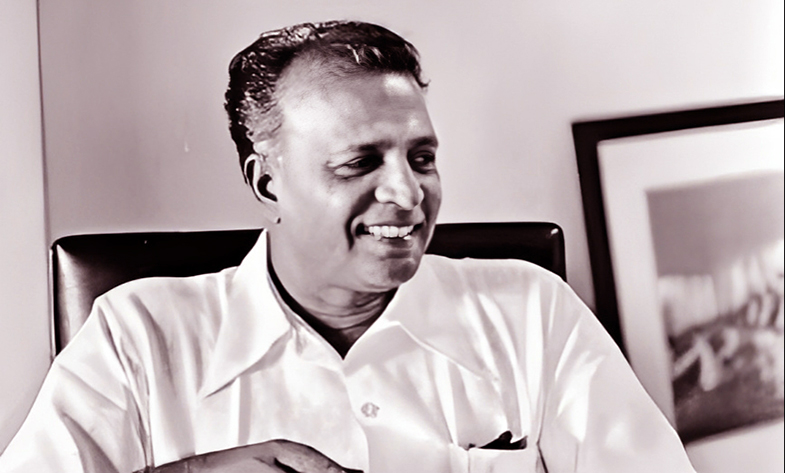
Statement from the Dock of Dr. N .M. Perera, Member of the State Council
(Comrade N.M. Perera’s statement from the dock on the 8th of February, 8, 1944, when he was tried at the Kandy Magistrate’s Court on the charge of escaping from lawful custody. He was convicted by the Magistrate and sentenced to six months’ rigorous imprisonment and fined of Rs. 100. This was the maximum penalty the law could exact from our comrade. Editor, Samasamajist)
(Excerpted from NM: in his own words and as seen by others – birth centenary publication)
Sir, I am proud to be the accused today. I am not the accused but the accuser. It is not I who am on trial today, but H.E. the Governor and the nefarious system of which he is an instrument. My trial will serve once again, as so often before, from the trial of Bracegirdle onward, to uncover the mask of hypocrisy that shrouds British imperialism, and expose the naked hideousness of the ugly monster that it really is.
This trial symbolizes in richfulness the struggle of the millions of workers and peasants of Ceylon to be free from the shameful exploitation to which they have been subjected to for centuries.
Languished in jail
Arrested without any order and without any specific charges we have languished in jail ever since June 1940, without even the pretense of a trial. It is indeed fitting that our arrest, with the written consent of a great Buddhist, should have synchronized with the pinnacling of the Ruwanweliseya Dagoba by that very same personage. The one was as much a watershed in the history of the country as the other. If the One symbolized the revival of Buddhist culture, the other symbolized the struggle of the masses of a subject race to be free.
It is fitting also that the man who wished to rejuvenate the past should also be the man who wished to throttle the future. History is more likely to curse him for the latter than venerate him for the former.
What crimes have my colleagues and I committed to merit arrest? We have indeed many to our credit. Ever since 1933 we have devoted our full energies towards disseminating the principles of scientific socialism, and the developing of a mass revolutionary movement for the attainment of socialism.
Politics at this stage in Ceylon was still less a matter of principles than personalities. And politics and political discussion were the exclusive concern of the intelligentsia and confined to the high circles of Cinnamon Gardens and the lofty atmosphere of Nuwara Eliya. Explaining the rudiments of politics, we are glad, we were the first to draw the masses into the vortex of the political struggle. A mass political organization was still unknown at that stage and to our credit lies the creation of the first of its kind.
After we entered the State Council we had many more crimes to account for. If we have fought for free schoolbooks for poor children, for a free midday meal to the needy children, for more dispensaries and hospitals, for more and better trained midwives, for maternity benefits for poor expectant mothers, for land for the landless, for higher wages and shorter working hours, for work or unemployment benefits for the unemployed, for workmen’s compensation, these are some of our crimes.
We have successfully organized workers into Trade Unions, particularly in the Up-country estate areas the All-Ceylon Estate Workers Union, thereby not merely have the stature and the class consciousness of the workers been raised, but also their ruthless exploitation by callous and unscrupulous employers has been curbed. But there is one crime which is the most heinous of them all, and for which neither the imperialists nor their brown henchmen would ever forgive us. We have led the fight against British imperialism for the freedom of the country.
Towards achieving that independence we have endeavoured to organize the masses of this country. Our trial today is a measure of the success of that organization. To all these charges I plead guilty.
I am accused of escaping from lawful custody. Escaping from custody I admit; but lawful it was not. The mere edict of one man, however eminent, I decline to acknowledge as lawful.
Even the arrest of admitted fascists in England had the explicit sanction of Parliament. Did the Governor have the sanction of the State Council? More than once the State Council has in unequivocal language demanded our release. By his obstinate defiance of the verdict of a democratic legislature all claim to lawfulness has been forfeited. The legality of law is the adequacy of its moral content. And liberty is the right to revolt against such inadequate laws.
Far from being guilty I take my stand on the moral justness of the cause I uphold and the convictions for which I have lived and laboured. The Ruwanwella electorate chose me for the policy I stood. I would have deserved the highest censure and condemnation had I faltered in fighting for that policy of national independence and the establishment of socialism. I am prepared to abide by the verdict of that electorate and of the workers and peasants of Ceylon. I decline to acquiesce in an order fashioned by the arbitrary will of one individual, who represents nobody but a system that the masses of this country abhor, for it has battened and fattened on their life-blood for a century and more.
Our escape from custody was deliberately planned and deliberately timed for the purpose we had in mind: the participation in the momentous struggle that was due to be launched in India. We are proud we had the privilege of contributing our little towards the cause of the freedom of that great country. The independence of Ceylon is inconceivable except in terms of the independence of India. The two struggles are indissolubly linked.
The first phase of the Indian struggle for freedom is no doubt over. And the imperialists may gloat over the discomfiture that has attended this first effort. But the second and last phase is not far off, and the imperialists will yet live to rue the day that they set foot on that country.
Fascism in the colonies
It has been hurled at us that we would have been much worse off under fascism. One hears it so often repeated that one is amazed at the naivete of those who utter it. Do they who so glibly utter it realize what a consummate refutation it is of everything for which they profess to stand for? At best it is a confession that the difference is of degree, not of kind. What boots it to save democracy by utilizing fascist methods? Moreover is there a difference of degree?
We will not delve very far into the past. We will not traverse the long and bloody history of the British that wrought an Empire by robbery by night and perfidy by day. Let us consider the treatment meted out to India in her recent struggle to be free. The wholesale butchery and rape that was let loose in Chimur are too recent even for complaisant white-washers of British imperialism to ignore.
In Midnapur after the adult population was secured behind prison bars, sex-starved, depraved soldiers indulged in an orgy of rape and violence including pregnant women and young girls that beggars description and is revolting to contemplate. And these are some of the outstanding cases of a period of nightmarish devilry throughout the length and breadth of India that would make Hitler blush at his own modesty! We were the unfortunate or fortunate spectators of some of these incidents. Apparently when Hitler’s “brown shirts” wield their rubber truncheons on the backs of innocent Jews it is fascism, but when British soldiers and the Indian police belabour and mutilate the flower of Indian manhood and womanhood it is democracy.
And for what crimes are the Indians thus treated? For the sin of clamouring for the freedom of their motherland! And still we are told Britain is waging a war for freedom and democracy. It was laughable were it not so tragic. Nearer home has it been any different? The manner in which the labourers of Ramboda, Wewessa and Wewelhinne and other estates were beaten and kicked and bullied and harassed by the khaki-coated minions of the Government is too deeply impressed in our minds to be easily forgotten. And the fault of these labourers was that they demanded higher wages and better working conditions. If this is not fascism, what is?
What is fascism but finance-capitalism in its last gasp with naked and unashamed brutality and oppression? Fascism suppresses workers and destroys the militant Trade Unions. Have not the British Imperialists done the same in India and Ceylon? There are prisoners and detenues in India and Ceylon whose sole crime is that they were members of a Trade Union like the All-Ceylon Estate Workers Union.
Fascism suppresses liberty of speech and association, and the liberty of the press. Have not the British imperialists done the same in India and Ceylon? Fascism wants colonies for unhampered exploitation and treats the colonial peoples as subject races fit only to hew wood and draw water for them. Is the attitude of the British imperialists to the colonies and their races different? Where then in essence is the difference between fascism and British imperialism?
Class rule
Nor can we be oblivious of the fact that the ruling classes in Britain have found their natural alignment with the fascists and have frequently showered unstinted praise on the fascist regimes. It was only the other day that the newspaper, Reynolds News in England, unearthed an earlier speech of Mr. Churchill wherein he had extolled II Duce to the skies and had declared that had he been an Italian he would have deemed it an honour to follow in the wake of Mussolini.
It suits him now to style that bloodthirsty criminal a hyena and a snivelling jackal. But the tune was different when fascism was in the ascendant. The activities and the proclivities of the Cliveden Set, and the popularity of Mr. Chamberlain with Mussolini, scarcely need emphasis. What is the true import of the release of Sir Oswald Mosley and his whole fascist crew much to the chagrin and bitter resentment of the British working class, while thousands of genuine socialists, and therefore antifascists, are languishing in jail?
Is public opinion so short-memoried that it can forget the deal the British Government made with Italy to dismember Abyssinia? Only the opposition of an outraged public forced it stealthily to back out of the deal. And what help did the British give to a hapless, unarmed Abyssinia against her monstrous rape and seizure, and that with the use of poison gas contrary to all international treaties and obligations?
Was it not the British Government which by that clever confidence trick of non-interference and non-intervention ensured the victory of fascist Franco over the workers and peasants of Spain, butchering millions of them in the process? Who is the best friend and prop of Franco today, and that notwithstanding Franco’s avowed support of Nazi Germany and Fascist Italy, but the British Government? How does fascism become monstrous in Italy and Germany and good and acceptable in Spain? Does it not conclusively demonstrate that the British ruling class is at heart fascist, and that its struggle with Hitlerism is born of the inevitable clash of the division of colonies between two finance-capitalist States?
Aggression with British connivance
One could scarce forbear to laugh when one notices the eleventh-hour unctuous solicitude for China in her struggle against Japan. It appears that only now it has dawned on imperialist Britain that China is fighting against the unquenchable rapacity of Japanese imperialism. Was it self-interest, opportunism or identity of political ideology that dictated Sir John Simon, the then Secretary of State for Foreign Affairs, to help Japan in his brilliant advocacy of “lebensraum” for Japan at the League of Nations, and thereby justify the Manchurian annexation by Japan?
For over a decade China had fought Japanese aggression, an aggression conducted with the tacit connivance of British and the other great powers. Single-handed she had carried on a major war against this eastern counterpart of Britain ever since 1937. What help did she get? Not even a word of sympathy. On the contrary the British Government went out of her way to gratify the insatiable appetite of Japan by closing the Burma Road, thus facilitating the quicker subjugation of China, for it sundered the last link of communication between China and the rest of the world.
Not until Japan in her impetuosity declared ‘war on the Anglo-American imperialism did they wake up to the greatness of China and acknowledge the tremendous sacrifices she has made in safeguarding democracy for the world, a profusion of belated praise that must indeed be very embarrassing to China.
Fool’s paradise
Is it then surprising that we are not impressed by the magic formula so vehemently mouthed by imperialist politicians that this war is fought to save democracy, to end the tyranny of fascism over small nations? Between imperialism and fascism there is nothing to choose. The last World War was fought for the division of colonies, as its sequel the treaty of Versailles showed, the present World War has no other aims and aspirations. This war is the clash of two rival imperialisms: the one fighting to preserve the colonies it has, and the other to snatch and grab what it can. So far as we are concerned, a plague on them both!
The wanton aggression by Germany on Soviet Russia, the first Workers’ State, has modified our attitude to the war to this extent, that we are prepared to defend by every independent means available to us the security and integrity of that State. No more and no less.
Any other course in the light of the realities of things is neither honest nor sensible. Nothing that has transpired in the course of this war warrants any change in our attitude. On the contrary the persistent refusal to apply the Atlantic Charter to colonial countries like India and Ceylon, and the now famous dictum of the British Premier that he “did not become the first minister to preside over the liquidation of the Empire,” has only confirmed and strengthened our convictions.
There are those who live in a fool’s paradise that at the end of this war the imperialist leopard would change its spots. For our part we are neither so credulous nor so simple-minded. These are the reasons which have induced us to consider our detention unlawful, and our escape from custody lawful.
(Reproduced from Samasamajist of 31 January 1946)
N.M. Perera was convicted and sentenced on the same day and by the same Court as was his close comrade, fellow State Council Member, Philip Gunawardena whose statement from the Dock is also reproduced.


by Jehan Perera
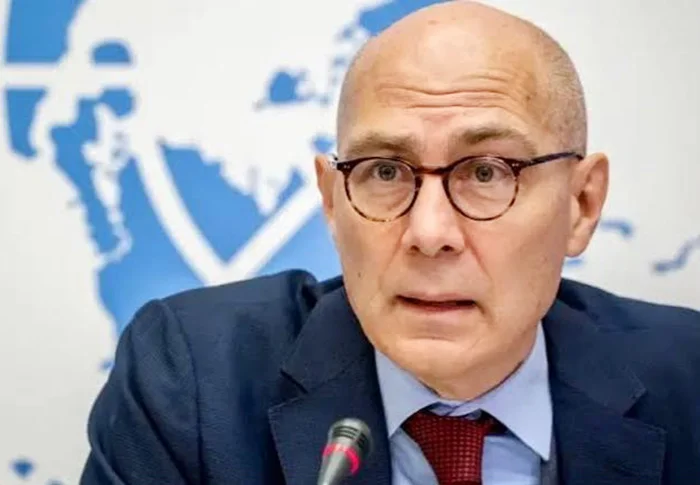
The ongoing 63rd session of the United Nations Human Rights Council, which runs from September 7 to October 7, 2026, in Geneva is important to Sri Lanka. Its outcome will send a signal to other international actors, including the European Union, as to whether Sri Lanka’s reform policy is on track. The written update on Sri Lanka, prepared by the Office of the United Nations High Commissioner for Human Rights under High Commissioner Volker Türk and presented by Deputy High Commissioner Nada Al-Nashif, has taken a more holistic approach to the government’s performance over the past year. It acknowledged the progress Sri Lanka has made under the NPP government in relation to accountability for financial fraud and other economic crimes. At the same time, the High Commissioner’s update made clear that progress in relation to economic crime cannot be equated with progress in relation to accountability for grave human rights violations committed during the armed conflict and in other periods of political violence.
The government may have felt sufficiently confident that its response to the High Commissioner’s update could be handled by its representative in Geneva and did not require the attendance of Foreign Minister Vijitha Herath. Sri Lanka’s representative Sumith Dassanayake called for a fundamental review of country-specific mandates within the UN Human Rights Council. Sri Lanka has been facing repeated scrutiny in the form of successive UNHRC resolutions from 2012 onwards. Ambassador Dassanayake argued that such mandates should not continue indefinitely and must be regularly assessed against measurable objectives and tangible outcomes. This may reflect confidence that its record of reform is beginning to receive recognition internationally. The reports and statements at the Human Rights Council acknowledged progress in the government’s efforts to address corruption and economic crime.
The government’s anti-corruption drive has included investigations into allegations involving individuals who held the highest political offices in the country. The arrest of former President Ranil Wickremesinghe in connection with alleged misuse of public funds, and the investigation into the controversial SriLankan Airlines Airbus transaction involving former President Mahinda Rajapaksa’s son, are examples of the reach of these investigations. The arrest of SLPP National Organiser and Member of Parliament Namal Rajapaksa in connection with allegations relating to the Airbus purchase scandal has also demonstrated that the government is willing to pursue cases involving politically powerful figures.
Wide Range
The ongoing investigations appear to encompass a wide range of parliamentarians and government members, both past and present. They suggest that accountability for corruption is not being confined to lower-level officials or to individuals who lack political influence. This is precisely the kind of accountability that the public has long demanded and that previous governments have too often failed to deliver. The government is also reaching into the upper levels of the military hierarchies of the past. The case in which 11 young men, most of them Tamil, disappeared after being abducted in Colombo between 2008 and 2009 involved allegations that some families were asked to pay ransoms. The investigation into this case has reached senior military figures. The willingness to pursue such cases is important because it challenges the assumption that those who exercised power during the war are beyond the reach of the law. Such cases would provide a practical test of whether the government’s commitment to accountability for economic crimes is part of a broader commitment to the rule of law.
Success in prosecuting corruption cannot substitute for justice for those who were unlawfully killed, disappeared, tortured or otherwise victimised. The UN report noted that there had been no recognition or accountability for crimes under international law, gross human rights violations and serious violations of international humanitarian law committed by all parties during the war. The government has yet to establish a credible and effective process to address the many cases of enforced disappearance, extrajudicial killing, torture and other serious violations. The government needs to take the international commitments it has inherited on human rights issues seriously. It needs to adopt a multi-pronged approach and go beyond focusing primarily on financial and corruption-related accountability.
Need Action
As a member of the international community, Sri Lanka has a responsibility to abide by the commitments it has made. It cannot selectively uphold international obligations postponing those that are politically difficult. Also, as a small country, Sri Lanka has a self-interest in ensuring the survival of international law, which is all that it has to protect it from the depredations of the bigger international actors. The erosion of international law by powerful states makes it all the more important that smaller states uphold the principles on which the international system is based. Sri Lanka cannot credibly appeal to international law when it is threatened from outside while disregarding its own obligations within. Sri Lanka also needs to win the confidence of its own population that it is committed to justice and equality for all. Public opinion polls and community-level research have disclosed that ethnic and religious minorities are appreciative of the sense of greater security they enjoy under the present government from ethnic or religious extremists.
But a sense of security is not the same as the fulfilment of rights. As far as the Tamil people are concerned, the government has yet to deliver on several of its specific promises. These include the long-standing problems of missing persons, the release of political prisoners who have been members of Tamil militant organisations, and the return of land taken over for military purposes during the war. The issue of Buddhist statues and archaeological sites found on their properties which are then taken from their control continue to trouble them especially as they see no signs of resolution of those disputes. The issue of pastureland in the east of the country in Mylathamadu is particularly concerning to them as they see orders by successive presidents, both President Ranil Wickremesinghe and President Anura Kumara Dissanayake, being disregarded on the ground. The Mylathamadu pastureland dispute is where traditional Tamil dairy farmers have engaged in multi-year protests against the ongoing encroachment of their ancestral grazing lands by Sinhalese crop cultivators relocated under government development schemes.
The government’s failure to hold Provincial Council elections is particularly troubling. The provincial council system is the only one that can provide the Tamil people and other ethnic minorities the opportunity to wield political power and exercise a measure of self-determination in the areas in which they are the numerical majority. The continued postponement of Provincial Council elections therefore has consequences that go beyond an ordinary electoral delay. It deprives communities of an important constitutional avenue for democratic participation and power-sharing. The ethnic and religious minorities appreciate what the government is doing in the larger national interest, but they must not be made to feel that their special concerns are being ignored. The government cannot resolve Sri Lanka’s entire legacy of rights violations overnight. But it does need to demonstrate that it is willing to move forward on multiple fronts, not only on a few.

 by Hasini Lecamwasam
Brain drain in Sri Lanka is at an all-time high. The latest Human Flight and Brain Drain Index for 2024 shows that we are 16th of 175 countries on this count, and first in South Asia. That this is a crisis goes without saying. Brain drain affects all sectors, and is a huge strain on the resources of a developing country. Particularly in Sri Lanka, where considerable public investment is made in the moulding of professionals through the system of free education, this amounts to transferring the resources of poorer countries to richer ones with top migration destinations. It is, therefore, important to consider the push and pull factors behind skilled outmigration, specifically from the public university system of Sri Lanka, a key focus of the Kuppi column.
From frustration to exit
Several bitter realities in our crumbling public university system act as push factors in the migration decisions of academics. Many essays on this column have, over several years, attempted to highlight numerous aspects of this erosion. Perhaps, primary among them is the lack of adequate funding, which has debilitating ramifications for the system: very little investment is made in the up-keep of infrastructure (and even less in its expansion), resulting in serious constraints in accommodating growing batches of students and the wellbeing of the staff (particularly in regional universities); research funding is negligible, severely curtailing academics’ ability to effectively discharge their primary duty of teaching which should ideally be informed by their research (and the research of others, access to which is also, unfortunately, mediated by funding); a funding crunch also means a slash in (or greater constraints on) recruitments, increasing the workloads of academics, currently in service, and eating into the quality of their teaching and research.
What recruitments are done frustrate those with any faith in merit. As many of our interventions in this column have shown, recruitment processes are characterised by archaic selection criteria that place very little weight on a candidate’s postgraduate growth and the advantages of interdisciplinary training. Added to this is the general preference for ‘culturally compliant’ candidates who would not rock the boat too much. The combined effect is that those with the capacity and spirit to try out innovations in education are discouraged from joining or staying on in the public university system. Some, or many, of them may instead seek appointments abroad.
A thread that binds all of these problems together is pervasive hierarchy which, again, many interventions on this column have sought to highlight. It is the interest in preserving hierarchy that leads to the preference for alumni in recruitment processes. Hierarchy within universities can be particularly frustrating for younger faculty and women, who typically have to bear the brunt of the workload of their senior, often male, colleagues. In a context of funding, and, therefore, recruitment, restrictions, this translates into a disproportionate burden being placed on junior (usually female) faculty, seriously hindering their prospects of growing into successful academics due to the time constraints within which they have to operate. Junior academics, therefore, are more likely to look to educational institutions abroad for what they hope would be a different work culture that respects them more.
Ideological ruses
On top of these structural frustrations are also the workings of neoliberal ideology. For one, the nature of relations between the global metropole and peripheral countries like Sri Lanka largely dictates what is desirable and what is not. The apparent lifestyles of Western countries – from food to clothing, housing, appliances, and so on – have continued to lure people from the periphery with the promise of a ‘better’ life, alongside better career advancement opportunities. This, of course, masks much of the struggle that goes on behind the scenes to survive in Western societies. For instance, in most cases highly attractive public infrastructure such as roads, public transport, clean air, quality control of food, and so on belie the astronomical privatised costs of healthcare and education. Health insurance is usually mandatory and steep in most high-income settings, while even subsidised education (for which eligibility criteria are strict) creates a serious dent in household earnings. Of course, the happy images of glossy trams and gleeful international travellers don’t convey this.
A second ideological ruse is the myth of greater opportunities and recognition abroad. While there is no denying that local skilled sectors – be it higher education, health, civil service, or private white-collar positions – are replete with issues that inhibit merit-based professional advancement, the notion that things are fundamentally different in Western countries stems from an uninformed optimism. As is now increasingly known and discussed, Western labour markets are notoriously racialised, and equivalent skills are rarely treated as such. Instead, it is usually demanded that skilled migrants clear certain formal examinations in their host countries. In fields like medicine, this is followed by an interview that may also be racially prejudiced. Once these initial steps are cleared, remuneration reverts to square one irrespective of experience accumulated abroad, not to mention the many subtle aggressions, rejections, and trials one has to go through in the negotiation of everyday life. In the many cases where professional qualifications are used as leverage for a move abroad, sights are set on a better future for one’s children, which again is informed by the misplaced faith in greater opportunities and a lack of awareness of the factors outlined above. Needless to say, in the global swing to the Right, things have become even more challenging. In such a context, considering the few rare cases where skilled migrants live extremely comfortable lives as the norm becomes a dangerous misconception.
The two ideological pull factors mentioned above are complemented by a push factor, which has to do with a highly classed understanding of what a white-collar professional is due in their society. Many of these aspirations are clearly articulated in academic trade union action demanding separate quotas for school entry, increased fuel allowances, winning back the presently stalled vehicle permit scheme, salary hikes, and so on. While working people have every right to agitate for better material conditions, insofar as it remains unconnected to a broader movement for improving the conditions of the lot of the working class, it remains self-serving and very much within the class logic of capitalist society. Since these demands are articulated as a means of maintaining distinction, it is clear that they are not envisaged as part of a class movement. The frustration of not having these needs for distinction satisfied may push some to seek greener pastures abroad, at least financially, (perhaps as a means of social mobility based on it), only to be disappointed on most occasions.
What is to be done?
Addressing the systemic push factors listed above requires, first and foremost, greater allocations for free public higher education. This would immediately translate into more recruitments and less work per academic, and better research and teaching in the long haul. An increase in funding would also ideally lead to greater infrastructural investments, especially including improving the living conditions of those who work in regional universities amid untold hardships. Next, fairer, more creative, and, therefore, more effective recruitment policies are badly needed to attract talented individuals to university positions. Rather than carving out a ‘special category’ for academics to achieve this purpose, which is informed by a classed logic, this needs to be done through fundamental reforms in recruitment processes. Third, a persistent attack on the entrenched hierarchy within universities through internal reform is much called for. Reforming recruitment practices will go a long way towards addressing this. Measures should also be taken to introduce more stringent policies against SGBV (not to mention ragging, even though it is not directly connected to brain drain). Such measures would create a safer, fairer, and more attractive workplace, which would give more reasons for people to stay.
On top of greater allocations, we also need a transformation of our aspirations themselves if this situation is to change. That necessitates a kind of education capable of questioning the ‘paradise’ conception of Western societies, and lays bare their colonial material and ideological dimensions, in both their historical and contemporary manifestations. These colonial understandings of the ‘good life’, moreover, have devastating ecological implications for the planet, not to mention social justice. An education with the ability to transform this mindset would hopefully prove to be more than a mere path to social mobility, rather being a tool of social emancipation that renders mobility moot.
(Hasini Lecamwasam is with the Department of Political Science, University of Peradeniya)
Kuppi is a politics and pedagogy happening on the margins of the lecture hall that parodies, subverts, and simultaneously reaffirms social hierarchies.
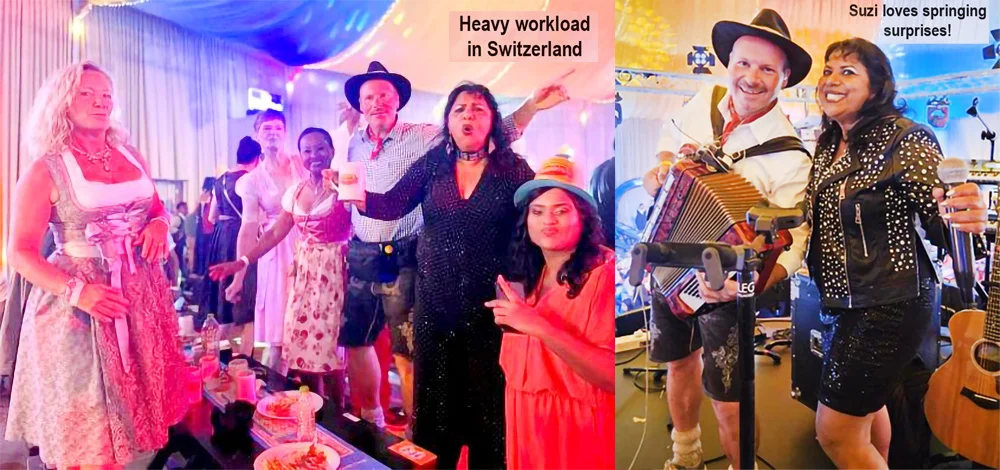
 Charming audiences in Switzerland as Suzi Flückiger, Sri Lanka’s own Suzi Croner is coming home… for a very special occasion.
The bubbly former frontline vocalist of 90s band Friends will take the stage at a popular venue in Colombo for Oktoberfest 2026.
Known in Europe for her country and classic hits, Suzi has remained a much-loved name back home. This will be a rare chance for local fans to see her live and celebrate the voice behind so many Friends memories.
Oktoberfest 2026 in Colombo promises an evening of live music, traditional Bavarian food and beer, colourful dirndls and lederhosen, folk dancing, and plenty of community cheer.

Suzi Croner (Flückiger)
Against this lively backdrop, Suzi will take the stage for a special solo set, featuring her own pre-recorded music. She performed at the event last year too, as a solo artiste, but a German band providing the music.
This year, however she says, it’s a different scene.
“The novel attraction will be the dancers from Germany — all girls, clad in German outfits,” Suzi said. She added that the event will also highlight the activities generally connected with Oktoberfest, which should generate a lot of fun and excitement for those who join her in Colombo next month.
Suzi has become a much-in-demand artiste in Europe, and has even performed Down Under, in Melbourne.
In Switzerland, where she has been based for the past 42 years, she continues to charm audiences with country and classic hits, performing at private events and community nights across Europe.
“My weekends are generally loaded with my work as a singer,” she said. “And I also play tennis three times a week, because I need to keep fit to entertain my audience in an active way.”
Her repertoire is made up mainly of Swiss, German and English songs.
And true to form, Suzi loves springing surprises.
“So watch out when you join me at Oktoberfest 2026, in Colombo!” she said.

US Supreme Court rejects Trump mail ballot restrictions ahead of midterms

Eastern Province Divisional Secretariats recognized for outstanding performance

Students of Rahmaniya Maha Vidyalaya Eravur visit Presidential Secretariat and President’s House

Showers above 100 mm expected at times in the Western, Sabaragamuwa, Central, Uva and Southern provinces, and in Ampara and Batticaloa districts

Controversy over absence of Agriculture Minister, Deputy at NPP’s inaugural farmers’ rally

Thousands march in Jaffna demanding international investigation into Chemmani

‘Dates have the highest sugar content to fight Coronavirus’

Sunday Island 27 December – Headlines

#SundayIsland 17th December – Headlines

Sunday Island – 28th March

Sunday Island Headlines – 21 March

Sunday Island – 21st February – Headlines
-

 Sports4 days ago
DDS set to lose Test captaincy
-

 News4 days ago
Sri Lanka faces new grid challenge as rooftop solar surges: former CEB GM
-

 Latest News4 days ago
Shafali, Deepti power India into sixth T20 Asia Cup final
-

 Latest News3 days ago
Sri Lanka thwart Fatima Sana challenge to secure Asia Cup final spot
-

 Opinion6 days ago
Navigating Sri Lanka’s Israeli Dilemma
-
 Features5 days ago
Lost for 90 years: Rare Goby resurfaces in Jaffna
-

 News2 days ago
Gnanasara Thero absconding after SC ruling
-

 News3 days ago
Ammunition cache found in old Kandy bungalow