
News
Illicit artificial toddy trade deprives govt. of Rs. 80 billion in revenue annually

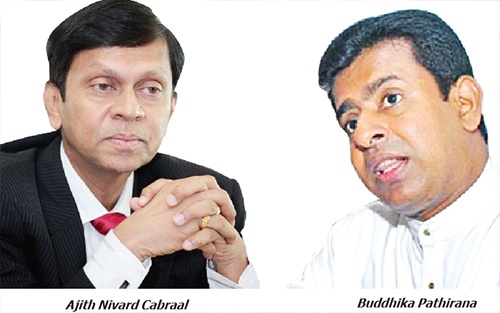
State Minister promises remedial action
By Saman Indrajith
One of the topics that kept reverberating throughout the budget debate that ended in parliament last Wednesday was the drain of excise revenue as a result of loopholes in the tax net by artificial toddy manufacturing businessmen.
Various facets of the issue were raised by SJB Matara District MP Buddhika Pathirana during the question time on three separate days highlighting the severity of the damage inflicted on the national economy by tax evading toddy businessmen who deprive the government coffers of a whopping Rs. 80 billion annually.
Following the disclosure by MP Pathriana, State Minister of Money & Capital Market and State Enterprise Reforms Ajith Nivard Cabraal promised remedial action.
Commissioner-General of Excise, Ariyadasa Bodaragama, acknowledged that there exists a tax leakage but he was wary of the figure of Rs. 80 billion.
Bodaragama is due to retire at the end of the month. Deputy Commissioner-General of the Inland Revenue Department, M. J. Gunasiri has been named as his successor.
Challenges before Gunasiri, as the new Excise Commissioner-General, are enormous, and whether he would be able to help Minister Cabraal deliver on his promise remains to be seen.
As Gunasiri earlier served as Deputy Commissioner-General Tax Administration (Corporate Small Entities & Non Corporate Sector) at the Inland Revenue Department, his expertise may be useful to remedy the situation. However, he has only three more months of service before his retirement. Unless he is given a service extension, the task of finding solutions to the tax evasion issue raised by Pathirana will probably have to wait till another Commissioner-General is appointed.
Pathirana told The Sunday Island that the government coffer is bound to lose over Rs. 80 billion a year due to tax evasion by artificial toddy manufacturers and the ramifications to the national economy are more acute if the health cost is also taken into account.
“We have seen many instances of serious health problems that illicit brewers caused to the people. Artificial toddy is produced by mixing urea, ammonia, nickel cadmium of old batteries and sugar. This harmful brew is sold at liquor shops and used for manufacturing ‘coconut arrack’ and vinegar.
“Suppose we overlook tipplers who consume the toxic brew knowingly or unknowingly, what about innocent consumers who buy vinegar? In Sri Lankan food culture, vinegar is an integral part. Imagine the number of people who get ill because they consume vinegar made of artificial toddy,” the MP said.
“The artificial toddy industry is well-rooted in coastal areas in the south. If one checks the number of trees tapped and the number of liters of toddy being sold, it is a very simple calculation to understand how much artificial toddy is being consumed. Only around one and a half litres of toddy could be tapped from a single coconut palm. As per reports of coconut researchers, the amount could vary slightly due to factors such as climate, humidity and season. The amount being sold by license holders varies from the actual amount extracted from palms. A difference is in the region of 60,000-70,000 litres. So, it is obvious that toddy comes from other sources”, he noted.
There have been raids by police and STF but toddy businessmen continue to ply their trade because the police cannot take the culprits before courts as per Sections 49, 50 and 52 of the Excise Ordinance. They have to hand over the suspects and the equipment to excise officers, who most of the time do not produce the suspects in courts but release them after filing a Technical Crime Report (TCR), the parliamentarian further said.
“Under the TCR, the racketeers only have to pay a small sum by way of a composition fee. The TCR is actually one of the loopholes these businessmen get out so easily. I pointed out all these to the government. I hope Minister Cabraal will act as promised. I also pointed out to him that there are not only excise officers but some finance ministry officials who benefit from the artificial toddy business. I hope and pray that the minister will be able to remedy this situation,” Pathirana added.
President of the Nawa Sinhala Rawaya, Ven Magalkande Sudattha Thera said the illicit toddy industry is thriving despite isolated raids. The police and the STF conducted successful raids in many areas in the recent past. Thereafter, the police hand over the suspects and equipment to the Excise Department for legal action. Excise Department officials file a TCR and release them on a composition fee.
Many illicit toddy producers have licences for toddy tapping. So finding sugar, ammonia, yeast, batteries in toddy amounts to only a technical error; it becomes a technical crime if they suspect that the manufacturer had purposefully mixed them with toddy or produced toddy using them as ingredients. During a recent raid, the police found three bags containing 25 kilos of ammonia to be used to produce toddy. How could the government ensure public safety when poison is being sold in bottles in the name of toddy, the prelate asked.
President of the consumer watchdog National Movement for Consumer Rights Protection, Ranjith Withanage said that old mobile phone batteries were also being used in the fermentation process of artificial toddy.
He said a countrywide survey conducted by his organisation revealed that discarded mobile phone batteries and power banks and chemicals such as urea were used to produce artificial toddy.
“We have information that such toddy is being sold to produce coconut arrack and vinegar. Arrack and vinegar made from artificial toddy were sold in the market while those responsible for preventing consumers from such harmful products have done nothing so far to raid shops and places that sold them”, he asserted.
Withanage said that local arrack and vinegar made from artificial toddy have been identified as one of the main causes of chronic kidney diseases.
He further said the government loses over Rs 180 billion a year due to the illicit liquor and tobacco (Rs. 100 billion on illicit liquor and tobacco and Rs. 80 billion on illicit toddy).
“We expected the government to present budget proposals to counter the loss of revenue, but there was none”, he added.
Excise Department spokesman, Deputy Commissioner, Kapila Kumarasinghe said there were instances where toddy manufacturers were caught for using illegal methods to increase the volume of alcohol. Water, sugar, urea, yeast and salt are being used to get a high content of ammonia in toddy.
He said that toddy is being sold in taverns as fresh toddy and bottled toddy after pasteurizing so that they could be kept for one to two weeks. Toddy is also being sold for the production of vinegar. If toddy with additives are used to distill arrack, the machines extract only the alcohol and the additives are discarded as ‘spent-wash’. The distilling machines are calibrated only to extract alcohol, and not other elements in the raw materials.
In the most popular brands of arrack sold in the market, there is only three percent toddy and 97 percent water, ethanol and rectified spirits. Adding alien items during production is illegal,” he warned, adding that the Excise Department with its available resources is fighting hard not only against the artificial toddy industry but also other narcotics and drugs, he said.
Excise Commissioner General Bodaragama acknowledged there was a significant loss of excise revenue due to various tactics used by toddy manufacturers.
He said that there is a leakage of tax revenue but assured that he was certain that it could not be Rs. 80 billion.
State Minister of Money & Capital Market and State Enterprise Reforms Ajith Nivard Cabraal told The Sunday Island that Pathirana had raised this issue several times in Parliament and he had already instructed Secretary to the Ministry of Finance and the Excise Department officers to submit a comprehensive report to him on the matter.
The toddy industry extends from Kalutara, Gampaha, Puttalam, Badulla, Moneragala, Hambantota, Anuradhapura to the Northern and Eastern provinces. As at Dec. 31, 2019, there were 3,094 licensed toddy tappers and 32 licensed toddy producers in the country.
“There could be many more engaged in supportive services for their livelihood but we have no exact details on them”, he noted.
“Pathirana made constructive suggestions and we took note of them. We are thankful to his efforts and are determined to remedy the situation. I intend to study this matter first with my officials. I assure you that this would be studied properly and necessary action initiated”, the Minister assured.


The Bar Association of Sri Lanka (BASL) yesterday called on all political parties, represented in Parliament, to allow their members to vote on the proposed 22nd Amendment to the Constitution according to their conscience, stressing that the responsibility for deciding whether the Bill should be enacted now rests with Parliament.
In a statement issued after the Supreme Court’s determination on the 22nd Amendment Bill, BASL President Rajeev Amarasuriya and General Secretary Nalin de Silva have said the SC’s determination should not be interpreted as an endorsement of the proposed constitutional amendment as a matter of policy.
The BASL has said the SC’s jurisdiction, under Articles 120, 121 and 123 of the Constitution, was to determine the constitutional requirements for the enactment of the Bill, including whether the Bill, or any of its provisions, required approval at a referendum under Article 83.
“The determination is therefore not a determination as to whether the proposed amendment is good or bad policy, desirable or undesirable, wise or unwise, or whether Parliament ought to enact it,” the BASL said.
Full text of the BASL statement: The Supreme Court has now delivered its Determination on the Twenty-Second Amendment to the Constitution Bill and determined that the Bill does not require the approval of the People at a Referendum.
In terms of Articles 120, 121 and 123 of the Constitution, the jurisdiction of the Supreme Court in relation to the Bill is to determine the constitutional requirements for its enactment, including importantly whether the Bill, or any provision thereof, requires the approval of the People at a Referendum by virtue of Article 83.
The Determination is therefore not a determination as to whether the proposed Amendment is good or bad policy, desirable or undesirable, wise or unwise, or whether Parliament ought to enact it.
This distinction is also evident from Sri Lanka’s previous constitutional amendments. During the 48 year history of the second republican Constitution there have been many amendments which passed constitutional muster but nevertheless had a negative effect on democracy, constitutionalism, the independence of the judiciary and the rule of law.
The question that now arises is whether Parliament ought to enact the proposed Amendment. That responsibility rests with Parliament and with each individual Member of Parliament when they vote on the Bill.
In making that decision, Members of Parliament should be mindful of the possible and probable consequences the 22nd Amendment will have on our nation. They should also consider the lack of transparency and a proper consultative process in the introduction of the 22nd Amendment. As representatives of the people they should also consider the concerns that have been expressed in relation to the proposed Amendment by a broad cross-section of society including the Maha Nayakes of the Three Nikayas, the Catholic Bishops’ Conference in Sri Lanka, the Church of Ceylon, the Bar Association of Sri Lanka, the Judicial Service Association, the Commonwealth Lawyers Association, LAWASIA, the International Association of Judges, the United Nations Special Rapporteur on the Independence of Judges and Lawyers, the French National Bar Council, and more than 40 Professional Associations and Unions, including the Government Medical Officers’ Association and other leading professional bodies.
Accordingly, the Bar Association of Sri Lanka calls upon all the political parties in Parliament to allow the Members of Parliament to speak and vote on the 22nd Amendment according to their conscience.
The responsibility now lies with Members of Parliament, when called upon to vote, to take a principled position according to their conscience giving due consideration to their constitutional responsibility, their representative capacity and most importantly their duty to the sovereign People of Sri Lanka.

SL to regain access to international financial and capital markets next year in line with IMF projections
Sri Lanka is on course to regain access to international financial and capital markets around 2027, in line with the International Monetary Fund’s (IMF) current economic projections, IMF Mission Chief Evan Papageorgiou said yesterday.
Papageorgiou said the IMF’s core assumptions under Sri Lanka’s economic programme continued to envisage the country returning to international capital markets in 2027.
“Our previous assumption that Sri Lanka will go back to capital markets still stands. We still have a good trajectory to achieving this in 2027 or thereabouts, and that should be the goal,” he said.
Papageorgiou stressed that Sri Lanka could not rely solely on domestic sources of financing to build long-term economic resilience and would need a diversified funding strategy.
“Every country needs to have a good ability to access funds both in domestic markets, as it already has, as well as international markets for eurobonds and other modes,” he said.
He said a return to international capital markets would have significant implications for Sri Lanka’s external debt composition, while strengthening foreign exchange reserves would remain essential as the country prepares to meet future debt-servicing obligations.
The IMF’s assessment comes amid improving international investor sentiment towards Sri Lanka and positive developments in the country’s sovereign credit ratings.
Papageorgiou cited Fitch’s recent upgrade of Sri Lanka’s credit rating as a positive development, saying global investors were increasingly viewing the country from a more constructive perspective.
Sri Lanka remains under the IMF’s Extended Fund Facility (EFF) programme, which is scheduled to continue until March 20, 2027. Regaining access to international capital markets remains a key milestone under the country’s broader economic recovery.
The IMF has stressed the importance of rebuilding Sri Lanka’s foreign exchange buffers and maintaining stability in domestic financial markets as the country approaches substantial external debt repayments.
A sustained improvement in these areas would help strengthen the country’s capacity to return to international markets while safeguarding macroeconomic stability, the IMF has indicated.
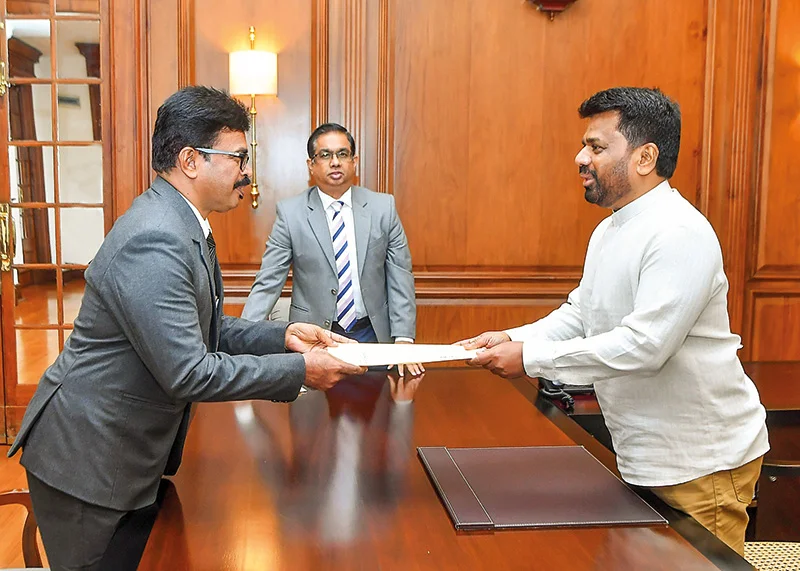
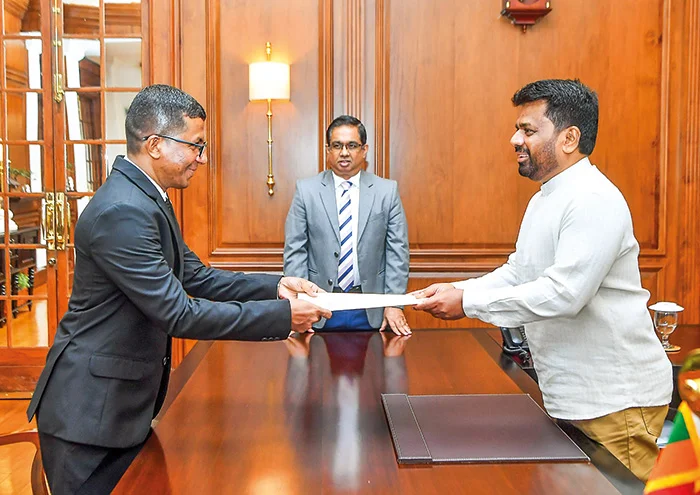
President Anura Kumara Dissanayake yesterday (23) handed over appointment letters to three Special Grade officers of the Judicial Service as High Court Judges, at a ceremony held at the Presidential Secretariat, according to the President’s Media Division (PMD).
The new appointees are Perumal Sivakumar, District Judge of Jaffna; Anandi Kanagaratnam, Senior Assistant Secretary of the Judicial Service Commission; and Gnanesha Lalith Kannangara, District Judge of Colombo.
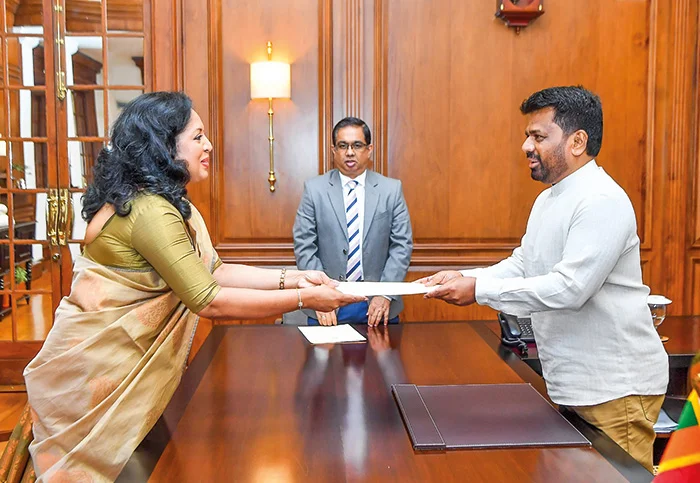
The three senior Judicial Service officers will take up duties as High Court Judges following their appointments.
The appointments were made from among Special Grade officers of the Judicial Service, the PMD said.

Showerss above 100 mm are likely at some places in the Western, Sabaragamuwa, Central and North-western provinces and in Galle and Matara Districts

Mirabai Chanu wins Asian Games silver as Ri breaks weightlifting record

Trump greets China’s Xi Jinping on arrival for three-day US

BASL calls for conscience vote on 22nd Amendment

IMF: Sri Lanka on course for 2027 market return

President appoints three new judges to High Court

‘Dates have the highest sugar content to fight Coronavirus’

Sunday Island 27 December – Headlines

#SundayIsland 17th December – Headlines

Sunday Island – 28th March

Sunday Island Headlines – 21 March

Sunday Island – 21st February – Headlines
-

 News5 days ago
Shanakiyan urges urgent action over reported death sentence for Lankan in Saudi Arabia
-

 News6 days ago
Bid for Basil’s extradition nears final stage: Police
-

 News4 days ago
Namal Rajapaksa Buddhist gambit fails, bail denied
-

 Features4 days ago
Why the spelling Sri Lankan names in English vary
-

 Features4 days ago
Three bands, a new identity: Sri Lankan wolf snake recognised as distinct species
-

 Business4 days ago
SLIIT holds largest-ever convocation
-

 News4 days ago
Govt monitors reported Saudi death sentence – Foreign Ministry
-

 Business4 days ago
All-new Bolero MaXX Pik-Up unveiled in Lanka