
News
IFC reaffirms commitment to Sri Lanka amid plans to increase investments

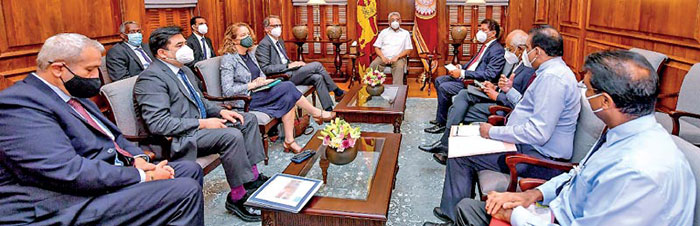
International Finance Corporation Regional Vice President for Asia and the Pacific Alfonso Garcia Mora has said that IFC aims to boost its investments in Sri Lanka, with a focus on supporting private sector job creation, paving the way for robust investments to help spur the country’s recovery and future growth, it said.
The comments by IFC Regional Vice President for Asia and the Pacific Alfonso Garcia Mora, came at the end of a three-day visit to Sri Lanka, which included a meeting with the President Gotabaya Rajapaksa, Finance Minister Basil Rajapaksa, government officials, including Central Bank Governor Ajith Nivard Cabraal, private sector representatives, entrepreneurs, and development partners.
Garcia Mora was accompanied by IFC’s Vice President for Risk Mohamed Gouled, Regional Director for South Asia Hector Gomez Ang and the new Country Manager for Sri Lanka and the Maldives Lisa Kaestner, as well as the World Bank Country Director for Sri Lanka, Maldives and Nepal Faris Hadad-Zervos.
“In my meeting with the President, we discussed the need to have a sound macro fiscal stability to attract foreign capital and provide medium- and long-term certainty,” Garcia Mora said. “The talks also focused on ways to maximise the potential of the country’s private sector to help address Sri Lanka’s challenges and achieve the inclusive growth the country needs.”
“We are committed to Sri Lanka,” Garcia Mora said. “This is demonstrated by our investment commitments in the past six months which have targeted export-oriented industries. Since the onset of the pandemic, IFC has also played a strong counter cyclical role in its financing and will continue to build on that program going forward.”
During his meetings, Garcia Mora highlighted IFC’s investment of $ 450 million during the first 18 months of the pandemic in Sri Lanka as a sign of IFC’s steadfast commitment to the country.
“We are working with the private sector in the country to create a robust investment pipeline and this can be accelerated with additional reforms in the infrastructure sector, allowing the private sector to play a bigger role,” Garcia Mora said. “IFC intends to invest a further $ 150 million during the current fiscal year ending in June 2022. Over the next five years, IFC is looking at an investment pipeline of more than $ 800 million, specifically in supporting growth-enabling sustainable infrastructure.”
IFC’s efforts will focus around three strategic pillars in Sri Lanka: supporting innovation for growth, including export diversification, start-ups, niche market agriculture and value additions for export, high tech manufacturing; growth-enabling sustainable infrastructure, including low-cost clean energy, sustainable transport and logistics systems; and deepening social and financial inclusion, including digitisation, economic participation of underserved people, especially women.
While in Colombo, Garcia Mora also signed a cooperation agreement with John Keells Holdings (JKH) to develop a commercially viable and sustainable street market in Colombo 2, which will also promote women’s participation in hospitality and tourism. The officials also had the opportunity to meet clients and partners of the Women in Work program – IFC’s largest, standalone country-based gender program designed to close gender gaps in Sri Lanka’s private sector.
Since the beginning of the pandemic, IFC has invested $ 450 million in Sri Lanka, including $ 175 million in JKH to boost retail and tourism – IFC’s largest investment in Sri Lanka over its 50-year operations. As part of the overall pandemic response, IFC injected $ 50 million in Commercial Bank of Ceylon and $ 25 million in Nations Trust Bank to help small businesses stay afloat during the height of the pandemic.
IFC’s strategy also focused on expanding export diversification, promoting sustainability and inclusive growth. Last year, IFC piloted a new digital health program – DigiHealth – to boost access to affordable and quality health-care services in Sri Lanka and beyond.
In October, IFC also issued its first-ever rupee-denominated bond in the country – the ‘Serendib Bond’ – to ensure that the private-sector has access to long-term offshore financing in local currency.


The final rites and cremation of the Most Ven. Keppetiyagoda Siriwimala Nayake Thera, Chief Incumbent of the historic Getambe Rajopawanaramaya Temple and Anunayake of the Sri Lanka Ramanna Maha Nikaya, will be held under State patronage at 4 pm tomorrow (21).
The cremation ceremony will be held at the Getambe Urban Grounds in Kandy.
The Nayake Thera, 98, passed away on Sunday while receiving treatment at a private hospital in Kandy. He had been ailing for some time.
A prominent voice on national, religious and cultural issues, Ven. Siriwimala Thera was actively involved in Buddhist revivalist activities and was widely recognised for his outspoken views on matters concerning the country, the nation and Buddhism.
He served as the Chief Incumbent of the historic Getambe Rajopawanaramaya Temple and held the position of Anunayake of the Sri Lanka Ramanna Maha Nikaya.
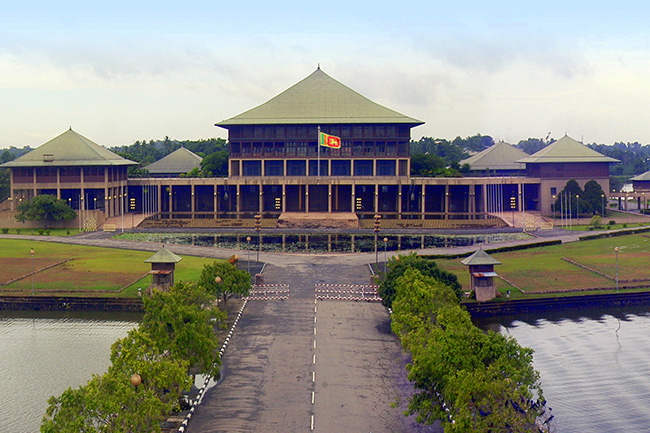
The Sectoral Oversight Committee on Economic Development and International Relations has called for the speedy implementation of the Microfinance and Credit Regulatory Authority Act to strengthen regulation of the microfinance sector and protect the public from exploitative lending practices.
The Committee, chaired by MP Lakmali Hemachandra, made the call during a meeting with officials of the Sri Lanka Microfinance Practitioners’ Association at the Parliament complex, the Parliament Department of Communication said.
Committee members stressed the need to regulate informal lenders charging excessively high interest rates, which have placed a heavy financial burden on the public, while ensuring a fair regulatory environment for legitimate microfinance institutions.
The discussions covered the licensing of microfinance institutions, legal and practical difficulties arising from certain provisions of the Act, restrictions on accepting deposits and the cost of funds.
Proposals were made to simplify the licensing process for existing institutions, allow limited public deposits under regulatory supervision and facilitate access to lower-cost funding.
The Committee also considered establishing a mechanism to channel concessional funding from international institutions, including the Asian Development Bank, to regulated microfinance institutions to help reduce lending rates.
The implementation of consumer protection provisions, the timeframe for establishing the Regulatory Authority and deadlines for institutions to obtain licences were also discussed.
Meanwhile, the Committee considered the granting of mining rights for 68 grids to state-owned Lanka Mineral Sands Limited (LMSL) and measures to provide operational support to the company.
The Committee decided to issue the necessary recommendations on the matter.
LMSL has sought exclusive mining rights over mineral sand deposits along the northeastern coastline to prevent their allocation to other private institutions.
The discussions focused on ensuring a long-term and uninterrupted supply of mineral sands for value-added industries, particularly by utilising deposits along the eastern coast.
The Committee also considered attracting local and foreign investment for value-addition projects, in line with the Government’s policy of exporting mineral sands as value-added products rather than raw materials.
The review of previously issued mining licences, action against irregular licences and the transfer of relevant mineral deposits to LMSL were also discussed.
Officials informed the Committee that information on certain recently identified irregularities had been referred to the Criminal Investigation Department.
Members stressed the need to establish a multi-agency mechanism to ensure transparency and better coordination among institutions involved in the future issuance of mineral mining licences.
MPs Lakshman Nipuna Arachchi, Sagarika Athawuda, Kandhasamy Prabhu, Thilina Samarakoon, Wijesiri Basnayake, Suranga Rathnayake and Sivagnanam Sritharan, along with officials of the Ministry of Industries and Entrepreneurship Development, attended the meeting.
Sri Lanka will host the 69th World Congress of the International Police Association (IPA) from October 20 to 31, marking the first time the organisation’s annual global congress is being held in Asia.
The congress and IPA Friendship Week 2026 will be held at the Cinnamon Lakeside Hotel in Colombo, bringing together around 450 delegates representing 69 countries.
The delegates will include presidents and secretaries general of IPA National Sections, along with senior members of the organisation from around the world.
The IPA, established in Great Britain in 1950, is the world’s largest police organisation, with more than 600,000 members across 69 National Sections. It was established to promote friendship and international cooperation among police officers.
The 11-day programme will include official ceremonies, congress meetings and cultural excursions, giving participants an opportunity to experience Sri Lanka’s heritage, cultural diversity and hospitality.
The event is also expected to provide a platform for strengthening international cooperation and professional ties among police officers while promoting mutual understanding and goodwill among participating countries.
IGP Priyantha Weerasooriya is scheduled to address the 69th IPA World Congress on behalf of the host country.
The hosting of the congress is being described as a milestone for the IPA, as it will be the first World Congress organised in the Asian region.

LOLC Microfinance Bank Pakistan named ‘Best Turnaround Bank 2026’ in Pakistan

Final rites for Ven. Siriwimala Thera tomorrow

House Committee urges speedy regulation of microfinance sector

Lanka to host first IPA World Congress in Asia

Main CSE indices dive as local economic climate remains unpromising

Browns Hotels & Resorts triumphs with Gold and Silver Awards at the South Asian Travel Awards 2026

‘Dates have the highest sugar content to fight Coronavirus’

Sunday Island 27 December – Headlines

#SundayIsland 17th December – Headlines

Sunday Island – 28th March

Sunday Island Headlines – 21 March

Sunday Island – 21st February – Headlines
-

 Latest News7 days ago
Nissanka’s return headlines Sri Lanka’s Test squad against Pakistan
-

 News6 days ago
Sri Lanka, India caught in US-Iran ship crisis
-

 Features2 days ago
Kotahena:A Small Enclave, An Extraordinary Legacy
-

 Latest News7 days ago
Imran Khan’s PTI braces to fight federal takeover of Khyber Pakhtunkhwa
-

 Latest News6 days ago
Missiles intercepted near Riyadh after Saudi coalition hits Yemen fuel depot
-

 News3 days ago
Asgiri Mahanayake calls for immediate release of Gnanasara Thera
-

 Latest News6 days ago
Kusal Mendis’ unbeaten 87 hands Sri Lanka consolation win
-
 News7 days ago
Mahinda and Shiranthi hospitalised