
Features
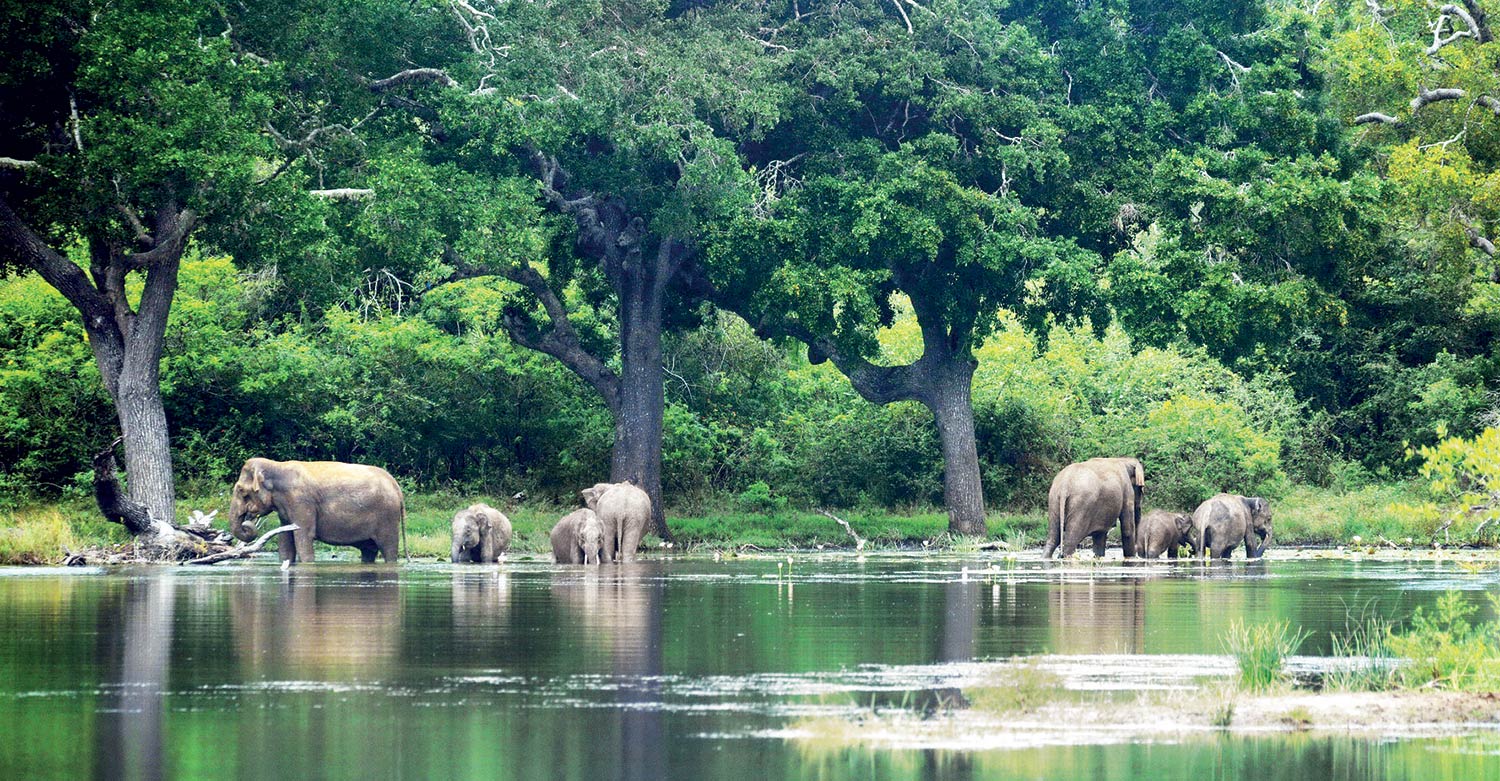
HUMAN-ELEPHANT CONFLICT: Who is the real Menace?

By Rohan Wijesinha
As per a media release dated July 29, 2024, in an effort to uplift the ecotourism industry in Sri Lanka, the Ministry of Wildlife, Forest Resources Conservation and Irrigation has proposed several measures, and is preparing legislation to implement them. In addressing Human-Elephant Conflict, their proposition commences,
“…measures taken to control the elephant menace…”
https://www.newswire.lk/2024/07/29/sri-lanka-sees-surge-in-tourism-due-to-eco-friendly-initiatives/
This is a press statement from the only Ministry that is established for conservation and wildlife, and for the protection of Sri Lanka’s iconic endangered species, the Sri Lankan Elephant. They proclaim an endangered creature whose protection they have responsibility for a ‘menace’!
This same media release also states the following:
“…4,700 workers have been hired to maintain the existing 5,390 Km of electric fencing.”
Electric fencing is, currently, the most effective way of keeping elephants out of an area; however, they have to be erected in the right place, on ecological boundaries and not administrative ones. Sri Lanka currently has the highest percentage of human-elephant conflict (HEC) amongst nations that host this special species. If the existing electric fences, of a length that can circumvent this island twice over, were effective, then Sri Lanka would not suffer the ignominy of heading such shameful statistic. It is very apparent that these fences are in the wrong places. Virtually all electric fences erected on administrative boundaries have elephants on both sides. So why all of this expense to maintain something that has been incorrectly done? Would it not be better to spend time and expense on relocating these fences to where they should be?
The media release goes on to state that
“The Ministry also plans to conduct a survey on the country’s elephant population for the first time in 13 years…”
This is an admission that the true number of wild elephants in Sri Lanka is not known. The last survey, conducted in 2011, produced an estimate of 5,879. However, unlike in Africa, where elephants can be relatively easily counted on the open plains, in Sri Lanka, it is much harder to make accurate counts as the usual habitat of elephants is of grasslands interspersed with forests and scrubland. Aerial surveys are of little use. In addition, the elephants need to be counted by those who can easily identify different individuals, or the same animal may be counted several times. This accuracy may not always achieved by the use of volunteers.
Policy based on fact or fallacy?
A Member of Parliament recently made a statement in the House that Sri Lanka’s elephant population had increased and that they should be exported or taken into captivity. In response, the Minister for Wildlife stated that
“…the elephant population has increased as natural deaths have decreased due to measures taken to protect them.”
Based on which information are these alarming statements made? The last census? Or have they already determined the result of the proposed count?
In the meantime, the stark reality is as follows:
As per official figures, between 2012 and 2023, 3,740 elephants died, over half at the hands of humans, and brutally, from gunshots, poison, electrocution, train and road accidents, and in prolonged agony from snares, and worst of all Hakka patas (Jaw Bombs), where they perish after several days from having their mouth parts blown off.
This represents 64% of the estimate of 2011. Even if, as alleged by the Minister, that 2011 number has doubled, that is still a third of the original number. This is the systematic decimation of a species.
The actuality, however, may be that as elephant habitat and forests are destroyed and encroached on, elephants have become more visible and are forced to find food somewhere, even in human cultivations. In addition, research has shown that where they have been confined to areas by ill-advised fencing, as in the Yala National Park, over 50% of calves do not survive to adolescence. With a lack of food and their mother’s being unable to produce sufficient milk for their nutrition, they starve to death.

Who is the real menace?
Elephants cause less than 20% of crop depredation yet, from those wild animals who feed on human cultivations, they are the only ones who have the ability to fight back when threatened. This has resulted in 1,090 people losing their lives between 2014 and 2023. Every human life is precious and their deaths may have been prevented if the policymakers heeded the learnings of science and experience. In 2020, a National Action Plan was formulated, by all stakeholders, to mitigate HEC; strategies that were tested and achievable.
The Plan is being implemented, but slowly, due to there being no government budgetary allocations. However, with funding from the ADB and WB, one of the strategies, that of community-based seasonal paddy field fencing will have over 100,000 ha of paddy tracts protected by the Maha season. After all, the focus should be on protecting people and their cultivations, not on imprisoning elephants to starve to death. If the Government was really committed to mitigating HEC, funding for implementation of the National Action Plan should have been a priority…alas not so!
So, people and elephants continue to die.
Elephants are vital for the economy of the country. As many as 47% of overseas visitors to Sri Lanka visit the National Parks. Minneriya hosts the largest ‘Gathering’ of Asian Elephants in the World, and Uda Walawe is one place where a wild elephant may be observed on any day of the week, on any day of the year. Destroy them, one way or another, and what will there be to attract visitors to these places?
Of course, elections are afoot and elephants do not have a vote. However, what is the legacy that the politicians wish to leave for the future? Or is political survival all that matters? It is not just the Government but the Opposition who see the elephant as a creature to be destroyed too. In a video now gone viral, a politician supporting a leading opposition candidate, who purports to be a wildlife enthusiast, has stated that should he be elected to power, farmers will issued with guns to shoot and kill any wild animal encroaching onto their cultivations. So little hope for the elephant there.
Instead of spouting unfounded proclamations and propose unachievable plans, would the policymakers not be better engaged in taking practical steps to protect humans and elephants from this desperate dance to the extinction of the lesser. After all, approximately 6,000 elephants are up against 22 million people.
The Wildlife & Nature Protection Society (WNPS) are showing some constructive measures that can be taken, rather than empty words. They are piloting cheaper deterrents to keep elephants out of human cultivations and homes, working with elephant researchers and the DWC in the further study of the behaviour of elephants, they also work with local communities to help them understand the value of elephants, and of the enormous economic benefits that they might derive from having these magnificent creatures as neighbours. In addition, they are about to launch a scheme to provide Education Scholarships for all schoolchildren who have lost a parent due to HEC, from 2023 onwards. This will be for the duration of their school careers.
The Oxford Dictionary defines a menace as being “…a person or thing that is likely to cause harm: a threat or a danger.” Are elephants really the menace?


As a clinician whose journey in medicine began from the lecture halls of the Colombo Medical Faculty, in 1965, and then matured through securing the coveted MBBS(Ceylon) degree in 1970, followed by a further kaleidoscopic journey down the specialist corridors, from 1978 onwards, I have witnessed the remarkable evolution of healthcare in Sri Lanka. I have seen the admirable resolve of a nation that managed to offer free healthcare, at the point of delivery, to all its citizens, and I have seen many a battle being fought to bring state-of-the-art treatments for the benefit of sick patients, even despite some of the initial scepticism on the part of some.
However, as we now try to navigate the turbulent waters of 2026, I find myself compelled to speak even impulsively. This is not a mission of fault-finding, or a manifestation of a desire to “ruffle feathers,” for the sake of fanning a fire. Rather, it is a reflection offered in good faith, born from the “Spirit of an Enthusiast” who has seen both the brickbats as well as the accolades bestowed on our profession. My goal is relatively simple: which is to bring to light the silent, sometimes extremely difficult, situations faced by patients, doctors, and relatives, and to urge for a compassionate and collective solution to a crisis that threatens the very foundation of the care we provide.
The Generic Gamble: The Lament of the Ward
The cornerstone of our health service has always been the provision of free medicine to all who come to our state medical facilities. For decades, the “generic-only” policy served as a vital safety net. But, today, that net is fraying, not just at the edges but virtually as a whole. In our hospital wards, the clinician’s heart sinks when a patient fails to respond to a standard course of treatment.
We are increasingly haunted by the fancy terminology, “Quality Failure”, as alerts on medicinal drugs. When an anti-infective medicine lacks the potency to clear an infection, or when a poor-quality generic drug fails to stabilise the circulation of a little gasping child who is fighting for his life, the treating doctor is left in a state of agonising clinical despair. It is a profound lament to realise that while the medicine is “available” on the shelf, its efficacy remains as a question mark. The “free health service” becomes tragically and obstinately expensive when it leads to prolonged hospital stays, complications, or, in the worst cases, even the loss of a life that could have been saved with a more reliable formulation of an essential medicine. We must acknowledge that a cheap drug that does not work is the most expensive drug of all. For the doctor, this turns every prescription into a calculated risk, a far cry from the “best possible care” we were trained to deliver. These situations are certainly not the whims of fancy of a wandering mind, but real-time occurrences in our health service.
The Vanishing Innovators and the Small Market Reality
In the private sector, the situation is equally dire, though the causes are different. We must face a hard truth: Sri Lanka is a comparatively small market in the global pharmaceutical landscape. For the world’s leading manufacturers of proven, branded medicines and vaccines, our island is often a small, rather peripheral, consideration.
When the National Medicines Regulatory Authority (NMRA) fixes prices at levels that do not even cover the “Cost, Insurance, and Freight” (CIF) value, let alone the massive research and development costs of these innovator drugs, these companies inevitably reach a breaking point. They do not “bail out” through a lack of compassion, but do so even reluctantly sometimes, because they simply cannot sustain their operations at a loss.
Over the last few years, we have watched in silence as reputable international companies have closed their shops and departed our shores. With them have gone some of the vaccines that provided a lifetime of immunity, and the so-called branded drugs that offered predictable, life-saving results. When these “Gold Standards” vanish, the void is often filled by products from regions with lower regulatory oversight, leaving the patient with no choice but to settle for what is available or just what is left.
The Shadow Economy of “Baggage Medicines”
Perhaps the most heartbreaking symptom of this broken system is the rise of the “baggage medicine” market. Walk into any major private hospital today, and you will hear the whispered conversations of relatives trying to source drugs from abroad, in a clandestine manner.
Reputed branded drugs are being brought into the country in the suitcases of international travellers. While these relatives are acting out of pure, desperate love, the medical risks are astronomical. These medicines sometimes bypass the essential “Cold Chain” requirements for temperature-sensitive products like insulin or specialised vaccines. There is no way to verify if the drug in the suitcase is genuinely effective, or if it has been rendered inert by the heat of a cargo hold of an aircraft.
As a physician, it is an agonising dilemma: do I administer a drug brought in a suitcase to save a life, knowing very well that I cannot certify its safety? We are forcing our citizens into a shadow economy of survival, stripped of the protections a modern regulatory body should provide.
The Unavoidable Storm: Geopolitical Shocks
Adding to this internal struggle is the current unrest in the Middle East. As of March 2026, the escalation of conflict has sent shockwaves through global supply chains. With major maritime routes, like the Strait of Hormuz effectively halted and air cargo capacity from Middle Eastern hubs, like Dubai, slashed by over 50%, the cost of transporting medicine has become a moving target.
* Skyrocketing Logistics: Freight surcharges and war-risk insurance premiums have added “unavoidable costs” that simply cannot be absorbed by local importers under a rigid price cap.
* Delayed Transport is delayed healing:
Shipments rerouted around the Cape of Good Hope add weeks to delivery times, leading to stockouts of even the most basic medical consumables.
These are global forces beyond our control, but our regulatory response must be agile enough to recognise them. If we ignore these external costs, we are not just controlling prices; we are ensuring that the medicine never arrives at all.
The Rights of Patients Seeking Private Healthcare
Whatever the reason for patients seeking private healthcare, all of us have an abiding duty to respect their wishes. It is their unquestionable right to have access to drugs and vaccines of proven high quality, if they decide to go into Private Fee-levying Healthcare. This is particularly relevant to the immunisation of children. Sometimes the child receives the first dose of a given vaccine in a Private Hospital, but when he or she is taken for the second dose, that particular vaccine is not available, and they are not able to tell the parents when it would be available as well.
Some of the abiding problems, associated with immunisation of children and adults in the Private Sector, were graphically outlined at the Annual General Meeting of the Vaccines and Infectious Diseases Forum of Sri Lanka, held on the 10th of March, 2026. This needs to be attended to as a significant proportion of vaccines are administered to patients, both children and adults, in the Private Sector.
In other cases, the drug or drugs of proven quality is or are not available in the Private Sector as the company, or importing authority, has wound up the operations in our country due to their inability to sustain the operations, resulting from factors entirely beyond their control. Let us face it, the current pharmaceutical industry is significantly profit-oriented, and they will continue to operate only in countries where their profit margins are quite lucrative.
A Humane Call to All Stakeholders
The current scenario is a shared burden, and it requires a shared, compassionate solution. We must look at this, not through the lens of policy or profit, but through the eyes of the patient waiting in the clinic or in the ward.
* To the Ministry of Health and the NMRA:
We recognise the extremely difficult task of balancing affordability with quality. However, we urge a “Middle Path.” We need a dynamic pricing mechanism that reflects the reality of global trade logistics and the unique challenges of a relatively smaller market. Let us prioritise the restoration of “Quality Assurance” as the primary mandate, ensuring that every generic drug in the state sector is as reliable as the branded ones we have lost. To be able to provide such an abiding certificate of good quality, we need a fully-equipped state-of-the-art laboratory.
* To the Private Sector and Importers:
We ask you to remain committed to the people of Sri Lanka. Your role is not just commercial; it is a vital part of the national health infrastructure. A transparent dialogue with the regulator is essential to prevent more companies from leaving.
* To our Patients and their Families:
We hear your lamentations. We see the struggle in your eyes when a drug is unavailable or when you are forced to seek alternatives from abroad. We respect your right to seek the best possible treatment, and we are advocating for a system that honours that choice legally and safely.
Finally, the Spirit of Care
In the twilight of my career, I look back at my work and the thousands of patients I have treated. The “Spirit of an Enthusiast” is certainly not one of resignation, but of persistent hope. We have the clinical talent and the commitment of our healthcare professionals, we have the history of a strong health service, and we have a populace that deserves the best. For us, in this beautiful land, hope springs eternal.
Let us stop the “baggage medicine” culture. Let us invite the innovators back to our shores by treating them as partners in health, not just as vendors. Let us also ensure that our state-sector generics are beyond reproach.
This is a mission to find a way forward. For the sake of the child in the ward, the elderly patient in the clinic, and the integrity of the medical profession. We desperately need to act now, together, hand in hand, and with a pulsating heart of concern, for the entire humanity we are committed to serve.
by Dr B. J. C. Perera
MBBS(Cey), DCH(Cey), DCH(Eng), MD(Paediatrics), MRCP(UK), FRCP(Edin),
FRCP(Lond), FRCPCH(UK), FSLCPaed, FCCP, Hony. FRCPCH(UK), Hony. FCGP(SL)
Specialist Consultant Paediatrician and Honorary Senior Fellow,
Postgraduate Institute of Medicine, University of Colombo, Sri Lanka.

I was recently given several books dealing with religion, and, instead of looking at questions of church union in current times, I turned first to Buddhism in the 19th century. Called Locations of Buddhism: Colonialism and Modernity in Sri Lanka, the book is a study by an American scholar, Anne M Blackburn, about developments in Buddhism during colonial rule. It focuses on the contribution of Ven. Hikkaduwe Sri Sumangala who was perhaps the most venerated monk in the latter part of the 19th century.
Hikkaduwe, as she calls Ven. Sumangala through the book, is best known as the founder of the Vidyodaya Pirivena, which was elevated to university statues in the fifties of this century, and renamed the University of Sri Jayewardenepura in the seventies. My work in the few years I was there was in the Sumangala Building, though I knew little about the learned monk who gave it its name.
He is also renowned for having participated in the Panadura debates against Christians, and having contributed to the comparative success of the Buddhist cause. It is said that Colonel Olcott came to Sri Lanka after having read a report of one of the debates, and, over the years, Ven. Sumangala collaborated with him, in particular with regard to the development of secondary schools. At the same time, he was wary of Olcott’s gung ho approach, as later he was wary of the Anagarika Dharmapala, who had no fear of rousing controversy, his own approach being moderate and conciliatory.
While he understood the need for a modern education for Buddhist youngsters, which Olcott promoted, free of possible influences to convert which the Christian schools exercised, he was also deeply concerned with preserving traditional learning. Thus, he ensured that in the pirivena subjects such as astrology and medicine were studied with a focus on established indigenous systems. Blackburn’s account of how he leveraged government funding given the prevailing desire to promote oriental studies while emphatically preserving local values and culture is masterly study of a diplomat dedicated to his patriotic concerns.
He was, indeed, a consummately skilled diplomat in that Blackburn shows very clearly how he satisfied the inclinations of the laymen who were able to fund his various initiatives. He managed to work with both laymen and monks of different castes, despite the caste rivalry that could become intense at times. At the same time, he made no bones about his own commitment to the primacy of the Goigama caste, and the exclusiveness of the Malwatte and Asgiriya Chapters.
What I knew nothing at all about was his deep commitment to internationalism, and his efforts to promote collaboration between Ceylon Lanka and the Theravada countries of South East Asia. One reason for this was that he felt the need for an authoritative leader, which Ceylon had lost when its monarchy was abolished by the British. Someone who could moderate disputes amongst monks, as to both doctrine and practice, seemed to him essential in a context in which there were multiple dispute in Ceylon.
Given that Britain got rid of the Burmese monarchy and France emasculated the Cambodian one, with both of which he also maintained contacts, it was Thailand to which he turned, and there are records of close links with both the Thai priesthood and the monarchy. But in the end the Thai King felt there was no point in taking on the British, so that effort did not succeed.
That the Thai King, the famous Chulalongkorn, did not respond positively to the pleas from Ceylon may well have been because of his desire not to tread on British toes, at a time when Thailand preserved its independence, the only country in Asia to do so without overwhelming British interventions, as happened for instance in Nepal and Afghanistan, which also preserved their own monarchies. But it could also have been connected with the snub he was subject to when he visited the Temple of the Tooth, and was not permitted to touch the Tooth Relic, which he knew had been permitted to others.
The casket was taken away when he leaned towards it by the nobleman in charge, a Panabokke, who was not the Diyawadana Nilame of the day. He may have been entrusted with dealing with the King, as a tough customer. Blackburn suggests it is possible the snub was carefully thought out, since the Kandyan nobility had no fondness for the low country intercourse with foreign royalty, which seemed designed to take away from their own primacy with regard to Buddhism. The fact that they continued subservient to the British was of no consequence to them, since they had a façade of authority.
The detailed account of this disappointment should not, however, take away from Ven. Sumangala’s achievement, and his primacy in the country following his being chosen as the Chief Priest for Adam’s Peak, at the age of 37, which placed him in every sense at the pinnacle of Buddhism in Ceylon. Blackburn makes very clear the enormous respect in which he was held, partly arising from his efforts to order ancient documents pertaining to the rules for the Sangha, and ensure they were followed, and makes clear his dominant position for several decades, and that it was well deserved.
by Prof. Rajiva Wijesinha
Attempting to bask in the glory of the past serves no purpose, some may argue supporting the contention of modern educationists who are advocating against the compulsory teaching of history to our youth. Even the history they want to teach, apparently, is more to do with the formation of the earth than the achievements of our ancestors! Ruminating over the thought-provoking editorial “From ‘Granary of the East’ to a mere hunduwa” (The Island, 5th March), I wished I was taught more of our history in my schooldays. In fact, I have been spending most of my spare time watching, on YouTube, the excellent series “Unlimited History”, conducted by Nuwan Jude Liyanage, wherein Prof. Raj Somadeva challenges some of the long-held beliefs, based on archaeological findings, whilst emphasising on the great achievements of the past.
Surely, this little drop in the Indian ocean performed well beyond its size to have gained international recognition way back in history. Pliny the Elder, the first-century Roman historian, therefore, represented Ceylon larger than it is, in his map of the world. Clicking on (https://awmc.unc.edu/2025/02/10/interactive-map-the-geography-of-pliny-the-elder/) “Interactive Map: The Geography of Pliny the Elder” in the website of the Ancient World Mapping Centre at the University of North Carolina at Chappel Hill, this is the reference to Anuradhapura, our first capital:
“The ancient capital of Sri Lanka from the fourth century BCE to the 11th century CE. It was recorded under the name Anourogrammon by Ptolemy, who notes its primary political status (Basileion). It has sometimes been argued that a “Palaesimundum” mentioned by Pliny in retelling the story of a Sri Lankan Embassy to the emperor Claudius is also to be identified with Anourogrammon. A large number of numismatic finds from many periods have been reported in the vicinity.”
Ptolemy, referred to above, is the mathematician and astronomer of Greek descent born in Alexandria, Egypt, around 100 CE, who was well known for his geocentric model of the universe, till it was disproved 15 centuries later, by Copernicus with his heliocentric model.
It is no surprise that Anuradhapura deservedly got early international recognition as Ruwanwelisaya, built by King Dutugemunu in 140 BCE, was the seventh tallest building in the ancient world, perhaps, being second only to the Great Pyramids of Giza, at the time of construction. It was overtaken by Jetawanaramaya, built by King Mahasena around 301 CE, which became the third tallest building in the ancient world and still holds the record for the largest Stupa ever built, rising to a height of 400 feet and made using 93.3 million baked mud bricks. Justin Calderon, writing for CNN travel under the heading “The massive megastructure built for eternity and still standing 1,700 years later” (https://edition.cnn.com/travel/jetavanaramaya-sri-lanka-megastructure-anuradhapura) concludes his very informative piece as follows:
“Jetavanaramaya stands today as evidence of an ancient society capable of organising labour, materials and engineering knowledge on a scale that rivalled any civilisation of its time.
That it remains relatively unknown beyond Sri Lanka may be one of history’s great oversights — a reminder that some of the ancient world’s most extraordinary achievements were not carved in stone, but shaped from earth, devotion and human ingenuity.”
Extraordinary achievements of our ancestors are not limited to Stupas alone. As mentioned in the said editorial, our country was once the Granary of the East though our present leader equated it to the smallest measure of rice! Our canal systems with the gradient of an inch over a mile stand testimony to engineering ingenuity of our ancestors. When modern engineers designed the sluice gate of Maduru Oya, they were pleasantly surprised to find the ancient sluice gates designed by our ancestors, without all their technical knowhow, in the identical spot.
Coming to modern times, though we vilify J. R. Jayewardene for some of his misdeeds later in his political career, he should be credited with changing world history with his famous speech advocating non-violence and forgiveness, quoting the words of the Buddha, at the San Francisco Conference in 1945. Japan is eternally grateful for the part JR played in readmitting Japan to the international community, gifting Rupavahini and Sri Jayewardenepura Hospital. Although we have forgotten the good JR did, there is a red marble monument in the gardens of the Great Buddha (Daibutsu) in Kamakura, Japan with Buddha’s words and JR’s signature.
It cannot be forgotten that we are the only country in the world that was able to comprehensively defeat a terrorist group, which many experts opined were invincible. Services rendered by the Rajapaksa brothers, Mahinda and Gotabaya, should be honoured though they are much reviled now, for their subsequent political misdeeds. Though Gen-Z and the following obviously have no recollections, it is still fresh in the minds of the older generation the trauma we went through.
It is to the credit of the democratic process we uphold, that the other terrorist group that heaped so much of misery on the populace and did immense damage to the infrastructure, is today in government.
As mentioned in the editorial, it is because Lee Kuan Yew did not have a ‘hundu’ mentality that Singapore is what it is today. He once famously said that he wanted to make a Ceylon out of Singapore!
Let our children learn the glories of our past and be proud to be Sri Lankan. Then only they can become productive citizens who work towards a better future. Resilience is in our genes and let us facilitate our youth to be confident, so that they may prove our politicians wrong; ours may be a small country but we are not ‘hundu’!
By Dr Upul Wijayawardhana
-

 News6 days ago
Prof. Dunusinghe warns Lanka at serious risk due to ME war
-

 News4 days ago
Historic address by BASL President at the Supreme Court of India
-

 Sports5 days ago
Royal start favourites in historic Battle of the Blues
-

 Sports4 days ago
The 147th Royal–Thomian and 175 Years of the School by the Sea
-

 Business5 days ago
BOI launches ‘Invest in Sri Lanka’ forum
-

 News5 days ago
CEBEU warns of operational disruptions amid uncertainty over CEB restructuring
-
 Features5 days ago
Indian Ocean zone of peace torpedoed!
-
 News4 days ago
Power sector reforms jolted by 40% pay hike demand