
Foreign News
Huge drugs bust reveals battles on cocaine ‘superhighway’

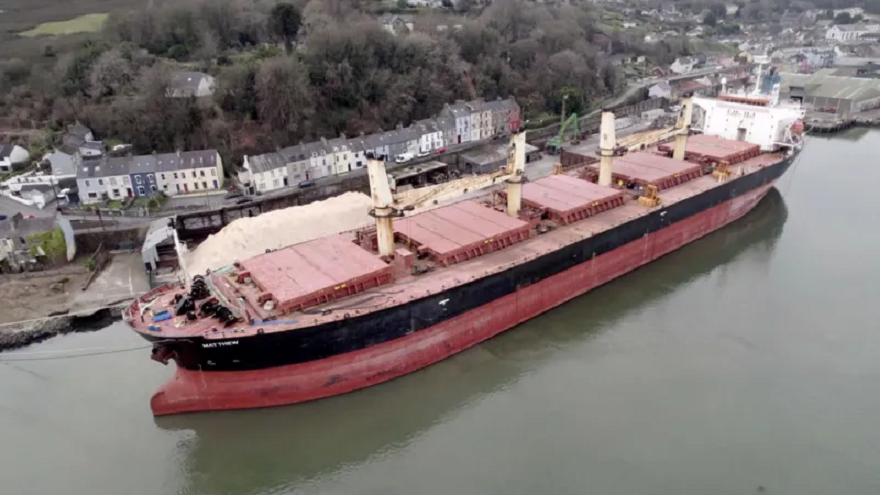
The text message came from Dubai with a Santa emoji. “OK lads. No need for luck. Really this couldn’t be any more straightforward. Just relax and this will all be over soon.”
It was sent to a fisherman from Ukraine and an unemployed man from Teesside who were sailing to the middle of the Irish Sea to collect cocaine from a passing cargo ship, the MV Matthew.
As it turned out, they needed plenty of luck and very little was straightforward.
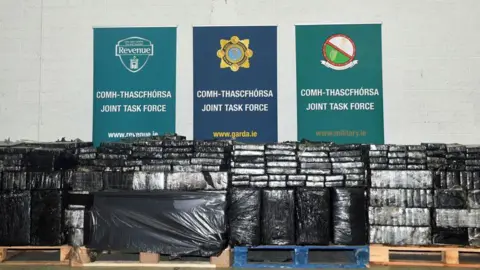
The two men were part of an audacious attempt to traffic more than 2.2 tonnes of cocaine into the UK and Europe. It ended in failure, with a successful strike against the powerful drug cartels by the Irish authorities.
Eight men were convicted and jailed for a total of 129 years. All of the cocaine was destroyed.
But despite this result, law enforcement agencies across Europe admit they are struggling to stop the growing quantity of cocaine crossing the Atlantic from South America.
The Maritime Analysis Operations Centre (MAOC), which polices the transatlantic drug trade, says 100 ships suspected of trafficking drugs to Europe were not stopped last year because the authorities didn’t have enough vessels to intercept them.
“We have the intelligence of the vessel that’s crossing the Atlantic… that it’s loaded at that time, and still we don’t have the interception assets available,” its director, Sjoerd Top, tells Panorama.
Up to 600 vessels are monitored by MAOC each day, while record amounts of cocaine are being produced in South America, he adds.
UK users consumed 117 tonnes of cocaine last year, the UK’s National Crime Agency reported. The number of cocaine-related deaths has risen ten-fold since 2011.
The drug is usually shipped in large container ships to European ports like Rotterdam and Antwerp. But security has been tightened there, so smugglers are looking for alternative routes.
Many are now using at-sea drop-off methods, unloading bales of cocaine from a “mother” vessel to be picked up by a smaller “daughter” craft and taken to shore.
“We’ve intercepted tonnes of cocaine in the last six months alone, multiple one, two tonne seizures through this method at sea,” Charlie Eastaugh, UK Border Force maritime director, tells us.
But the cartels are unrelenting and have increasingly been targeting Ireland – the only European country with an open border with the UK – as a back door.
Ireland has almost 2,000 miles of coastline, much of it ideal for smuggling, with many hundreds of isolated inlets.
And that coastline is vulnerable. The country’s defence forces help combat the cartels. Ireland has the lowest defence spending in the EU, just 0.2 % of GDP. The Irish Naval Service has eight ships but can usually put just two to sea because of a shortage of sailors.
“We have 132,000 square miles of water under our jurisdiction. A responsibility to the EU for 16% of European waters… two ships. It doesn’t make any sense,” former naval commander Eugene Ryan says.
It is the same with air support. The Irish Defence Forces are supposed to provide the helicopters to help protect the coastline. But Panorama has been told that sometimes they don’t have a single one available that can do the job.
“The narcotic superhighway comes right across the Atlantic and one of the first countries it reaches is Ireland. Our territorial waters are a free-for-all really, it’s like the Wild West out there,” says Cathal Berry, an ex-Irish Army commandant.
The Irish government says it maintains a “continuous presence and vigilance” within its maritime domain. It says funding for defence will increase by €600m (£520m) – a 55% increase over four years – and “significant initiatives… have also resulted in the stabilisation of Naval Service strength”.

While the record cocaine seizure on the MV Matthew was a success for the Irish state, it also showed the potential weaknesses in the country’s defences.
A group of cartels, believed by law enforcement to be led by the notorious Kinahan organised crime group, bought the cargo ship for around £10m in August 2023.
In mid-September, three men were sent to buy a trawler called the Castlemore in the fishing port of Castletownbere, in the south-west of Ireland.
They were Ukrainian Vitaliy Lapa, Jamie Harbron from Stockton-on-Tees and a Scottish man who had arrived from Dubai – who police called Person of Interest One.
Police were watching as the Scotsman oversaw a €300,000 (£260,000) payment from a building company in Dubai. Panorama has identified him as Glaswegian Stefan Boyd – although it is not known if he played a wider role.
Boyd flew back to Dubai first class, where he is believed to remain. Panorama has been unable to contact him for comment.
Lapa and Habron – who were later convicted – took the Castlemore to sea on Friday 22 September, not knowing that police had fitted a tracker to the vessel.
The police later obtained messages that showed the crew were getting instructions from Dubai.
The Irish authorities tracked the MV Matthew and the Castlemore over the next two days, as the two vessels attempted, but failed, to rendezvous in the Irish Sea during storms. The trawler had engine problems and lost power intermittently.
As the weather worsened, the Iranian skipper of the MV Matthew, Soheil Jelveh, wanted to head north, but his Dubai bosses warned him to avoid UK waters. “The Irish coastguard has VHF only, the British coastguards have boats too,” they messaged.
At the time, the Irish navy only had one ship at sea, the WB Yeats. It was, in fact, already tracking the smugglers and awaiting an order to intervene.
On Sunday night, the Castlemore ran aground on a sandbank in the storm and the traffickers on the trawler had to call the Irish coastguard to save them. They were winched to safety by helicopter.
On the MV Matthew, panic had set in. Less than 24 hours later the skipper falsely claimed he had been injured and needed urgent treatment. He too was airlifted to safety by the coastguard, which was unaware of the navy operation.
At hospital, it was discovered Jelveh had more than $50,000 (£37,982) in his bag. He was arrested after jumping off a bed and trying to make a dash out the hospital doors.
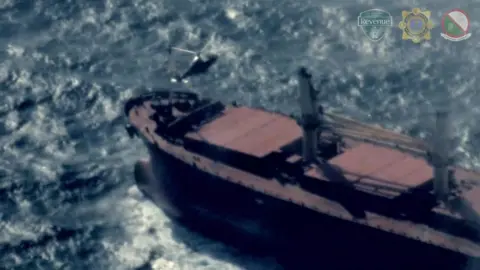
Meanwhile, a Filipino man, Harold Estoesta, had taken over as skipper and tried to evade the navy.
Voice messages and texts tell the tale of the next few hours.
A boss in Dubai, calling himself Captain Noah, told the crew to hold their nerve. “My stress level is near to heart attack. Try to be calm, be calm. Full speed go,” he said in a voice message.
But the navy ordered the MV Matthew to redirect to Cork – eventually firing warning shots. The first time since the 1980s.
One recorded exchange gives a sense of the drama, with the new skipper telling the navy, “We are afraid. We will go away because you fire at us. Please do not fire at us. My crew now panicking, crying”.
The navy commander responds: “You do not have to be afraid. All I ask is that you proceed to Cork Harbour.”
The Irish authorities decided to board the MV Matthew using the Irish Army Rangers Wing, but there weren’t any suitable helicopters available.
Five were in a hangar, waiting for spare parts and servicing. The only airworthy helicopter was being used as an air ambulance.
“They had to strip out all the medical equipment, and re-task it for a military tasking,” says Cathal Berry, a former deputy commander of the Rangers Wing. Two machine guns were quickly installed.
The bosses in Dubai still did not think the Irish military could stop them.
Captain Noah told them in an audio message, “Guys, please listen to me. ‘Til now there is no helicopter for you guys, no commando, nothing. OK, be confident.”
The final messages sent to Captain Noah from the MV Matthew were pictures of a helicopter hovering over the ship. Seconds later, the rangers dropped onto the deck and captured the crew.
Against the odds, and despite the shortage of ships and helicopters, the drug bust was a win for the Irish state.
Since then, another four attempts to traffic large quantities of cocaine to the UK have been uncovered by Irish police. But the traffickers are relentless and have huge resources.
“If I was in narco now I’d be rubbing my hands together,” says Eugene Ryan, the former commander of fleet operations in the Irish navy. “If they send 20 tonnes of cocaine on a number of vessels and some get caught, they’ll still get 12-15 tonnes in.”
Drug trafficking is a growing problem across Europe – and those leading the fight say every country needs to do more to stop it.
[BBC]

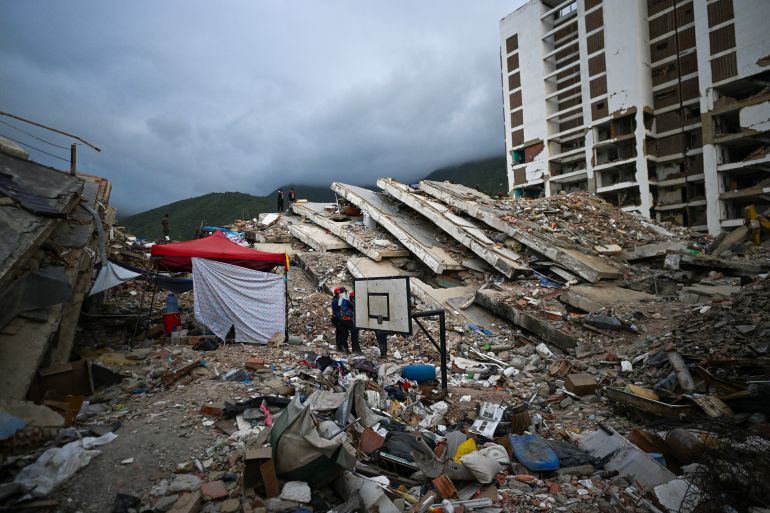
The World Bank has said that the powerful earthquakes that struck Venezuela in late June caused an estimated $19.6bn in physical damage, underscoring the country’s challenging path to recovery.
In a statement on Thursday, the World Bank said 47 percent of the damage occurred to residential buildings, while 27 percent occurred to infrastructure and 26 percent to non-residential buildings.
“The earthquakes have disrupted lives, damaged critical infrastructure, and created new challenges for Venezuela’s recovery,” Susana Cordeiro Guerra, the World Bank vice president for Latin America and the Caribbean, said in a statement. “Recovering effectively begins with reliable evidence.”
Government authorities have estimated that the magnitude 7.2 and 7.5 earthquakes that struck Venezuela on June 24 killed at least 5,000 people and injured nearly 17,000. An additional 18,000 remain homeless, as the country struggles to recover from the destruction amid persistent economic hardship.
Even before the disaster, the World Bank estimated that 76 percent of people in Venezuela, suffering from years of economic mismanagement and crushing US sanctions, were living in poverty.
“Without timely additional investment, the negative impact on productive capacity and living standards will slow the path to recovery,” said Cordeiro Guerra.
The World Bank says its estimate is meant to provide the Venezuelan government and those hoping to assist with recovery efforts with data on the scale of the challenges ahead.
The report, conducted using Global Rapid Damage Estimation (GRADE), says the areas of La Guaira state and Distrito Capital were most severely impacted. The estimate relies on local seismic data, remote-based earthquake modelling, satellite imagery, and damage reports from government and humanitarian groups.
While countries around the world have pledged support for Venezuela, it remains unclear where the funds for recovery might come from.
(Aljazeera)

More than 4,200 Israeli settlers and members of far-right groups have stormed the Al-Aqsa Mosque compond in occupied East Jerusalem in one of the largest incursions this year as they mark a Jewish holiday, Palestinian officials say.
Far-right Israeli National Security Minister Itamar Ben-Gvir also entered the site under heavy police protection on Thursday for Tisha B’Av, a Jewish day of mourning that marks the destruction twice of an ancient Jewish temple believed to have stood at the site known to Muslims as Al-Aqsa and to Jews as the Temple Mount.
The Palestinian administration of the Jerusalem governorate said 4,288 Israelis had so far entered the compound.
This number was expected to keep rising until sundown, perhaps reaching 5,000, the governorate said, which would exceed the numbers recorded in previous years during the same Jewish holiday.
Palestinian officials said Israeli forces imposed tight restrictions at the mosque’s gates, barred large numbers of Palestinian worshippers and students from entering, and assaulted several worshippers.
Nour Odeh, Al Jazeera’s correspondent in Ramallah in the occupied West Bank, said Israeli authorities had “taken extreme measures in the Old City” of Jerusalem, including barring entry to the Al-Aqsa compound for all but the elderly and tightening checkpoints such as those at Qalandiya and around East Jerusalem.
Israeli settlers performed Talmudic rituals inside the compound, including prostrating themselves, singing and praying, the Jerusalem governorate said.
Israeli media reported that police allowed more than 1,000 Israelis to pray at the site on Thursday. While non-Muslims are allowed to visit Islam’s third holiest site, they are forbidden from praying there as part of a 1967 agreement.
Ben-Gvir said Jews visiting the site on Tisha B’Av “feel like the owners”, praising what he called “tremendous progress” there, the Haaretz newspaper reported.
[Aljazeera]
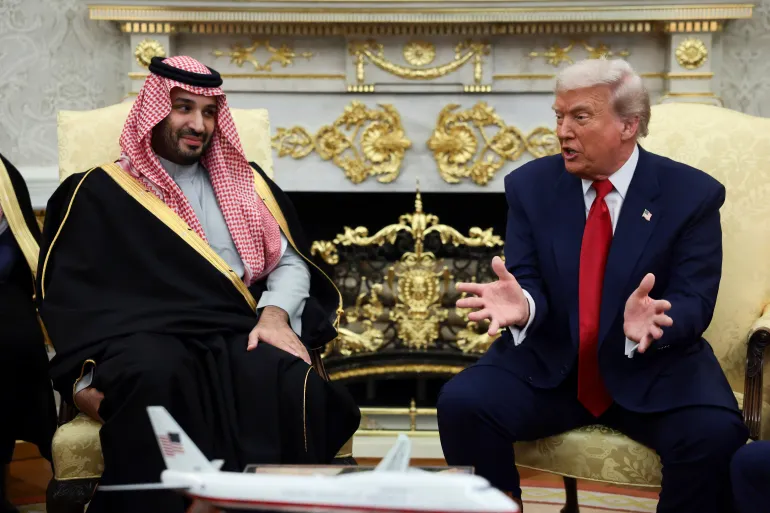
The United States and Saudi Arabia have reached a civilian nuclear cooperation deal, the administration of US President Donald Trump announced, as Washington and Riyadh push to deepen ties.
The US Department of Energy hailed the agreement as “historic” on Wednesday, saying that US companies will provide nuclear technology to the kingdom.
The deal consists of an accord under Section 123 of the Atomic Energy Act of 1954, known as a 123 agreement, “alongside an accompanying bilateral safeguards agreement”, the department said.
“These agreements reflect our two nations’ shared commitment to strengthening US-Saudi commercial relations, delivering prosperity at home and security to our allies abroad,” Energy Secretary Chris Wright said in a statement.
“Rest assured, these agreements uphold the highest standards of nuclear safety and nonproliferation, while relying on the world’s best nuclear technology and scientists, designed right here in the United States.”
Some US media reports have suggested that the deal will allow Saudi Arabia to enrich uranium domestically rather than import nuclear fuel from the US.
The Energy Department’s statement did not provide details on enrichment. If the reports are confirmed, the deal is likely to face opposition in Washington.
The statement called the agreement a “decades-long, multi-billion-dollar partnership” and said it will now be submitted to Congress for review.
Trump, together with Israel, launched a war on Iran in February to prevent the country from enriching uranium and acquiring a nuclear weapon, which Tehran denies seeking.
[Aljazeera]

Sooryavanshi the star as India complete 3-0 sweep

US and Iran hit pause on strikes for second day

Showers will occur in the Western, Sabaragamuwa and North-western provinces and in Galle, Matara, Kandy and Nuwara-Eliya districts

Chamika, Colambage help Galle Gallants consolidate top spot

BASL challenges NPP MP to repeat false claims outside Parliament

Judges’ retirement age row: Govt.-BASL powwow on the cards

‘Dates have the highest sugar content to fight Coronavirus’

Sunday Island 27 December – Headlines

#SundayIsland 17th December – Headlines

Sunday Island – 28th March

Sunday Island Headlines – 21 March

Sunday Island – 21st February – Headlines
-

 Features1 day ago
MBS: The Man of the Last Laugh
-
 Features1 day ago
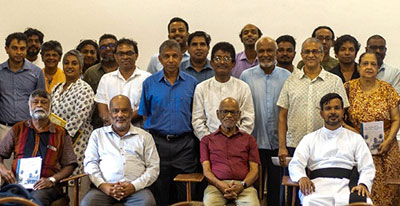
A Landmark Gathering of Minds: The Ceylon Journal Roundtable Revives the Spirit of Intellectual Dialogue
-
 Midweek Review5 days ago
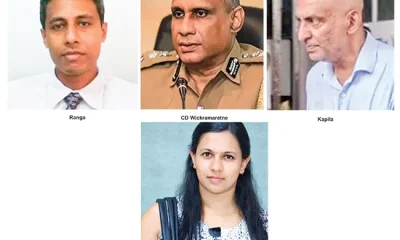
Three high-profile alleged suicides shaping key investigations
-

 Latest News2 days ago
Develop a programme to allocate underutilised state land for investment by returning migrant workers – President
-

 Life style1 day ago
A proud Sri Lankan voice in Australian Parliament
-

 News2 days ago
Fort Magistrate orders arrest of MP Archchuna
-

 Editorial1 day ago
‘Cockroaches’ tame a mighty regime
-
 Editorial2 days ago
An indictment of all parties