
Foreign News
Huge drugs bust reveals battles on cocaine ‘superhighway’

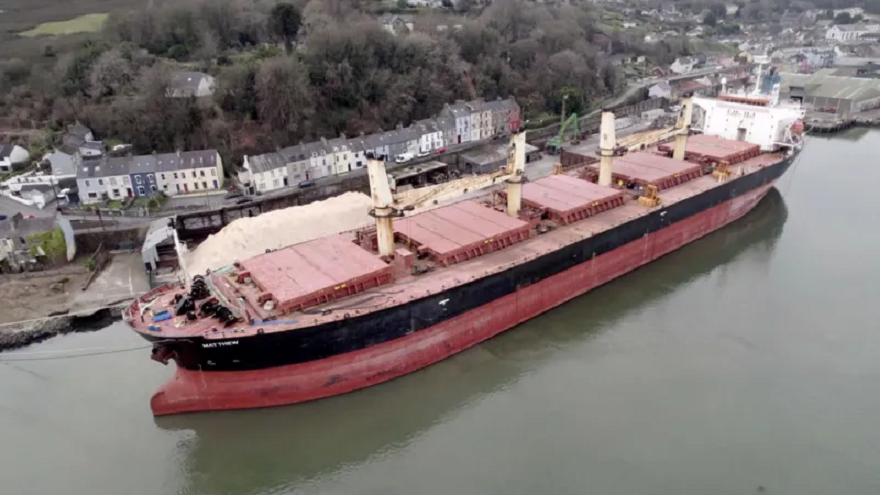
The text message came from Dubai with a Santa emoji. “OK lads. No need for luck. Really this couldn’t be any more straightforward. Just relax and this will all be over soon.”
It was sent to a fisherman from Ukraine and an unemployed man from Teesside who were sailing to the middle of the Irish Sea to collect cocaine from a passing cargo ship, the MV Matthew.
As it turned out, they needed plenty of luck and very little was straightforward.
The two men were part of an audacious attempt to traffic more than 2.2 tonnes of cocaine into the UK and Europe. It ended in failure, with a successful strike against the powerful drug cartels by the Irish authorities.
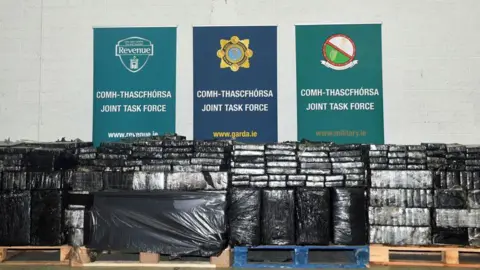
Eight men were convicted and jailed for a total of 129 years. All of the cocaine was destroyed.
But despite this result, law enforcement agencies across Europe admit they are struggling to stop the growing quantity of cocaine crossing the Atlantic from South America.
The Maritime Analysis Operations Centre (MAOC), which polices the transatlantic drug trade, says 100 ships suspected of trafficking drugs to Europe were not stopped last year because the authorities didn’t have enough vessels to intercept them.
“We have the intelligence of the vessel that’s crossing the Atlantic… that it’s loaded at that time, and still we don’t have the interception assets available,” its director, Sjoerd Top, tells Panorama.
Up to 600 vessels are monitored by MAOC each day, while record amounts of cocaine are being produced in South America, he adds.
UK users consumed 117 tonnes of cocaine last year, the UK’s National Crime Agency reported. The number of cocaine-related deaths has risen ten-fold since 2011.
The drug is usually shipped in large container ships to European ports like Rotterdam and Antwerp. But security has been tightened there, so smugglers are looking for alternative routes.
Many are now using at-sea drop-off methods, unloading bales of cocaine from a “mother” vessel to be picked up by a smaller “daughter” craft and taken to shore.
“We’ve intercepted tonnes of cocaine in the last six months alone, multiple one, two tonne seizures through this method at sea,” Charlie Eastaugh, UK Border Force maritime director, tells us.
But the cartels are unrelenting and have increasingly been targeting Ireland – the only European country with an open border with the UK – as a back door.
Ireland has almost 2,000 miles of coastline, much of it ideal for smuggling, with many hundreds of isolated inlets.
And that coastline is vulnerable. The country’s defence forces help combat the cartels. Ireland has the lowest defence spending in the EU, just 0.2 % of GDP. The Irish Naval Service has eight ships but can usually put just two to sea because of a shortage of sailors.
“We have 132,000 square miles of water under our jurisdiction. A responsibility to the EU for 16% of European waters… two ships. It doesn’t make any sense,” former naval commander Eugene Ryan says.
It is the same with air support. The Irish Defence Forces are supposed to provide the helicopters to help protect the coastline. But Panorama has been told that sometimes they don’t have a single one available that can do the job.
“The narcotic superhighway comes right across the Atlantic and one of the first countries it reaches is Ireland. Our territorial waters are a free-for-all really, it’s like the Wild West out there,” says Cathal Berry, an ex-Irish Army commandant.
The Irish government says it maintains a “continuous presence and vigilance” within its maritime domain. It says funding for defence will increase by €600m (£520m) – a 55% increase over four years – and “significant initiatives… have also resulted in the stabilisation of Naval Service strength”.

While the record cocaine seizure on the MV Matthew was a success for the Irish state, it also showed the potential weaknesses in the country’s defences.
A group of cartels, believed by law enforcement to be led by the notorious Kinahan organised crime group, bought the cargo ship for around £10m in August 2023.
In mid-September, three men were sent to buy a trawler called the Castlemore in the fishing port of Castletownbere, in the south-west of Ireland.
They were Ukrainian Vitaliy Lapa, Jamie Harbron from Stockton-on-Tees and a Scottish man who had arrived from Dubai – who police called Person of Interest One.
Police were watching as the Scotsman oversaw a €300,000 (£260,000) payment from a building company in Dubai. Panorama has identified him as Glaswegian Stefan Boyd – although it is not known if he played a wider role.
Boyd flew back to Dubai first class, where he is believed to remain. Panorama has been unable to contact him for comment.
Lapa and Habron – who were later convicted – took the Castlemore to sea on Friday 22 September, not knowing that police had fitted a tracker to the vessel.
The police later obtained messages that showed the crew were getting instructions from Dubai.
The Irish authorities tracked the MV Matthew and the Castlemore over the next two days, as the two vessels attempted, but failed, to rendezvous in the Irish Sea during storms. The trawler had engine problems and lost power intermittently.
As the weather worsened, the Iranian skipper of the MV Matthew, Soheil Jelveh, wanted to head north, but his Dubai bosses warned him to avoid UK waters. “The Irish coastguard has VHF only, the British coastguards have boats too,” they messaged.
At the time, the Irish navy only had one ship at sea, the WB Yeats. It was, in fact, already tracking the smugglers and awaiting an order to intervene.
On Sunday night, the Castlemore ran aground on a sandbank in the storm and the traffickers on the trawler had to call the Irish coastguard to save them. They were winched to safety by helicopter.
On the MV Matthew, panic had set in. Less than 24 hours later the skipper falsely claimed he had been injured and needed urgent treatment. He too was airlifted to safety by the coastguard, which was unaware of the navy operation.
At hospital, it was discovered Jelveh had more than $50,000 (£37,982) in his bag. He was arrested after jumping off a bed and trying to make a dash out the hospital doors.
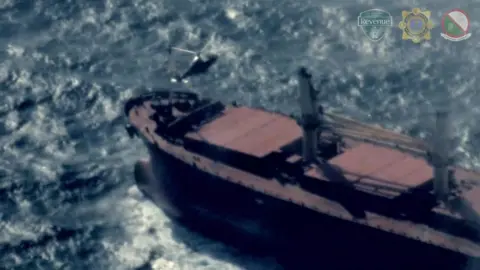
Meanwhile, a Filipino man, Harold Estoesta, had taken over as skipper and tried to evade the navy.
Voice messages and texts tell the tale of the next few hours.
A boss in Dubai, calling himself Captain Noah, told the crew to hold their nerve. “My stress level is near to heart attack. Try to be calm, be calm. Full speed go,” he said in a voice message.
But the navy ordered the MV Matthew to redirect to Cork – eventually firing warning shots. The first time since the 1980s.
One recorded exchange gives a sense of the drama, with the new skipper telling the navy, “We are afraid. We will go away because you fire at us. Please do not fire at us. My crew now panicking, crying”.
The navy commander responds: “You do not have to be afraid. All I ask is that you proceed to Cork Harbour.”
The Irish authorities decided to board the MV Matthew using the Irish Army Rangers Wing, but there weren’t any suitable helicopters available.
Five were in a hangar, waiting for spare parts and servicing. The only airworthy helicopter was being used as an air ambulance.
“They had to strip out all the medical equipment, and re-task it for a military tasking,” says Cathal Berry, a former deputy commander of the Rangers Wing. Two machine guns were quickly installed.
The bosses in Dubai still did not think the Irish military could stop them.
Captain Noah told them in an audio message, “Guys, please listen to me. ‘Til now there is no helicopter for you guys, no commando, nothing. OK, be confident.”
The final messages sent to Captain Noah from the MV Matthew were pictures of a helicopter hovering over the ship. Seconds later, the rangers dropped onto the deck and captured the crew.
Against the odds, and despite the shortage of ships and helicopters, the drug bust was a win for the Irish state.
Since then, another four attempts to traffic large quantities of cocaine to the UK have been uncovered by Irish police. But the traffickers are relentless and have huge resources.
“If I was in narco now I’d be rubbing my hands together,” says Eugene Ryan, the former commander of fleet operations in the Irish navy. “If they send 20 tonnes of cocaine on a number of vessels and some get caught, they’ll still get 12-15 tonnes in.”
Drug trafficking is a growing problem across Europe – and those leading the fight say every country needs to do more to stop it.
[BBC]

Foreign News
Naqvi casts uncertainty on Pakistan’s participation in T20 World Cup after Bangladesh ouster
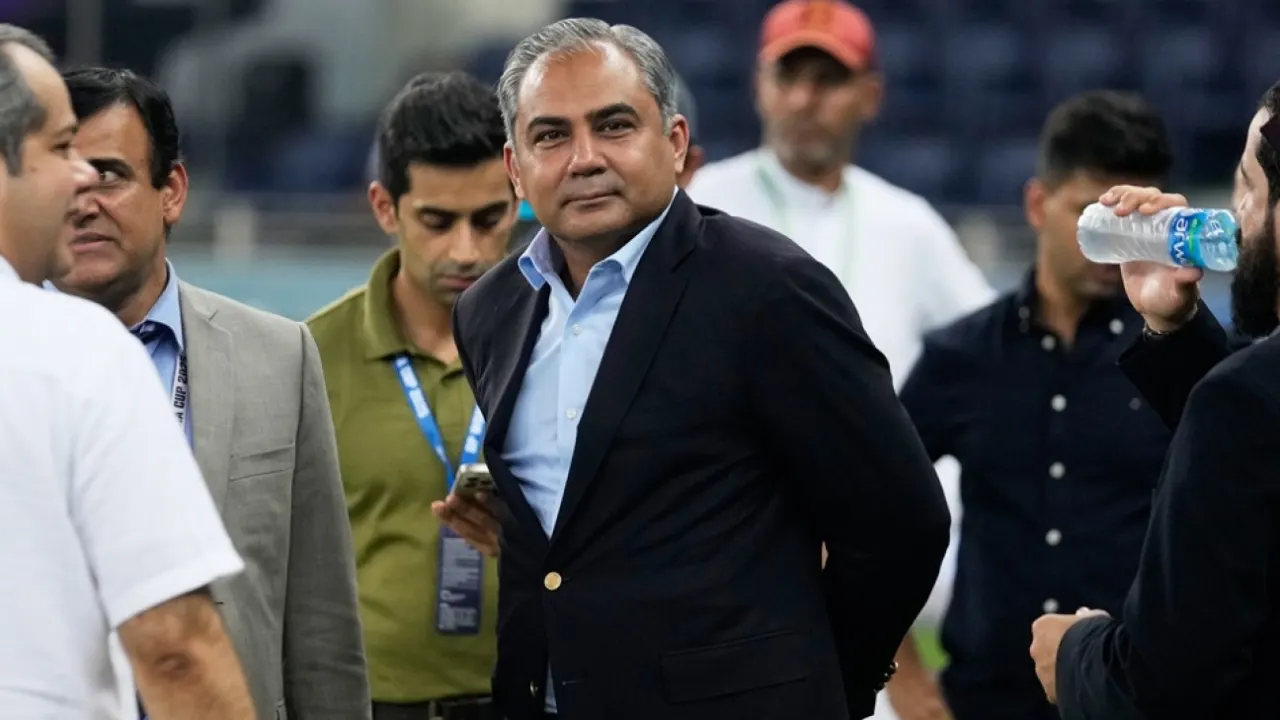
Pakistan’s participation at the upcoming Men’s T20 World Cup 2026 has been thrown into uncertainty after the PCB chairman Mohsin Naqvi said a final decision would be made after talking to Pakistan’s government. Speaking shortly after the ICC officially removed Bangladesh from the T20 World Cup owing to their refusal to play in India, Naqvi accused the ICC of “double standards” favouring India, and termed what happened to Bangladesh “an injustice”.
“Our stance on World Cup participation will be what the government of Pakistan instructs me,” he said. “The Prime Minister is not in Pakistan right now. When he returns, I’ll be able to give you our final decision. It’s the government’s decision. We obey them, not the ICC.”
Over the past week or so, Pakistan has firmly thrown its support behind Bangladesh in their dispute with the ICC demanding a venue outside of India to play their T20 World Cup matches. At an ICC meeting last week, the PCB was understood to be the only board to back the BCB in their stance. The tournament is jointly hosted by India and Sri Lanka, but Bangladesh’s games were all scheduled in India. Bangladesh, however, have said it is no longer safe for them to play in India after the BCCI, on January 3, instructed Kilkata Knight Riders to release Mustafizur Rahman rom their IPL 2026 squad.
Though no reason was stated for that directive, it came amid deteriorating relations between India and Bangladesh. On January 4, the BCB wrote to the ICC after consultation with the government that the Bangladesh team would not travel to India for its T20 World Cup matches due to security concerns, a stance it stuck to through several subsequent discussions with the ICC.
The ICC has repeatedly refused Bangladesh’s request, and earlier this week gave them an ultimatum demanding them to accept the schedule as it was, or face being removed from the tournament. On Saturday, with Bangladesh sticking to their position, the ICC formally announced Bangladesh would not be part of the T20 World Cup, and would be replaced instead by Scotland.
Naqvi was critical of the decision, calling it an injustice to Bangladesh. “I think Bangladesh has been hard done by,” he said. “You can’t have double standards. You can’t say for one country [India] they can do whatever they want and for the others to have to do the complete opposite. That’s why we’ve taken this stand, and made clear Bangladesh have had an injustice done to them. They should play in the World Cup, they are a major stakeholder in cricket.”
While there have been local, unverified reports that the PCB would refuse to participate in the World Cup in solidarity with Bangladesh should they be removed, the PCB has declined to confirm to ESPNcricinfo when approached. Naqvi’s comments to the media on Saturday was the first time anyone at the PCB has directly addressed the issue, where he repeatedly said the decision was no longer in the hands of the PCB.
“If the government of Pakistan says we mustn’t play, then maybe the ICC will bring in a 22nd team (after Scotland). It’s up to the government.”
No specific reason was given by Naqvi other than to support Bangladesh, as to why government permission would now be required for an event that starts in two weeks. Last year, both BCCI and PCB, with the approval of ICC, signed up to a hybrid model agreement by which both countries would play each other on neutral territory for all global events in the 2024-27 rights cycle.
Pakistan play all their games in Sri Lanka for this event (which already was a co-hosted event) and are scheduled to play the opening game of the tournament, against Netherlands on February 7. They are scheduled to play India on February 15 in Colombo in their group stage clash.
[Cricinfo]
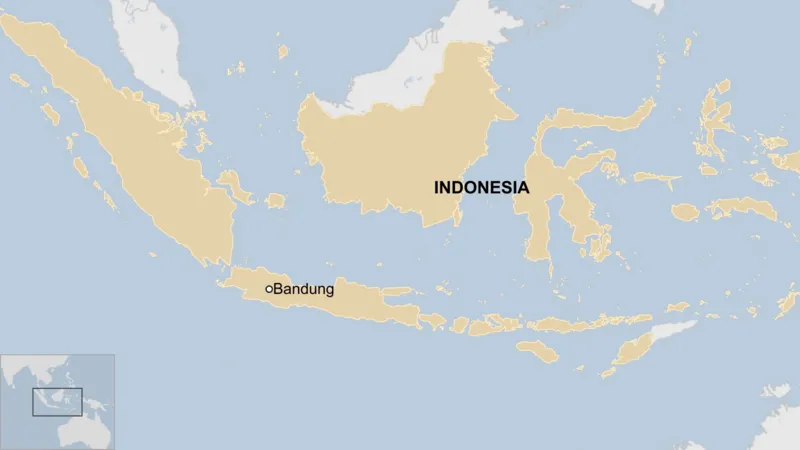
At least seven people have died and more than 80 others are missing after a landslide hit Indonesia’s West Java province, officials said.
The landslide occurred in the West Bandung region, south-east of the capital Jakarta, following days of intense rainfall.
More than thirty homes were destroyed after “landslide material buried residential areas, causing fatalities and affecting local residents”, Indonesia’s disaster mitigation agency said in a statement.
Flooding, landslide and extreme weather alerts have also been issued for the broader region.
The landslide hit the village of Pasirlangu around 02:30AM on Saturday [24] (19:30 GMT).
Two dozen people were evacuated safely from the affected region, according to Abdul Muhari, communication chief of the National Search Agency.
Images shared by local news outlets showed homes buried under mud and debris.
[BBC]

Former Canadian Olympic snowboarder and alleged drug kingpin Ryan Wedding has been arrested in Mexico and will be extradited to the US after years on the run, FBI Director Kash Patel has said.
Wedding, who had been on the FBI’s Ten Most Wanted Fugitives list, is accused of running a transnational drug trafficking operation that moved tonnes of cocaine across international borders.
Wedding, 44, was also wanted on murder charges. US officials had said they believed Wedding was living in Mexico under the Sinaloa drug cartel’s protection.
The head of Canada’s federal police force, which assisted in the investigation, spoke alongside Patel on Friday to praise the law enforcement operation.
Wedding is accused of running a vast drug trafficking operation responsible for importing some 60 metric tonnes of cocaine a year.
The organisation operated across North America, as well as several countries in Latin America and the Caribbean, and was also the largest supplier of cocaine to Canada, bringing in an estimated $1bn a year.
Before he was arrested, Wedding was accused of killing a federal witness in a case against him. Officials say he has also ordered the murders of several others.
Wedding is now facing a slew of felony charges, including witness tampering and intimidation, murder, money laundering and drug trafficking.
The FBI had previously placed a $15m (£11m) reward for information leading to his arrest. Patel declined to comment on whether anyone would be claiming the reward money.
US officials have released limited details regarding how Wedding was captured, except to say that his arrest took place on Thursday night in Mexico City.
Mexico’s top security official, Omar García Harfuch, said in a post on X that Patel had visited Mexico City on Thursday, and departed with two fugitives on the FBI’s 10 Most Wanted list.
He did not name the men arrested, but said one was a “Canadian citizen who voluntarily surrendered” at the US embassy in Mexico.
The Associated Press, citing an unnamed Mexican Security Cabinet member, reported that Wedding is the Canadian who turned himself in at the US embassy.
In his remarks at a news conference, Patel described Wedding as a “modern-day Pablo Escobar”, referring to the Colombian cartel leader. US officials have also compared him to Mexican drug dealer Joaquín “El Chapo” Guzmán.
“When you go after a guy like Ryan Wedding, it takes a united front,” Patel said, thanking Canadian and Mexican authorities for their help in the investigation.
Patel also thanked the FBI Hostage Rescue Team, who participated in taking Wedding into custody.
In an interview with Vanity Fair, Patel praised the team, which had also been involved in the capture of Venezuelan President Nicholas Maduro weeks earlier.
“This was a complex, high-stakes operation with zero margin for error,” Patel told the magazine.
“I was on the ground with our team in Mexico and witnessed extraordinary teamwork, precision, and trust between our agents and partners in Mexico.”
Wedding’s aliases include “El Jefe,” “Giant,” “Public Enemy,” “James Conrad King,” and “Jesse King”, the FBI said. He has reportedly had plastic surgery to change his appearance while on the run.
Officials allege that he launched his criminal enterprise following his release from a US federal prison in 2011, where he was serving a sentence for cocaine distribution.
Authorities allege he has ordered dozens of murders across the globe, including in the US, Canada and Latin America.
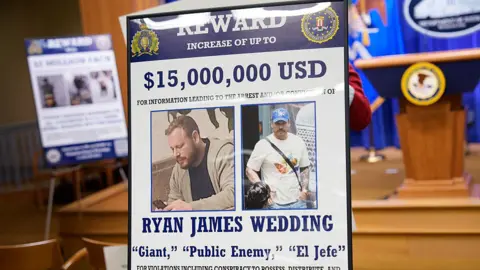
It is unclear to whom the medals belong. Wedding competed for Canada in the 2002 Olympic Games in Salt Lake City, but did not win any medals. He came in 24th place in the men’s giant parallel slalom ski event.
In November, the FBI seized his rare 2002 Mercedes CLK-GTR, which had been valued at $13m.
Patel also spoke about the recent arrest of another man in Mexico who had been on the FBI’s most wanted list.
American man Alejandro Castillo was wanted for the murder of his ex-girlfriend. According to the FBI, he has been in hiding in Mexico for nearly 10 years, and will now be extradited back to North Carolina for trial.
(BBC)

Royal Navy of Oman Ship ‘AL SEEB’ leaves island

Gold tops $5,000 for first time ever, adding to historic rally

Showers will occur in the Northern, North-central, Eastern, North-western, Western, Sabaragamuwa and Uva provinces and in Matale, Matara, Galle and Nuwara-Eliya districts

U – 19 World Cup: Andrew, McKenzie deliver West Indies comfortable win

U – 19 World Cup: Bowlers, Hogan help Australia breeze past South Africa

Abhishek blasts 14-ball fifty to hand India unassailable 3-0 lead against New Zealand

‘Dates have the highest sugar content to fight Coronavirus’

Sunday Island 27 December – Headlines

#SundayIsland 17th December – Headlines

Sunday Island – 28th March

Sunday Island Headlines – 21 March

Sunday Island – 21st February – Headlines
-
 Business20 hours ago
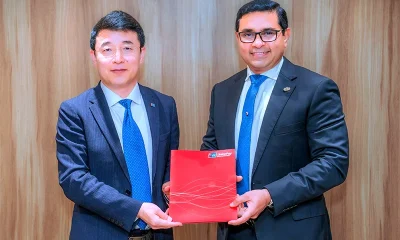
ComBank, UnionPay launch SplendorPlus Card for travelers to China
-

 Business2 days ago
ComBank advances ForwardTogether agenda with event on sustainable business transformation
-
 Opinion7 days ago
American rulers’ hatred for Venezuela and its leaders
-
 Opinion5 days ago
Remembering Cedric, who helped neutralise LTTE terrorism
-

 Business5 days ago
CORALL Conservation Trust Fund – a historic first for SL
-

 Opinion4 days ago
A puppet show?
-

 Opinion2 days ago
Conference “Microfinance and Credit Regulatory Authority Bill: Neither Here, Nor There”
-

 Opinion7 days ago
History of St. Sebastian’s National Shrine Kandana