
News
HRW says minorities, activists targeted in SL; actions contradict pledges of legal reform


Human Rights Watch in its World Report 2022 released on Thursday charged that the Sri Lankan Government in 2021 suppressed minority communities, harassed activists, and undermined democratic institutions.
It alleged that the Government of President Gotabaya Rajapaksa failed to carry out legal reforms promised to its international partners and blocked accountability for grave violations, including past war crimes.
“President Gotabaya Rajapaksa seems determined to reverse past rights improvements and protect those implicated in serious abuses,” said Human Rights Watch South Asia Director Meenakshi Ganguly. “While promising reforms and justice to deflate international criticism, his administration has stepped up suppression of minority communities.”
In the 752-page World Report 2022, its 32nd edition, Human Rights Watch reviews human rights practices in nearly 100 countries. Executive Director Kenneth Roth challenges the conventional wisdom that autocracy is ascendant.
In country after country, large numbers of people have recently taken to the streets, even at the risk of being arrested or shot, showing that the appeal of democracy remains strong. Meanwhile, autocrats are finding it more difficult to manipulate elections in their favour. Still, he says, democratic leaders must do a better job of meeting national and global challenges and of making sure that democracy delivers on its promised dividends.
The Rajapaksa Government has disregarded its own pledges of reform and continued to target minority Tamils and Muslims. The Government uses the Prevention of Terrorism Act, the country’s long-abused counterterrorism law, and policies that threaten religious freedom and minority land rights.
In March 2021 the United Nations Human Rights Council mandated the Office of the UN High Commissioner for Human Rights to collect and prepare evidence of grave crimes committed in Sri Lanka for use in future prosecutions.
But a resolution before the Sri Lankan parliament would drop human rights investigations begun under the previous administration. Additionally, the Rajapaksa Government’s appointment of people with poor rights records to independent bodies, including the Human Rights Commission of Sri Lanka and the Office of Missing Persons, have undermined their credibility and independence.
Throughout the year, Sri Lankan security forces harassed and threatened human rights defenders, journalists, lawyers, and the families of victims of past abuses, and suppressed peaceful protests. Security agencies, including the Police Terrorism Investigation Division, intrusively monitored and intimidated civil society groups and interfered in their funding sources on the pretext of combatting “terrorist financing.”
In June the European Parliament passed a resolution deploring the Sri Lankan Government’s intensifying repression. The European Commission engaged in human rights talks with the Government in which it renewed pledges to reform the Prevention of Terrorism Act. An assessment of Sri Lanka’s human rights record and its eligibility for continued trading privileges that are contingent upon respect for human rights, is expected from the commission in early 2022.
The Government struggled to protect people from COVID-19 as cases surged several times throughout the year, which contributed to widespread economic distress, but a military-controlled response to the pandemic led to further serious rights violations. The police killed at least three people while purportedly enforcing COVID-19 lockdown regulations.

Latest News
Heat Index at Caution Level in the Northern, North-central, North-western, Western, Sabaragamuwa, Eastern and Southern provinces and in Monaragala district.


Warm Weather Advisory
Issued by the Natural Hazards Early Warning Centre
at 3.30 p.m. on 20 April 2026, valid for 21 April 2026
The Heat index, the temperature felt on human body is likely to increase up to ‘Caution level’ at some places in the Northern, North-central, North-western, Western, Sabaragamuwa, Eastern and Southern provinces and in Monaragala district.
The Heat Index Forecast is calculated by using relative humidity and maximum temperature and this is the condition that is felt on your body. This is not the forecast of maximum temperature. It is generated by the Department of Meteorology for the next day period and prepared by using global numerical weather prediction model data.

Effect of the heat index on human body is mentioned in the above table and it is prepared on the advice of the Ministry of Health and Indigenous Medical Services.
ACTION REQUIRED
Job sites: Stay hydrated and takes breaks in the shade as often as possible.
Indoors: Check up on the elderly and the sick.
Vehicles: Never leave children unattended.
Outdoors: Limit strenuous outdoor activities, find shade and stay hydrated.
Dress: Wear lightweight and white or light-colored clothing.
Note:
In addition, please refer to advisories issued by the Disaster Preparedness & Response Division, Ministry of Health in this regard as well. For further clarifications please contact 011-7446491.
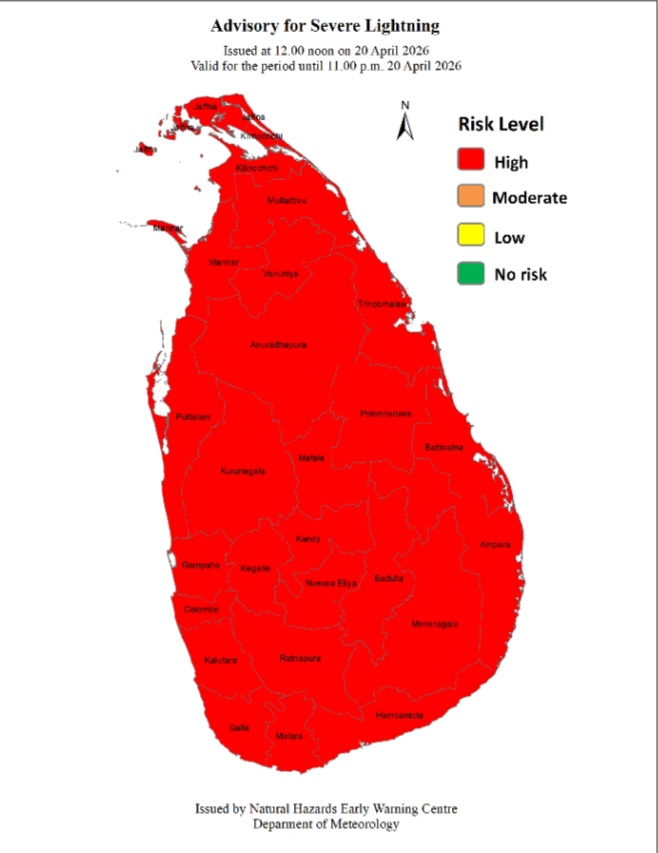
Advisory for Severe Lightning
Issued by the Natural Hazards Early Warning Centre
Issued at 12.00 noon 20 April 2026 valid for the period until 11.00 p.m. 20 April 2026
Thundershowers accompanied with severe lightning are likely to occur most places in the island after 1.00 p.m.
There may be temporary localized strong winds during thundershowers. General public is kindly requested to take adequate precautions to minimize damages caused by lightning activity.
ACTION REQUIRED:
The Department of Meteorology advises that people should:
Seek shelter, preferably indoors and never under trees.
Avoid open areas such as paddy fields, tea plantations and open water bodies during thunderstorms.
Avoid using wired telephones and connected electric appliances during thunderstorms.
Avoid using open vehicles, such as bicycles, tractors and boats etc.
Beware of fallen trees and power lines.
For emergency assistance contact the local disaster management authorities.
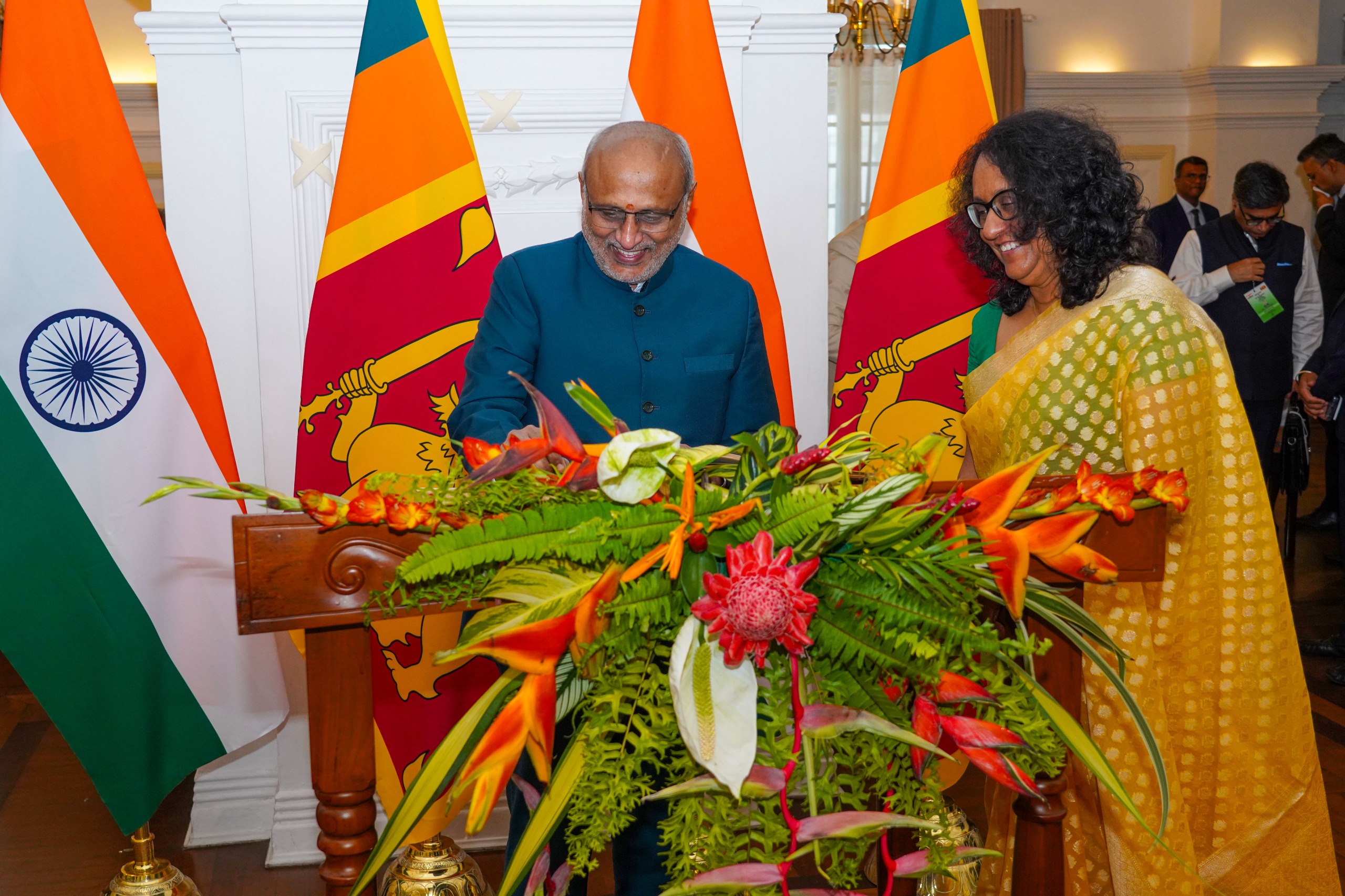
The Vice President of India, C.P. Radhakrishnan, who is currently on a two-day official visit to Sri Lanka, held a bilateral discussion with Prime Minister Dr. Harini Amarasuriya on Sunday (19) morning at Temple Trees.
Upon his arrival at Temple Trees, the Indian Vice President was received by Prime Minister Dr. Harini Amarasuriya. The Prime Minister also extended her congratulations to C.P. Radhakrishnan on his appointment as the Vice President of India.
During the meeting, the Vice President noted that this is his first official visit to Sri Lanka and expressed his appreciation for the warm welcome and hospitality extended to him during his stay.
The occasion was attended by the Minister of State for Fisheries, Animal Husbandry and Dairying, Prof. S.P. Singh Baghel; Members of Parliament Dr. K. Laxman and Dr. Medha Vishram Kulkarni; Foreign Secretary Vikram Misri; and the High Commissioner of India to Sri Lanka, Santosh Jha, and representing the Government of Sri Lanka the Minister of Foreign Affairs, Foreign Employment and Tourism Vijitha Herath; Minister of Sports Sunil Kumara Gamage; Minister of Women and Child Affairs Saroja Savithri Paulraj; Secretary to the Prime Minister Pradeep Saputhanthri; Secretary to the Ministry of Finance Harshana Suriyapperuma; Secretary to the Ministry of Education Nalaka Kaluwewa; and several other officials.
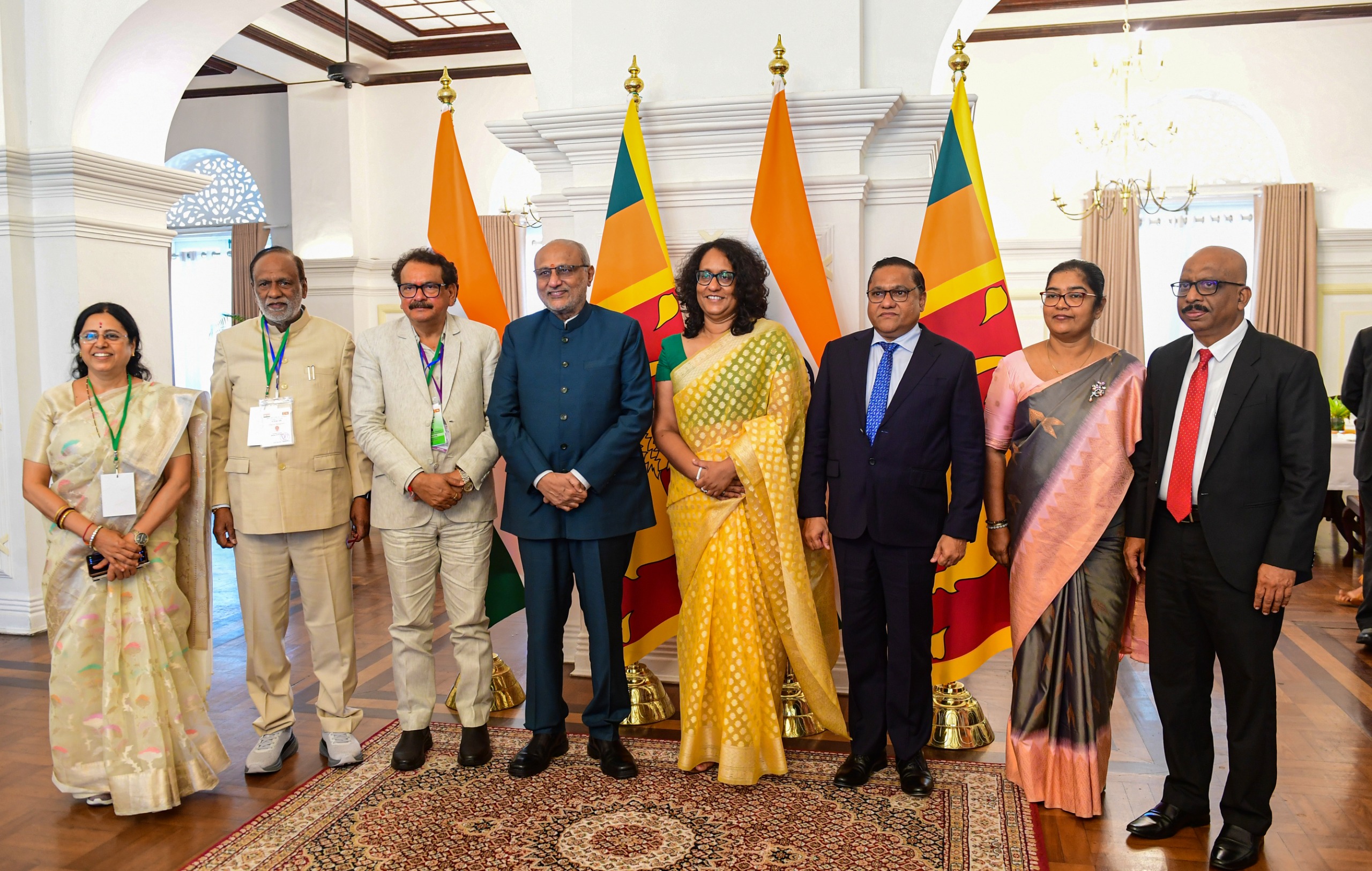
[Prime Minister’s Media Division]

Heat Index at Caution Level in the Northern, North-central, North-western, Western, Sabaragamuwa, Eastern and Southern provinces and in Monaragala district.

Dasun Shanaka handed one-year PSL ban

Nahid, Tanzid help Bangladesh level New Zealand series

Five UAE cricketers given citizenship through naturalisation

Moni, Sharmin help Bangladesh register maiden ODI win against Sri Lanka

Advisory for Severe Lightning issued for all provinces of Sri Lanka

‘Dates have the highest sugar content to fight Coronavirus’

Sunday Island 27 December – Headlines

#SundayIsland 17th December – Headlines

Sunday Island – 28th March

Sunday Island Headlines – 21 March

Sunday Island – 21st February – Headlines
-

 News5 days ago
PNS TAIMUR & ASLAT set sail from Colombo
-

 Business3 days ago
Harnessing nature’s wisdom: Experts highlight “Resist–Align” path to resilience
-

 News3 days ago
Gratiaen Trust announces longlist for the 33rd Annual Gratiaen Prize
-

 Latest News7 days ago
“I extend my heartfelt wishes to all Sri Lankans for a peaceful and joyous Sinhala and Tamil New Year!” – President
-

 News2 days ago
From Nuwara Eliya to Dubai: Isha Holdings markets Agri products abroad
-
 News3 days ago
Heroin haul transported on 50-million-rupee contract
-
 Latest News4 days ago
Singapore Zoo’s first Sri Lankan leopard cubs make their public debut
-
 Latest News7 days ago
US blockade of Iran would worsen global energy crisis, analysts say