
Sports
How two World Cup tickets changed cricket’s power bases

Rex Clementine
in Delhi
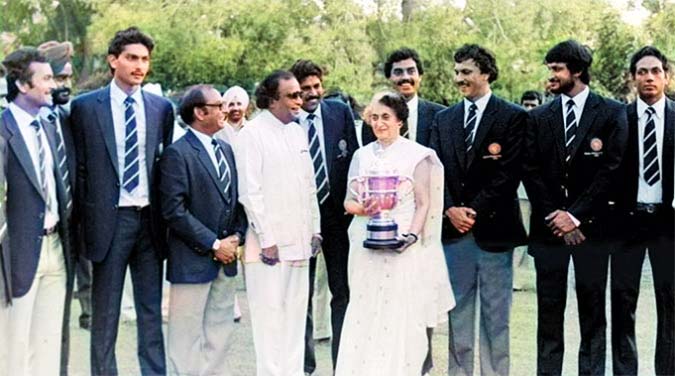
Literally, nobody expected India to reach the finals of the 1983 World Cup, leave alone winning it. In the previous edition of the tournament – in 1979 – they had even lost a game to Sri Lanka, who were yet to get Test status. But suddenly when Kapil Dev’s team entered the finals, the team had not only reached a new high but a stage was set to change the power bases of cricket too, rather accidentally.
India’s Minister of Education Siddhartha Shankar Ray is on a state visit to the UK. He approaches Indian Cricket Board President N.K.P. Salve, who was also a Cabinet Minister, to ask whether he could get two tickets for the game.
Those days ICC was run by MCC with Lord’s being the headquarters of the sport and MCC President becoming the ICC President automatically.
MCC turns down Salve’s request for two tickets for the final. The Indian board chief finds out that seats at the pavilion reserved for MCC members are empty. Obviously, MCC members aren’t interested in attending a game where England aren’t playing.
Once India create an upset by beating defending champions West Indies in the final, Salve returns home a determined man. He wants to move the next World Cup out of England. But that’s going to be a gigantic task.
Back in India, he calls for a meeting involving other regional heads of cricket such as Gamini Dissanayake and Nuzki Mohammad from Sri Lanka, Air Marshall Noor Khan from Pakistan and so on.
There they agree that the next World Cup should be held in Asia. Salve approaches Indian Prime Minister Indira Gandhi and relates his ambitious plans. He confides that he will struggle to get the finances to host such a mega event.
Mrs. Gandhi, the iron lady, promises him a blank cheque. Salve can go ahead with his plans for the World Cup. So how does she do it? She calls up business tycoon Dhirubhai Ambani, the founder of Reliance Group and father of Mukesh Ambani. The blank cheque is guaranteed.
When the matter is taken to ICC, England are furious and are determined not to let go of the sport’s showpiece event. But Salve had done his homework and played his cards smartly. He had come to a deal with Australia that they would get the chance to host the next World Cup in 1992. Australia agree provided there’s a secret ballot and not an open ballot.
Having brought the World Cup to Asia, Salve’s next move is to make sure there is a fair playing field for all cricketing nations, and he works rigorously to rid founding members of the ICC their veto powers.
This he does by promising member boards equal share of revenues and very soon, England and Australia lose their veto power.
Until very recently, the Indian board worked hand in hand with regional allies. But once they had total power, they wanted to do it solo. What has happened to the Asian solidarity? This is the first World Cup being held in Asia in one country. Always it used to be a joint effort.
Easily, India could have given Sri Lanka half their games to be held in Colombo and let Pakistan and Bangladesh play some of their games in Lahore and Dhaka. You can only wish sanity prevails.
Nobody has complained openly for everyone fears the Indian board. But you can see there are murmurs.
World cricket owes much to N. Salve for breaking England’s clout in the game. A chartered accountant from Nagpur. His parents were both freedom fighters and you can sense from where he got the guts to take on the establishment.
As for Mrs. Gandhi, sadly a year after giving the greenlight for the World Cup to be brought to Asia, she is gunned down by her own security guards. ‘Operation Blue Star’ that she had authorized to take the Sikh militants down, didn’t go down too well with the Sikhs. The military operation was a success, but in the process the forces desecrated the Golden Temple in Amritsar, the Sikhs’ holiest shrine.
As for Sri Lanka, they have been India’s closest ally. Australia once tried to diminish India’s power base by getting former Prime Minister John Howard as the President of the ICC. Howard had agreed to come on board on one condition. That was to get elected uncontested.
India did not object. They just kept quiet. Instead, they used Sri Lanka as a cat’s paw to object to Howard becoming the cricket boss. Sri Lanka’s objections were flimsy. But Maitland Place doesn’t care. All what they want is India to come to Colombo once in two years and play five ODIs and their cricket is set for a few years. And that’s the way the cookie crumbles!








by Reemus Fernando
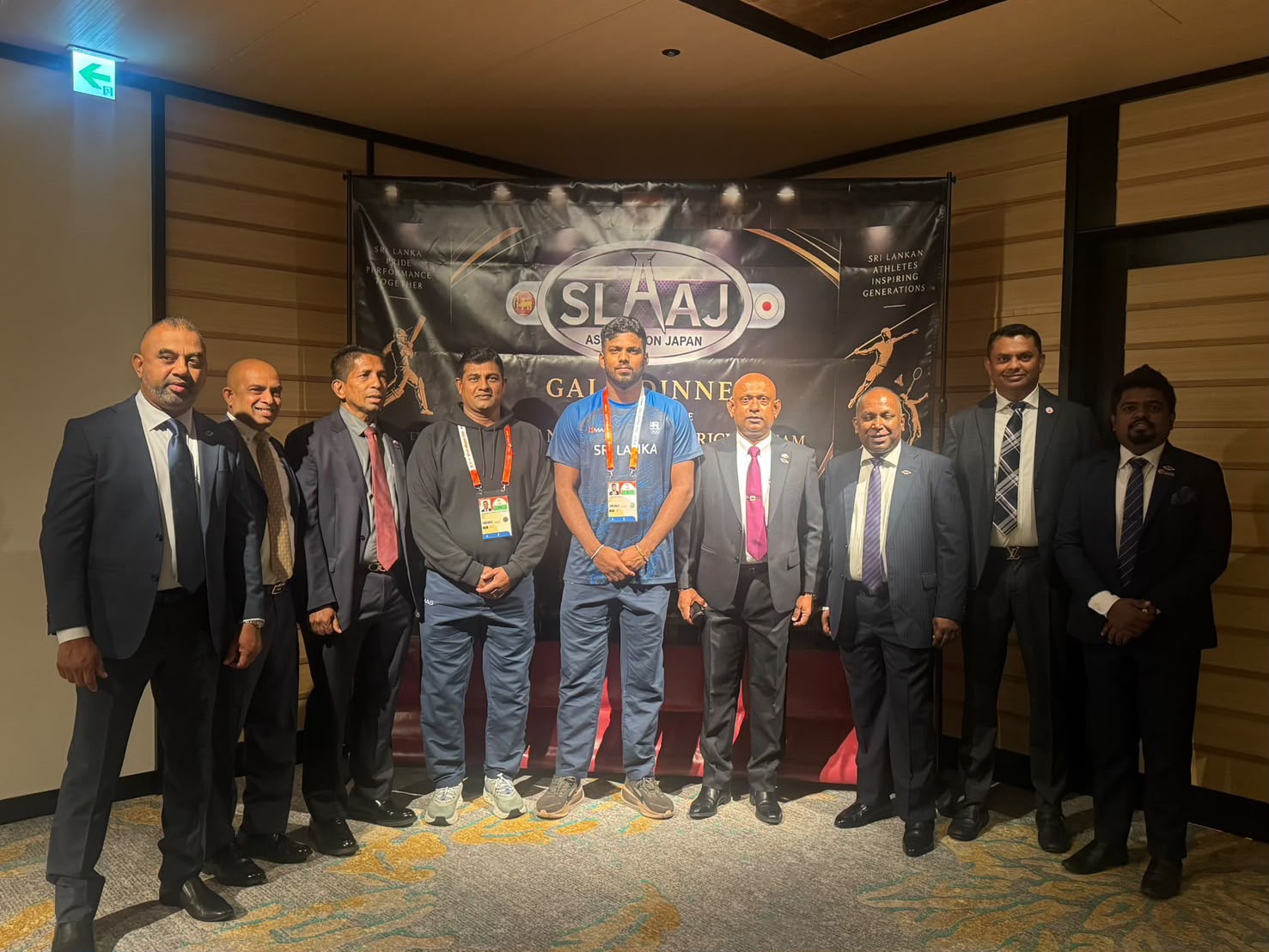
The Sri Lanka Automobile Association in Japan (SLAAJ) has awarded a brand-new Honda Vezel to gold medallist Rumesh Tharanga at a felicitation ceremony for the Sri Lankan team that competed at the Asian Games in Nagoya, Japan.
The gift was announced at the ceremony, held on the eve of the team’s departure from Nagoya.
”We decided to reward every Sri Lankan athlete who wins a gold medal with a brand-new vehicle. We invited all the Sri Lankan athletes taking part in the Games to the felicitation, and at the time of the event, only Tharanga had won gold,”
Nishantha Meegalla, Vice President of the Nagoya Prefecture of the Sri Lanka Business Council of Japan, told ‘The Island’.
Tharanga, the world’s top-ranked javelin thrower this season, won Sri Lanka’s first-ever javelin medal at the Asian Games on Monday, sealing the historic victory with a throw of 88.55 metres.

by Rex Clementine
Every cricket fan remembers that Angelo Mathews was Sri Lanka’s captain when Australia were whitewashed 3-0 in the Test series of 2016. Most will also remember Graham Ford, the master tactician, was Head Coach. But hardly anyone remembers the curator.
Perhaps they are not expected to. Curators rarely make headlines. Yet the truth remains that Godfrey Dabare produced the surfaces tailor made for Rangana Herath to weave his magic and the rest, as they say, is history.
Godfrey breathed his last on Tuesday morning after a brief illness. He was 62.
He had no degree in science or agriculture, qualifications that have become almost mandatory for chief curators these days. His university was the cricket field. His knowledge came from countless hours spent under the sun, studying soil, grass, weather and wickets, learning the craft the old fashioned way.
It is a little known fact that Godfrey spent three months in Galle preparing the venue ahead of its inaugural Test in 1998. He did a similar job in Dambulla before it became an international venue in 2001. He was a loyal lieutenant of former board chief Thilanga Sumathipala and both, Galle and Dambulla, were Thilanga’s treasured projects.
I first met Godfrey in 2000 when he was managing Chilaw Marians, then a club playing Division Three cricket. Within two years, the Marians had climbed into First Class cricket and soon became a thorn in the flesh of many fashionable Colombo clubs.
Did Godfrey occasionally use his influence as national curator to prepare pitches that suited his club? Of course he did. He was no paragon of virtue. But neither was he the villain some tried to paint him as.
He would often complain that he would unearth a rare gem from the beaches of Marawila or Wennappuwa, nurture him and give him a platform, only for one of the posh Colombo clubs to come along and pinch the player. Godfrey took those raids personally. And he was determined to teach them a lesson.
Above everything else, he cared deeply about his players.
Without his tireless work, Chilaw Marians would hardly have survived nearly three decades of First Class cricket. Now that he is gone, you cannot help but fear for the future of the club he built with such devotion, a club that has produced many fine cricketers, the latest being fast bowler Asitha Fernando.
Godfrey also had a soft spot for the press.
When England toured Sri Lanka in 2021, Sri Lanka Cricket kept journalists out of the grounds because of COVID restrictions. The press were not prepared to take it lying down, so several reporters climbed Galle Fort and covered the Tests from there.
That did not go down particularly well with SLC. The issue eventually reached Parliament, where there was rare cross party agreement that journalists should be allowed into the venue.
Relations between the cricket establishment and the press were frosty, to put it mildly. What those running the show did not know was that Godfrey was quietly sending food and drinks from inside the ground to the journalists perched on Galle Fort.
That was Godfrey.
His finest hour, however, came during the Asia Cup in 2023.
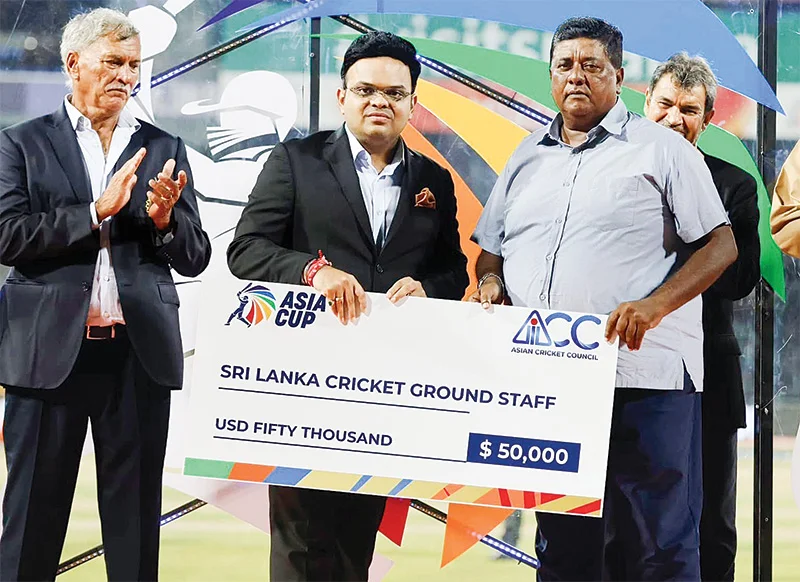
The tournament had been battered by bad weather and the ground staff worked around the clock, often in miserable conditions, to keep it moving. At the end of the tournament, the Asian Cricket Council recognised their extraordinary efforts by awarding the ground staff US$50,000. Godfrey received the cheque from ACC President Jay Shah.
Soon, murmurs began doing the rounds in Colombo. Would all that money actually reach the men who had sweated for it? There were plenty who had their doubts given the questions surrounding SLC’s financial management.
Godfrey made sure there could be no such suspicion.
Every groundsman received an equal share. Godfrey documented the payments, complete with bank and contact details of the recipients, and then, twisting the knife just a little, shared the information with the press.
He was an honest man, although often a misunderstood one.
There was another episode that summed up both Godfrey’s character and the world he occasionally had to navigate.
During a game at the R. Premadasa Stadium, the visiting team’s dressing room door had been smashed with brute force. Nobody quite knew what had happened.
When journalists rang Godfrey, he gave us chapter and verse. Bangladesh star Shakib Al Hasan, furious over an umpiring decision, had taken a bat to the dressing room door. Godfrey said he had CCTV footage and eyewitnesses to back up the claim.
The press went to town.
Shakib was summoned by the Match Referee and a suspension appeared to be looming.
Then, suddenly, Godfrey’s phone went silent.
The following day Shakib escaped with a slap on the wrist. There was apparently insufficient evidence.
A few weeks later, while journalists were watching Sri Lanka train at the R. Premadasa Stadium, Godfrey wandered over, put an arm around me and said: “Sorry, Rex. Bangladesh Cricket Board wanted the matter settled amicably. They agreed to pay for the damage. Board President (go figure who it was), called me and told me to delete the CCTV recording.”
That was Godfrey too.
Loyal to his friends. Loyal to his bosses. Sometimes caught between the two.
Sri Lankan cricket has lost one of those colourful characters who operated away from the television cameras but whose fingerprints were all over the game. Players came and went, administrators fought their battles and coaches collected the applause, but Godfrey was there in the background, preparing the stage on which they performed.
He will be missed.
His remains lie at his residence in Kurukulawa, Ragama. The burial will take place on Thursday in his hometown of Chilaw.

by Reemus Fernando
Since reaching the world number one ranking, javelin thrower Rumesh Tharanga has attained a level no other Sri Lankan athlete has reached. Winning gold at the Asian Games was therefore widely anticipated. What stood out was the way he overcame the wet conditions and, after trailing his rivals for three rounds, showed the composure to come from behind.
Here is why his medal is so special:
Tharanga’s gold at the Asian Games in Japan was Sri Lanka’s 13th in the 75-year history of the Games.
It was the 12th gold won by a Sri Lankan track and field athlete. The only other sport in which the country has won gold is cricket.
He is the first Sri Lankan javelin thrower to win Asian Games gold.
Sri Lanka had won only one previous gold in the field events: Nagalingam Ethirveerasingam’s high jump victory at the 1958 Tokyo Games, the country’s first ever.
Tharanga is also the first Sri Lankan to win gold in any throwing event.
He is the fifth Sri Lankan man to win an individual gold.
Track and Field Athletes who have won gold medals for Sri Lanka are:
Men’s
Nagalingam Ethirveerasingam high jump Tokyo 1958
Lucian Rosa 5,000m and 10,000m in Bangkok 1970
Wickremasinghe Wimaladasa 400m in Tehran 1974
Sugath Thilakarathne 400m in Bangkok 1998
Rumesh Tharanga Javelin Nagoya 2026
Sri Lanka Team inclusive of W. Wimaladasa, Sunil Gunawardana, Kosala Sahabandu and A. Premachandra won 4×400 m relay in Tehran 1974
Women’s
Damayanthi Dharsha 200m, 400m in Bangkok 1998 and 400m in Busan 2002
Susanthika Jayasinghe 100m in Busan 2002
Tharushi Karunaratne 800m in Hangzhou 2023

Gold winner Tharanga gets brand-new Honda Vezel from SLAAJ

Showers above 50 mm are likely at some places inthe Uva, Eastern and Central provinces and in Polonnaruwa and Mullaittivu districts after 1.00 p.m.

Civil society activist accuses govt. of favouring Ven. Gnanasara

More cops than cones

Sajith accuses govt. of using data selectively in crucial report

75 new inmates sent to Bogambara re-establishing it as a correctional facility

‘Dates have the highest sugar content to fight Coronavirus’

Sunday Island 27 December – Headlines

#SundayIsland 17th December – Headlines

Sunday Island – 28th March

Sunday Island Headlines – 21 March

Sunday Island – 21st February – Headlines
-
 Latest News6 days ago
Showers above 100 mm are likely at some places in the Western, Sabaragamuwa, Central and North-western provinces and in Galle and Matara Districts
-

 Editorial6 days ago
Crimes punished and unpunished
-

 Features5 days ago
Beyond traditional jobs: Why Sri Lanka needs to facilitate the gig economy
-

 Editorial4 days ago
Birth of a bad law
-
 Latest News5 days ago
Kusal, Wellalage star as Sri Lanka defend 322 in Headingley thriller
-

 News2 days ago
Police remove Thileepan statue in Jaffna
-
 Latest News7 days ago
Ms. P. M. Jayadeera (Engineer) appointed Director General of Irrigation
-

 News6 days ago
IMF: Sri Lanka on course for 2027 market return