
Sports
How cricket looked after an orphan and made him a star

by Rex Clementine
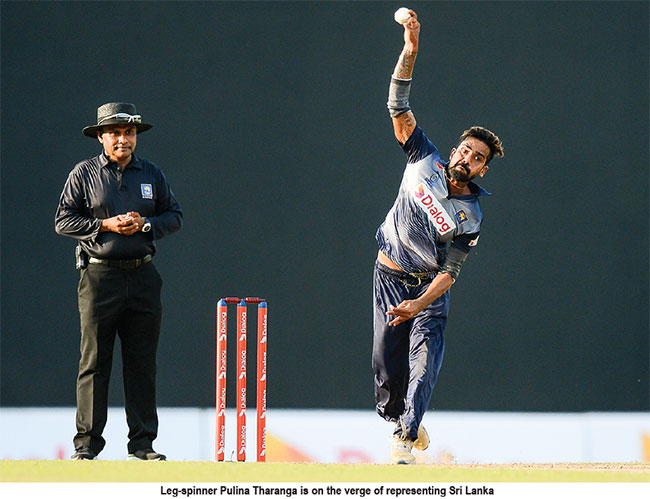
At the age of 28, Pulina Tharanga is on the verge of representing Sri Lanka. A leg-spinner, who is handy with the bat and excellent on the field, will soon make the headlines all over the world. His Steve Waugh like guts, the never say die attitude, is what that has impressed the coaches most. Like most southerners, he has inherited it by birth. Or perhaps he has developed the toughness more than the other southerners. Life threw challenges one after the other at him. Here’s his story.
Pulina Tharanga hails from Seenigama. He took up cricket at a young age representing Devananda Vidyalaya. His father was a fisherman. Life threw the first punch at him when he lost his mother to the 2004 tsunami. Less than a year later, his father went out to sea for fishing and never returned home.
Having lost both parents at the age of 11, young Pulina was abandoned; nowhere to go, no food and shelter. Cricket came to his aid. Ours is not just a gentleman’s game, it’s a generous game too.
Former Ananda College cricketer and Board Secretary Kushil Gunasekara hails from Seenigama and has taken a lot of initiatives to help the underprivileged people of his area. Quite a few prominent cricketers are trustees of the charity he runs and several legends of the game have visited his place be it Sir Ian Botham, Kapil Dev or Shane Warne.
As Kushil took young Pulina under his wings, having spotted his potential, he appealed to a few friends. The philanthropist has some influential friends around the world. Cricket’s most famous club, the Marylebone Cricket Club (MCC) came forward to sponsor Pulina providing him with a monthly allowance. There have been other big-hearted deeds like from David Cruse, a Sri Lankan living in Melbourne.
Thanks to cricket’s goodwill gestures, Pulina was able to chase his dreams. Tamil Union gave him the first big break in cricket. Then, he represented Sri Lanka Under-19 with flying colours and now he is set to take a giant step forward.
MCC will put up a grand show when Pulina plays a game at Lord’s as their efforts ensured he did not fall on the way side but continued his passion for the great game. Is there a better way to nurture the sport?
Pulina is not the traditional kind of leg-spinner. He is no Wanindu Hasaranga. He doesn’t loop the ball much but a wicket to wicket type of bowler. Bit like Anil Kumble. He doesn’t get much turn but he is pretty solid with his line and length that makes him an ideal prospect for T-20 cricket. Which is why he has been called up for the World Cup?
This year there have been some brilliant cricket stories of how players made it to the top despite many hardships. There is Pathum Nissanka and then Praveen Jayawickrama, both Kalutara boys. Pulina soon will be in the limelight as well and there are many such young kids who need help and guidance.
Kudos to Foundation of Goodness for looking after players like Pulina at a time when they most needed support. He is not the charity’s first cricketer though. There have been quite a few players who have been supported by them. The generosity is not limited to cricket but extends beyond; they show unconditional compassion.






Latest News
South Africa vs West Indies: Clash of heavyweights in another high-stakes battle in Ahmedabad


Is the ICC’s Super Eight the silliest qualifying process in the sporting universe? The unfathomable permutations of UEFA’s rejigged Champions League might beg otherwise. But it’s surely in a club of two.
After precisely two completed fixtures in an impressively sub-standard Group 2 of this T20 World Cup, we already knew our first semi-finalists … and even England themselves might be wondering how on earth they are still pointing in the right direction after their endless flirtations with catastrophe.
Over in Ahmedabad, however, there’s significantly more jeopardy brewing in Group 1. West Indies and South Africa, the two remaining unbeaten teams in the tournament, are gearing up for a heavyweight clash of the most literal variety, but even after they’ve finished battering seven bells out of each other, the victors will have no gurantees of progression just yet.
For West Indies, in particular, this feels like a must-win contest. They could hardly have laid out a more emphatic marker than their 107 run win over Zimbabwe on Monday. But, even allowing for that hefty NRR boost, a wounded India await as their final Super Eight fixture on Sunday. If that ends up being a straight knockout, then it’d be best to lay the killer blow here and now.
West Indies certainly have the form and the focus to do so. But, thrillingly, so do their opponents. In a tournament marked by reticence from a host of likely contenders, West Indies and South Africa have both been refreshingly route-one in their approach. Shimron Hetmyer’s 85 from 34 balls against Zimbabwe may have been the apogee of attacking batting in the tournament to date, but it was merely a continuation of the pedal-to-metal approach that enabled his team to out-muscle England by 13 sixes to six in their statement victory in Kolkata a fortnight ago.
South Africa, similarly, have not been backward in coming forward. India must have thought their last contest was in the bag when Jasprit Bumrah reprised his Barbados impact to reduce them to 20 for 3 after four overs at this same venue. They reckoned without a relentlessly aggressive middle order of Dewald Brevis, David Miller and Tristan Stubbs, who kept piling into the breach to produce a total of 187 for 7 that Marco Jansen soon proved to be more than enough to defend. A win on Thursday will almost certainly place South Africa in the semis, unless India lose all three games in the Super Eight.
More such bravery will be the requirement on Thursday. On a localised level, it’s thrilling to have such a high-stakes encounter at this stage of the competition. In reality, though, each of the tournament’s three likeliest winners would appear to have been crammed into the same under-sized pool. It’s sink-or-risk-being-sunk time at the Narendra Modi Stadium.
With 11 wickets at 12.18 – including eight in his last two outings, at this very venue, against New Zealand and India – Marco Jansen has the form and the method to make another statement impact for his team. Five of those wickets came in the powerplay – three against New Zealand, though they used his pace and bounce against him in between whiles, and two against India, who were never allowed to rally after his first-ball extraction of Tilak Varma. Every team craves a rangy left-arm seamer in this format, and Jansen’s combinations of angle, accuracy and steepling bounce mark him out as one of the very best.
If West Indies are to win, their batters need to keep swinging with the freedom and confidence that has brought them this far already. And no-one epitomises their current mood better than Shimron Hetmyer. With 219 runs at 54.75, he is the tournament’s second-highest run-scorer, behind Sahibzada Farhan’s tally of 283. In terms of pure six-hitting, his tally of 17 puts him way out on his own. If his game can sometimes seem too loose to function consistently, then it is entirely in keeping with West Indies’ mighty T20I heritage, including his 2016 forebears who counted almost exclusively in boundaries as they powered to their second world title, here on Indian soil, a decade ago.
No obvious reasons for West Indies to tinker with their winning formula, although Roston Chase’s offspin could be a consideration, especially with the significant core of left-handers in South Africa’s batting ranks. He would also add further depth to the batting line-up.
West Indies (probable): Brandon King, Shai Hope (capt & wk), Shimron Hetmyer, Rovman Powell, Sherfane Rutherford, Romario Shepherd, Jason Holder, Matthew Forde, Akeal Hosein / Roston Chase, Gudakesh Motie, Shamar Joseph.
The team that took on India was the strongest that South Africa could have put out, and for such a crunch contest, there’s no reason to think they’ll fiddle with their options.
South Africa (probable): Aiden Markram (capt), Quinton de Kock (wk), Ryan Rickelton, Dewald Brevis, David Miller, Tristan Stubbs, Marco Jansen, Corbin Bosch, Keshav Maharaj, Kagiso Rabada, Lungi Ngidi.
[Cricinfo]

A stunning rearguard from Mitchell Santner and Cole McConchie knocked Sri Lanka out of the 2026 T20 World Cup in spite of an electric start for the hosts as New Zealand sealed a crushing 61-run win. At an electric R Premadasa Stadium that crackled with perhaps the best atmosphere of the tournament, Sri Lanka’s spinners put New Zealand’s top and middle order to the sword, reducing them to 84 for 6.
But just as New Zealand’s innings looked to be petering out, Santner and McConchie responded with a fierce counterattack in the last four overs. McConchie began it with a takedown of Dushmantha Chameera before Santner flayed Maheesh Theekshana, up till then the game’s best bowler. The last four overs produced 70 runs as the duo put on 84, the highest seventh-wicket stand in T20 World Cup history.
Punch-drunk Sri Lanka never got up off the floor following that flurry of attacks. The first ball of the innings saw them lose their talisman Pathum Nissanka to Matt Henry’s inswinger, and Charith Asalanka fell in his following over. In response, Sri Lanka retreated into their shell as New Zealand strangled them with spin.
Rachin Ravindra only had a part-time role in India but he was thrust in as the main character. He responded with two wickets in his first over and rounded out his spell with 4 for 19 – his best T20I figures. The game was long done even as it meandered to a dispiriting conclusion for a crowd that had shown its side it was ready to play its part. As Sri Lanka limped to 107 for 8, and out of the tournament, the team itself simply couldn’t keep up its end of the bargain.
It was a boomerang of a day for Maheesh Theekshana for the extremes it swung between. It began inauspiciously when he put down a diving catch of Tim Seifert at short third off the bowling of Dilshan Madushanka – and copped a spray from the bowler for his trouble.
The following over, Theekshana would make no such mistake off his own bowling, diving sharply forward to send Finn Allen packing. It began three sensational overs for the spinner as he engineered a New Zealand collapse, dismissing Ravindra and Mark Chapman within three balls of each other. At that stage, his figures read 3-0-9-3. However, New Zealand’s late counterattack sullied them somewhat, with the spinner unable to stem the run-flow as Santner took him apart for 21 in his last over.
New Zealand had the momentum at the halfway mark thanks to the Santner-McConchie stand, and Henry made sure it carried on uninterrupted. Off the first ball of the chase, he produced an unplayable inswinger that burst past Nissanka’s inside edge to knock off the top of the stumps. It was the start of a wicket-maiden, and that dagger already plunged, he returned for his second to take another wicket to open the over. This time, it was Charith Asalanka, a listless heave merely ballooning up in the infield.
To add insult to injury, McConchie and Santner returned to strangle Sri Lanka through half of the powerplay, their three overs inside the first six going for 14. It all combined for the hosts limping along to 20 for 2 in six, the lowest powerplay score all tournament.
New Zealand played most of this World Cup on the flat Chennai surfaces, but tonight’s bowling performance revealed their impressive flexibility. Coming to Colombo, they demonstrated they were fully prepared for slower, turning surfaces. McConchie was added in place of James Neesham to add bowling depth, with Ish Sodhi playing his first game of the tournament, not counting the Pakistan fixture that was washed out.
But it was Ravindra who epitomised New Zealand’s vast flexibility with a career-best performance, taking four wickets across his spell and carving the heart out of Sri Lanka’s middle order. All told, the visitors used five different spin options with only three overs of seam bowled all innings – the fewest for New Zealand in a completed T20I innings.
Brief scores:
New Zealand 168 for 7 in 20 overs (Finn Allen 23, Mitchell Santner 47, Rachin Ravindra 32, Glenn Phillips 18, Cole McConchie 31*; Dunith Wellalage 1-27, Maheesh Theekshana 3-30, Dushmantha Chameera 3-38) beat Sri Lanka 107 for 8 in 20 overs (Kusal Mendis 11, Pavan Rathnayaka 10, Kamindu Mendis 31, Dunith Wellalage 29; Rachin Ravindra 4-27, Matt Henry 2-03, Mitchell Santner 1-19, Glenn Phillips 1-21) by 61 runs
[Cricinfo]
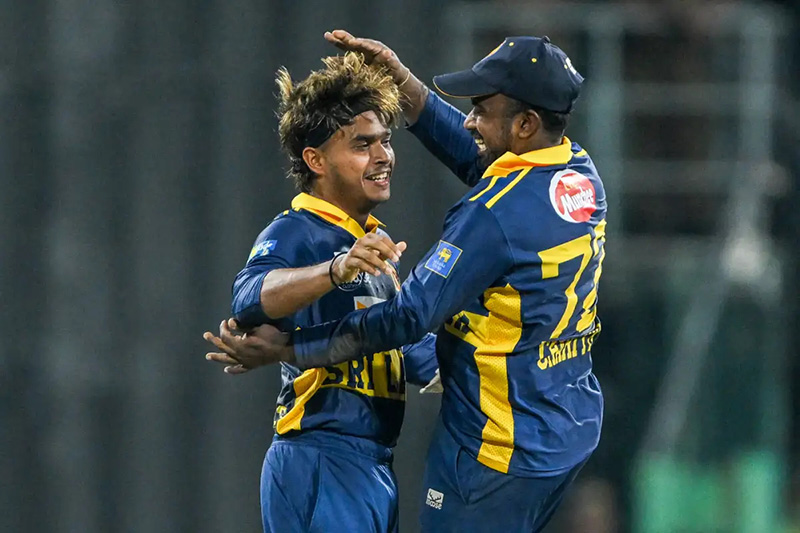
In a campaign where Sri Lanka have been forced to reshuffle their deck more often than they would have liked, Dunith Wellalage has found himself tossed the new ball during the Power Play and the young all-rounder has swum rather than sunk.
With Matheesha Pathirana, Wanindu Hasaranga and Eshan Malinga all ruled out by injury during the 20-nation showpiece, the former champions have had to plug gaps on the run. Wellalage, who may well have been watching from the sidelines had the cupboard been full, has instead been handed a front-row seat and he has made it count.
“It was a challenge bowling during the Power Plays and the key was for me to deny the batsmen boundaries,” Wellalage told reporters on the eve of Sri Lanka’s crunch Super Eight clash against New Zealand at the R. Premadasa Stadium. “I had to be clever with my lengths and when I did that the batters had to take a few chances. I relished the new challenge.”
Called upon to operate inside the first six overs against England when field restrictions were on, a phase usually reserved for the more experienced bowlers, the left-arm spinner rolled his arm over with maturity beyond his 23 years. He finished with three wickets, varying his pace and length like a seasoned campaigner.
With seven scalps from five outings, Wellalage is Sri Lanka’s second highest wicket-taker in the tournament behind Maheesh Theekshana’s eight. Not bad for a man who began the competition as a supporting act.
But it is not just with the ball that the former Under-19 captain has been asked to come forward. Sri Lanka’s think tank has nudged him up the batting order, promoting him from his usual berth at seven or eight, a move that has drawn praise from Batting Coach Vikram Rathour.
“I usually bat at number seven or eight, but I have been told to be ready to go up at number five if the situation arises,” Wellalage explained. “My role is to get some quick runs. The coaches have been very supportive and I enjoy the challenge.”
It is a role that demands clear thinking and brave stroke-play, the art of finding gaps rather than swinging blindly for the ropes. In a side that has at times been guilty of losing wickets in clusters, Wellalage’s calm head has offered stability.
Wednesday’s contest in Colombo is a must-win for Sri Lanka, who were handed a sobering 51-run defeat by England in their Super Eight opener. Another slip and the equation becomes steep; win, and the semi-final dream remains alive.
“We have got to now win both these games,” Wellalage said. “We have played New Zealand a lot in recent years and we know that we can beat them in these conditions. We are still in with a chance to make it to the semis and winning tomorrow will be important.”
Sri Lanka’s struggles in global tournaments since lifting the T20 crown in 2014 have been well documented. They have had to navigate qualifying routes and even missed out on the 2024 Champions Trophy, the first Men’s ICC event they failed to feature in since making their World Cup debut in 1975.
Yet Wellalage believes the tide is slowly turning.
“We know how important a home World Cup is. The fans have turned up in numbers and we have always believed that we can make it to the semi-finals,” he said. “The last two games haven’t gone to our plan but we are looking forward to the must-win clash tomorrow.”
Sri Lanka boast a healthy record at the RPS, where the surface often demands application over audacity. It is not a venue for reckless slogging but for bowlers who hit their straps and batters willing to graft before they unfurl.
“We have a good record at this ground and our winning percentage here has been good. All players are looking forward to doing well tomorrow,” Wellalage added.
by Rex Clementine

South Africa vs West Indies: Clash of heavyweights in another high-stakes battle in Ahmedabad

Ravindra, Santner, McConchie eliminate Sri Lanka

Fair weather except for a few showers in the Southern province and in Rathnapura and Monaragala districts after 2.00 p.m

X-Press Pearl disaster fuels global call to classify plastic pellets as hazardous

Foreign Minister Herath decries deadlock in global disarmament

CoPF orders officials to establish legal framework for Rs. 200 for estate workers daily attendance allowance

‘Dates have the highest sugar content to fight Coronavirus’

Sunday Island 27 December – Headlines

#SundayIsland 17th December – Headlines

Sunday Island – 28th March

Sunday Island Headlines – 21 March

Sunday Island – 21st February – Headlines
-

 Features4 days ago
Why does the state threaten Its people with yet another anti-terror law?
-

 Features4 days ago
Reconciliation, Mood of the Nation and the NPP Government
-

 Features4 days ago
Victor Melder turns 90: Railwayman and bibliophile extraordinary
-

 Features3 days ago
LOVEABLE BUT LETHAL: When four-legged stars remind us of a silent killer
-
 Features4 days ago
Victor, the Friend of the Foreign Press
-
 Latest News5 days ago
New Zealand meet familiar opponents Pakistan at spin-friendly Premadasa
-

 Latest News5 days ago
Tariffs ruling is major blow to Trump’s second-term agenda
-

 Latest News5 days ago
ECB push back at Pakistan ‘shadow-ban’ reports ahead of Hundred auction