
News
How an Intruder in the General Assembly was Upstaged by a Foreign Minister

By Thalif Deen
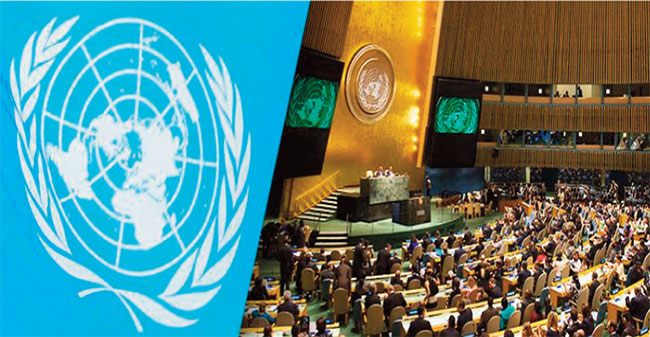
UNITED NATIONS – Sri Lanka had its fair share of Foreign Ministers who made their annual visits to the UN during the General Assembly sessions in September when the world body traditionally hosted over 150 world leaders, including heads of state and heads of government.
Sri Lanka’s Foreign Minister ACS Hameed had one of his memorable moments when an Eelam activist and lawyer from London, Krishna Vaikunthavasan, surreptitiously gate-crashed into the UN and tried to upstage Hameed by walking onto the podium of the General Assembly hall and momentarily took the speaker’s slot.
The incident, perhaps a rarity in the history of the UN, saw the intruder unleashing a diatribe against a member state accusing it of genocide and lambasting the government for committing war crimes against the Tamils fighting for a separate state in northern Sri Lanka.
When the president of the Assembly realized he had an interloper on his hands, he cut off the mike and summoned security guards who bodily ejected him from the hall and banned him from the UN premises. And as Hameed walked up to the podium, there was pin drop silence in the Assembly Hall.
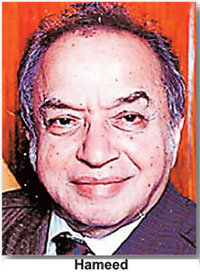 As a member of the Sri Lanka delegation at that time, I was seated behind Hameed. But the unflappable Hameed, unprompted by any of his delegates, produced a riveting punchline: “Mr President”, he said “I want to thank the previous speaker for keeping his speech short,” he said, as the Assembly, known to suffer longwinded speeches, broke into peals of laughter. The intruder was in effect upstaged by the Foreign Minister.
Hameed’s canny sense of humor also went far beyond the confines of the UN. When he came under attack for staying in five-star luxury hotels during the UN General Assembly sessions in New York, he fired back at the Opposition MP in Parliament with a rejoinder dripping with sarcasm: “Where do you want me to stay when I travel overseas as the Foreign Minister?”, he asked. “in thosai boutiques?”
To put it in perspective, that would be like rooming at the Ambal Café in Hulftsdorf or Saraswathy Lodge in Bambalapitya. Or perhaps Saravana Bhavan in New York’s Lexington Avenue.
Hameed routinely pitched his tent either at New York’s Hyatt Regency, the Intercontinental Barclay, the Waldorf Astoria or the Palace Hotel—and he did it in style, like scores of other high-flying Foreign Ministers arriving for the UN sessions. A globe-trotter of near-biblical proportions, he was probably in Colombo only on transit, in between catching overseas flights.
Hameed was an unforgettable character in his heyday—enjoying every single moment of his tenure as Foreign Minister beginning 1977. And more so, because President JR Jayewardene (JRJ) never addressed the UN nor stepped into the UN premises (even while he stayed at the Waldorf Astoria in New York during his state visit to Washington DC in April 1983.) The reasons for shunning the UN remains a mystery.
With Sri Lanka holding the chairmanship of the Non-Aligned Movement (NAM) during 1976-1979, Hameed was constantly called upon to preside over some of the thorniest international issues of the mid-1970s: which of the two Cambodian factions had the rightful claim to the seat at the UN (the General Assembly session that day was held up for over four hours as he negotiated behind closed doors to help resolve the dispute, with backing from the UN’s Legal Adviser)? Was it Kampuchea under the Khmer Rouge regime (1975-1979)?
And, in another dispute, should Egypt, which had signed the Camp David peace agreement with Israel in 1978, be driven out of NAM? There were also sharp divisions in NAM over the disputed territory of Western Sahara in the Maghreb region of North Africa and the split over the Soviet invasion of Afghanistan (1979-1989).
 As he sat in judgement, Hameed’s closest advisers during the General Assembly sessions included two outstanding career diplomats, Jayantha Dhanapala and Nihal Rodrigo, along with Ernest Corea, Sri Lanka’s High Commissioner to Canada and later Ambassador to the United States.
Ernest was one of Hameed’s longstanding friends, having known him long before he became Foreign Minister, and was the only Sri Lankan Ambassador who addressed him by his first name: Shahul, throwing protocol to the winds.
As Ernest once told me : “Shahul faced many challenges in his life – one of them was a lack of physical height – but his biggest challenge was managing the Foreign Affairs portfolio for the Sri Lanka government. To the best of my recollection, he was the first Foreign Minister to hold that portfolio without the direct involvement of the Prime Minister’s/President’s office”. Previously, Defence and External Affairs were integrated into a single portfolio.
When President Jayewardene unhitched them, there was a fairly widespread perception, particularly in Colombo’s foreign policy establishment, that the whole business of foreign affairs was being downgraded. “Shahul proved them wrong”, said Ernest.
As part of the landscape in the UN Delegate’s Lounge, Hameed was seen holding court, even as he kept chomping at his cigar, probably the best from Cuba, which he picked up in Havana during his frequent trips to the Cuban capital, before Sri Lanka handed over the NAM chairmanship to Fidel Castro in 1979.
At home, Hameed had a tough task steering the NAM ship among sceptics like Gamini Dissanayake and Lalith Athulathmudali, and of course, JRJ himself. Still, Hameed showed remarkable patience and persistence.
Perhaps his most joyous moment as Foreign Minister was when JRJ told Fidel Castro at the Havana summit that it was Hameed who enabled Sri Lanka to hand over NAM’s leadership to Cuba “untarnished and unaltered.”
This put to rest the speculation even within his own party that his days as Foreign Minister would be short. “The fact is that JRJ realized as few others did that Shahul had an intuitive feel for international relations. Those who had the privilege of working with him understood this. He had his faults. Who doesn’t?,” asked Ernest.
“I am not going to be counted among his critics who might want to let fly at him now that he is no longer with us. Rather, I would like to remind those of us who worked with him and others who observed him at work that he was outstanding in several areas”.
First, he was tri-lingual: in English, Sinhala and Tamil. This gave him a remarkable reputation among his peers. Second, he had a phenomenal memory and could at precisely the correct moment during a drafting session pull out from the recesses of his mind a word, a phrase or other salient reference that added substance and depth to a public policy statement. He was also insistent, as some of his colleagues were not, that a solid Sri Lanka/India relationship was an essential component of foreign policy, said Ernest.
“One more point needs to be stressed and this is very personal. He was an excellent extempore speaker. He could intervene in a debate to deal with a complex issue for which most of us were unprepared as if he was saying to himself: “Here’s that loose ball I was waiting for,” declared Ernest.
Armed with self-deprecating humour, Hameed funded the publication of a collection of cartoons that lampooned him. He particularly relished a cartoon which showed him sitting before a huge globe with the caption: “Let me see – what are the countries I have still not visited.” His initials ACS were spelled out as “All Countries Seen.”
An equally lovable cartoon in November 1978 showed a world-weary Hameed arriving at the Katunayake airport and innocently asking a passer-by: “My dear man, could you show me the way to Harispattuwa?,” his electorate in his hometown of Akurana, a majority Sinhala Buddhist electorate. And to have been elected over a very long period was a tribute to Hameed’s political relationship among his voters.
The cartoons were sketches from some of Sri Lanka’s celebrated artistes of the 1970s, including W.R.Wijesoma, Jiffrey Yoonoos, Mark Gerreyn and Amita Abayesekera.”One of the greatest gifts is the ability to laugh at oneself,” said Wijesoma in an introduction to the book titled “Mr Foreign Minister”, ” Mr Hameed is doing just that, and I believe he is having the last laugh.”
Oscar Wilde once made the distinction between two forms of torture: the rack and the Press. Ask any politician, said Hameed, and he would opt for the grisly torture chamber over the editorial offices and the news desks in Colombo.
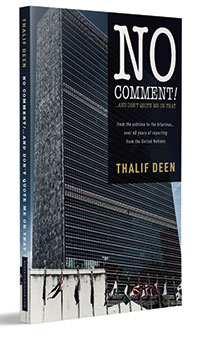
This article is adapted from a newly-released book on the United Nations titled “No Comment—and Don’t Quote Me on that” authored by Thalif Deen. The book is available on Amazon and at the Viitha Yapa bookshop.

Latest News
A strong Technical and Vocational Education and Training (TVET) system equips individuals with practical, relevant, and future-oriented skills helping to innovate responsibly towards a greener and sustainable future – PM

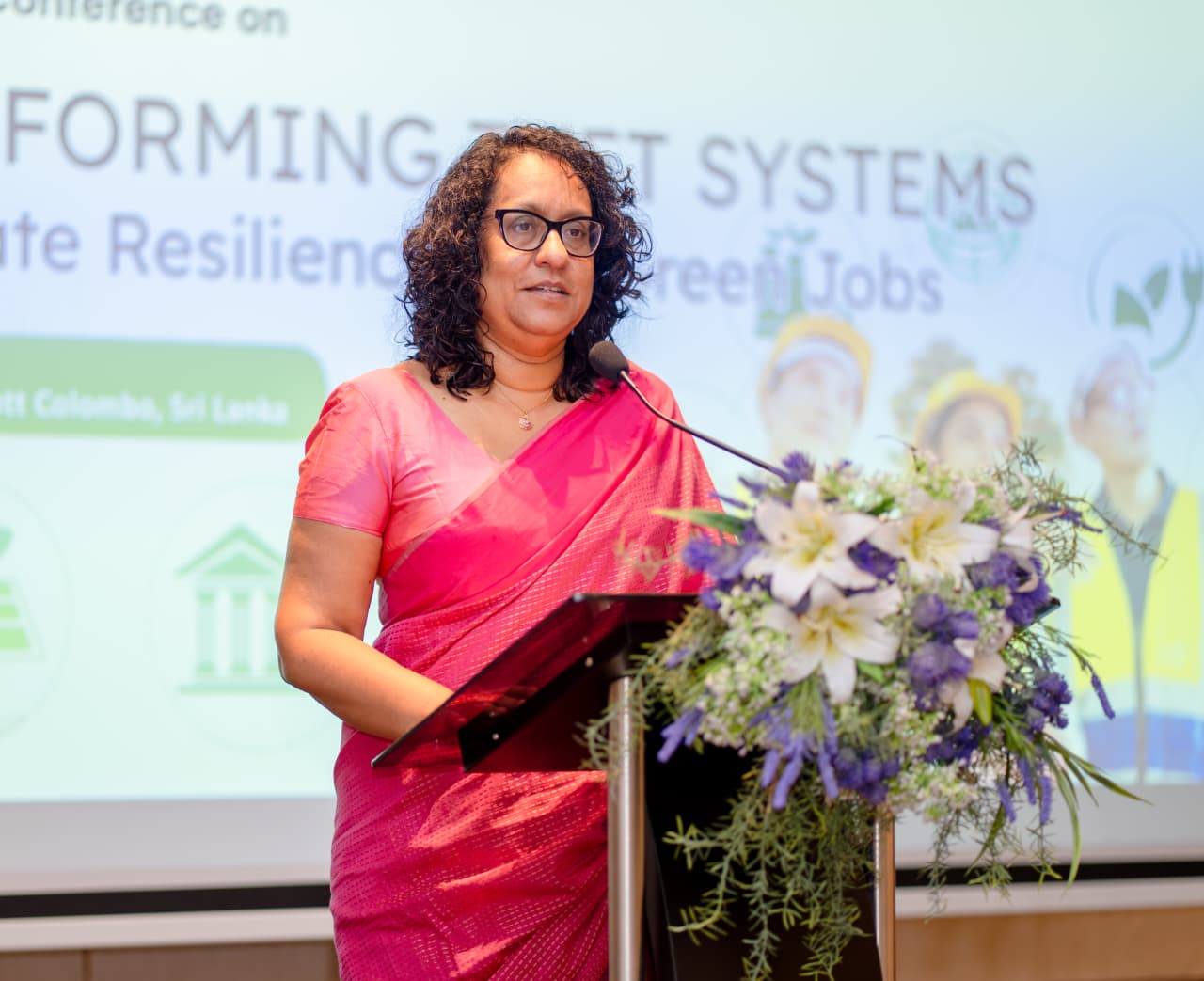
The Prime Minister, Minister of Education, Higher Education and Vocational Education Dr. Harini Amarasuriya participated as the Chief Guest in the international conference on ’Transforming TVET Systems for climate resilience and green jobs’ organized by Colombo Plan Staff College, Philippines together with the Ministry of Education, Higher Education and Vocational Education Sri Lanka on 24 th of March at Courtyard by Marriott Colombo, Sri Lanka.
The Conference serves as the flagship event of the five-day Regional Programme on “Transforming TVET for a Digital, Green, and Inclusive Economy” (23-27 March 2026), which continues throughout the week, bringing together representatives from CPSC member countries including Bhutan, Fiji, Malaysia, Maldives, Myanmar, Nepal, Philippines, Thailand, Pakistan, and Sri Lanka, fostering high-level dialogue and knowledge sharing on climate-resilient and green skills development.
The Conference features technical and plenary sessions on climate-responsive TVET systems, green skills development, national policy frameworks, and emerging technologies shaping industry transformation.
Addressing at the event, the Prime Minister emphasized the role of Technical and Vocational Education and Training (TVET) that equips individuals with practical, relevant, and future-oriented skills in addressing climate change and shaping a sustainable future.
The Prime Minister reaffirmed that this transformation remains a national priority for Sri Lanka. She stressed that education must go beyond knowledge dissemination to empower individuals with opportunities, dignity, and the capacity to contribute meaningfully to society.
She further emphasized the need to integrate environmental sustainability into education and training systems by embedding green skills in curricula, investing in modern training facilities, promoting innovation, and fostering collaboration between training institutions and emerging green industries.
Highlighting the importance of ensuring equity the Prime Minister further stated, that opportunities arising from the green transition must be accessible to all, including youth, young women, people with special needs, and marginalized communities.
Reaffirming Sri Lanka’s commitment to working closely with regional and international partnerships, the Prime Minister emphasized the importance of transforming them to actual benefits and partnerships.
The occasion was attended by the Secretary to the Ministry of Education, Higher Education and Vocational Education Nalaka Kaluwewa, Additional Secretary (Vocational Training) Ms. Samanthi Senanayake Director General Colombo Plan Staff College Prof. Dr. Suresh K. Dhameja , TVET administrators, institutional leaders, policymakers, instructors, industry representatives, and international delegates from across the region and seniors officials and officials from Ministries.
(Prime Minister’s Media division)
News
PM reviews progress of the committee appointed for the establishment of a National Nursing University
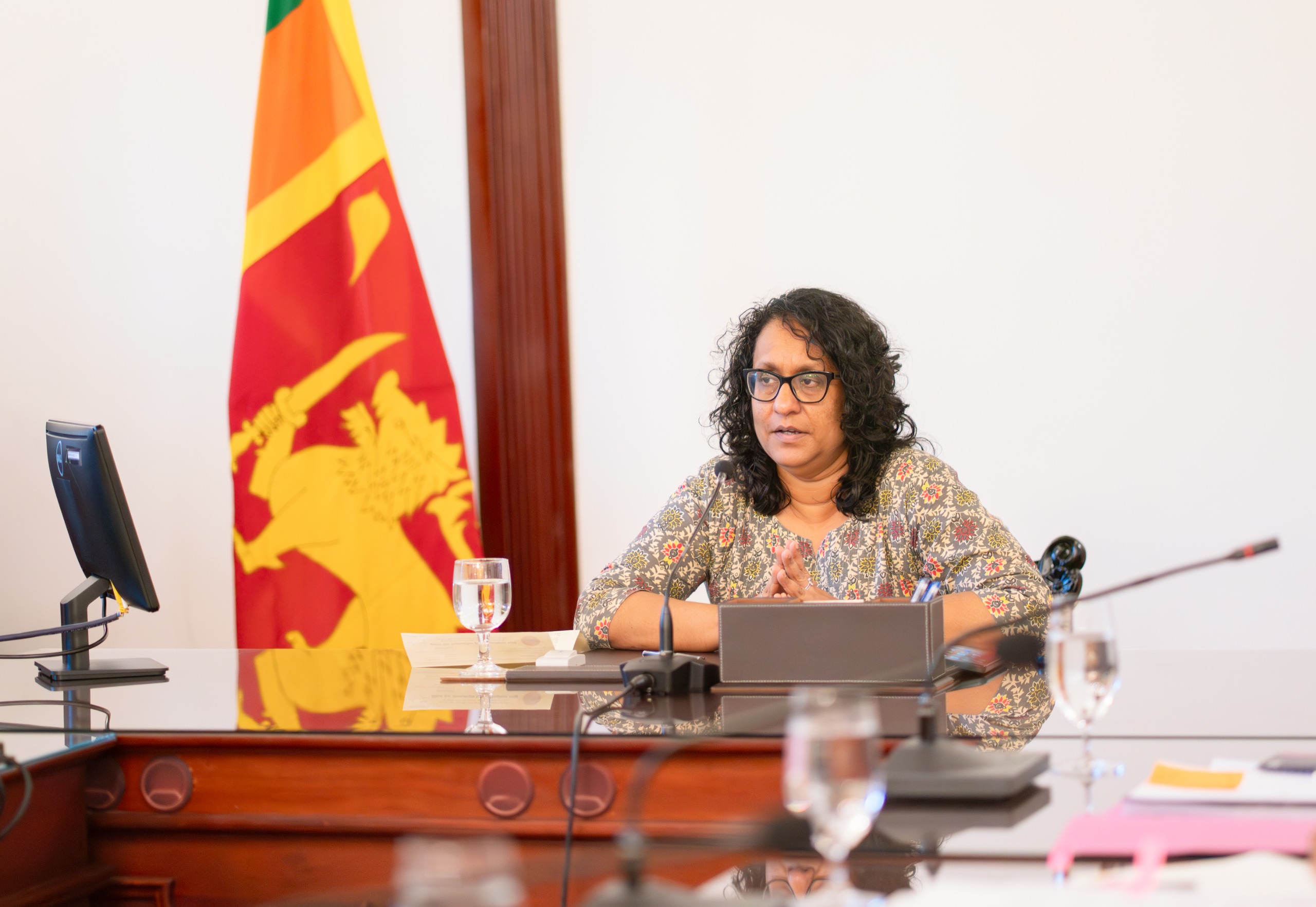
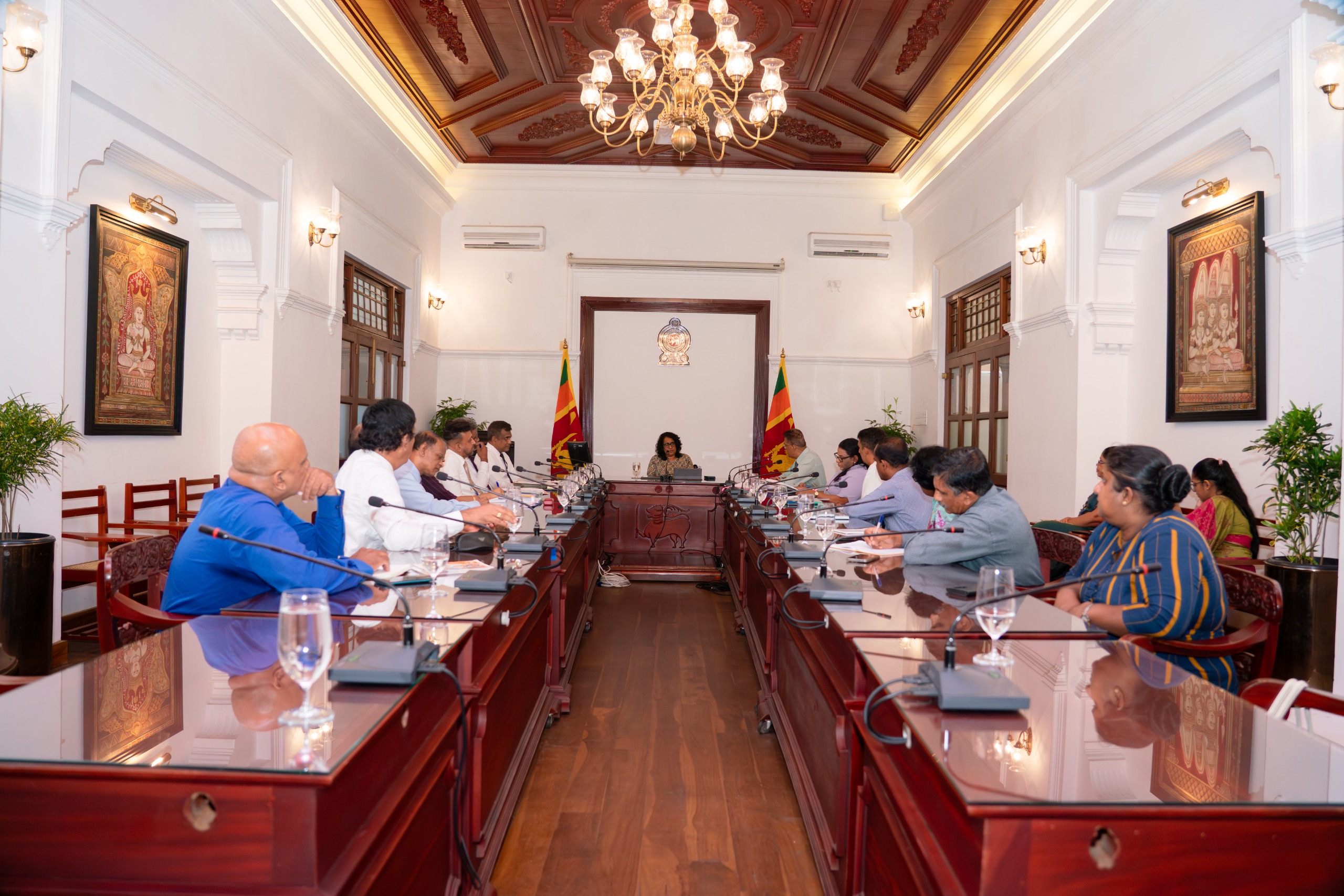
A discussion to review the current progress of the special committee appointed under the government’s policy proposals to establish a National Nursing University aimed at elevating the nursing profession in Sri Lanka to degree level was held on 23rd of March at the Prime Minister’s Office under the patronage of Prime Minister Dr. Harini Amarasuriya.
During the meeting, the Prime Minister inquired into the progress made by the committee in relation to the establishment of the Nursing University and paid attention to the issues and views presented by the committee members.
Emphasizing that establishing a university is a long-term and complex process, the Prime Minister pointed out the importance of advancing this project in line with higher education standards, without hasty decisions, while also taking into account the existing conflicts and challenges within the university system.
The meeting was attended by the Vice Chairman of the University Grants Commission, Professor K. L. Wasantha Kumara, representatives of the All Ceylon Nurses’ Association, and officials from the Ministry of Health and Mass Media.
(Prime Minister’s Media Division)
Latest News
Heat Index at ‘Caution level’ in the Western, Sabaragamuwa, Southern and North-western provinces and in Anuradhapura, Mannar, Vavuniya and Monaragala districts
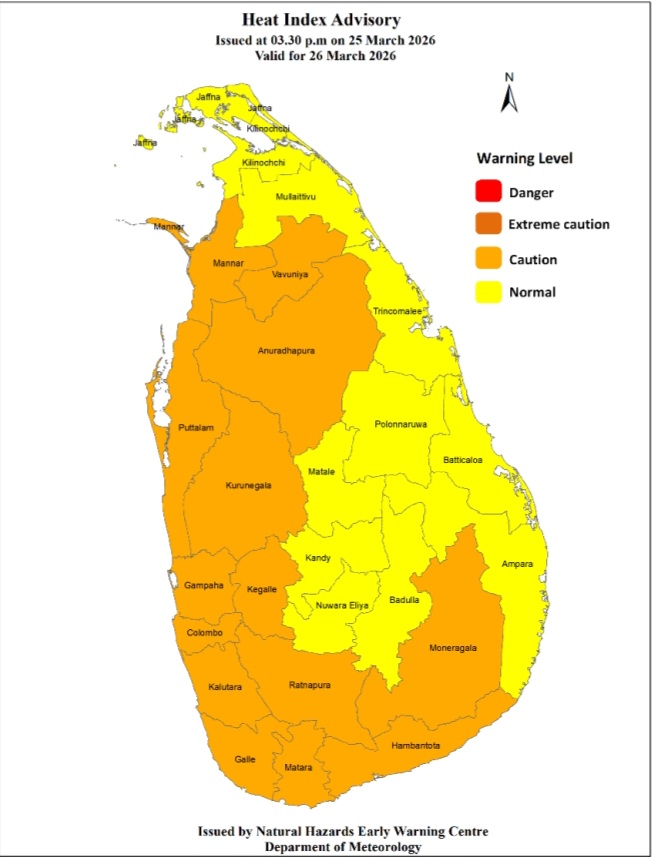
Warm Weather Advisory
Issued by the Natural Hazards Early Warning Centre of the Department of Meteorology
at 3.30 p.m. on 25 March 2026, valid for 26 March 2026.
The Heat index, the temperature felt on human body is likely to increase up to ‘Caution level’ at some places in the Western, Sabaragamuwa, Southern and North-western provinces and in
Anuradhapura, Mannar, Vavuniya and Monaragala districts.
The Heat Index Forecast is calculated by using relative humidity and maximum temperature and this is the condition that is felt on your body. This is not the forecast of maximum temperature. It is generated by the Department of Meteorology for the next day period and prepared by using global numerical weather prediction model data.

Effect of the heat index on human body is mentioned in the above table and it is prepared on the advice of the Ministry of Health and Indigenous Medical Services.
ACTION REQUIRED
Job sites: Stay hydrated and takes breaks in the shade as often as possible.
Indoors: Check up on the elderly and the sick.
Vehicles: Never leave children unattended.
Outdoors: Limit strenuous outdoor activities, find shade and stay hydrated.
Dress: Wear lightweight and white or light-colored clothing.
Note:
In addition, please refer to advisories issued by the Disaster Preparedness & Response Division, Ministry
of Health in this regard as well. For further clarifications please contact 011-7446491.

A strong Technical and Vocational Education and Training (TVET) system equips individuals with practical, relevant, and future-oriented skills helping to innovate responsibly towards a greener and sustainable future – PM

PM reviews progress of the committee appointed for the establishment of a National Nursing University

UN votes to recognise enslavement of Africans as ‘gravest crime against humanity’

Meta and YouTube found liable in landmark social media addiction trial

Showers expected in the Western and Sabaragamuwa provinces and in Galle and Matara districts after 2.00 pm.

Heat Index at ‘Caution level’ in the Western, Sabaragamuwa, Southern and North-western provinces and in Anuradhapura, Mannar, Vavuniya and Monaragala districts

‘Dates have the highest sugar content to fight Coronavirus’

Sunday Island 27 December – Headlines

#SundayIsland 17th December – Headlines

Sunday Island – 28th March

Sunday Island Headlines – 21 March

Sunday Island – 21st February – Headlines
-

 Features4 days ago
Trincomalee oil tank farm: An engineering marvel
-

 News2 days ago
Senior citizens above 70 years to receive March allowances on Thursday (26)
-

 News7 days ago
CIABOC tells court Kapila gave Rs 60 mn to MR and Rs. 20 mn to Priyankara
-
 Features7 days ago
Science and diplomacy in a changing world
-

 Features4 days ago
The scientist who was finally heard
-
 News2 days ago
Japanese boost to Sri J’pura Hospital, an outright gift from Tokyo during JRJ rule
-

 News2 days ago
CEB Engineers warn public to be prepared for power cuts after New Year
-

 News6 days ago
Colombo, Oslo steps up efforts to strengthen bilateral cooperation in key environmental priority areas