
Editorial
Honorable MP in the Customs net


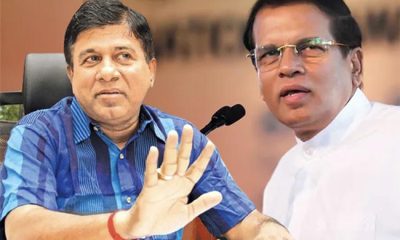
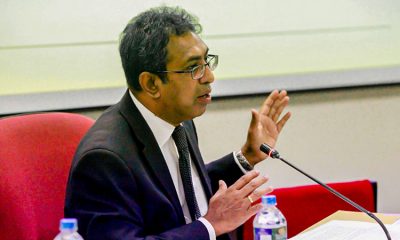
Whether they will admit it or not, politicians in the country are well aware that they are not top of the pops where public opinion is concerned. Few people rate politicians positively although there are many exceptions. Last week’s gold and smartphone smuggling detection at the Bandaranaike International Airport served to aggravate this assessment. Puttalam District MP Ali Sabri Raheem arriving from Dubai was detected, on a tip off, by customs and found carrying contraband worth Rs. 75 million.
Telephones hummed and he was able to reach the highest in the land who reportedly promised to “go into the matter.” Thankfully, he got no respite, the contraband was confiscated and he was slapped with a fine of Rs. 7.4 million which was quickly paid. Raheem was free within hours and was able to be present in Parliament to vote against the government motion to sack Janaka Ratnayake, the Chairman of the Public Utilities Commission of Sri Lanka (PUCSL).
He went over national television to plead his innocence blaming an unnamed golaya for the crime. This worthy, the MP claimed, had packed their bags and the politician said he did not know what went into them. That, of course, is a story that will be hard to sell. People are not as gullible as Raheem would like to believe. Though photographs of customs officers posing with the contraband detected have been widely published, the public is totally ignorant of many relevant details of this detection. In the first instance, who was this person who accompanied the MP? Was he a paid member of the MP’s staff? Was the contraband found only in the MP’s baggage or was it divided between the two passengers’ bags? If so, was the golaya, who the MP has publicly blamed for the scandal also been questioned and what did he say? Queries on all these matters and more remain unanswered and only the tip of the iceberg has surfaced.
Predictably there have been many developments since the smelly stuff hit the fan. It was reported on Friday that some 20 MPs, mostly belonging to opposition parties, have handed a letter to the speaker requesting an investigation. They have rightly said that a scandal of these proportions would result in all parliamentarians being tarred with the same brush in the court of public opinion. The cynic would say that they need ot bother on this score as this has already happened in the public mind, with politicians and not only parliamentarians, having been negatively viewed long before the newest scandal broke.
Be that as it may, we wonder whether the speaker has any role in such matters. MPs are very conscious of their rights and privileges and there have been occasions where the speaker’s permission – he is the custodian of such rights and privileges – were obtained before an MP is questioned by police in the case of an investigation. This has been demanded on occasions when need for such questioning arose. There is also a code of conduct for parliamentarians adopted in March 2018. Clearly the recent smuggling matter would (or should) be caught up it that.
People could well ask whether hurling missiles, throwing chilli flakes in the parliamentary chamber and not allowing the speaker to take his seat and perform his functions do not come within the ambit of the code. If it does, why did not what happened in the House during the “October Revolution” of 2018 when then President Maithripala Sirisena sacked Prime Minister Ranil Wickremesinghe and installed Mahinda Rajapaksa in his stead, come under the glare of that well-intentioned but seemingly impotent code?
Apart from the demand that the speaker looks into Raheem’s conduct and take appropriate action, Field Marshal Sarath Fonseka has seen a deeper conspiracy. He alleged on Thursday that the MP, free of the customs clutches, rushing to parliament post-haste to vote against the resolution to remove the PUCSL Chairman from his post was a government plot to lump Raheem with the opposition! That worthy himself is on record saying he voted against the government as there was nobody to help when he needed assistance. “So why should I vote for that government?”, he asked
Criminals are usually not apprehended committing a first offence. The fact that somebody knew that something was going on and was able to tip off the customs suggests that this recent detection is not a one off. Why should Members of Parliament be issued diplomatic passports and accorded VIP facilities at the airport? What differentiates them from ordinary people whose votes catapulted them into positions of privilege with perks galore at the taxpayer’s expense? Tipping off customs is, of course, a lucrative business with fat reward entitlements. Whoever blew that whistle which felled the MP will benefit tidily. Let us hope that such a person does not get a bullet in his head from a motorcycle gunman for his pains as is becoming all too common today in this island of ours.
A question was also asked in parliament why the fine imposed was relatively modest considering the value of the contraband. We believe that the law permits a fine three times the value of the smuggled goods. In this instance it had been a mere 10 percent. State Minister of Finance Ranjit Siyambalapitiya had replied that the fine that was slapped was highest for such offences in recent times.
Admittedly a fine of over Rs. 200 million might never have been collected. Such fines seldom are. Of course the confiscation of the contraband would have cost somebody very big bucks. Couriers are widely used for smuggling via passenger baggage and how tight a hold the customs has on this business method that is widespread is anybody’s guess.








Saturday 10th October, 2026
It will soon be showtime in Parliament. The Opposition has submitted a motion of no confidence against Speaker Dr Jagath Wickramaratne to Secretary General of Parliament Kushani Rohanadheera. Debates on no-confidence motions invariably descend into slanging matches, with members of both sides of the House trading insults and dragging one another’s reputations through the mud.
The motion of no confidence reportedly contains about 50 allegations, including misconduct, misuse of public property, financial irregularities, conflict of interest and violation of parliamentary procedures. The Opposition has called upon the Speaker to step down immediately.
The fate of no-confidence is not difficult to guess. What determines the outcome of a vote on such a motion is the numbers the opponents and the proponents can muster. There is no such thing as a conscience vote in the Sri Lankan Parliament. The Opposition has only 66 members as opposed to the government’s 159 including the Speaker. Some Opposition MPs are accused of running with the hare and hunting with the hounds. They disappear during crucial votes in the House. So, the no-confidence motion against the Speaker is doomed. The Opposition cannot be so naïve as to expect a different outcome; it is apparently planning to use the motion to inflict maximum possible damage on the government.
Gone are the days when the Speakers acted impartially, commanding the respect of all members of the House. Over the past several decades, the Chair has been reduced to little more than an appendage of the government of the day. Hence the Opposition’s frequent complaints of grievances. Worryingly, the campaigners for democracy and rights and privileges of lawmakers act out of expediency rather than principle once ensconced in power.
Ideally, the Speaker should be independent of political parties if he or she is to act impartially. Time was when political parties did not field candidates to challenge the Speakers at general elections. That helped A. F. Peiris (1952) and R. S. Pelpola (1960) enter Parliament without facing competition. The practice was that a Speaker would not normally be opposed at the next general election, reflecting the expectation that the office should be impartial and above party politics.
There have also been instances where the Speakers were elected unanimously in Parliament. They include Speaker Wickramaratne, his predecessors Asoka Ranwala and the late Anura Bandaranaike. Sadly, Ranwala had to resign over a degree certificate issue and Dr Wickramaratne is facing a no-confidence motion.
A government with a parliamentary majority can shoot down no-confidence motions with ease, but the issues raised by the Opposition do not go away. The SLPP-UNP government defeated a no-confidence motion against the then Health Minister Keheliya Rambukwella over a procurement scam, but subsequently he was prosecuted. It also defeated a no-confidence motion against Speaker Mahinda Yapa Abeywardena. But both the SLPP and the UNP suffered humiliating defeats at the last general election. Most of the SLPP MPs who voted to defeat the no-confidence motions against Rambukwella and Abeywardena could not even contest the last general election. The NPP MPs defeated a no-confidence motion against the Energy Minister Kumara Jayakody, but he had to step down subsequently albeit over some other allegation and legal action. This is something the JVP/NPP politicians who think no end of their supermajority ought to take cognisance of.

Friday 9th October, 2026
Some crucial problems have remained intractable in the public sector because a chronic lack of inter-institutional cooperation has stood in the way of tackling them. The Committee on Public Enterprises (COPE) has recently addressed one such issue. While examining the affairs of the Coconut Development Authority (CDA), the Coconut Research Institute, and the Coconut Cultivation Board, the COPE raised serious concerns over the food-safety risks posed by reprocessed and adulterated coconut oil entering the local food industry.
When COPE Chairman Dr. Nishantha Samaraweera pointed out that there had been about 150 instances of non-compliance with required standards in the coconut-oil manufacturing sector and asked what action had been taken against the errant companies, CDA Chairman Shantha Ranatunga said his institution could only trace such manufacturers and ensure corrective action. Dr. Samaraweera asked why the Health Ministry or the Consumer Affairs Authority had not been informed of those illegal practices, but he did not receive a clear answer. The officials only said they were not authorised to do so. Faulting most state institutions for working in silos with no cooperation among them, the COPE Chairman revealed the health risks posed by the waste cooking oil trade. He deserves praise for taking up this vital issue and calling for action to protect the public.
Sri Lanka’s edible oil problem has been a recurring food-safety concern for decades, with the evidence pointing to several forms of malpractice, from blending coconut oil with cheaper vegetable oils and reselling used oil to the distribution of products contaminated with aflatoxins. The repeated detection of such products also raises questions about the effectiveness of market surveillance, testing and enforcement.
In 2017, raids conducted by the Consumer Affairs Authority revealed that large quantities of used cooking oil had been placed alongside barrels of oil apparently processed with chemicals and colouring. Some samples were found to be adulterated. Officials said vendors had bought used cooking oil from food outlets and resold it after treating it with chemicals.
A 2021 study by a team of university researchers, has revealed an established chain in which hotels and restaurants sell used cooking oil to vendors, who filter it and remove sediments, before distributing it to small-scale restaurants for further use as cooking oil. Public health experts have pointed out that repeatedly heated, degraded or adulterated edible oils may increase the risk of cardiovascular disease and other chronic diseases. Volumes have been written about the waste cooking oil racket in the food industry, but it is doubtful whether any meaningful interventions have been made to eliminate it.
Media reports have shed light on another dimension of the waste edible oil racket. It has been reported that trade-data records indicate 67 shipments in the July 2024-June 2025 period under a category including “used cooking oil”, involving 31 Sri Lankan buyers and 38 suppliers. However, the database groups several oil categories together, and therefore this by itself does not prove that the imported used oil was intended for human consumption, but it is believed that at least a part of those imported waste cooking oil consignments entered the food industry. A thorough investigation is needed to prevent such illegal practices.
Non-communicable diseases (NCDs) reportedly account for about three-quarters of all deaths in Sri Lanka, making them the country’s dominant cause of mortality. Doctors have warned that the consumption of degraded, repeatedly heated or contaminated cooking oil may increase the risk of some NCDs, particularly certain cancers. Hence the pressing need for a comprehensive strategy to monitor and regulate the cooking oil trade and prosecute those who engage in illegal practices.
There are about 20 medical doctors in the current Parliament, including Health Minister Dr. Nalinda Jayatissa. They ought to use their collective voice to press for the proper enforcement of existing laws, or for new legislation, where necessary, to put an end to the waste cooking oil racket and other such illegal practices that endanger public health.


Thursday 8th Octobber, 2026
Hardly a day passes in this country without a torrent of news about politicians whose actions evoke memories of famous poets, thinkers, historians and jurists of yore, such as Juvenal, Edward Coke, Lord Acton and Niccolò Machiavelli. This has been particularly so during the past several weeks.
Speaker Dr Jagath Wickramaratne has dismissed a privilege issue raised by SJB MP Ajith P. Perera. He has ruled that as the Presiding Authority and guardian of Parliament’s powers, rights and privileges, the Speaker cannot be subjected to a privilege complaint or disciplinary inquiry by a committee subordinate to the Chair in respect of actions taken in his official capacity. MP Perera’s complaint was that his parliamentary privileges had been breached because no formal action had been taken or final decision made on a written request submitted on August 3 by 18 Opposition MPs seeking the appointment of a Special Select Committee to investigate delays in the judicial system and prison overcrowding. The Speaker ruled that there was no prima facie breach of parliamentary privilege.
Far be it from us to tell the Speaker how to exercise his discretionary powers. Yet we cannot help repeating a question from Juvenal’s Satires: Who guards the guards? (Quis custodiet ipsos custodes?) This famous question, which Juvenal deliberately left hanging, has since become modern shorthand for the broader problem of unchecked power without accountability. Are discretionary powers cartes blanches that place those who wield them above the law and the rules and regulations governing the vital institutions under their purview? Shouldn’t the exercise of such powers be firmly grounded in morality to guard against misuse and impunity?
Juvenal’s Satires are a caustic critique of social inequality, political corruption, decadence and the behaviour of the Roman elite. His work is of particular relevance to Sri Lanka, as it is also the source of the well-known phrase “bread and circuses” (panem et circenses). The only difference is that people here are treated to endless political circuses and theatre without reasonably priced bread or rice. Sri Lankans were waiting in long queues near filling stations, with the government struggling to restore uninterrupted fuel supplies, when news broke of another high-profile arrest.
Speaker Wickramaratne’s ruling has come less than two weeks after the enactment of the controversial 22 nd Amendment (22A) to the Constitution, introduced by the JVP-NPP government to raise the retirement age of the superior court judges allegedly with an ulterior motive. 22A became law in a manner that contravened the time-honoured principle nemo judex in causa sua (‘no one should act as a judge in a case in which they have a personal interest), rooted in Roman law and given its classic common-law formulation by Sir Edward Coke.
22A cleared its constitutional hurdle in the Supreme Court and was then steamrollered through Parliament. As one bad apple spoils the barrel, so one obnoxious law can undermine an entire legal system. Legendary jurists such as Coke would turn in their graves if they knew of the enactment of 22A.
Of all political thinkers, the only one whose counsel Sri Lankan politicians appear to have taken to heart is Machiavelli, particularly his advice on keeping and breaking promises, as evidenced by the sheer number of unfulfilled election pledges. Most of them have also taken a leaf out of the book of Joseph Goebbels, the Nazi regime’s master propagandist if the manner in which they repeat lies is anything to go by. They win elections, promising to usher in good governance, but once they realise their goal, their conduct becomes a textbook example of Lord Acton’s famous dictum about power.
Citizen Perera surely does not aspire to be in the same league as Juvenal, Acton, Coke et al., but his assessment of Sri Lankan politics and politicians is no less noteworthy: mole thiyanakota bale ne, bale thiyanakota mole ne, which can be roughly translated as, “When one has brains, one has no power, and when one has power, one has no brains.” Nothing exemplifies this truism more than the conduct of current Opposition politicians, who appear to be acting sensibly and that of their ruling-party counterparts, who appear to have taken leave of their senses.

Cabinet approval has been granted to several proposals and policies related to the new Education Reforms – Prime Minister

The Anti-Corruption Act is being amended to strengthen It, not to weaken it – PM

Renshaw 190 lifts Australia to 390 before Hazlewood strikes

Pope says death penalty ‘inadmissible’ as US plans to livestream execution

Attack on airport in Saudi capital, Riyadh, leaves several injured

Hurricane Isaias downgraded after making landfall in Florida

‘Dates have the highest sugar content to fight Coronavirus’

Sunday Island 27 December – Headlines

#SundayIsland 17th December – Headlines

Sunday Island – 28th March

Sunday Island Headlines – 21 March

Sunday Island – 21st February – Headlines
-

 News6 days ago
Geneva takes up Sallay’s case and govt. ignores opportunity to answer accusations
-

 Features7 days ago
The first woman in the foreign service or Ceylon Overseas Service it was then called
-

 News7 days ago
Nearly 20 Iranian tankers stranded off Lanka amid US sanctions
-

 Features5 days ago
Preventing grievances from becoming communal
-

 Sports3 days ago
Nissanka absence opens door for Sri Lanka’s young guns
-

 News4 days ago
Gnansara Thera to be assigned to prison printing section: Officials
-

 Features6 days ago
Sri Lanka Cricket Bill: Governance reform is not yet a cricket strategy
-

 Features3 days ago
The Sri Lankan who made Scottish history