
Latest News
Hong Kong and southern China battle widespread flooding from record rains

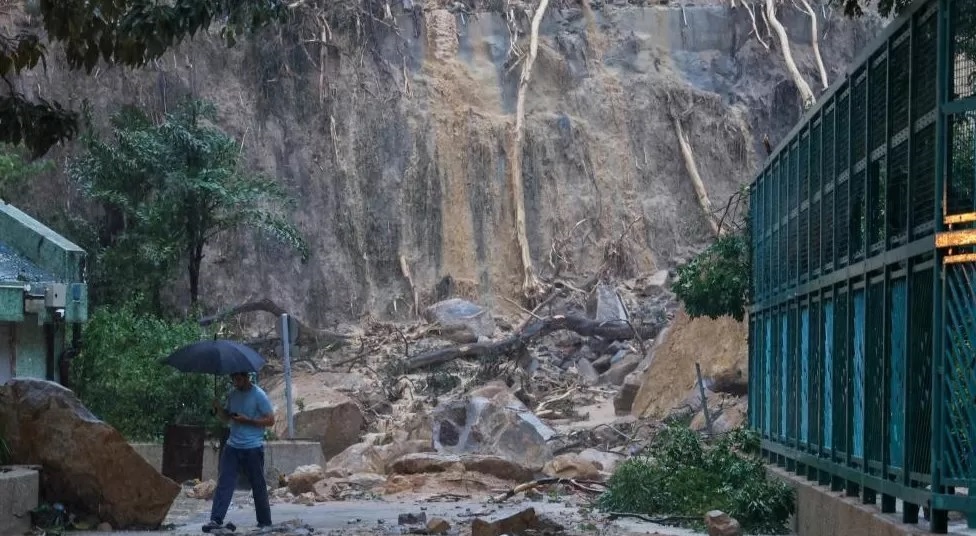
Hong Kong and southern Chinese cities are battling widespread flooding as the region endures some of its heaviest rainfall on record.
On Friday, streets and subway stations were under water in Hong Kong as officials shut schools and workplaces. The weather bureau said the downpour, which began on Thursday, is the biggest to hit the city in nearly 140 years.
Emergency services said more than 100 people had been taken to hospital and several rescues had taken place.
Pictures from the city on Thursday night showed the torrential rain turning streets into raging rivers, flooding shopping centres and public transport.
Videos on social media showed people climbing on to cars and other elevated platforms to escape the waters, which have risen several metres-high in some areas, blocking off subway entrances. The city’s cross harbour tunnel, a key route connecting the main island to the Kowloon peninsula in its north, was inundated. The rain also triggered landslides in Hong Kong’s mountainous areas – blocking some highways.
By Friday afternoon, the downpours had somewhat eased with authorities downgrading the rainstorm from a “black” warning to “amber” alert. But they warned showers were expected to persist until Saturday.
On Thursday, authorities had issued the black warning, which is triggered when rainfall exceeds 70mm an hour. The Hong Kong Observatory later that night reported an hourly rainfall of 158.1 millimetres, the highest since records began in 1884.
More than 200mm of rain was recorded on Hong Kong island, Kowloon and the north-eastern part of the city between 18:00 local time (10:00 GMT) and midnight – a total that exceeds the amount the entire city typically receives within certain months.
Heavy rain has also drenched southern China, with the city of Shenzhen – across the border from Hong Kong – reporting its heaviest showers since records began in 1952.
Hundreds of flights have been suspended in the wider Guangdong province, while local authorities advised residents in low-lying areas to consider evacuations.
Tens of millions of people live in the densely populated coastal areas of southern China.
On Thursday night, Shenzhen discharged water from its reservoirs after issuing a notice to Hong Kong – an action that raised questions from Hong Kong locals online as to whether this exacerbated their city’s flooding.
But Hong Kong’s security chief Chris Tang said on Friday the discharge had no impact on the city’s floods and the action was safe for both Shenzhen and Hong Kong.
China’s meteorological administration expects extreme rainfall to continue in the country’s southwestern region on Friday and Saturday. The latest downpour comes less than a week after two typhoons, Saola and Haikui, hit southern China in quick succession – and sparked a citywide shutdown in Hong Kong.
Climate change has increased the intensity and frequency of tropical storms, leading to an increase in flash flooding and greater damage.
(BBC)


A Chamari Athapaththu seven-wicket haul and Nilakshika Silva’s 50 off 35 saw defending champions Sri Lanka withstand a valiant Indonesian side to register a resounding 75-run victory in their Asia Cup match in Dubai.
Athapaththu was undoubtedly the pick of the bowlers, as she started and finished Indonesia’s slide with career best figures of 7 for 05, inclusive of a hat-trick – nearly two in fact. Chasing a target of 125, the opening pair of Maria Corazon and Rahmawati Pangestuti struck 16 runs in the first two overs, but once spin came into play scoring slowed down to a trickle and Indonesia were eventually bowled out for 49 in the 19th over.
Sri Lanka, too, had found it tough to combat Indonesia’s mix of spin and slow-medium seamers as they stumbled to 62 for 6 in the 13th over, but their innings received a timely boost as Nilakshika countered with a trademark back-against-the-wall effort to drag her side to a total that seemed about par on a pretty sluggish surface. In the end it proved to be plenty.
Sri Lanka struggle early on
Having been put in to bat on a fresh surface, Sri Lanka were perhaps guilty of a little complacency against their less-fancied opponents. Time and again the top order sought to find the boundary, and time and again they failed to find their timing.
On a wicket where the ball was hardly coming on, the Sri Lankan batters’ tunnel vision focused squarely on boundary hitting and eschewed strike rotation; there were 19 dot balls in a powerplay that had fetched 31 runs for the loss of two wickets.
By the halfway point of the innings, the dot count had risen to 28. The scorecard, meanwhile, read 47 for 5. Indonesia, to their credit, did well to bowl to their fields and frustrate the Lankan batters.
Sanjana Kavindi got to double-digits with a pair of nicely struck boundaries, but she was the only one of Sri Lanka’s top five to do so – and she was eventually done in on 15 missing an attempted cut on a straight one.
Nilakshika brings the Silva-lining
With recognised batting fast running out, Sri Lanka needed someone to take control of the innings, and as she has done so often over recent years it was Nilakshika that stood up to be counted.
She first strung together 17 off 18 with Kaushini Nuthyangana, but when Nuthyangana fell Nilakshika produced a masterclass in batting with the tail. She cajoled Kawya Kavindi to keep rotating the strike, and when the opportunity arose she was unerring in finding the boundaries – including Sri Lanka’s first and only six of the innings in the penultimate over.
Their seventh-wicket partnership eventually ended on 50 off 36, reached simultaneously alongside side Nilakshika’s fifty – her third in T20Is – but by then she had already ushered her side to safety.
Athapaththu steals the show
In Chethana Vimukthi, Sri Lanka might have their first ever genuine fast bowler but on a wicket where the ball was not quite coming on, pace never seemed like the answer. For the first two overs of the chase, Indonesia’s openers did well to find boundaries against Vimukthi and and fellow seamer Kawya, but then Sri Lanka introduced their spinners.
Athapaththu promptly castled Pangestuti before removing Corazon and Rada Rani off consecutive deliveries in her next over. Here she missed her hat-trick by a whisker, a yorker narrowly missing Desi Wulandari’s off stump.
She brought herself back into the attack in the 14th and removed Nanda Sakarini, and she capped things off by achieving her hat-trick at the second time of asking, taking three wickets off what proved to be the final three deliveries of the innings.
Scores:
Sri Lanka Women 124 for 7 in 20 overs (Sanjana Kavindi 15, Nilakshika Silva 50, Kawya Kavindi 15*; Ni Ariani 1-23, Sang Maypriani 2-15, Ni Luh Dewi 3-32, Sofia Velic 1-21) beat Indonesia Women 49 all out in 18.3 overs (Rahmawati Pangestudi 10, Ni Made Putri Suwandevi 12; Kavya Kavindi 1-14, Sugandika Kumari 1-03, Chamari Athapaththu 7-05, Kavisha Dilhari 1-02) by 75 runs
[Cricinfo]

The Memorandum of Understanding (MoU) relating to the project to provide technological solutions to prevent wild elephants from being hit by trains was signed yesterday (01) afternoon at the President’s Media Centre, under the patronage of Secretary to the President Dr Nandika Sanath Kumanayake.
Coordinated through the “Clean Sri Lanka” programme, the project is being implemented as a public-private partnership, with the Railway Department, the Department of Wildlife Conservation and the Forest Conservation Department working together, with full financial support from People’s Bank.
The system consists of three-beam detection, passive infrared (PIR) sensors, automatic temperature sensors and a tamper alarm system to detect animals weighing more than 20 kilogrammes and unauthorised interference. Signal lights (red/yellow/green) installed on either side of the railway tracks, together with a special screen installed inside the locomotive cab, will alert the driver in advance to the exact location of an elephant.
A demonstration test of the system was successfully conducted at the Pinnawala Elephant Orphanage premises in the presence of the relevant officials, following which a report on the system was prepared.
The system will be implemented as a pilot project from next month at 13 locations where wild elephant accidents are frequent. A newly developed website is also scheduled to be launched to enable the progress of the project to be viewed live.
Additional General Manager of Railways P.D.S.B. Chandrasena, Director General of Wildlife Conservation M.S.L.R.P. Marasinghe, Conservator General of Forests S.C. Palamakuumbura and Chairman of People’s Bank Chandana Guniyangoda signed the relevant MoU. Officials from the Clean Sri Lanka Secretariat, including Presidential Additional Secretary (Clean Sri Lanka) Engineer S.P.C. Sugeeshwara, as well as senior officials from the Railway Department, Department of Wildlife Conservation, Forest Conservation Department and People’s Bank, were also present.
[President’s Media Division]

The Commissioner General of Examinations has announced that the results of the 2026 Grade 5 Scholarship Examination have been released online, and can be viewed on the department’s official website: www.doenets.lk

Malta businessman acquitted of plotting journalist Caruana Galizia murder

Nilakshika fifty, Athapaththu seven-for rescue Sri Lanka against Indonesia

Winners to receive medals at Western Province School Games after many years

MoU signed for technology to prevent wild elephant-train collisions

Grade 5 scholarship exam results released

Prime Minister participates in Global Conscious Food Systems Summit in Bhutan

‘Dates have the highest sugar content to fight Coronavirus’

Sunday Island 27 December – Headlines

#SundayIsland 17th December – Headlines

Sunday Island – 28th March

Sunday Island Headlines – 21 March

Sunday Island – 21st February – Headlines
-

 News6 days ago
Eight politicians in drug kingpin probe
-

 Features4 days ago
“Wrap Me Up in My Blazer”— A Gentlemanly Bradby Reminiscence
-

 Business6 days ago
Sri Lanka opens up: A new season of direct connectivity
-

 Features3 days ago
When Sri Lankan stories find their own voice
-
 Latest News7 days ago
Nepal-Tibet floods: What happened, what caused them and who is missing?
-

 Features6 days ago
Redefining ageing in Sri Lanka
-

 Editorial7 days ago
Unfolding El Niño and burning issues
-

 Editorial6 days ago
The toxic legacy of two lakes