
Business
Hirdaramani Group invests Rs.10 billion in new textile plant, ‘Mihila Tex’


Project driven to create numerous employment opportunities
Hirdaramani Group, recently announced its latest milestone in advancing sustainable apparel production with a Rs.10 billion investment in a cutting-edge new textile mill, ‘Mihila Tex’ in Pannala, Sri Lanka.
This state-of-the-art facility will play a pivotal role in reshaping the future of the apparel industry and bolstering Sri Lanka’s position as a sustainable manufacturing hub. The Group will collaborate with Hengda Textiles in this venture, a leading global textile manufacturer and technical partner renowned for its innovation and commitment to sustainability.
‘Mihila Tex’ is part of the Hirdaramani Group’s long-term strategy to strategically grow its apparel business in Sri Lanka and strengthen its local value chain to minimise the extensive outflow of foreign exchange for raw material imports, while providing optimised apparel solutions to its customers worldwide.
Key highlights of the joint venture and ‘Mihila Tex’ in Pannala include:
This significant investment will be utilised to develop a state-of-the-art textile mill that integrates the latest advancements in sustainable technologies and practices to minimise energy consumption, reduce waste generation, and optimise resource management.
The mill will incorporate advanced technology in water recycling and purification systems to minimise water consumption.
The facility will be powered by renewable energy sources, aligning with both companies’ commitment to reducing carbon emissions and contributing to Sri Lanka’s renewable energy goals.
Hirdaramani Group and Hengda Textiles intend to obtain internationally recognised sustainability certifications for the mill, affirming their shared dedication to environmentally responsible manufacturing.
The establishment of the new mill will create numerous employment opportunities, positively impacting the local economy and supporting the livelihoods of many Sri Lankans.
Vinod Hirdaramani – Chairman, Hirdaramani Group commenting on the new project said, “The investment in ‘Mihila Tex’ comes at a strategic point in our long-term growth journey. Our commitment to boosting Sri Lanka’s apparel industry remains a priority – as reinforced by high value investments such as these – where the industry will benefit from Hengda Textiles’ advanced expertise and best practices in manufacturing. We are also happy to have the opportunity to enrich the livelihoods of 800+ employees and to extend further impact across the community through our presence in Pannala.”
Zheng Jianfan – Chairman, Hengda Textiles commented, “We are happy to embark on this partnership with the Hirdaramani Group to establish our presence in Sri Lanka, a renowned global apparel hub. We believe that this new textiles venture, supported by the financial backing of the Hirdaramani Group, will help the industry in its upward growth trajectory by offering sustainable, faster, and advanced apparel solutions to customers worldwide. We look forward to leveraging the strengths of the Group and the industry as we forge ahead with this long-term partnership over the ensuing months.”


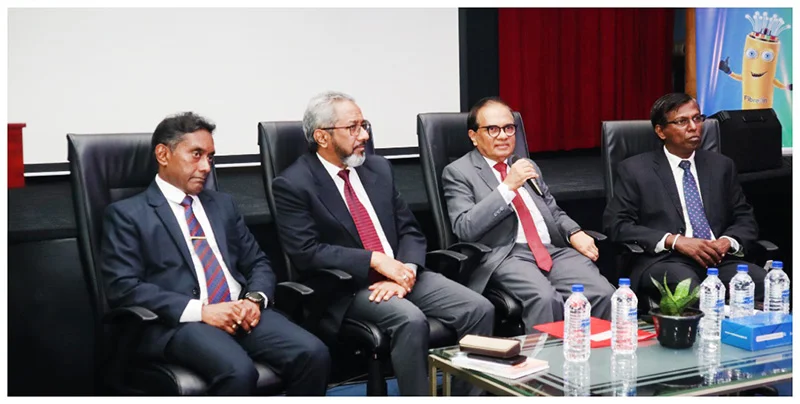
Sri Lanka Telecom PLC said its dollar reserves rose by around 30 percent in the first quarter of 2026, strengthening the group’s foreign currency position at a time when many Sri Lankan companies remain cautious about external payment risks and exchange-rate volatility.
Chairman of the SLT Group, Dr. Mothilal de Silva disclosed the increase during a post-results media briefing on May 19, following the release of the group’s first-quarter financial results, but declined to reveal the exact value of the reserves, describing the information as commercially sensitive.
“We do not disclose the exact figure because it could affect our negotiations with international suppliers and contractors,” he said in response to a question raised by The Island.
The stronger dollar liquidity comes as a strategic advantage for SLT-MOBITEL, whose operations remain heavily dependent on imported telecom infrastructure, including fibre-optic equipment, transmission hardware, mobile network systems and digital technology platforms largely priced in US dollars.
The improved reserve position is likely to provide the telecom group with greater flexibility in funding future network expansion, servicing foreign currency obligations and managing exchange-rate exposure in a sector closely tied to global technology supply chains.
The remarks came as SLT Group reported its strongest-ever quarterly operating profit and net earnings for the first quarter of 2026, supported by rising broadband demand and improved operational performance.
Group revenue rose 10.6 percent year-on-year to Rs. 30.8 billion, while operating profit surged 39.1 percent to Rs. 5.1 billion. Profit after tax increased 53.3 percent to Rs. 3.1 billion.
The company also highlighted continued investment in broadband and next-generation infrastructure, including the wider rollout of 5G services, as Sri Lanka’s telecom sector positions itself for higher data consumption and enterprise digitalisation.
Unlike many earnings announcements that focus primarily on revenue growth and profitability, SLT’s comments on foreign currency reserves may carry broader significance for investors monitoring corporate resilience in Sri Lanka’s still-fragile post-crisis recovery environment.
When The Island asked whether the Group’s profitability was sustainable amid a slow revenue growth environment, the SLT Group said revenue expansion remained challenging, but added that it had a robust strategy in place to sustain growth.
By Sanath Nanayakkare
…exporters gain little as deeper structural weaknesses persist
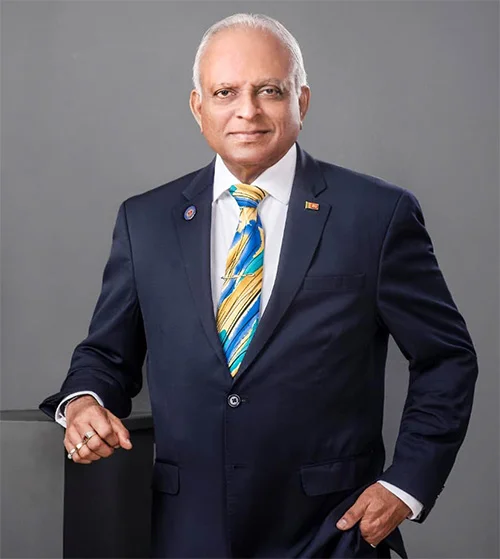
Sri Lanka’s weakening rupee is placing severe pressure on industries heavily dependent on imported raw materials, fuel, machinery, and spare parts, with small and medium enterprises (SMEs) facing the gravest threat to survival, according to Indhra Kaushal Rajapaksa.
Speaking to The Island Financial Review, Rajapaksa warned that while a depreciating currency may offer exporters temporary exchange gains, the broader economic impact is proving damaging across multiple sectors of the economy.
“Most businesses are struggling because Sri Lanka imports a significant portion of its industrial requirements. As the rupee weakens, costs rise sharply across the board,” he said.
Industries are responding through a combination of price increases, aggressive cost-cutting, delayed investments, and efforts to source cheaper alternatives. However, Rajapaksa stressed that many firms are operating under shrinking profit margins and mounting uncertainty.
“Companies are trying to survive by passing some costs to consumers, reducing operational expenses, and postponing expansion plans. But SMEs are under extreme pressure because they have limited reserves and weaker access to foreign currency,” he noted.
Rajapaksa observed that large corporates are better positioned to withstand currency shocks due to stronger balance sheets, export earnings, and greater financial flexibility. In contrast, smaller enterprises remain highly vulnerable to fluctuations in import costs and financing conditions.
He identified construction, vehicle imports, pharmaceuticals, electronics, logistics, and manufacturing industries reliant on imported inputs among the sectors worst affected by the rupee depreciation.
“These sectors depend heavily on foreign supplies. Every decline in the rupee immediately increases production and operating costs,” he said.
While export-oriented industries may appear to benefit from currency depreciation, Rajapaksa cautioned that the gains are often overstated.
“There is only a short-term conversion advantage when export earnings are brought back into rupees. But many exporters also depend on imported raw materials and machinery, so their own costs increase simultaneously,” he explained.
He added that the burden of currency depreciation ultimately falls on ordinary consumers through rising food prices, higher fuel and transport costs, more expensive imported goods, and accelerating inflationary pressures.
“Consumers are paying the price indirectly every day,” he said.
Rajapaksa acknowledged that some companies are attempting to localise supply chains and increase the use of domestic raw materials. However, he pointed out that Sri Lanka currently lacks the industrial scale and production capacity to fully replace imports competitively.
“There is growing interest in local sourcing, but Sri Lanka cannot produce everything locally at the required scale or cost efficiency,” he said.
The continued volatility of the currency is also affecting investor confidence, with businesses finding it increasingly difficult to plan ahead.
“Investors value stability. Frequent currency fluctuations create uncertainty and discourage both local and foreign investment,” Rajapaksa warned.
He called on the government to focus on stabilising the economy, strengthening foreign reserves, supporting SMEs and export industries, reducing unnecessary imports, encouraging local production, and ensuring consistent economic policies.
“Policy consistency is critical. Businesses need confidence to invest, expand, and create jobs,” he said.
Rajapaksa also cautioned that employment could suffer if economic pressures continue, particularly in import-dependent sectors and smaller businesses struggling to remain operational.
“Some export sectors may create opportunities, but it may not be enough to offset job losses elsewhere,” he observed.
Describing the current crisis as both cyclical and structural, Rajapaksa said Sri Lanka’s economic vulnerabilities extend beyond short-term currency movements.
“There are immediate pressures from both global and domestic financial conditions, but there are also deeper structural issues such as high import dependence, a narrow export base, and low productivity,” he said.
“Unless meaningful structural reforms are implemented, these problems will continue to recur.”
By Ifham Nizam
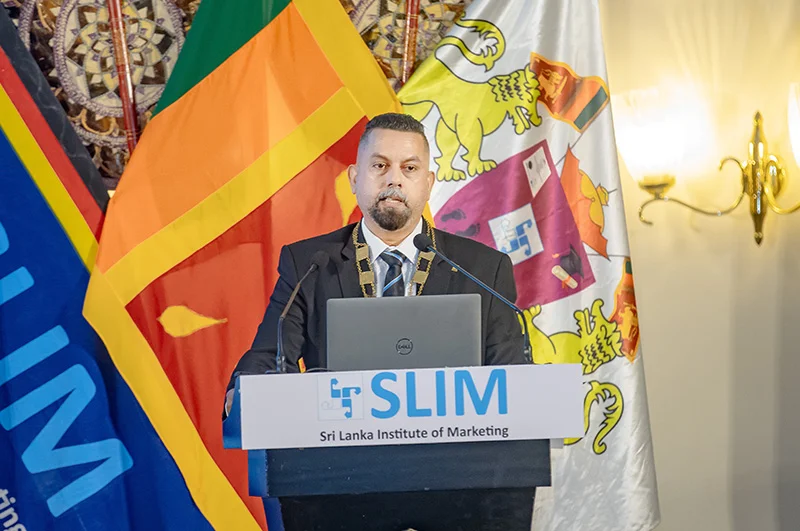
The Sri Lanka Institute of Marketing (SLIM), the country’s national body for marketing, successfully convened its Annual General Meeting (AGM) 2026 on 8th April 2026 at the iconic Galle Face Hotel.
The AGM marked a significant milestone in the Institute’s journey, as a new Council of Management and Executive Committee were formally appointed to steer SLIM into its next phase of growth. Building on the strong foundation laid during a transformative 2025, the AGM reflected both continuity and renewal, with an accomplished group of marketing professionals entrusted with leadership roles for the 2026/27 term. The event brought together SLIM members, industry leaders, and stakeholders, underscoring the Institute’s ongoing commitment to advancing the marketing profession in Sri Lanka.
At the helm of the newly appointed Council of Management is Enoch Perera, who assumes office as President. A seasoned marketing professional with extensive experience in international business, he currently serves as Assistant General Manager Marketing – International Business at PGP Glass Ceylon PLC. Joining him in key leadership roles are Manthika Ranasinghe as Vice President – Education and Research, and Rajiv David as Vice President – Events & Sustainability, both bringing with them strong industry expertise and strategic insight.
The Council is further strengthened by Asanka Perera and Nuwan Thilakawardhana as Joint Honorary Secretaries, Ms. Kaushala Amarasekara as Honorary Treasurer, and Dr. Rasanjalee Abeywickrama as Honorary Assistant Secretary. In addition, SLIM announced its Executive Committee for 2026/27, comprising a dynamic group of professionals representing diverse sectors of the marketing industry. The committee includes Channa Jayasinghe, Vijitha Govinna, Anuk De Silva, Sirimevan Senevirathne, Tharindu Karunarathne, Damith Jayawardana, Charitha Dias, Damith Pathiraja, Ms. Roshani Fernando, and Maduranga Weeratunga.

DR Congo cancels World Cup training camp over Ebola outbreak

US charges Cuba’s Raúl Castro with murder over 1996 downing of two planes

Prime Minister Dr Harini Amarasuriya meets Foreign Secretary of the United Kingdom

Alice Capsey 74 not out blazes trail in seven-wicket England win

Kolkata Knight Riders keep their IPL campaign alive with low-scoring win

Showers will occur at times in the Western, Sabaragamuwa Northern and North-western provinces and in Anuradhapura, Galle, Matara, Kandy and Nuwara-Eliya districts

‘Dates have the highest sugar content to fight Coronavirus’

Sunday Island 27 December – Headlines

#SundayIsland 17th December – Headlines

Sunday Island – 28th March

Sunday Island Headlines – 21 March

Sunday Island – 21st February – Headlines
-

 Features5 days ago
Sri Lankan Airlines Airbus Scandal and the Death of Kapila Chandrasena and my Brother Rajeewa
-
 News6 days ago
Lanka’s eligibility to draw next IMF tranche of USD 700 mn hinges on ‘restoration of cost-recovery pricing for electricity and fuel’
-

 News5 days ago
Kapila Chandrasena case: GN phone records under court scrutiny
-

 News5 days ago
Rupee slide rekindles 2022 crisis fears as inflation risks mount
-
 Features2 days ago
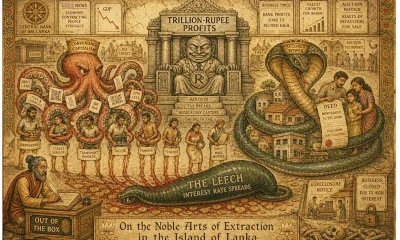
Octopus, Leech, and Snake: How Sri Lanka’s banks feast while the nation starves
-

 Business5 days ago
Expansion of PayPal services in Sri Lanka officially announced
-

 Features7 days ago
Mysterious Death of United Nations Secretary General Hammarskjöld
-

 News5 days ago
Court orders further arrests in alleged USD 42 Mn NDB fraud case