
Opinion
Harini vs. Prime Minister in the matter of conferment of Delhi University’s honorary doctorate


The Indian Express of 9 September 2025 said the Delhi University was set to confer an honorary doctorate on Sri Lanka’s Prime Minister Dr. Harini Amarasuriya, who is an alumna of Hindu College, one of Delhi University’s better-known colleges. The conferring of an honorary doctorate on a deserving person has conventionally been a matter of recognising the knowledge he or she has produced. Of recent, there is a trend this academic recognition is increasingly becoming a political act, offered as an extension of political largesse or influence peddling. When Prime Minister Dr Amarasuriya or any other Sri Lankan government representative, political or bureaucratic, accepts an award, it is not a simple private act, as it implicates both the government and by extension the country.
Let us consider the political dimensions of this honorary doctorate. If the Prime Minister attends the dedicated convocation and accepts the award, she goes beyond being mere Harini. The symbolic implications of her association with Delhi University at the present time – if she accepts the doctorate, and that too under the direct auspices of the Indian government, cannot be equated to the time she was an undergraduate at the Hindu College from 1991–1994.According to a notice issued on 8 September 2025 by the Registrar of Delhi University, a meeting of the university’s main decision-making body, the Academic Council has been called for the 11 September to discuss this matter. But the interest to offer an honorary doctorate to Dr. Amarasuriya did not come from within the university. Instead, it has allegedly been prompted by a letter from the Indian Ministry of External Affairs.
If so, conferring of this doctorate on the Sri Lankan Prime Minister is not an academic or intellectual exercise, but a vaguely disguised political act with serious implications. Against the backdrop of the recent politics of Delhi University marred in controversy and dismantling of academic freedom, an environment very different from Harini’s undergraduate days in the early 1990s and closer to India’s RSS-dominated BJP government’s divisive politics, her acceptance of the honorary doctorate is a conscious or poorly thought out endorsement of the university’s recent actions.
Prof Apoorvanand of Delhi University’s Hindi Department was recently sidelined in its search for a Head of Department, not due to any lack of qualifications but because his ideological stance was not to the taste of the government and therefore also the university administrators. It was not too long ago that Dr Amarasuriya fought against such decisions by former Sri Lankan governments in her own former university, the Open University of Sri Lanka. Delhi University’s recent (June 2025) attempt to remove proposed postgraduate Political Science syllabi on Islam, Pakistan and China is another case in point. Ideology yet again dictated the limits of academic freedom, and the paths inquiry can take under authoritarian rule.
The syllabi were dropped because they did not allegedly align with the ‘India First’ perspective. Harini would not have agreed to this if it had happened in her own former university. These are merely two of the many violations of Delhi University that goes against the spirit of any decent university. Does the Prime Minster of Sri Lanka want to give legitimacy to an institution that is now better known for such draconian and unethical acts than advanced learning?In the recent past, Prime Minister Narendra Modi and India’s External Affairs Minster S. Jaishankar created controversy over Sri Lanka’s Kachchativu Island, claiming it was ceded to Lanka in 1974, which was never India’s to begin with, therefore a misrepresentation of history and fact.
Jaishankar blamed the Congress Party Government of that time for ‘giving away’ the rights of Indian fishermen. Sri Lanka for its part has never seriously addressed this issue. And it is this Indian government that is now directing that the Sri Lanka Prime Minister to be given an honorary doctorate by Delhi University. Why? Are not serious and shady politics with long term consequences and the attempted creation of obligatory relationships at play here? Does the Prime Minster want to be associated with these unenviable institutional politics of Delhi Uniiverty and hegemonic Indian national politics represented by its present government?It is a different matter altogether, if Dr. Amarasuriya for sentimental reasons wants to accept this so-called honour. It tantamounts to an official and formal indication of Sri Lanka’s Prime Minister getting too close to indefensible acts attributed to Delhi University on the one hand and India’s present government on the other. After all, this is a matter of symbolism and implication.
The Prime Minister, having studied social anthropology at Edinburgh University and having a doctorate that she has actually earned through hard work, should know well what symbolic inferences mean in politics. She is giving needless legitimacy to a university that has now become a suffocating organisation more associated with disrupting academic freedom than freedom of inquiry. And, she is doing this not as Harini, but as Prime Minister of Sri Lanka and the country’s Minister of Education who is on record for her positive and progressive positions on academic freedom among others both during her university tenure and in politics.
It is unfortunate that the Prime Minister’s Office and the Sri Lankan Education Ministry are straddled with advisors sadly lacking in intelligence and commonsense and certainly not exposed to the symbolic implications of Indian and regional politics. It is also unfortunate that the Prime Minister also does not seem to have decent advisors or even personal friends worthy of consultation, and is incapable of independent reflection.
Sampath N. Edirisuriya

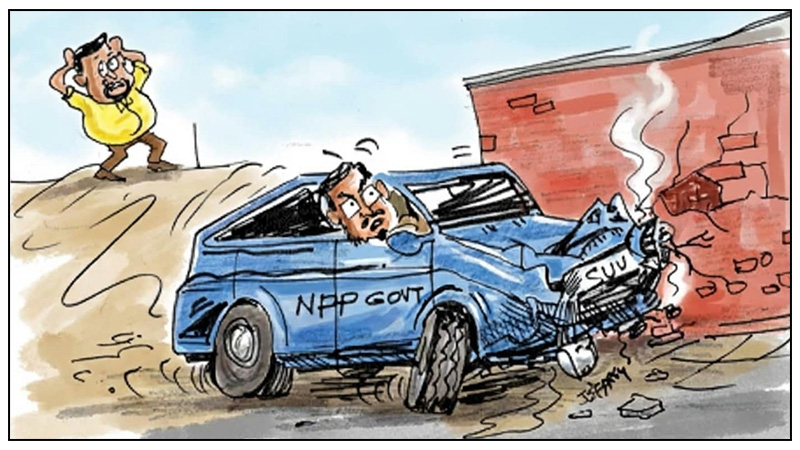
The NPP government is apparently sinking into a pit dug by the one of its members, ‘Dr’ Asoka Ranwala; perhaps a golden pit (Ran Wala) staying true to his name! Some may accuse me of being unpatriotic by criticising a government facing the uphill task of rebuilding the country after an unprecedented catastrophe. Whilst respecting their sentiment, I cannot help but point out that it is the totally unwarranted actions of the government that is earning much warranted criticism, as well stated in the editorial “Smell of Power” (The Island, 15 December). Cartoonist Jeffrey, in his brilliance, has gone a step further by depicting Asoka Ranwala as a giant tsunami wave rushing to engulf the tiny NPP house in the shore, AKD is trying to protect. (The Island, 18 December).
The fact that Asoka Ranwala is very important to the JVP, for whatever reason, became evident when he was elected the Speaker of Parliament despite his lack of any parliamentary experience. When questions were raised about his doctorate in Parliament, Ranwala fiercely defended his position, ably supported by fellow MPs. When the Opposition kept on piling pressure, producing evidence to the contrary, Ranwala stepped aside, claiming that he had misplaced the certificate but would stage a comeback, once found. A year has passed and he is yet to procure a copy of the certificate, or even a confirmatory letter from the Japanese university!
The fact that AKD did not ask Ranwala to give up his parliamentary seat, a decision he may well be regretting now following recent events, shows that either AKD is not a strong leader who can be trusted to translate his words to action or that Ranwala is too important to be got rid of. In fact, AKD should have put his foot down, as it was revealed that Ranwala was a hypocrite, even if not a liar. Ranwala led the campaign to dismantle the private medical school set up by Dr Neville Fernando, which was earning foreign exchange for the country by recruiting foreign students, in addition to saving the outflow of funds for educating Sri Lankan medical graduates abroad. He headed the organisation of parents of state medical students, claiming that they would be adversely affected, and some of the photographs of the protests he led refer to him as Professor Ranwala! Whilst leading the battle against private medical education, Ranwala claims to have obtained his PhD from a private university in Japan. Is this not the height of hypocrisy?
The recent road traffic accident he was involved in would have been inconsequential had Ranwala been decent enough to leave his parliamentary seat or, at least, being humble enough to offer an apology for his exaggerated academic qualifications. After all, he is not the only person to have been caught in the act of embellishing a CV. As far as the road traffic accident is concerned, too, it may not be his entire responsibility. Considering the chaotic traffic, in and around Colombo, coupled with awful driving standards dictated by lack of patience and consideration, it is a surprise that more accidents do not happen in Sri Lanka. Following the accident, may be to exonerate from the first count, a campaign was launched by NPP supporters stating that a man should be judged on his achievements, not qualifications, further implying that he does not have the certificate because he got it in a different name!
What went wrong was not the accident, but the way it was handled. Onlookers claim that Ranwala was smelling of alcohol but there is no proof yet. He could have admitted it even if he had taken any alcohol, which many do and continue to drive in Sri Lanka. After all, the Secretary to the Ministry overseeing the Police was able to get the charge dropped after causing multiple accidents while driving under the influence of liquor! He, with another former police officer, sensing the way the wind was blowing formed a retired police collective to support the NPP and were adequately rewarded by being given top jobs, despite a cloud hanging over them of neglect of duty during the Easter Sunday attacks. This naïve political act brought the integrity of the police into question. The way the police behaved after Ranwala’s accident confirmed the fears in the minds of right-thinking Sri Lankans.
In the euphoria of the success of a party promising a new dawn, unfortunately, many political commentators kept silent but it is becoming pretty obvious that most are awaking to the reality of a false dawn. It could not have come at a worse time for the NPP: in spite of the initial failures to act on the warnings regarding the devastating effects of Ditwah, the government was making good progress in sorting problems out, when Ranwala met with an accident.
The excuses given by the police for not doing a breathalyser test, or blood alcohol levels, promptly, are simply pathetic. Half-life of alcohol is around 4-5 hours and unless Ranwala was dead drunk, it is extremely unlikely any significant amounts of alcohol would be detected in a blood sample taken after 24 hours. Maybe the knowledge of this that made government Spokesmen to claim boldly that proper action would be taken irrespective of the position held. Now that the Government Analyst has not found any alcohol in the blood, no action is needed! Instead, the government seems to have got the IGP to investigate the police. Would any police officers suffer for doing a favour to the government? That is the million-dollar question!
Unfortunately, all this woke up a sleeping giant; a problem that the government hoped would be solved by the passage of time. If the government is hoping that the dishonesty of one of its prominent members would be forgotten with the passage of time, it will be in for a rude shock. When questioned by journalists repeated, the Cabinet spokesman had to say action would be taken if the claim of the doctorate was false. However, he added that the party has not decided what that action would be! What about the promise to rid Parliament of crooks?
It is now clear that the NPP government is not any different from the predecessors and that Sri Lankan voters are forced to contend with yet another false dawn!
by Dr Upul Wijayawardhana ✍️

The international tea industry is experiencing one of the most difficult periods in its history. Producers worldwide are caught in a paradox: tea must be made “cheaper than water” to stay competitive, yet this very race to the bottom erodes profitability, weakens supply chains, and drives away the most talented professionals whose expertise is essential for innovation. At the heart of this crisis lies the structure of commodity tea pricing. Although the auction system has served the world for over a century, it has clear limitations. It rewards volume rather than innovation, penalises differentiation, and leaves little room for value-added product development.
Sri Lanka, one of the world’s finest tea origins, feels this pressure more intensely than most. The industry’s traditional reliance on auctions prevents it from accessing the full premium that its authentic climate, terroir, and craftsmanship deserve. The solution is not to dismantle auctions—because they maintain transparency and global trust—but to evolve beyond them. For tea to thrive again, Ceylon Tea must enter the product market, where brand value, wellness benefits, and consumer experience define price—not weight.
Sri Lanka’s Unique Comparative Advantage
Sri Lanka possesses both competitive and comparative advantage unmatched by any other tea-producing nation. One of the least-discussed scientific advantages is its low gravitational pull, enabling the tea plant to circulate nutrients differently and produce a uniquely delicate, flavour-rich leaf. This natural phenomenon, combined with diverse microclimates, gives Sri Lankan tea extraordinary antioxidant density, rich polyphenols, and a full sensory profile representative of the land and its people.
However, this advantage is undermined by weaknesses in basic agronomy. Most estates do not use soil augers, and soil sampling is often inconsistent or unscientific. This leads to overuse of artificial fertilizer, underinvestment in regenerative practices, and weak soil organic matter (SOM). Without scientific soil management, even a world-class tea origin can lose its competitive edge. Encouragingly, discussions are already underway with the Assistant Indian High Commissioner in Kandy to explore sourcing 3,000 scientifically engineered soil augers for Sri Lanka’s perennial agriculture sector—a transformative step toward soil intelligence and sustainable input management.
Improving SOM, moderating fertilizer misuse, and systematically diagnosing soil nutrient deficiencies represent true sustainability—not cosmetic commitments. Plantation agriculture, which supports over one million Sri Lankan livelihoods, depends on this shift.
The Real Economic Challenge: Price per Kilogram
The most urgent sustainability problem is not climate change or labour cost—it is the low price per kilogram Sri Lanka receives for its tea. Nearly 20% of the tea leaf becomes “refuse tea”, a stigmatized fraction that still contains antioxidants and valuable nutrients but fetches a low price at auctions. The system inherently undervalues almost a fifth of the raw material.
A rational solution is to market the entire tea leaf without discrimination, transforming every component—tender leaf, mature leaf, fiber, and fines—into a premium product with a minimum retail value of USD 15 per kilogram. Achieving this requires product innovation, not further cost reduction.
Ceylon Pot Tea: A Transformative Opportunity
Ceylon Pot Tea emerges as a comprehensive solution capable of addressing long-standing structural issues in Sri Lanka’s tea industry. Unlike traditional tea grades, Pot Tea compresses the entire fired dhool into a high-value cube, similar to the global success of soup cubes. Every part of the leaf is represented, unlocking maximum biochemical utilisation and offering consumers a fuller taste profile with richer aroma, deeper colour, and higher antioxidant content.
Pot Tea is perfectly aligned with the health and wellness market, one of the fastest-growing global consumer segments. As an Herbal Medicinal Beverage (HMB), it captures the complete phytonutritional matrix of the tea leaf, including polyphenols, catechins, and climate-influenced compounds unique to Ceylon. The product also offers storytelling power: every cube reflects the terroir, the gentle fingers that plucked the leaf, and the mystical nature of tea grown in a land with unusually low gravitational intensity.
Already, international partners—particularly in Russia—and domestic innovators have expressed enthusiasm. Pot Tea aligns closely with the policy direction set by the Hon. Samantha Vidyarathne and the NPP Government, especially the national goal of achieving 400 million Kgs of national annual production per year by unlocking new value chains and premium product categories.
Why Immediate Government Intervention Is Necessary
For Sri Lanka to fully benefit from Ceylon Pot Tea and other modernized value chains, the government must urgently introduce:
1. Minimum Yield Benchmarks per hectare (3-year targets) for all perennial crops, informed by scientific investment appraisals.
2. A classification shift from “plantations” to land-based investment enterprises, recognising the capital-intensive, long-term nature of tea cultivation.
3. Incentives for soil testing, soil auger adoption, and SOM improvement programs.
4. Support for value-added tea manufacturing and export diversification.
These steps would create an enabling environment for Pot Tea to scale rapidly and position Sri Lanka as the world’s leading innovator in tea-based wellness products.
Way Forward: Positioning Ceylon Pot Tea for Global Leadership
The path ahead requires a coordinated national and industry-level effort. Sri Lanka must shift from simply producing tea to designing tea experiences. Ceylon Pot Tea can lead this transformation if:
1. Branding and Certification Are Strengthened
CCT (Ceylon Certified Tea) standards must be universally adopted to guarantee purity, origin authenticity, and ethical production practices.
2. Research, Soil Science & Agronomy Are Modernized
With scientific soil audits, optimized fertigation, and regenerative agriculture, Sri Lanka can unlock higher yields and stronger biochemical profiles in its leaf.
3. A Global Wellness Narrative Is Created
Position Pot Tea as a nutritional, therapeutic, anti-aging, and calming beverage suited for the modern lifestyle.
4. Export Market Activation Begins Immediately
Pilot shipments, influencer partnerships, and cross-border digital campaigns should begin with Russia, the Middle East, Japan, and premium EU markets.
5. Producers Are Incentivised to Convert Dhools to Cubes
This ensures minimal waste, improved margins, and equitable value distribution across the supply chain.
Conclusion: A New Dawn for Ceylon Tea
Ceylon Pot Tea offers Sri Lanka a rare chance to pivot from a commodity-driven past to a premium, wellness-oriented, high-margin future. It aligns economic sustainability with environmental responsibility. It empowers estate communities with modern agronomy. And most importantly, it transforms every gram of the tea leaf into value—finally rewarding the land, the planter, and the plucker.
If implemented with vision and urgency, Ceylon Pot Tea will not only revitalise an industry under immense pressure but also secure Sri Lanka’s place as the world’s most innovative and scientifically grounded tea nation.
By. Dammike Kobbekaduwe
(www.vivonta.lk & www.planters.lk) ✍️

It is with deep sorrow that I share the passing of one of my dearests and most trusted friends of many years, Lakshman Balasuriya. He left us on Sunday morning, and with him went a part of my own life. The emptiness he leaves behind is immense, and I struggle to find words that can carry its weight.
Lakshman was not simply a friend. He was a brother to me. We shared a bond built on mutual respect, quiet understanding, and unwavering trust. These things are rare in life, and for that reason they are precious beyond measure. I try to remind myself that I was privileged to spend the final hours of his life with him, but even that thought cannot soften the ache of his sudden and significant absence.
Not too long ago, our families were on holiday together. Lakshman and Janine returned to Sri Lanka early. The rest of the holiday felt a bit empty without Lakshman’s daily presence. I cannot fathom how different life itself will be from now on.
He was gentle and a giant in every sense of the word. A deeply civilized man, refined in taste, gracious in manner, and extraordinarily humble. His humility was second to none, and yet it was never a weakness. It was strength, expressed through kindness, warmth, and dignity. He carried himself with quiet class and had a way of making everyone around him feel at ease.
Lakshman had a very dry, almost deadpan, sense of humor. It was the kind of humor that would catch you off guard, delivered with too straight a face to be certain he was joking, but it could lighten the darkest of conversations. He had a disdain for negativity of any kind. He preferred to look forward, to see possibilities rather than obstacles.
He was exceptionally meticulous and had a particular gift for identifying talent. Once he hired someone, he made sure they were cared for in unimaginable ways. He provided every resource needed for success, and then, with complete trust, granted them independence and autonomy. His staff were not simply employees to him. They were family. He took immense pride in them, and his forward-thinking optimism created an environment of extraordinary positivity and a passion to deliver results and do the right thing.
Lakshman was also a proud family man. He spoke often, and with great pride, about his children, grandchildren, nephews, and nieces. His joy in their achievements was boundless. He was a proud father, grandfather, and uncle, and his devotion to his family reflected the same loyalty he extended to his colleagues and friends.
Whether it was family, staff, or anyone he deemed deserving, Lakshman stood by them unconditionally in times of crisis. He would not let go until victory was secured. That was his way. He was a uniquely kind soul through and through.
Our bond was close. Whenever I arrived in Sri Lanka, it became an unspoken ritual that we would meet at least twice. The first would be on the day of my arrival, and then again on the day I left. It was our custom, and one I cherished deeply. We met regularly, and we spoke almost daily. He was simply a top-class human being. We were friends. We were brothers. His passing has devastated me.
Today I understood fully the true meaning of the phrase ‘priyehi vippaogo dukkho’ — (ප්රියෙහි විප්පයෝගෝ දුක්ඛෝපෝ) ‘separation from those who are beloved is sorrowful.’
My thoughts and prayers are with Janine, Amanthi, and Keshav during this time of profound loss. Lakshman leaves behind indelible memories, as well as a legacy of decency, loyalty, and quiet strength. All of us who were fortunate to know him will hold that legacy close to our hearts.
If Lakshman’s life could leave us with just one lesson, that lesson would be this. True greatness is not measured in titles or possessions, but in the way one treats others: with humility, with loyalty, with kindness that does not falter in times of crisis. Lakshman showed us that to stand by someone, to believe in them, and to lift them up when they falter, is the highest of callings, and it was a calling he never failed to honour.
Rest well, my dear friend.
Krishantha Prasad Cooray

NBRO identifies landslide risks in 14 districts

Danger of weak drug regulation

Pathfinder Foundation lays out a practical vision for Sri Lanka’s economic future

Iain Douglas-Hamilton: Science, courage, and the battle for elephants

Awesome power of gratitude

Ranwala crash: Govt. lays bare its true face

‘Dates have the highest sugar content to fight Coronavirus’

Sunday Island 27 December – Headlines

#SundayIsland 17th December – Headlines

Sunday Island – 28th March

Sunday Island Headlines – 21 March

Sunday Island – 21st February – Headlines
-

 Midweek Review5 days ago
How massive Akuregoda defence complex was built with proceeds from sale of Galle Face land to Shangri-La
-
 News4 days ago
Pope fires broadside: ‘The Holy See won’t be a silent bystander to the grave disparities, injustices, and fundamental human rights violations’
-

 News4 days ago
Pakistan hands over 200 tonnes of humanitarian aid to Lanka
-
 News5 days ago
Burnt elephant dies after delayed rescue; activists demand arrests
-

 Business3 days ago
Unlocking Sri Lanka’s hidden wealth: A $2 billion mineral opportunity awaits
-

 Editorial5 days ago
Colombo Port facing strategic neglect
-

 News3 days ago
Army engineers set up new Nayaru emergency bridge
-

 News5 days ago
Sri Lanka, Romania discuss illegal recruitment, etc.