
Latest News
Hamas names next Israeli hostages set to be released

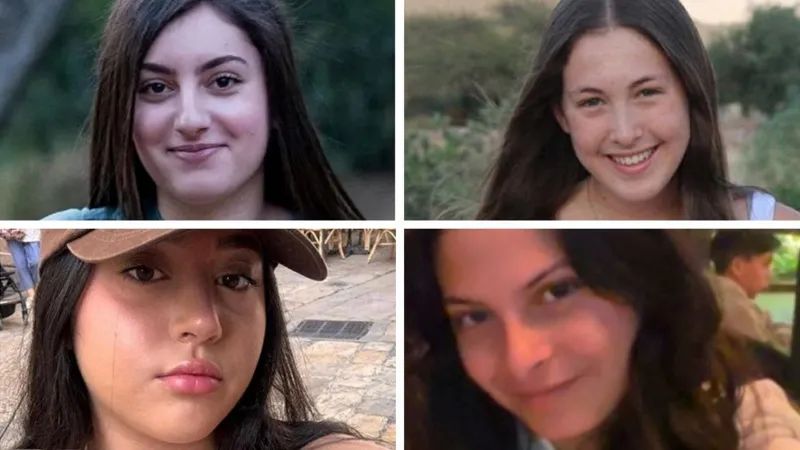
Hamas has named four hostages to be released on Saturday under the Gaza ceasefire deal.
It says they are soldiers Karina Ariev, Daniella Gilboa, Naama Levy and Liri Albag. They will be freed in exchange for 180 Palestinian prisoners held in Israel.
It will be the second such exchange since the ceasefire came into effect last Sunday.
Three hostages and 90 prisoners were released in the first swap.
The ceasefire halted the war which began when Hamas attacked Israel on 7 October 2023. About 1,200 people were killed and 251 taken back to Gaza as hostages.
More than 47,200 Palestinians, the majority civilians, have been killed in Israel’s offensive, Gaza’s Hamas-run health ministry says.
It was originally thought that a female Israeli civilian, Arbel Yehud, would be included in the list of those to be released on Saturday.
It is unclear why her name is not on the list, though Israeli media reported that Palestinian Islamic Jihad (PIJ), a separate group, is holding her.
Hamas is expected to provide information about the remaining 26 hostages due to be released over the next five weeks.
This includes the Bibas family – two parents and two children, one of whom, Kfir, was 10 months old when taken captive and is the youngest hostage. It is unclear if this information will include the names or just the number of living or dead hostages.
The prisoners who will be released are of a more serious category than those freed in the first exchange. They will include those who have killed, some of whom are serving sentences of more than 15 years.
Israel has insisted that no-one who was involved in the 7 October attacks will be freed.
Ariev, Gilboa, Levy and Albag were seized at the Nahal Oz military base which was overrun by Hamas gunmen. Footage showed them among a group of women being tied up with their hands behind their backs. They were seen pleading for help while being taunted by their captors.
The women were part of a unit which surveilled the Israel-Gaza border.
Three weeks ago Hamas released a video of Albag, 19, calling for the Israeli government to reach a deal.
The ceasefire was concluded after months of indirect negotiations between Israel and Hamas, led by the US, Qatar and Egypt.
It will be implemented in three stages, with the second stage due to begin six weeks into the truce. About 1,900 Palestinian prisoners will be released during the first stage in exchange for 33 hostages. Israeli forces will also begin withdrawing from positions in Gaza and hundreds of thousands of displaced Palestinians will be able to return to areas they had fled or been forced from.
The ceasefire is meant to lead to a permanent end to the war in Gaza.
Ninety-one hostages taken on 7 October 2023 are still held in Gaza. Fifty-seven of them are assumed by Israel to still be alive. Three others – two of whom are alive – have been held for a decade or more.
Three female Israeli hostages have already been released as part of the latest ceasefire and hostage release deal.
Romi Gonen, 24, was captured as she tried to escape the Nova music festival when it was targeted by the militant group as part of the 7 October 2023 attack.
She has been freed alongside Doron Steinbrecher, 31, a veterinary nurse, and Emily Damari, 28, who holds dual British-Israeli nationality.
All three arrived back in Israel on Sunday after being released by Hamas in Gaza, and were reunited with their families.
(BBC)

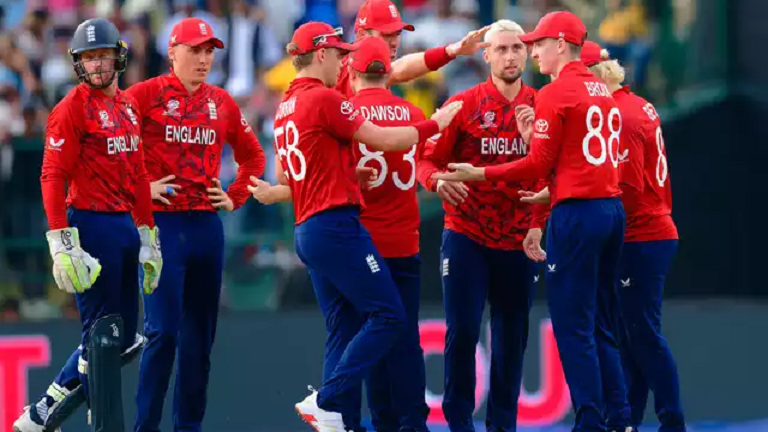
Having been under covers for long periods, the surface showed some stickiness in the previous Super Eights game here, making run-scoring far from straightforward. However, with no rain around now, the pitch has had time to settle, which could aid better batting compared to the England-Sri Lanka game. That said, spin is still expected to play a major role. On the weather front, there is no rain forecast for Tuesday.
Even though Shaheen Afridi spent a fair amount of time bowling in the practice session on the eve of the game, it appears unlikely that the left-armer will return to the XI, with Salman Mirza set to retain his place. Pakistan brought back Fakhar Zaman into the mix against New Zealand in place of Khawaja Nafay. With the game getting washed out, they would want to stick to their call and give the experienced Zaman a go.
In that scenario, Babar’s role could be limited to that of a stabiliser at No. 4 in case of early wickets.
[Cricbuzz]
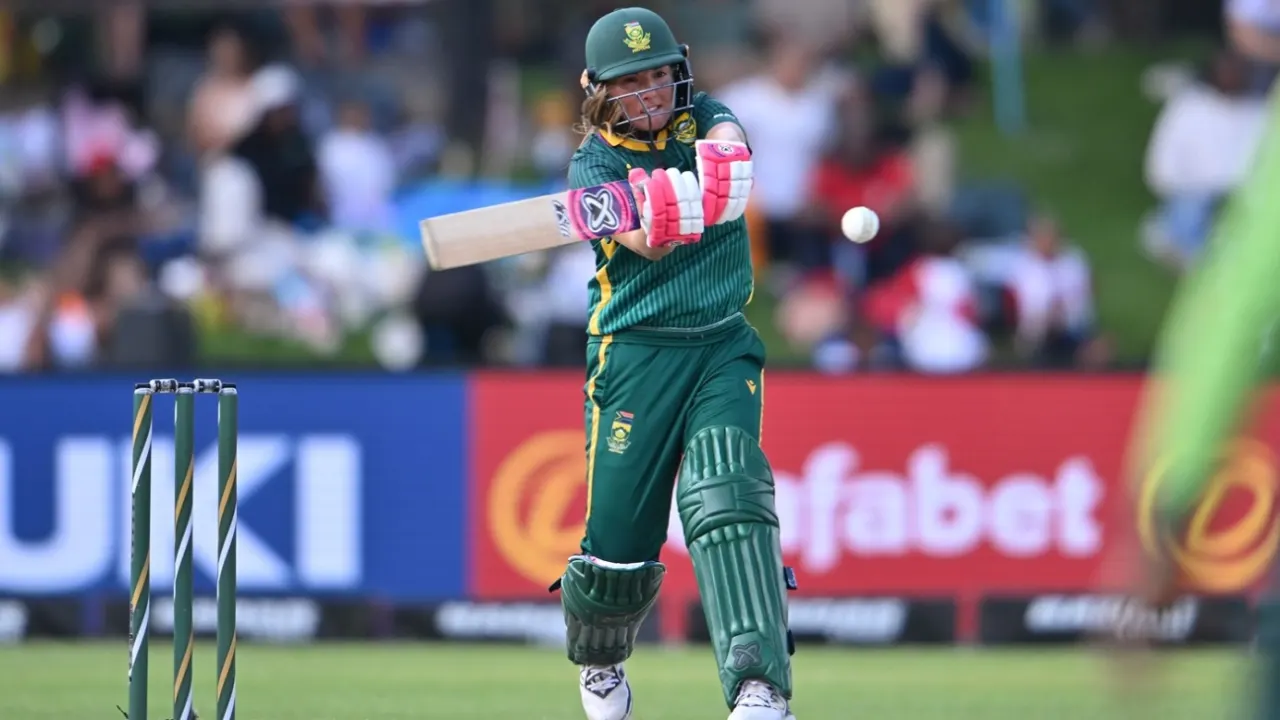
A blistering 93 not out from Sune Luus, and an all-round bowling display from the South Africa bowlers overpowered Pakistan in a rain affected first ODI in Bloemfontein. A weather delay meant the contest had been reduced to 41 overs-a-side at the Manguang Oval. Put in to bat first, South Africa lost two early wickets but were steadied by skipper Laura Wolvaardt. She had reached 43 when she fell to Nashra Sandhu, leaving South Africa at 84 for 3 after 17 overs.
Luus then staged a recovery through the middle overs in the company of Annerie Dercksen: for the fourth wicket, they stitched together a partnership of 80 in just 12.2 overs. However, the acceleration was halted when Dercksen fell for a 37-ball 31 to Syeda Aroob Shah. It was the first of three wickets to fall in a clump: South Africa lost 3 for 6 at one point.
Luus ensured that no further wickets were lost in the remaining nine overs of the innings. She laced eight fours and one six on her way to an unbeaten 76-ball 93. But the finishing kick came from the keeper-batter Sinalo Jafta, who made a career-best 57 not out off 38 deliveries. Her strike rate of 150 would end up being the best from either side, and launched South Africa to a total of 260 for 6.
Requiring more than a run-a-ball from the get go, Pakistan struggled in their chase. They were reduced to 5 for 2 within their first four overs, with strikes from Ayanda Hlubi (1 for 22) and Nadine de Klerk (2 for 36). Sidra Amin (68) and Ayesha Zafar (81) stitched together a 116-run partnership for the third wicket to keep Pakistan in the contest, though they went just below six an over during these 20.3 overs.
By the time Amin had been ripped out by Luus – who finished with 2 for 31 from six overs – the required rate had risen above seven. Pakistan huffed and puffed, with Aliya Riaz’s quickfire 26-ball 31 keeping them interested. But when she was stumped off Nonkululeko Mlaba’s left-arm spin, Pakistan had been held down to 217 for 8.
Three overs remained, and they needed an improbable 44 runs off them.Tumi Sekhukhune was at the front of the mop-up job with a lower order that did not come close to threatening this equation. She picked up the remaining two wickets to finish on figures of 3 for 50, and Pakistan were bowled out for 223 to hand South Africa a 1-0 lead.
Brief scores:
South Africa Women 260 for 6 in 41 overs (Sune Luus 93*, Laira Wolvaardt 43, Sinalo Jaffa 57*; Nashra Sandhu 2-45) beat Pakistan Women 223 in 38.5 overs (Ayesha Zafar 81, Sidra Amin 68; Nadine de Klerk 2-36, Tumi Sekhukhune 3-50, Sune Luus 2-31) by 37 runs
[Cricinfo]
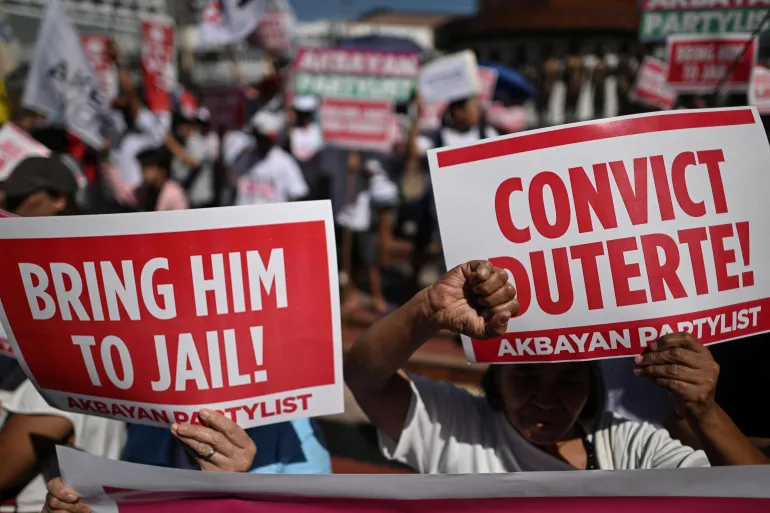
The International Criminal Court (ICC) has begun pretrial hearings for former Philippine President Rodrigo Duterte, who is facing three counts of crimes against humanity for deadly anti-drugs crackdowns he oversaw while in office.
Duterte, 80, was not in The Hague courtroom on Monday, having waived his right to appear as prosecutors began presenting evidence to support their charges of his alleged involvement in dozens of killings as part of his so-called war on drugs.
The four-day confirmation-of-charges hearing will determine whether there is enough evidence against Duterte to proceed to a formal trial.
After the hearing, the judges will have 60 days to issue a written decision.
The case marks a reversal of fortune for Duterte, who has repeatedly cursed the ICC, and offers families of victims and survivors of his six-year war on drugs a chance at justice.
The United States-based watchdog Human Rights Watch said the hearing on Monday was “a critical step in ensuring justice for victims of the Philippines’ ‘war on drugs’” while families of victims called it a “moment of truth”.
Llore Pasco, the mother of two men killed by unknown attackers in 2017, told Al Jazeera it was urgent that all those involved in the so-called war on drugs, including the former president, “are held accountable”.
“I feel a little bit nervous, but this is the moment of truth. We are all hoping that the ICC and the judges will hear the cry of the victims.”

Luzviminda Siapo, whose 19-year-old son was killed in 2017, said she was encouraged that there is progress in the case against Duterte, whom she described as the “brains” behind the killings.
“I hope other perpetrators will also be brought to justice,” she told Al Jazeera.
ICC prosecutors have charged Duterte with crimes against humanity, alleging his involvement in at least 76 murders from 2013 to 2018.
The true number of killings during his campaign in the Philippines is thought to be as high as 30,000 and lawyers for the victims have argued that a full trial could encourage many more families to come forward.
The first of the three counts against Duterte concerns his alleged involvement as a coperpetrator in 19 murders carried out from 2013 to 2016 while he was mayor of Davao City.
The second relates to 14 murders of so-called “high-value targets” in 2016 and 2017 when he was president.
The third charge covers 43 murders committed during “clearance” operations of lower-level accused drug users or pushers across the Philippines from 2016 to 2018.
Duterte denies the charges, his lawyer Nicholas Kaufman told journalists in advance of the hearing.
Duterte, who was president from 2016 to 2022, was arrested in Manila in March, flown to the Netherlands and has since been held at the ICC’s detention unit at Scheveningen Prison.
He followed his initial hearing three days later via videolink, appearing dazed and frail and barely speaking.
In a letter sent to the court on Tuesday, Duterte remained defiant, saying he does “not recognise” the jurisdiction of the court and he is “proud” of his legacy.
Duterte also accused the court of carrying out his “kidnapping” in cooperation with incumbent President Ferdinand Marcos Jr, a former ally and the 2022 running mate of his daughter, Vice President Sara Duterte.
The Philippines left the ICC in 2019 on Duterte’s instructions, but the court has ruled that it still has jurisdiction over offences committed there from 2011 to 2019.
The defence has appealed the ruling, and a decision on its filing is still pending.
Duterte, the first Asian former head of state to appear before the ICC, remains hugely popular in the Philippines, where many favoured his tough approach to crime.
Two demonstrations have been registered for Monday in The Hague – one in support of Duterte and another in support of the victims of the “war on drugs”.
[Aljazeera]

Spin in focus again as high-flying England eye Pakistan scalp

All-round Sune Luus hands South Africa series lead against Pakistan

ICC opens hearings into ex-Philippine President Rodrigo Duterte

New York Mayor Zohran Mamdani orders citywide shutdown as snowstorm hits

Dottin out obstructing the field as Sri Lanka clinch series

Prime Minister Attends the 40th Anniversary of the Sri Lanka Nippon Educational and Cultural Centre

‘Dates have the highest sugar content to fight Coronavirus’

Sunday Island 27 December – Headlines

#SundayIsland 17th December – Headlines

Sunday Island – 28th March

Sunday Island Headlines – 21 March

Sunday Island – 21st February – Headlines
-
 Features2 days ago
Why does the state threaten Its people with yet another anti-terror law?
-

 Features2 days ago
Victor Melder turns 90: Railwayman and bibliophile extraordinary
-
 Features2 days ago
Reconciliation, Mood of the Nation and the NPP Government
-

 Features18 hours ago
LOVEABLE BUT LETHAL: When four-legged stars remind us of a silent killer
-
 Features2 days ago
Victor, the Friend of the Foreign Press
-
 Latest News3 days ago
New Zealand meet familiar opponents Pakistan at spin-friendly Premadasa
-

 Latest News3 days ago
Tariffs ruling is major blow to Trump’s second-term agenda
-

 Latest News3 days ago
ECB push back at Pakistan ‘shadow-ban’ reports ahead of Hundred auction