
Sports
Greg Barclay re-elected as ICC chairman without contest

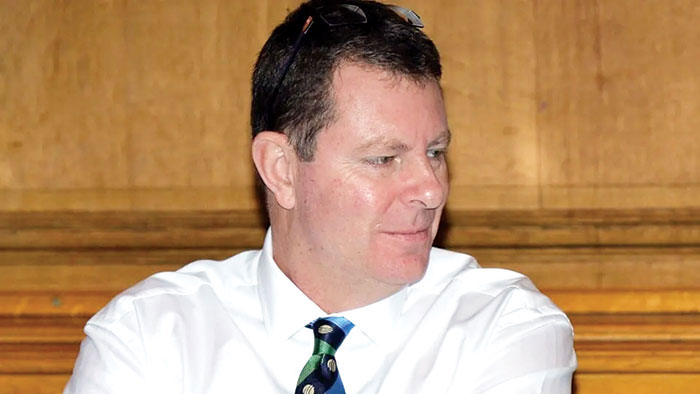
Greg Barclay has been re-elected as ICC chairman for another two-year term after his rival, Zimbabwe Cricket (ZC) chairman Tavengwa Mukuhlani, pulled out of the contest late on Friday. Barclay, who served his first stint as ICC chair between 2022 and this November, will now be in the position until 2024.
The election assumed intrigue over the last couple of weeks after Mukuhlani decided to enter the fray despite knowing Barclay had potentially more votes in his favour from the 16-strong ballot. The election rules stated that winner would be determined by a simple majority. Mukuhlani, a long-term director on the ICC board, had at least six backers including some of the smaller countries from the Asian bloc. However, it was the BCCI, as always, which carried a lot of influence over the voting process.
Despite stating informally that the board was leaning towards supporting Barclay, the BCCI kept everyone guessing which way they would eventually vote in case of an election. Whilst no one at the ICC has officially spoken, more than one director pointed out to ESPNcricinfo that the BCCI wanted to have a prime seat on the influential Finance & Commercial Affairs committee, which not only decides budget allocations for ICC events, but also looks after the distribution of money to member countries from the overall revenue pool.
Accordingly, the BCCI camp led by Jay Shah and Arun Dhumal (IPL chairman) landed in Australia more than a week before the ICC Board meetings happening this weekend in Melbourne. Shah replaced former India captain Sourav Ganguly as the BCCI representative (BCCI president between 2019 till October) on the ICC Board while Dhumal will be sitting on the chief executives committee. More importantly, Shah will also be part of the F&CA and is poised to take over as chair of the committee at its next meeting in March 2023 from Ross McCollum, former Cricket Ireland chair, who is due to retire soon.
Ever since the Shashank Manohar-lead ICC dismantled the Big Three power structure in 2017, and put in place a new financial model that enhanced the earnings of smaller Full Member countries, the BCCI has publicly said it would strive to get a bigger share of the ICC revenue pool which recently got much bigger this August after Disney Star* bought the broadcast rights for men’s and women’s events between 2024-27. The deal, to broadcast in the India market only, is reportedly worth over US$3 billion, considerably more than what the ICC got in the previous rights cycle (which was for eight years, and globally). That pot will get more bigger once the ICC sells the broadcast rights in the remaining key markets including the USA, Australia and Europe.
Both Barclay and Mukuhlani’s manifestos comprised having a re-look at the financial distribution model as well as advocating changes to the ICC governance structure. While Mukuhlani has pulled out of the ICC chair contest, his camp believes they have secured enough assurances that smaller countries will receive a more significant share from the ICC revenues as well as occupying key positions in the ICC committees. Accordingly, Imran Khawaja, the ICC deputy chair, will retain that post and continue to lead the ICC Development Committee. Khwaja had lost to Barclay in 202 ICC chair elections and had thought of running again before deciding to back Mukuhlani.
Mukuhlani himself is part of the ICC’s Audit Committee and chair of the Membership Committee. He is also part of the global body’s Olympics working group, which is tasked with pushing for cricket’s entry in the Summer Games. Mukuhlani said in an ICC media release on Saturday that he decided to “withdraw” because he believed Barclay continuing as ICC chair was “in the best interest of the sport.”
On his part, Barclay said his aim would now be to “strengthen” cricket and help it grow beyond the “core markets.”
“Over the last two years we have made significant strides forward with the launch of our global growth strategy that provides clear direction to build a successful and sustainable future for our sport,” Barclay said.
(cricinfo)

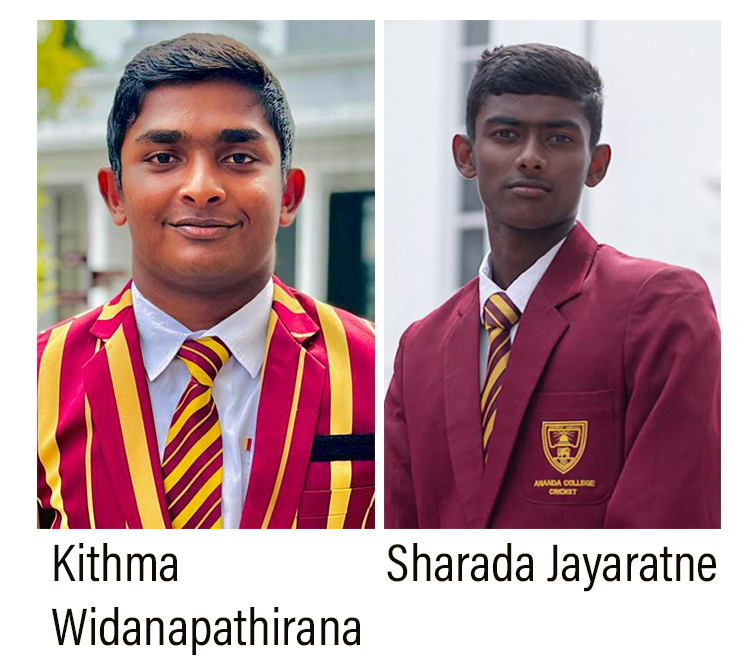
Left arm spinner Sharada Jayaratne took bowling honours of the day’s Under 19 cricket encounters as he took six wickets for Ananda to restrict Richmond to 168 runs in the traditional match at Ananda Mawatha.
Richmond were strongly placed at one stage with Risinu Rupasinghe (40) and Senuk Dulneth adding 91 runs for the first wicket. But when skipper Kithma Widanapathirana broke the stand, Richmond collapsed. Kithma and Sharada shared all ten wickets to fall.
In response the home team were 37 for three wickets at stumps with Vihanga Mihiranga inflicting early dammage.
At Darley Road, Wesley had a promising start with openers Shamma Fernando and Rasheed Nahyan putting on 58 runs for the first wicket before Nushan Perera and Sri Lanka Under 19 spinner Vigneswaran Akash shared seven wickets between them to restrict the Campbell Park team to 161 runs.
In reply St. Joseph’s reached 74 for no loss at stumps. The Joes amassed those runs in just 12.1 overs with Aveesha Samash hammering an unbeaten 53 in 38 balls (6x4s, 4x6s).
At De Soysa Stadium, Moratuwa, Mahanama posted 350 for nine wickets declared against Prince of Wales as Dulnith Sigera (74), Eshan Withanage (71n.o.) and Sineth Veerarathne (59) made half centuries.
For the Cambrians Nethul Anuhas took five wickets.
by Reemus Fernando
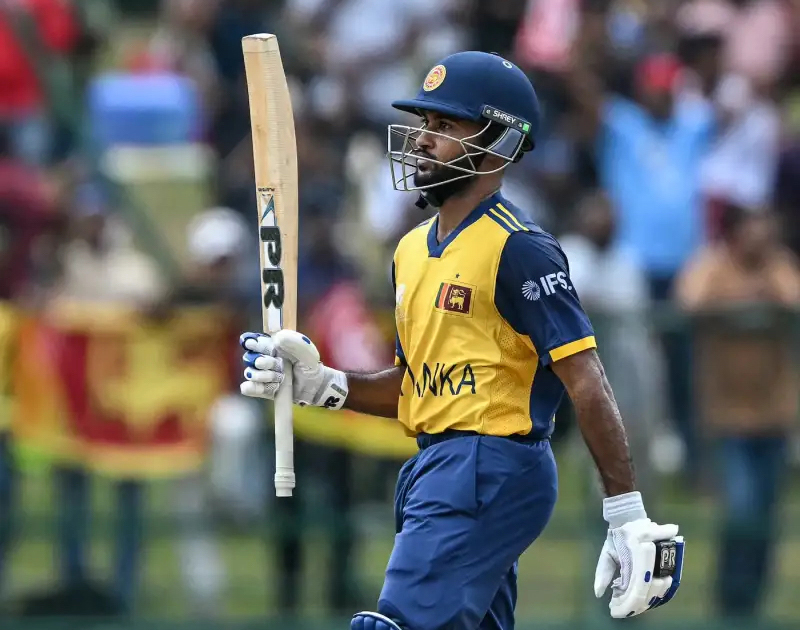
Former Sri Lanka captain Angelo Mathews believes the islanders have unearthed a gem in Pavan Rathnayake, backing the 23-year-old middle-order batter to scale the game’s highest peaks.
Drafted into the World Cup squad at the eleventh hour, Rathnayake has wasted little time in justifying the selectors’ leap of faith. While much of the spotlight has rightly fallen on Pathum Nissanka’s match-winning heroics, the youngster has quietly gone about his business, compiling runs with poise and a range of strokes that suggest he belongs on this stage.
Rathnayake’s inclusion was no shot in the dark. Sri Lanka’s struggles against spin had been laid bare in the lead-up to the tournament and the think tank sought a batter who could milk the tweakers rather than get tied in knots. Rathnayake ticked that box emphatically, earning praise from batting coach Vikram Rathour for the way he used his feet to get to the pitch of the ball and employed soft hands to manoeuvre the field.
Mathews, who has long advocated fast-tracking the youngster into the senior set-up, said the signs were unmistakable.
“We are seeing someone special in Pavan Rathnayake,” Mathews told Telecom Asia Sport.
“I have seen him in close quarters and what impressed me most is his temperament. If he gets a start, he will go on to get a big hundred. I rate him very highly. The manner in which he plays spin is remarkable. He can both use his feet and rock back as well. He is a huge find for Sri Lanka and the world will start talking about him as we move on,” he added.
Mathews reserved special praise for the youngster’s mental steel, a trait he believes separates the run-of-the-mill from the truly elite.
“Pavan has a cool head and is so good to watch when he is on song. He is a man of few words, but mentally a very tough bloke and that’s what separates good players from great ones. I have no doubt he can go on to become a great,” Mathews said.
Sri Lanka became the first side to book their ticket to the Super Eight stage of the T20 World Cup after a stirring win over Australia, a result that sent fans into raptures and put the former champions back in the reckoning.
They begin their Super Eight campaign on Sunday against England, returning to a contest that promises high voltage and little margin for error.
On paper, Sri Lanka appear to have most bases covered. But the injury list has thrown a spanner in the works. Eshan Malinga, Wanindu Hasaranga and Matheesha Pathirana have all been ruled out, forcing the selectors into three replacements and leaving the bowling attack short on experience at the business end.

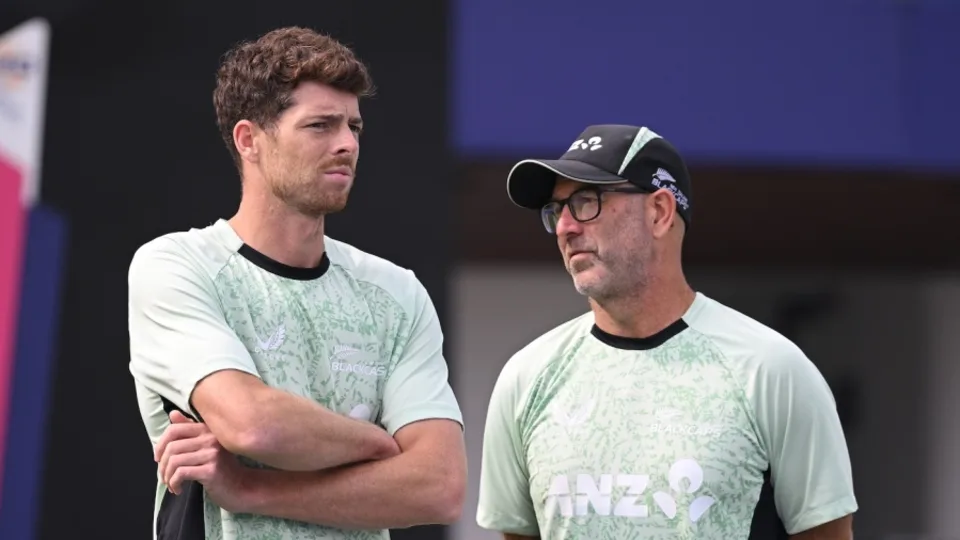
41: That’s the number of times New Zealand and Pakistan faced each other across formats in a 30-month period between October 2022 and April 2025. Twenty four of those meetings came in T20Is, with the sides compensating for a tour which New Zealand abandoned in 2021, citing security concerns by piling on as many bilateral engagements as is it was possible to fit in a calendar.
Aside from a T20 World Cup semi-final in Sydney in 2022, none of those games mattered as much as the one in Colombo on February 21. Both sides have much convincing to do as credible title-contenders after a group stage which saw them ease past lower-ranked teams while getting thumped by the one powerhouse they played. In New Zealand’s case, it was South Africa who gave them a battering, while Pakistan were left similarly bruised by an Indian side that has otherwise not quite hit its straps.
For New Zealand, the biggest challenge is the switch of venue. They played all of their games in Chennai and Ahmedabad, and relied on a balance between seam and spin that leaned towards the former, with Mitchell Santner the only frontline spinner and Rachin Ravindra or Glenn Phillips chipping in with the odd over. In Colombo, that balance is likely to reverse as the slower bowlers take centre stage, something Pakistan have deployed so effectively in most of their matches.
Santner’s men have not tinkered much with the batting order, which has held up remarkably well for the most part. Against weaker oppositions, some combination of openers Finn Allen and Tim Seifert, or top order batters Ravindra and Phillips, have showcased enough firepower to ease home. Opposition attacks have also struggled to puncture their way through, with New Zealand losing just 14 wickets in four games, the second fewest for any side in this tournament.
Unlike New Zealand, Pakistan know this city intimately well by now. Three of their four games may have been played at the SSC – the other Colombo ground – but their match against India here at the RPS was, like Saturday’s contest, also an evening game, giving them a valuable read into the pitch and conditions. It is the venue they used more spin on than any other, with captain Salman Ali Agha suggesting that would only continue in the Super Eight.
Pakistan’s top order has the explosiveness to blow teams away, even if they have struggled to translate that potential with form for Saim Ayub. Sahibzada Farhan at the other end has taken on the mantle for powerplay run-scoring as runs for Agha having dried up before the game against Namibia, and Babar Azam no nearer to maximising his ability. That fragility too quickly brings up a middle order comprising too many bowling allrounders or the untested Khawaja Nafay, a situation that led to a near-defeat against the Netherlands and a decisive defeat against India.
This is two teams situated among the middle powers of this World Cup, eager to demonstrate they’re better than what they managed against true superpowers like India and South Africa. What matters, ultimately, is which of them can show they’re better than the middle power they face off against on Saturday.
Jacob Duffy takes a wicket against Pakistan every 10.5 deliveries. Among bowlers with at least 15 scalps against Pakistan, no one in the world matches that strike rate. Eighteen of his 62 wickets have come against Saturday’s opponents, at an average of 12.77, comfortably the best amongst teams he has played more than five games against. The catch, however, is that all but one of those wickets have come in New Zealand, in conditions very different to what’ll be in front of him at the Premadasa in Colombo. But Hardik Pandya, who boasts an almost equally impressive record against Pakistan, did not find this very venue an impediment against bowling effectiveness against Pakistan. Duffy will hope to have similar success.
Abrar Ahmed was, arguably harshly, dropped against Namibia after an off-day against India. But his longer-term form makes it unlikely he will stay out of the side again in the raised stakes of the Super Eight. He was Pakistan’s second-highest wicket-taker in 2025, and at the Asia Cup last year, his economy rate of 5.36 in spin-friendly conditions was by far the most miserly in the tournament. All of that points to the India game being an aberration, with Pakistan needing him at his best for the business stages. He was Pakistan’s best bowler in the two series against Sri Lanka and Australia prior to this World Cup, and how he responds to the wake-up call of his axing may go some distance to determining the fate of Saturday’s game.
Abrar Ahmed is expected to come back into the side, but Pakistan will not want to make wholesale changes to a team that delivered so handsomely in their must-win game against Namibia.
Pakistan: Sahibzada Farhan, Saim Ayub, Salman Ali Agha (capt) Babar Azam, Khawaja Nafay, Shadab Khan, Usman Khan (wk) Mohammad Nawaz/Faheem Ashraf, Salman Mirza, Usman Tariq, Abrar Ahmed
New Zealand will take a late call on Lockie Ferguson, who gets into Sri Lanka on Friday night after being granted paternity leave. It will be interesting to see how New Zealand manage to incorporate more spin into their XI to reconcile with Sri Lankan conditions. That might bring Ish Sodhi in for his first game this World Cup.
New Zealand: Tim Seifert (wk), Finn Allen, Rachin Ravindra, Glenn Phillips, Mark Chapman, Daryl Mitchell, Mitchell Santner (capt), Jimmy Neesham, Matt Henry, Ish Sodhi Jacob Duffy
[Cricinfo]

Atmospheric conditions are favorable for thundershowers over most parts of the island

Trump brings in new 10% tariff as Supreme Court rejects his global import taxes

Ravi demands full disclosure on Lanka’s usable reserves, flags forex leakages

Sajith exposes highly questionable coal imports from South Africa in 25 vessels; calls for independent probe

Ex-TRCSL Chairman Palpita enlarged on bail

NWSDB GM, two others granted bail in corruption case

‘Dates have the highest sugar content to fight Coronavirus’

Sunday Island 27 December – Headlines

#SundayIsland 17th December – Headlines

Sunday Island – 28th March

Sunday Island Headlines – 21 March

Sunday Island – 21st February – Headlines
-
 Life style6 days ago
Marriot new GM Suranga
-

 Business5 days ago
Ministry of Brands to launch Sri Lanka’s first off-price retail destination
-

 Features6 days ago
Monks’ march, in America and Sri Lanka
-

 Features6 days ago
The Rise of Takaichi
-

 Features6 days ago
Wetlands of Sri Lanka:
-

 News6 days ago
Thailand to recruit 10,000 Lankans under new labour pact
-
 News6 days ago
Massive Sangha confab to address alleged injustices against monks
-
 Sports2 days ago
Old and new at the SSC, just like Pakistan