
Business
Government of Sri Lanka and UNDP Map Out SDG Investment for Private Sector to Support Recovery


The SDG Impact Standards were also introduced to the Sri Lankan market to guide investors and enterprises on integrating sustainability and the SDGs into management practices
The Government of Sri Lanka and UNDP in Sri Lanka on Aug. 30 announced the launch of the Sri Lanka SDG Investor Map (the Map), a market intelligence tool that seeks to direct private capital where Sri Lanka’s Sustainable Development Goals (SDG) priorities, Government policy and market opportunity intersect, as the country seeks to rebuild its economy sustainably, using the SDG framework as its guide. The methodology for the Map was created by UNDP SDG Impact, a press release from participants said.
Explaining the Map will be a crucial tool to accelerate Sri Lanka’s recovery pathway and build forward better, the reease said it can be used by:
Investors wishing to explore Sri Lanka as an investment destination while also rendering benefits for local communities and the environmentEnterprises that want to adjust their business strategy towards inclusive models and are seeking market intelligence and investment rationale to validate their approach
Government agencies seeking to address entry level barriers for the private sector and to build an amenable ecosystem for the development of SDG enabling sectors
“In Sri Lanka, the Map was the result of a strong collaboration between UNDP and Sri Lanka’s Sustainable Development Council, the nodal government institution responsible for coordination, facilitation, monitoring, evaluation and reporting on the implementation of the 2030 Agenda for Sustainable Development in Sri Lanka,” the release said.
“Sri Lanka’s apex investment promotion agency, the Board of Investments (BOI) of Sri Lanka, also provided input and validation during the development of the Map and is a key partner for the Map’s launch. Through secondary research and over 50 consultations with public and private sector organizations, the Map has identified 15 Investment Opportunity Areas (IOAs) that cover investment themes and business models across five SDG priority sectors: Renewable Energy, Healthcare, Infrastructure, Food & Beverages and Consumer Goods,” the release added.
At the event, UNDP called on the private sector to adopt the SDG Impact Standards, the independent and global management standards that guide businesses and investors in their decisions to optimize interrelated economic, social and environmental impacts. The forthcoming SDG Impact Standards Assurance Framework and SDG Impact Seal recognizes investors and enterprises who are more likely to be contributing positively to sustainability, reducing the risk of impact-washing.
Speaking at the event, Mr. W.A. Sarath Kumara, Deputy Secretary Treasury, Ministry of Finance stated, “Sri Lanka’s commitment to achieving the SDGs is explicit in our continued pursuit of national policies and development plans and programmes in alignment with SDGs over the years. Innovative financing mechanisms become imperative to synergize the government, private sector, and capital markets to generate the additional resources needed to finance the SDGs. The SDG Investor Map is therefore a timely intervention that would provide the potential investors with the required market information relating to potential investment opportunity areas.”
Highlighting how the map will inform Sri Lanka’s efforts to rebuild its economy sustainably, Ms. Hanaa Singer-Hamdy, Resident Coordinator, United Nations in Sri Lanka, said “a whole-of-society approach is needed to mitigate the immediate impacts of Sri Lanka’s economic crisis and assure the country’s long-term sustainable development. The Sri Lanka SDG Investor Map offers a compelling pathway for private sector entities to increase the alignment of their investments with the SDGs. It complements the recently launched United Nations Sustainable Development Cooperation Framework 2023–2027 by translating relevant country-level SDG gaps and priorities into private sector investment opportunities that will have lasting impacts on lives and livelihoods across the country.”
Commenting on the collaboration, Ms. Chamindry Saparamadu, Director General, Sustainable Development Council stated, ‘Partnerships underpin the success of the 2030 Agenda for Sustainable Development. Each stakeholder has particular strengths to bring to bear in delivering on the SDGs. Partnership and collaboration between the Sustainable Development Council and the UNDP in creating Sri Lanka’s first ever SDG Investor Map provides a classic example of how the strengths of each agency was leveraged to produce an innovative solution that could help bridge the financing gap for SDGs in Sri Lanka’.
Highlighting UNDPs role, Ms. Malin Herwig, Officer-In-Charge, UNDP in Sri Lanka commented, “The SDG Investor Map has provided us market intelligence on SDG aligned investment opportunities for Sri Lanka at this critical juncture. UNDP together with the Government of Sri Lanka, through the Map, calls for development partners, IFIs and private impact investors to come together to formulate financing solutions to contribute to the country’s recovery and SDG acceleration.”
Ms Fabienne Michaux, Director of SDG Impact concluded, “While there is much to be done, there is a great opportunity for the private sector to integrate sustainability and the SDGs into their investments and businesses to help Sri Lanka build forward better. The Sri Lanka SDG Investor Map has done a large part of the leg-work by identifying those sectors that will have the most development impact and that are aligned to the Government’s SDG targets. This coupled with the adoption of the SDG Impact Standards which guides the private sector to manage their impact, will further the country’s ability to build a more resilient future, leaving no one behind”.
About SDG Impact
SDG Impact is a UNDP flagship initiative, working to accelerate private sector contributions towards sustainability and the achievement of the Sustainable Development Goals (SDGs) by 2030. Its aim is to make it easier for organizations to place sustainability, the SDGs and managing for impact at the core of business and investment purpose, how value is created, and how capital is allocated through its SDG Impact Standards and the SDG Investor Maps.
Learn more sdgimpact.undp.org and follow us on Twitter @SDGImpact
About UNDP
UNDP is the leading United Nations organization fighting to end the injustice of poverty, inequality, and climate change. Working with our broad network of experts and partners in 170 countries, we help nations to build integrated, lasting solutions for people and planet.
Learn more at www.undp.org/srilanka or follow us at @UNDPSriLanka
For more information, please contact:
Contact: socialmedia.lk@undp.org | 0779804188 | 011-2580691 Ext. 1501 Get in touch: UNDP on Twitter | Facebook | Instagram

Business
Earth Day warning: Environmental neglect risks undermining Sri Lanka’s economic stability — CEJ


By Ifham Nizam
Today, April 22, as the world marks Earth Day, the Centre for Environmental Justice (CEJ) warned that Sri Lanka’s fragile economic recovery could face serious setbacks if environmental degradation and climate vulnerabilities are not urgently addressed—framing sustainability as a core economic priority rather than a peripheral concern.
CEJ stressed that the country’s exposure to climate shocks—ranging from floods and droughts to coastal erosion—poses direct and escalating risks to key economic sectors including agriculture, water resources, fisheries, and infrastructure.
CEJ chairperson Hemantha Withanage stressed that Sri Lanka’s development trajectory remains dangerously disconnected from environmental realities.
He told The Island Financial Review:”Sri Lanka is highly vulnerable to climate change. Increasingly erratic weather patterns are already disrupting livelihoods, damaging crops, and straining water systems. If these risks are not integrated into economic planning, the cost to the national economy will be severe.”
The warning comes at a time when Sri Lanka is attempting to rebuild fiscal stability, attract investment, and strengthen export sectors. However, CEJ argues that environmental mismanagement—from unchecked pollution to poor land-use planning—continues to erode long-term economic resilience.
The organisation pointed out that climate-induced disasters not only incur immediate financial losses but also create cascading impacts across industries. Agricultural output declines, supply chains are disrupted, and public expenditure rises due to disaster response and infrastructure repairs—placing further pressure on an already constrained national budget.
CEJ also highlighted that unsustainable practices, including excessive plastic use and chemical pollution, carry hidden economic costs—ranging from healthcare burdens to ecosystem damage and loss of tourism appeal.
However, the group noted that policy interventions can yield measurable gains. It cited the government’s move to ban the distribution of polythene bags in supermarkets from November 2025, following a court ruling, as a step that has already contributed to a significant reduction in plastic usage.
“Policy consistency and enforcement are key. When strong environmental regulations are implemented, the benefits are not only ecological but also economic,” Withanage said.
Framing this year’s Earth Day theme, “Our Power, Our Planet,” CEJ called for a shift towards sustainable consumption patterns, green investment, and climate-resilient infrastructure.
“Environmental protection is no longer optional—it is central to economic survival and growth,” CEJ emphasised.

Sampath Bank PLC reported a solid financial performance for 2025, with earnings surpassing market expectations and reinforcing investor confidence in its medium-term growth trajectory, according to a recent equity research update by First Capital Holdings PLC.
The bank recorded a net profit of LKR 32.6 billion for the full year 2025, marking a 13.5% year-on-year increase. Fourth-quarter profit came in at LKR 9.4 billion, marginally down 2% from a year earlier, largely due to base effects stemming from a one-off impairment reversal in the corresponding period of 2024.
Core banking operations remained robust. Net interest income rose 8.1% year-on-year in the final quarter, supported by strong credit expansion, while fee and commission income grew 23.2%. Total other income surged 130%, aided by improved treasury performance, including a turnaround to a trading gain compared to a loss a year earlier.
A key highlight for investors was the sharp expansion in the loan book, which grew 32.6% year-on-year to reach LKR 1.2 trillion by end-2025. Growth was driven by import financing, leasing, and long-term lending. Deposit growth, while more moderate at 11.8%, was led by gains in savings accounts.
Asset quality also improved during the year, with the Stage 3 loan ratio declining to 3.31% from 4.69% a year earlier, reflecting stronger recoveries and improved repayment capacity among borrowers. The reinstatement of parate execution laws further supported recoveries.
Capital and liquidity positions remained well above regulatory thresholds, with total capital adequacy at 17.65% and liquidity coverage at nearly 240%, providing ample buffers to sustain lending growth.
Looking ahead, First Capital forecasts earnings to grow at a more moderate pace, projecting net profits of LKR 34.7 billion in 2026 and LKR 39.9 billion in 2027, as macroeconomic momentum is expected to ease.
Reflecting broader market re-rating trends, the bank’s estimated fair value for 2026 has been revised down to LKR 165 per share, though the stock still offers an expected total return of around 18%. A 2027 fair value of LKR 180 implies a potential return of 30%.
Despite near-term headwinds, the First Capital report maintains a “buy” recommendation on Sampath Bank, citing strong fundamentals, improving asset quality, and sustained credit growth as key drivers of long-term value.
By Sanath Nanayakkare
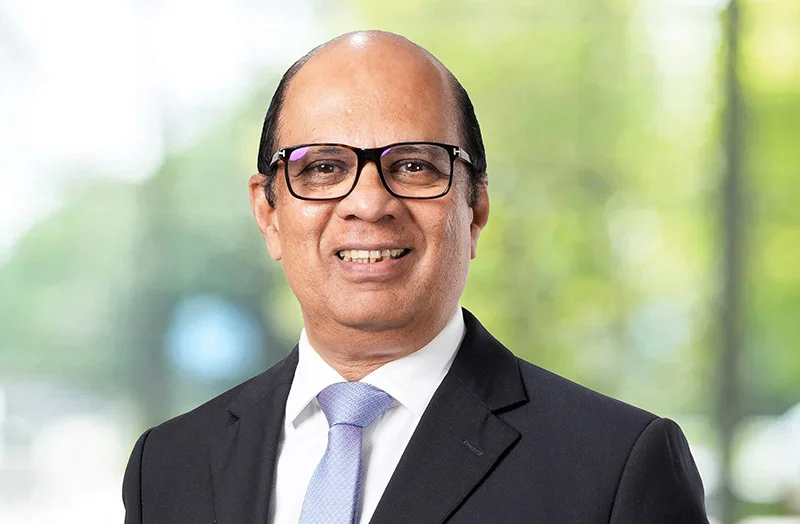
Dialog Axiata PLC, Sri Lanka’s #1 connectivity provider, announced the appointment of Mr. Arjuna Herath as an Independent Non-Executive Director, effective 1 May 2026. Herath brings extensive experience across consulting, corporate finance, investments, and regulatory governance.
“Arjuna brings a unique blend of private sector experience and public sector leadership, with deep exposure to regulatory and institutional environments. His insights will add meaningful value to the Board as we continue to strengthen governance and navigate an increasingly dynamic digital landscape,” said David Lau, Chairman of Dialog Axiata PLC.
Herath most recently served as Chairman of the Board of Investment of Sri Lanka, contributing to national investment promotion strategy. He was also the inaugural Chair of the Sri Lanka Data Protection Authority, where he led early regulatory efforts in digital privacy. Earlier, he served as Senior Partner and Head of Consulting at Ernst & Young (EY) Sri Lanka and Maldives, and held roles in corporate development at Ceylon Tobacco Company and Merchant Bank of Sri Lanka.
He has held several key regulatory roles, including as Commissioner of the Securities and Exchange Commission of Sri Lanka, Board Member of the Sri Lanka Accounting and Auditing Standards Monitoring Board, and Member of the Company Law Advisory Commission. He currently serves as a Director of the Colombo Stock Exchange.
Herath is a Fellow Member and a Past President of The Institute of Chartered Accountants of Sri Lanka and has contributed extensively to the global accountancy profession. He is the first Sri Lankan to chair a committee of the International Federation of Accountants (IFAC), where he led the Professional Accountancy Organisation Development Committee.

IRGC seizes two vessels in Strait of Hormuz amid US blockade

Cabinet approves establishment of Activity-Based Learning Centers at Regional Level for Commerce Education
M/s. Resources Development Consultants (Pvt) Ltd appointed to prepare Feasibility Study and detailed plans for the extension of the Kelani Valley Railway Line from Avissawella to Ratnapura
Import and Export (Control) Regulations No. 01 of 2026, issued under the Imports and Exports (Control) Act, No. 1 of 1969, to be submitted for concurrence of the Parliament

Cabinet nod to establish ‘Sri Lanka Industrial Transformation and Innovation Authority ‘
Iraj Chaminda Pathiraja appointed Controller General of Immigration and Emigration

‘Dates have the highest sugar content to fight Coronavirus’

Sunday Island 27 December – Headlines

#SundayIsland 17th December – Headlines

Sunday Island – 28th March

Sunday Island Headlines – 21 March

Sunday Island – 21st February – Headlines
-
 News2 days ago
Rs 13 bn NDB fraud: Int’l forensic audit ordered
-

 Business5 days ago
Harnessing nature’s wisdom: Experts highlight “Resist–Align” path to resilience
-

 News5 days ago
Gratiaen Trust announces longlist for the 33rd Annual Gratiaen Prize
-

 News4 days ago
From Nuwara Eliya to Dubai: Isha Holdings markets Agri products abroad
-

 Opinion3 days ago
Shutting roof top solar panels – a crime
-

 News5 days ago
Heroin haul transported on 50-million-rupee contract
-

 Latest News6 days ago
Singapore Zoo’s first Sri Lankan leopard cubs make their public debut
-

 News3 days ago
Church calls for Deputy Defence Minister’s removal, establishment of Independent Prosecutor’s Office