
Business
Earth Day warning: Environmental neglect risks undermining Sri Lanka’s economic stability — CEJ


By Ifham Nizam
Today, April 22, as the world marks Earth Day, the Centre for Environmental Justice (CEJ) warned that Sri Lanka’s fragile economic recovery could face serious setbacks if environmental degradation and climate vulnerabilities are not urgently addressed—framing sustainability as a core economic priority rather than a peripheral concern.
CEJ stressed that the country’s exposure to climate shocks—ranging from floods and droughts to coastal erosion—poses direct and escalating risks to key economic sectors including agriculture, water resources, fisheries, and infrastructure.
CEJ chairperson Hemantha Withanage stressed that Sri Lanka’s development trajectory remains dangerously disconnected from environmental realities.
He told The Island Financial Review:”Sri Lanka is highly vulnerable to climate change. Increasingly erratic weather patterns are already disrupting livelihoods, damaging crops, and straining water systems. If these risks are not integrated into economic planning, the cost to the national economy will be severe.”
The warning comes at a time when Sri Lanka is attempting to rebuild fiscal stability, attract investment, and strengthen export sectors. However, CEJ argues that environmental mismanagement—from unchecked pollution to poor land-use planning—continues to erode long-term economic resilience.
The organisation pointed out that climate-induced disasters not only incur immediate financial losses but also create cascading impacts across industries. Agricultural output declines, supply chains are disrupted, and public expenditure rises due to disaster response and infrastructure repairs—placing further pressure on an already constrained national budget.
CEJ also highlighted that unsustainable practices, including excessive plastic use and chemical pollution, carry hidden economic costs—ranging from healthcare burdens to ecosystem damage and loss of tourism appeal.
However, the group noted that policy interventions can yield measurable gains. It cited the government’s move to ban the distribution of polythene bags in supermarkets from November 2025, following a court ruling, as a step that has already contributed to a significant reduction in plastic usage.
“Policy consistency and enforcement are key. When strong environmental regulations are implemented, the benefits are not only ecological but also economic,” Withanage said.
Framing this year’s Earth Day theme, “Our Power, Our Planet,” CEJ called for a shift towards sustainable consumption patterns, green investment, and climate-resilient infrastructure.
“Environmental protection is no longer optional—it is central to economic survival and growth,” CEJ emphasised.



Sampath Bank reported Total Operating Income of Rs 28.5 Bn for the quarter ended 31st March 2026, supported by steady growth in Net Interest Income (up 5%) and Net Fee and Commission Income (up 28%) year-on-year.
Notwithstanding this performance, Profit After Tax (PAT) declined by 26% to Rs 6.2 Bn, due to significantly higher impairment provisions of Rs 4.5 Bn recognised in response to the continued expansion of the loan book and taking into account the evolving geopolitical conditions. Additionally, one-off gains from the disposal of Treasury Bills and Bonds moderated to Rs 0.7 Bn in 2026, a decrease of Rs 2.0 Bn compared to the elevated levels recorded in the previous year.
The Bank’s total asset base crossed the Rs 2 Tn milestone for the first time, representing a significant achievement supported by strong loan growth of Rs 127 Bn in the first quarter of 2026.
The Sampath Group delivered a Profit Before Tax (PBT) of Rs 9.4 Bn and a Profit After Tax of Rs 6.8 Bn for the quarter ended 31st March 2026.
Fund Based Income
The Bank reported total interest income of Rs 46.5 Bn, reflecting year-on-year growth of 6%. This increase was primarily driven by the expansion of the loan portfolio during the reporting period and in the latter part of the previous year, compared to the negative loan growth recorded in the corresponding period of the previous year, as well as an upward movement in the Average Weighted Prime Lending Rate (AWPLR).
Interest expense for the quarter also increased by 6% to Rs 26.4 Bn, reflecting growth in both deposit and borrowing portfolios. As a result, Net Interest Income (NII) stood at Rs 20.1 Bn, an increase of 5% compared to the corresponding quarter of the previous year.
The Net Interest Margin (NIM) contracted marginally by 2 basis points to 4.09%, from 4.11% reported for 2025. This decline was primarily attributable to lower yields across the Bank’s investment portfolio, reflecting reduced rates in the Government Securities portfolio compared to the previous period.
Non-Fund Based Income
During the three-month period ended 31st March 2026, the Bank’s total non-fund based income declined marginally by 4% to Rs 8.3 Bn, mainly due to a decrease in capital gains from the sale of Treasury bills and bonds. Capital gains declined from Rs 2.7 Bn in 1Q 2025 to Rs 0.7 Bn in 1Q 2026, representing a year-on-year decline of 75%.
Net fee and commission income, driven by credit expansion, higher trade volumes and increased card usage, recorded a robust growth of 28% across all income channels, reaching Rs 6.1 Bn by the end of the quarter.
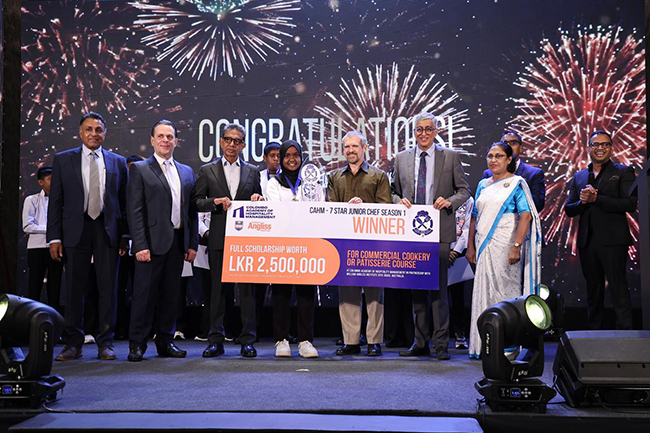
The Grand Finale of the CAHM – 7 Star Junior Chef Competition – Season 01 was successfully held on 9th of May at the CAHM premises, SLIIT Main Campus, Malabe, celebrating the talent, creativity and passion of young aspiring chefs from across Sri Lanka.
Organised by the Colombo Academy of Hospitality Management (CAHM) at SLIIT, with 7 Star by Serendib Flour Mills as Title Sponsor, the national-level competition provided students aged 13 to 16 with a platform to explore culinary arts, gain practical exposure and discover future opportunities in hospitality.
The Colombo Academy of Hospitality Management (CAHM), Sri Lanka’s largest private hospitality, foods, tourism, and events education provider, in partnership with the William Angliss Institute, (RTO – 3045) Australia and operating within the SLIIT premises Malabe. Through this partnership, CAHM delivers internationally competitive training in culinary arts, offering students an exceptional learning experience that prepares them for opportunities in Sri Lanka and on the global stage.
The competition’s journey began with an encouraging islandwide response, attracting over 5,000 inquiries from aspiring participants, parents and schoolteachers, with over 1,400 applications submitted. Following a careful evaluation process, 204 applicants were shortlisted for the competition, progressing through structured rounds that offered hands-on culinary exposure, industry insights and preparatory guidance, before the final 10 contestants were selected to compete at the Grand Finale.
Following several competitive rounds, 10 finalists secured their places at the Grand Finale. The finalists were Bareerah Bariq of Muslim Ladies College Colombo 04, Nikhel Venuk Elisha of St Joseph’s College Colombo 10, Anooshka Vigneswaran of Girls High School Kandy, Prabhasha Muthubhashini Gunawardhana of Kalutara Balika Vidyalaya, Shamha Nazim of Ilma International Girls’ School Colombo 05, Sithuki Siyansa Methsandi of Buddhist Ladies College Colombo 07, Sandaruwani Nisansala of Moratu Maha Vidyalaya Senuth Insanda of Nalanda College Colombo 10, Pinidu Senuranga Fernando of Boys’ Model School Malabe, and Poorna Bandara Tennakoon of Royal International School Kurunegala.
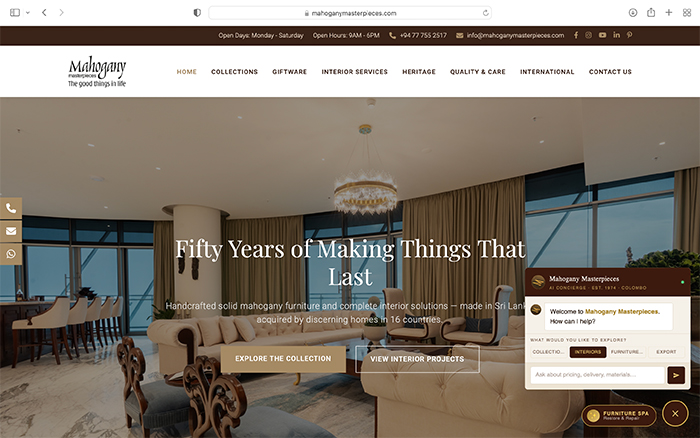
Mahogany Masterpieces (Pvt) Ltd, Sri Lanka’s pre-eminent luxury solid wood furniture house and turnkey interior solutions provider, today announces the launch of its new digital flagship at www.mahogany.lk, alongside the introduction of what the company believes to be the most sophisticated AI Concierge deployed by any luxury brand in Sri Lanka.
The launch marks a defining chapter in the brand’s fifty-two-year history: a company founded on uncompromising craft, now presenting itself to the world with a digital presence that matches the standard of its showroom. The new website consolidates for the first time the full breadth of what Mahogany Masterpieces offers; bespoke solid wood furniture across beds, dining, lounge, and occasional collections; end-to-end interior solutions from concept to completion; the pioneering Furniture Spa restoration and care service; and a 46-year export programme now serving 16 countries.
Sri Lanka’s Most Sophisticated Luxury AI Concierge
The centrepiece of the new digital experience is the MM AI Concierge. A custom-built, brand-trained conversational assistant deployed natively across the website. Available at any hour and on any page, the Concierge carries deep knowledge of Mahogany Masterpieces’ full product range, materials, finishes, interior services, export capabilities, and brand heritage. It responds with the warmth and precision of the MM showroom team, handling enquiries about the Piano Finish, custom fabrication timelines, Furniture Spa services, and interior projects around the clock.

Showers about 150mm are likely at some places in the Western, Sabaragamuwa and North-western provinces and showers above 100mm are likely at some places in Galle and Matara districts

Tilak Varma, Shardul Thakur hand Punjab Kings fifth successive defeat

Opposition accuses govt. of weaponising tax laws

Floods, landslides affect 3,475 people

Bid to release forest lands sparks outrage

Money laundering case against Yoshitha: Preliminary objections overruled

‘Dates have the highest sugar content to fight Coronavirus’

Sunday Island 27 December – Headlines

#SundayIsland 17th December – Headlines

Sunday Island – 28th March

Sunday Island Headlines – 21 March

Sunday Island – 21st February – Headlines
-

 News5 days ago
Lanka Port City officials to meet investors in Dubai
-
 News2 days ago
Ex-SriLankan CEO’s death: Controversy surrounds execution of bail bond
-

 News6 days ago
SLPP expresses concern over death of former SriLankan CEO
-

 News6 days ago
Police inform Fort Magistrate’s Court of finding ex-CEO of SriLankan dead under suspicious circumstances
-

 Features3 days ago
When University systems fail:Supreme Court’s landmark intervention in sexual harassment case
-
Features3 days ago
High Stakes in Pursuing corruption cases
-

 Midweek Review2 days ago
A victory that can never be forgotten
-

 News6 days ago
President of Vietnam and delegation departs Sri Lanka