
News
GL says he will have to rewrite his books on constitutional law


By Saman Indrajith
SLPP MP and law scholar Prof G. L. Peiris told Parliament yesterday that he might have to rewrite the books that he had written on constitutional law because of the violations of basic norms of democracy taking place under the incumbent regime.
“Unprecedented developments are taking place in this polity. Such developments have never been seen in the democratic world. I taught constitutional law for two generations and my books are still being used to teach the subject in the universities and in the courts. Now, I have to rewrite them because the democratic norms, theories and ethical practices of constitutionalism prescribed therein are blatantly violated in this country now. This is very unfortunate. We must understand this problem without our party differences.
“Infamous Hapuhinne affair is an example. Hapuhinne is an innocent public servant. He issued written orders to all Returning Officers to suspend taking deposits for the election that has been announced. Later, it transpired that he did so on the basis of a directive from the Cabinet. Thereafter, it came to light that the Cabinet has not made such a decision to issue a directive. Hapuhinne within an hour withdrew his order. Once the elections are declared it is the job of the elections commission to make decisions and implement them as per the provisions of the 21st Amendment to the Constitution. The Cabinet has no role there. Hapuhinne would have to serve a three-year jail term for this mishap if someone goes before the courts. If the Cabinet Secretary has issued such a letter to Hapuhinne, then the Cabinet Secretary will have to go to jail for three years. Nowhere in a democratic country in this world have such things taken place. The developments that take place in this country today are against all norms and values of democracy.
“We have upheld the Westminster principles of parliamentary traditions since 1931. This legislature has now become a tool in the hands of the executive. The president in this Throne speech made promises with lofty ideals to strengthen parliament, but he acted in the diametrically opposite manner by flattening parliamentary sovereignty.
“So, I will have to rewrite all my books because the norms and values of constitutionalism are no longer valid in this country. Next week, I have a lecture at a university and I will ask students to dump my books in the dustbin because the values envisaged to be in a democracy are no longer valid in practice under this regime.”


Court of Appeal issues warrant for monk’s arrest
by Shamindra Ferdinando
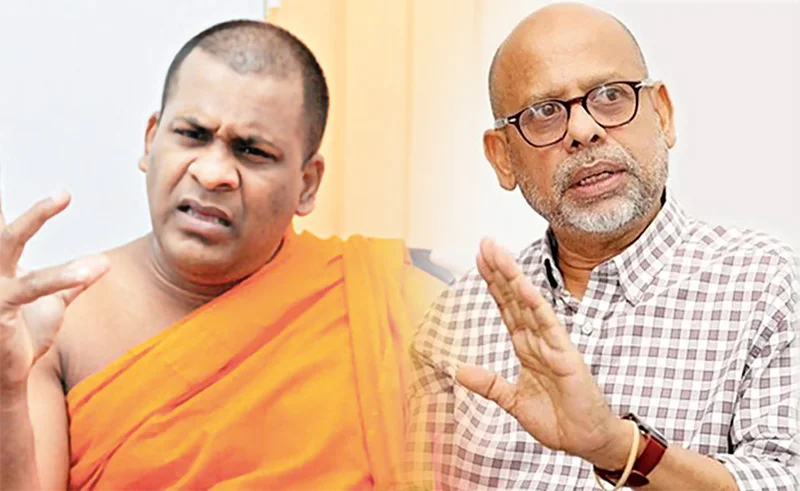
Civil society activist Gamini Viyangoda on Monday (28) lambasted the NPP government for its failure to act promptly on the Supreme Court cancelling the presidential pardon granted to the General Secretary of Bodu Bala Sena (BBS) Galagodaatte Gnanasara.
Addressing a gathering at the Sri Lanka Foundation to mark the launch of ‘Rajapaksha Samagama’ and ‘Pasku Praharaye Thoththa Babala’ by Lasantha Ruhununuge and Tharindu Uduwaragedara and M.F.M., Faseer, Viyangoda alleged that President Dissanayake’s government was also acting in a manner partial to Gnanasara Thera, the way all previous governments had done.
The NPP should be ashamed of its pathetic failure to act swiftly and decisively, immediately after the Supreme Court revoked President Maithripala Sirisena’s pardon. Viyangoda said that the government owed an explanation as to why law enforcement authorities couldn’t apprehend Gnanasara, following the announcement made on 14 Sept. “For two weeks what were they doing,” he asked.
Ven. Gnanasara was sentenced, in 2018, for a six-year period for contempt of court and intimidating Sandya Eknaligoda, the wife of Prageeth Eknaligoda who disappeared in 2010. But, President Sirisena pardoned him before the convicted monk completed one year of his six-year term.
Viyangoda said that Ven. Gnanasara had openly moved about freely, launched a book and acted as if the Supreme Court ruling didn’t have any impact. Every minute Gnanasara stayed in the open it was an affront to the Supreme Court, Viyangoda said, accusing the government of shielding a wrongdoer.
Referring to certain incidents during the Yahapalana time, Viyangoda revealed that he personally sought the then Prime Minister Ranil Wickremesinghe’s direct intervention to have Ven. Gnanasara, hiding at a faraway temple, apprehended. “I met Wickremesinghe at Temple Trees. When I raised the failure on the part of police to apprehend Gnanasara, Wickremasinghe immediately called Sagala Ratnayake, who was in charge of public security at that time. Ratnayake promised to take the monk to custody the following day. The next day, Gnanasara surrendered through a lawyer.”
Viyangoda alleged that the Wickremesinghe government had shielded Vem. Gnanasara. The Wickremesinghe-Sagala Ratnayaka duo did that in style, he said, accusing the present government, too, of doing the same.
The Court of Appeal yesterday (29) issued a warrant for the arrest of Gnanasara Thera and ordered that he be produced before the court on 1 Oct.
The court further directed that the warrant be executed through the Inspector General of Police.
This happened when a motion filed by the Attorney General, seeking an order to enforce the prison sentence imposed on Gnanasara Thera, was taken up before the Court of Appeal.
The motion was heard before a Court of Appeal bench, comprising Justices Mayadunne Corea and Lakmali Karunanayake.
President’s Counsel Anura Meddegoda, appearing for Gnanasara Thera, told the court that his client was resting due to illness and requested a date to study the motion and make submissions.
But State Counsel Sajith Bandara declared that the matter concerned a criminal case and requested that the court issue a warrant if the accused failed to appear before the court.

Colombo’s bus priority lane rule returned today, 29 September, as a pilot programme across the city and nearby areas. It applies from 6 a.m. to 9 a.m. and from 4 p.m. to 7 p.m. daily. The renewed operation covers seven designated lanes, meant to cut delays and make public transport more predictable.
Transport Minister Bimal Rathnayake said officials would monitor the trial to assess its effect on congestion and public transport efficiency. Police have told all officers to take legal action against violators. Drivers may enter a lane only in unavoidable cases, such as emergencies, exceptionally heavy traffic, or to cross it when turning.
The Lanka Private Bus Owners’ Association has welcomed the move, and Metro Bus is adding five new routes.
The rule has been revived before, and past efforts struggled with enforcement, so the pilot project’s results will matter.
(Image courtesy Hiru)
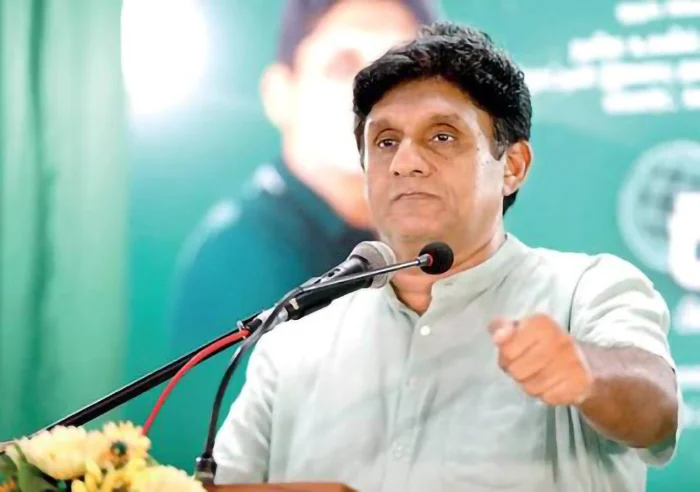
Opposition Leader Sajith Premadasa has said the government is attempting to paint a falsely beautiful picture of the country’s situation through the Socio-Economic Data report issued together with the Census and Statistics and the Central Bank. “They have selectively included certain information while intentionally omitting other vital facts,” Premadasa has said in a media statement. When presenting data, there must be chronological consistency and integrity. The Central Bank and the Department of Census and Statistics have no right to present outdated data to formulate a conclusion, thereby marginalising an entire segment of the population, Premadasa has argued, pointing out that their primary duty is to report accurate information to the public.
Premadasa says that up to page 18 of the report, recent data from 2023 to 2025 have been used. For main economic indicators, macroeconomic indicators, demographic data, and life expectancy, 2024 data have been used. Indicators such as external trade finance, consumer price indices, Real GDP, imports and exports, prosperity indices, and human development indices have also been compared with Asian and SAARC countries using recent data. However, for the section detailing socio-economic conditions from page 19 to page 34, the data used are exclusively from the outdated 2016–2019 period.
When discussing socio-economic conditions, the data used for household income and expenditure surveys, provincial-level conditions, housing facilities, energy consumption, cooking, and population distribution are entirely from 2016 to 2019, the Opposition Leader has said. Specifically, the data on poverty mentioned on page 33, and even the data on per capita daily food consumption capacity on page 34, belong to this old 2016–2019 timeframe. Formulating a report for the year 2026 using such outdated data is a deliberate attempt to mislead the country and its people.
Premadasa says that from page 35 onwards, fresh 2025 data have been used for sections on prosperity, demographics, the labour force, and employment. Recent data based on current market conditions have also been provided for Gross National Income (GNI) by industrial sources, food prices, imports and exports, tourism, government revenue, state debt, and interest rates.
“If the authorities can present recent data (for 2023, 2024, and 2025) for foreign debt, financial activities, financial sector trends, and money supply, why are they using 2016 and 2019 data for poverty to mislead the country?” the Opposition Leader has asked, pointing out that the main report and its summary prove that while the government uses updated data for macroeconomic aspects, it uses obsolete data regarding poverty, inequality, income distribution, and living standards. The Opposition Leader has called this a historic deception regarding the country’s poverty, asking whether the 12.11.2026 Budget will be on these false data?
Premadasa has said that the government claims that a person can survive for 30 days on Rs. 17,315, which is an absolute lie and a deception. “This Government lacks updated data or definitions for poverty. Since the country went bankrupt, a proper household income and expenditure survey has not been conducted, nor has the poverty line been accurately identified.” He questioned whether the upcoming budget, scheduled for 12.11.2026, will be based on these false and flawed data.

Rain stays away as India and Sri Lanka look for fair contest to enter final

Gold winner Tharanga gets brand-new Honda Vezel from SLAAJ

Showers above 50 mm are likely at some places inthe Uva, Eastern and Central provinces and in Polonnaruwa and Mullaittivu districts after 1.00 p.m.

Civil society activist accuses govt. of favouring Ven. Gnanasara

More cops than cones

Sajith accuses govt. of using data selectively in crucial report

‘Dates have the highest sugar content to fight Coronavirus’

Sunday Island 27 December – Headlines

#SundayIsland 17th December – Headlines

Sunday Island – 28th March

Sunday Island Headlines – 21 March

Sunday Island – 21st February – Headlines
-
 Latest News6 days ago
Showers above 100 mm are likely at some places in the Western, Sabaragamuwa, Central and North-western provinces and in Galle and Matara Districts
-

 Editorial6 days ago
Crimes punished and unpunished
-

 Features5 days ago
Beyond traditional jobs: Why Sri Lanka needs to facilitate the gig economy
-

 Editorial4 days ago
Birth of a bad law
-

 News2 days ago
Police remove Thileepan statue in Jaffna
-
 Latest News6 days ago
Kusal, Wellalage star as Sri Lanka defend 322 in Headingley thriller
-

 News4 days ago
TIN mandatory for key transactions from Nov. 1
-

 News6 days ago
IMF: Sri Lanka on course for 2027 market return