Connect with us

Business

George Keyt Foundation’s charity auction conducted by Sotheby’s opens new chapter for Sri Lankan art and artists

Published

on

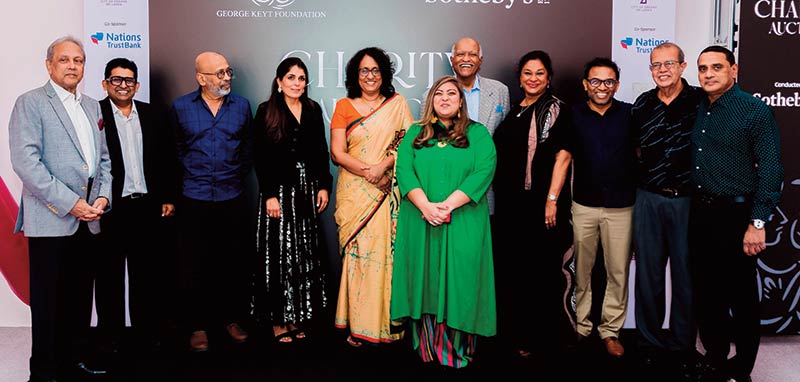
Prime Minister Harini Amasuriya; Ishrat Kanga - Director, Specialist, and Co-Worldwide Head of Modern and Contemporary South Asian Art, Sotheby’s; Malaka Talwatte (Chairperson – George Keyt Foundation) with Trustees of George Keyt Foundation; Abbas Esufally, Jagath Weerasinge, Leena Hidaramani, Arun Dias Bandaranaike, Nadija Thambiah, Priyantha Udagedara, Mike Anthoniz and Suresh Dominic

Sri Lanka’s first-ever Sotheby’s conducted auction, in partnership with George Keyt Foundation, celebrating the country’s contemporary and modern artists, successfully concluded recently. The historic event also provided a strong foundation to propel Sri Lankan art into the international spotlight.

The three-day event held from 7-9 December at Cinnamon Life combined public art viewings, an expert panel discussion on Sri Lankan art’s regional influences led by Ishrat Kanga Director, Specialist, and Co-Worldwide Head of Modern and Contemporary South Asian Art, Sotheby’s and culminated in a charity auction featuring 46 lots from 35 of Sri Lanka’s foremost artists.

The charity auction conducted by Sotheby’s created an unprecedented platform for Sri Lankan artists to gain international recognition and opened new doors for local artists to access global art markets and collectors.

In addition, the participation of Sotheby’s South Asian Art specialist transformed the local initiative into a globally significant event, signalling the international art market’s growing interest in Sri Lankan artistic talent.

The prestigious auction drew an illustrious gathering of art enthusiasts, collectors, and connoisseurs from both local and international circles, the diplomatic corps, corporate art patrons, and established figures from the South Asian art scene. Their presence was complemented by emerging collectors and young art enthusiasts.

At the event’s conclusion, auctioneer Ishrat Kanga was presented the White Gloves as a token of recognition by the George Keyt Foundation. A white glove auction represents the auction’s absolute success, where each artwork finds a new home, and no item remains unsold.

The successful auction will fund several crucial cultural preservation projects, including the continued upkeep and development of the Gothami Viharaya murals – works painted by George Keyt himself. Additionally, the proceeds will support the creation of a catalogue Raisonne of Keyt’s works and the production of a documentary film chronicling the artist’s life and contributions to Sri Lankan art. The funds from the auction will also enable the Foundation to continue vital initiatives including the Kala Pola and Artist of the Year program.

The Foundation aims to continue to build on the event’s momentum, furthering the mission of preserving Sri Lanka’s artistic heritage while creating a new generation of artists.



Continue Reading
Advertisement
Click to comment

Leave a Reply

Your email address will not be published. Required fields are marked *

Business

How Online Shoppers Navigate Labels

Published

on

Online food retail has changed how trust is built. When customers browse your digital shelves, they are no longer holding a package, reading fine print or inspecting seals in person. Instead, their decisions hinge on small on-screen signals, badges like “Organic,” “Non-GMO,” “Fair Trade.” These labels now act as silent salespeople, influencing whether a product is added to the cart or quietly skipped.

For a growing segment of online shoppers, particularly younger, digitally fluent consumers, these badges are not decorative. They are decision shortcuts. But they are also increasingly questioned. Is the claim credible? Is it verified? Is it meaningful or simply marketing language? When shoppers cannot physically examine packaging, uncertainty creeps in and skepticism grows.

Recent findings from a comprehensive survey conducted by the TilliT team reveal a critical tension for online food retailers. TilliT is a digital platform that has been using AI and Blockchain for end-to-end tracking of global supply chains and the survey covered over 1,000 consumers representing diverse demographics and included both an online questionnaire and in-person meetings to ensure depth and representation.

The results show that while digital grocery delivers speed and convenience, it also introduces a trust gap. Today’s shoppers are informed, value-driven and actively seeking alignment with health, ethical and dietary priorities. Yet too often, the digital shelf fails to communicate credibility clearly. This is no longer just a branding challenge; it is a trust problem. And in e-commerce, trust is what turns product views into purchases.

The digital grocery cart is being pushed most frequently by younger adults. Our survey data shows a clear concentration of shoppers in the 18-34 age range, with significant activity among those aged 18-24 and 25-34.

Their shopping frequency varies, some are weekly devotees to delivery apps, while others shop online for food a few times a month or only occasionally. When it comes to their spending philosophy, the majority are pragmatic balancers, seeking a sweet spot between price and quality. However, a meaningful and growing segment, often driven by health, ethical or dietary needs, is explicitly willing to pay more for higher quality or for products bearing labels they trust. This signals a market where value is increasingly defined by transparency and credibility, not just the lowest price.

Here’s a curious finding: some online shoppers admit they usually don’t even notice certification badges while browsing. The digital interface, with its rapid scrolling and visual noise, can make these small icons easy to miss. But for those who do look, these badges become powerful signals. The most frequently noticed and sought-after labels include Organic, Sugar-free/Low sugar, Gluten-free, Vegan/Vegetarian and Non-GMO, followed by Halal and Fair Trade. Crucially, when a shopper’s eye does land on a relevant badge, its importance skyrockets.

Most rate these certifications as ‘very’ or ‘somewhat’ important in their final purchase decision. An Organic badge isn’t just decoration for a health-conscious millennial; it’s a key filter in their search for authenticity.

Don’t mistake notice for naivety. Online shoppers approach these badges with a healthy dose of caution. When asked about their level if trust, responses paint a picture of a skeptical yet hopeful audience. The most common sentiments are ‘I mostly trust it’ and the telling ‘I am not sure.’ Far fewer express full, unwavering trust. This ‘trust gap’ is the central challenge for brands and retailers. Shoppers want to believe the claims, but the digital environment, where anyone can slap a ‘natural’ icon on a product image, breeds uncertainty. This is especially true for claims related to sustainability or ethical sourcing, where verification feels more abstract than checking for gluten.

This is where the solution becomes crystal clear. Shoppers are practically begging for proof. A strong majority find a ‘Verified by an independent system’ mark, accompanied by a clickable link to view the actual certificate, to be ‘very’ or ‘extremely’ valuable. This isn’t a nice-to-have; it’s a powerful trust-builder. The data is striking: when presented with detailed certificate information (who issued it, its validity dates, what it actually means), most respondents said it would make them ‘much more likely’ to buy the product.

In a world of vague claims, verifiable, third-party validation is the antidote to doubt. It transforms a badge from a marketing symbol into a credible credential.

So, what should that click reveal? Shoppers have spoken and their priorities are pragmatic. Above all, they want a simple explanation in everyday language. Jargon and technical terms create barriers. Following that, they want to know the issuing organization’s name, is it a reputable certifier? Validity dates are critical; is this certification current? Shoppers also want clarity on scope: which specific products or ingredients does this certificate cover? Knowing the country of issuance is also a common request, adding another layer of context. This checklist is a blueprint for digital transparency: keep it simple, show the source, prove it’s current and define the scope.

Given this hunger for verification, the business implication is straightforward. When presented with a choice between two online shops selling the same product, one that clearly verifies and explains its certification badges and one that does not, respondents showed a very strong preference for the verified shop. They are ‘very likely’ or ‘somewhat likely’ to choose the platform that offers transparency. This isn’t a minor tilt in preference; it’s a significant competitive advantage. In the battle for the digital grocery basket, the retailer that invests in making labels trustworthy isn’t just building consumer confidence; it’s driving conversion and loyalty.

While the demand for verification is high, baseline understanding of common labels varies. Shoppers tend to be very familiar with terms like Organic, Vegan and Gluten-free, labels often tied to immediate personal health or dietary choices. However, familiarity drops noticeably for other important certifications like Non-GMO, Fair Trade or specific allergen-free claims. This ‘familiarity gap’ presents an opportunity. It’s not enough to just verify a Fair-Trade badge; brands and retailers can also play an educational role by explaining, in that simple language shoppers crave, what that certification means for workers and communities. Transparency paired with education is a powerful combination.

The journey from a digital storefront to a delivered grocery bag is paved with questions. The findings are a clear signal to the food and retail industry: the era of passive, decorative badges is over. Today’s online shopper, particularly the younger, value-driven consumer, is a detective. They are looking for clues, verifying sources and making informed choices aligned with complex personal values. The brands and platforms that will thrive are those that recognize this shift. They will move beyond simply displaying labels to actively validating them, explaining them in human terms and building a bridge of trust that turns cautious scrolling into confident clicking.

In the end, the most important ingredient in the future of online food shopping won’t be listed on the label, it will be the transparency that proves the label is true.

by a special correspondent

Continue Reading

Business

Dialog Surpasses 1,000 5G Sites, Strengthening Nationwide 5G Coverage

Published

on

Dialog Axiata PLC, Sri Lanka’s #1 connectivity provider, announced that its 5G network has surpassed 1,000 live sites, marking a major milestone in the rapid expansion of next-generation mobile connectivity across the island. The milestone reflects Dialog’s continued progress in line with rollout commitments set by the Telecommunications Regulatory Commission of Sri Lanka (TRCSL), with the company already achieving the 2026 rollout targets ahead of schedule. This further strengthens Dialog 5G Ultra as the country’s fastest-growing 5G network, supporting Sri Lanka’s ongoing digital transformation and future-ready ambitions.

Building on its commercial launch of 5G with over 220 sites serving more than 1.5 million subscribers, Dialog has scaled its network at pace, extending coverage across all districts. This continued expansion strengthens the foundation for more reliable, high‑speed connectivity, enabling individuals, enterprises, and communities to engage more meaningfully in an increasingly digital economy.

Commenting on the milestone, Supun Weerasinghe, Director / Group Chief Executive of Dialog Axiata PLC, said, “Surpassing 1,000 5G sites marks an important step in strengthening Sri Lanka’s digital infrastructure. At Dialog, our focus goes beyond expanding network reach — it is about enabling new possibilities across communities and industries, empowering enterprises to innovate, and supporting the country’s long‑term digital and economic progress. As we continue to invest in next‑generation connectivity, we remain committed to building a digitally inclusive future and unlocking the full potential of 5G for Sri Lanka.”

As the first operator to commercially enable 5G in Sri Lanka, Dialog continues to lead the evolution of mobile connectivity, building on its legacy of introducing 2G, 3G, and 4G technologies to the country. Through sustained investment in world‑class infrastructure, Dialog 5G Ultra is designed to support future‑ready applications ranging from enhanced consumer experiences to enterprise innovation and emerging digital ecosystems.

Customers with 5G‑compatible smartphones can experience Dialog 5G Ultra by being within a 5G coverage area, enjoying enhanced speeds and next‑generation performance. To further broaden access to 5G technology, Dialog has introduced the Dialog A76 5G, the country’s most affordable 5G smartphone, priced at LKR 35,999, alongside flexible payment options that make upgrading to 5G more accessible.

Aligned with its brand promise of “The Future. Today.”, Dialog continues to play a pivotal role in shaping Sri Lanka’s digital landscape by extending advanced connectivity nationwide and supporting long‑term innovation, inclusion, and economic growth. For more information, please visit www.dialog.lk/5g

Continue Reading

Business

European Union mobilises 2.6 million Euro to strengthen civil society in Sri Lanka

Published

on

Representatives from govt, policy makers and social acitivists

The European Union (EU)-funded “Together We Rise” initiative, implemented by World Vision and SAFE Foundation in Sri Lanka, is a €2.6 million project designed to strengthen civil society and promote human rights, inclusion and accountable governance. Over three years, the project will support 50 civil society organisations (CSOs) by providing targeted training and resources, while also engaging government institutions, policymakers and 250 social activists to enhance transparency, accountability and civic participation.

The initiative is expected to reach 701,100 people across nine districts, with a focus on underserved and conflict-affected areas. Participating organisations will include women-led, youth-led and those representing persons with disabilities. In addition, more than 350 CSO staff will benefit from tailored capacity-building and technical support to strengthen their effectiveness and long-term sustainability.

To achieve this, the project will begin by conducting a Capacity Development Needs Assessment (CDNA) to better understand the strengths and gaps of selected CSOs. Based on these findings, tailored Capacity Development Plans will be developed for each organisation, ensuring support is relevant, targeted, and impactful. Furthermore, through a capacity-building approach, CSOs will be strengthened in key areas including governance and leadership, financial management and compliance, inclusion, safeguarding, and gender equity, civic engagement and advocacy, digital capacity and innovation, as well as resilience and long-term sustainability.

Dr. Johann Hesse, Head of Cooperation at the European Union in Sri Lanka, noted, “With this EUR 2.6 million programme, the EU is investing in a stronger partnership with civil society for inclusive and sustainable development. Civil society organisations work alongside public institutions, helping to reach communities, mobilise citizens, and support the implementation of activities that are both national and EU priorities”.

In addition, selected CSOs will receive small grants to implement their development plans and respond to community needs, ensuring that learning is translated into action. The project will also create platforms for dialogue and engagement between communities, civil society, and government stakeholders, supporting advocacy efforts and influencing policy change.

Highlighting the importance of addressing structural inequalities, Nirosha Hapuarachchi, Project Manager for Together We Rise at SAFE Foundation, noted, “Youth unemployment (ages 15–29) stands at 34.5% in 2025, according to the Department of Census and Statistics. This highlights a critical gap between the skills possessed by young people and the demands of the labour market. Similarly, women and persons with disabilities continue to face social, economic, and structural challenges that limit their ability to access their rights and opportunities. In response to these challenges, the ‘Together We Rise’ project aims to promote inclusive development by addressing the needs and rights of youth, women, and persons with disabilities, enabling them to achieve sustainable, improved well-being”.

The initiative was introduced through a stakeholder engagement platform that brought together representatives from the EU, government institutions, civil society organisations, and community leaders, highlighting the importance of partnerships in driving sustainable development.

Chandrarathna D. Vithanage, Director General of the National Secretariat for Non-Governmental Organisations, emphasised the role of partnerships, stating, “A country can only truly develop when the government, business sector, and civil society work together. Together We Rise is a timely initiative with clear goals to strengthen the NGO sector, and I look forward to being part of this journey, building knowledge, fostering trust, and empowering village-level communities to take charge of the challenges they face.”

Underscoring the importance of inclusive, community-driven approaches, Glattes Rosairo, Project Manager for Together We Rise at World Vision Lanka, remarked, “Together We Rise is not just a phrase – it is a commitment to building strong, collaborative relationships that empower CSOs. This initiative prioritises listening to communities, amplifying the voices of persons with disabilities, youth, and women, and strengthening grassroots leadership to ensure sustainable and meaningful impact across Sri Lanka.”

Grounded in a rights-based, inclusive, and locally led approach, the project prioritises listening to communities, amplifying marginalised voices, and strengthening grassroots leadership – ensuring sustainable and meaningful impact across Sri Lanka.

Continue Reading

Trending