
News
‘Genocide’: Dire warning issued over Canadian move, Sabry asked to move resolution in parliament

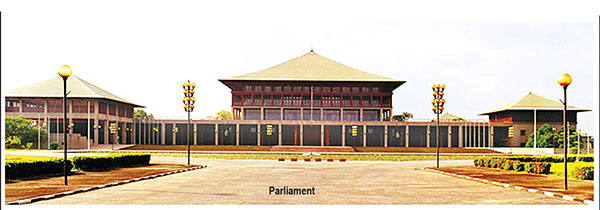
By Shamindra Ferdinando
Chairman of the Oversight Committee on National Security Rear Admiral Sarath Weerasekara, MP, has warned many countries would endorse Canadian declaration of genocide here unless the government took tangible measures to counter the Ottawa’s politically motivated lie.
The warning was issued on Wednesday (07) when the defence top brass, including the heads of State Intelligence Service (SIS) and Directorate of Military Intelligence (DMI) and top level Foreign Ministry delegation appeared before the committee chaired by the former Navy Chief of Staff. They included Defence Secretary General Kamal Gunaratne, Chief of Defence Staff (CDS) General Shavendra Silva and Foreign Secretary Aruni Wijewardene.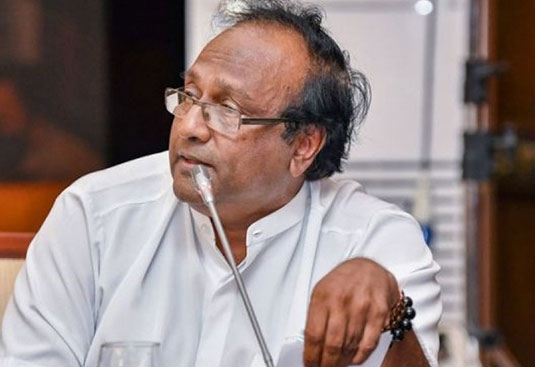
State Defence Minister Pramitha Bandara Tennakoon was also present. Former Public Security Minister Weerasekera urged the Foreign Ministry to take the initiative to move a motion in Parliament to condemn the Canadian genocide charge after having secured the approval of Cabinet-of-Ministers. The MP revealed a decision to move a private member’s motion in that regard.
Parliamentarian Weerasekera appreciated Foreign Minister Ali Sabry, PC’s strong response to the Canadian move.On the basis of Canadian motion approved in their parliament in May last year, Canada in January imposed travel ban on ex-Presidents, Mahinda Rajapaksa and Gotabaya Rajapaksa.
The failure on the part of the government to counter travel bans imposed by the US and Canada on the basis of unsubstantiated war crimes allegations would be severely detrimental to the war winning military, lawmaker Weerasekera warned.
The MP said that genocide charge if not challenged and allowed to continue, it could justify their push for a separate state.Sri Lanka brought the war to a successful conclusion in May 2009. MP Weerasekera said that military officers would be discouraged and couldn’t be expected to take the initiative in case of a future conflict.
Since gaining independence 75 years ago, the military and police quelled two southern insurgencies in 1971 and 1987-1990 and terrorist war in the Northern and Eastern Provinces.Underscoring the responsibility on the part of the government whichever party in power and parliament to stand by the military and police, MP Weerasekera urged the Foreign Ministry to appropriately use the disclosure made by Lord Naseby in the House of Lords in Oct 2017 on the basis of wartime dispatches from the UK High Commission in Colombo (January-May 2009) and the then US Defence Advisor Lt. Colonel Lawrence Smith’s declaration in support of the Sri Lankan military (in June 2009).
Responding to The Island queries, MP Weerasekera said that Sri Lanka’s failure to use available information to counter lies propagated by interested parties couldn’t be justified under any circumstances. The whole issue has to be examined afresh against the backdrop of Sri Lanka betraying her own military and police at Geneva-based United Nations Human Rights Council (UNHRC) in Oct 2015, MP Weerasekera said, adding that he expected the Foreign Ministry to take up this issue vigorously.
During Wednesday’s meeting MP Weerasekera told defence and foreign ministry officials that Sri Lanka had been wrongly dealt with by the UNHRC. The MP asserted that the issues at hand should have been dealt with in terms of non-international armed conflict. In terms of the relevant law, travel bans couldn’t be imposed on the military, MP Weerasekera said.
Pointing out that the UN Secretary General’s report prepared by a three-member team led by Marzuki Darusman as well as the OISL report acknowledged that the Sri Lanka conflict was a non-international armed conflict, MP Weerasekera urged the Foreign Ministry to set the record straight.
Those who had escaped the LTTE and sought protection behind army lines proved the genocide charge a myth, the MP said.MP Weerasereka also questioned the Foreign Ministry’s response to the unsubstantiated war crimes allegations with the focus on the Sri Lankan mission in Ottawa.
Commenting on the ongoing debate over the repealing of the Prevention of Terrorism Act (PTA) , MP Weerasekera stressed that Sri Lanka couldn’t dilute the security law while being a signatory to UN Resolution 1373 (2001) enacted in the aftermath of Sept 11 Al Qaeda attacks on the US.
MP Weerasekera also warned that the downsizing of the Army shouldn’t be at the expense of security in the Northern Province. The former naval veteran underscored the need to maintain adequate strength to face any eventuality.The government recently declared that the Army would be reduced to 100,000 by 2030 after bringing down the strength to 135,000 next year. At the time the war ended the paid strength was 205,000.








It has been reported that former Inspector General of Police (IGP) C.D. Wickramaratne has been found dead at his residence in Athurugiriya this morning (17)
it is suspected that he may have taken his own life.

A heated argument broke out between Jaffna District MP Archchuna Ramanathan and Fisheries Minister Ramalingam Chandrasekar during the Kilinochchi District Coordination Committee meeting held yesterday (16).
A video footage of the incident shows the MP and the Minister engaging in a heated verbal exchange, following which a physical confrontation appeared to develop when the Minister attempted to grab files reportedly in the possession of MP Ramanathan.
“If you lay a hand on me, I’ll lay a hand on you too… got it?” Ramanathan is heard telling the Minister during the exchange.
Police and officials present at the meeting intervened to prevent the situation from escalating further.
The circumstances that led to the confrontation were not immediately clear.
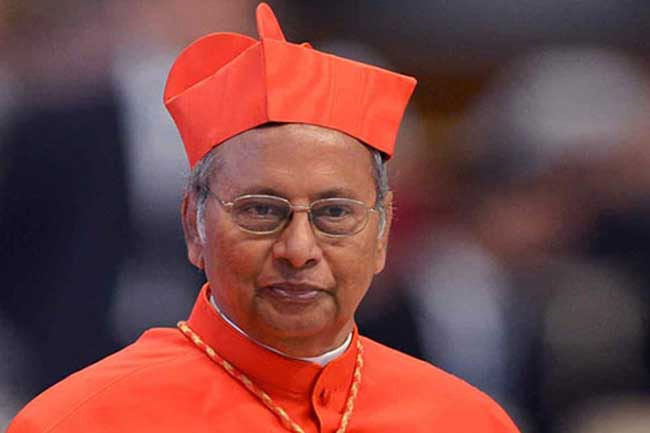
Archbishop of Colombo Malcolm Cardinal Ranjith has filed an intervening petition before the Court of Appeal in connection with a petition filed by former head of the State Intelligence Service, Major General (Retired) Suresh Sallay, challenging his arrest and detention under the Prevention of Terrorism Act over investigations into the Easter Sunday terror attacks.
The Cardinal has sought permission from the court to make submissions in relation to Sallay’s petition and requested that it be dismissed.

Eight killed, at least 34 missing after landslide in China’s Chongqing

Garry Sobers dies, aged 89

Magnitude 7.3 earthquake quake strikes off Mexico coast

Can Argentina and Messi beat Spain and Yamal to defend World Cup?

Anushka Sanjeewani, Vishmi Gunaratne return for Pakistan ODIs

Lennox stars again as New Zealand take series lead after West Indies collapse

‘Dates have the highest sugar content to fight Coronavirus’

Sunday Island 27 December – Headlines

#SundayIsland 17th December – Headlines

Sunday Island – 28th March

Sunday Island Headlines – 21 March

Sunday Island – 21st February – Headlines
-
 Features6 days ago
Prison riots and politics: NPP’s biggest challenge and Sri Lanka’s biggest opportunity
-

 Editorial7 days ago
What’s the world coming to?
-
 Features3 days ago
Dirty Money
-

 Editorial6 days ago
Much ado about crime: Fish or cut bait
-
 Features6 days ago
More on Saudi Arabia: ARAMCO and beyond
-

 News23 hours ago
Money laundering case against Yoshitha, fixed for pre-trial conference
-
 Midweek Review3 days ago
The sordid tale of theft and tragedy at Finance Ministry
-
 Latest News4 days ago
Oil prices hit 1-month high as US-Iran attacks dim Strait of Hormuz outlook