
Features
Gamini Dissanayake the man he was and what fired the Mahaweli project


Excerpted from volume ii of the Sarath Amunugama autobiography
Since Gamini played an important role in my career I will reproduce here an essay which was entitled; “Fifty; A Beginning”, that I wrote for a felicitation volume which was published to mark his 50th birthday. When I presented the first copy of this volume to JRJ at Braemar, he looked at the title and said, half in jest “I hope it is not the beginning of the end”. Gamini who joined me for the presentation was not amused.
My article in this volume covers Gamin’s considerable contribution to the development of both politics and economic growth in the country. Unfortunately, a few years after this book was published, he was killed by a suicide bomber of the LTTE. Gamini then was on the campaign trail as a Presidential candidate in 1994. He was becoming more and more confident of winning the top prize.
His death was a personal blow to me because I was one of his chief supporters. I was with him that fatal morning in Kandy addressing propaganda meetings. He wanted me to return with him by helicopter to Colombo for the final meeting at Thotalanga on the out skirts of Colombo. But I had an engagement in my electorate and stayed back to see my father and mother in Nugawela. That was a fateful decision since had I got back in the helicopter to Colombo I would have been with Gamini and most probably have been killed along with him.
This is what I wrote in the felicitation volume:
“My earliest recollections of Gamini go back to Trinity College. I was a part of a group of students in whom our principal Norman Walter reposed great hopes as scholars who would enter the University thereby contradicting the oft stated, and certainly ill-deserved notion, that Trinity mostly produced “flannelled fools and muddied oafs”.
“Some of us would assemble regularly at the Kandy Public Library which had an astonishing range of magazines and books. Then we would spend the evening together, walking round the Kandy Lake debating many of the issues we had read about and needed further discussion. On these walks round the lake we would often encounter the Dissanayake boys playing near their lakefront home.
“I remember Gamini most because he had the habit of probing us, his peers, for new ideas and information when we spoke to him. We had a more mundane reason also for knowing Gamini and his brothers. They were the children of the owner of -Silverdale’, Kandy’s best known cafe. After our long walks we would retire to ‘Silverdale’ for a snack and an iced coffee and envy the Dissanayake boys whom we imagined could tuck in to all that delicious food at will!
“Gamini’s father, Andrew, was a leading citizen of Kandy. He had come down from Kotmale and started several businesses, which proved to be so successful that he was a well recognized Kandyan entrepreneur of his time. He was a very affable and gentle person – characteristics which have been inherited by his eldest son. Dissanayake pere (Snr.) always had time for the people of Kandy. We would see him at public gatherings with a large circle of admirers and friends around him.
“He was involved with the politics of the hill country, of Kandy and the Nuwara Eliya regions in particular. He was the President of the All-Island Local Authorities Association and had come to know, at a personal level, the acknowledged father of local government in Sri Lanka, the charismatic S.W.R.D. Bandaranaike.
“After the departure of Dudley Senanayake into semi-retirement from national politics many leading Kandyans found no basis for supporting the ruling UNP caucus of the time. Many of them joined Bandaranaike’s SLFP. Andrew Dissanayake was nominated for the Nuwara Eliya constituency by the SLFP in 1956. He won handsomely and was appointed a deputy minister in the Bandaranaike government.
“Unlike many of his party colleagues, and very much like his son Gamini later on, Andrew was devoid of rancour and hatred. He treated all his constituents and parliamentary colleagues with consideration. This civilized approach to politics has obviously had an impact on Gamini who grew up in an atmosphere of political engagement. Many national party leaders would drop in at their home for a meal and Gamni was an avid listener to their political discussions.
“By 1970, Gamini had passed out as an advocate and was busy building a civil practice in the Chambers of Neville Samarakoon, Queen’s Counsel, another distinguished alumnus of Trinity College. The legal milieu in which he moved, Neville Samarakoon and B.J. Fernando in particular, brought him closer to the ruling circles of the UNP and at the age of 27, Gamini was nominated to stand for his father’s old constituency.
“By this time the SLFP had been rent apart by internal quarrels and Andrew, with many of his early SLFP colleagues, had retired from politics in disgust. It is worth recalling that the SLFP led by Mrs. Bandaranaike, was keen to field young Gamini Dissanayake once it became known that he would enter politics. However, it was Dudley Senanayake’s request that prevailed.
“Dudley threw his full support to the young aspirant even though Nuwara Eliya was, at that time, represented by Donald Ranaweera, a UNP Member of Parliament. It was not an easy decision, since the incumbent UNP MP was the publisher of the Times Group of newspapers and an important financier of the party. Ranaweera also had the backing of the Deputy Leader of the party, J R Jayewardene.
“However, Dudley and JRJ finally decided to field Gamini. It turned out that the decision was the right one. Though the UNP, met with a disastrous defeat in 1970, Gamini emerged as a successful candidate. If I remember right, he was the only newcomer to the UNP benches in Parliament that year. The recently formed SLFP government vented its rage on the young MP. It resented the entry of a son of one of its own stalwarts into the ranks of the UNP.
“The SLFP took the defeat of their candidate, William Fernando, Felix Dias Bandaranaike’s protege, as a major affront. Gamini had to face an election petition and a fresh election. He won again which served to enhance his image in the country and reinforce the view that the UNP was getting over its defeat and was on a ‘winning streak’.
“The 1970 to 1977 period was perhaps the best years of the UNP as a mass organization. Though small in numbers in Parliament, UNP MPs challenged the might of the SLFP and was able to outwit and out-maneuver them. Gamini was in the thick of this campaign. He emerged as a front rank speaker and organizer of the Opposition.
“There were three national level speakers of the UNP who went round the country: JRJ, Premadasa and Gamini. He drew large crowds at meetings and became a firm favourite of the party rank and file. Under the leadership of J R Jayewardene, the UNP swept back into power in 1977. They humbled the coalition government of Mrs. Bandaranaike. Gamini’s role in this historic struggle, was recognized by the party when in an internal party poll for its highest executive body, Gamini obtained 110 votes, second only to the veteran R. Premadasa, who polled 118 votes. On the basis of this watershed poll, Gamini emerged as third ranking leader of the UNP, after Jayewardene and Premadasa.
“Accordingly, he was assigned what was to be the most spectacular project of the 1977 UNP government – Mahaweli development. This was in addition to the subjects of Lands and Land development, which were the traditional focus of attention of successive UNP regimes. The Mahaweli project which was just another development programme undertaken by the SLFP, though it was inaugurated during the Dudley Senanayake regime, was expanded into the key lead project of the JRJ government.
“The UNP accelerated the Mahaweli programme which was planned to be completed in 30 years to six on the orders of JRJ. Five major dams – Kotmale, Victoria, Maduru Oya, Randenigala and Rantambe – were constructed with foreign assistance. Three hundred thousand (300,000) acres of land were irrigated and 7,500 megawatts of electrical power was generated through this giant hydro-electrical, agricultural and farmer settlement scheme, the magnitude of which was unprecedented even in Sri Lanka, a country best known for its historic hydraulic civilization.
“As acknowledged by President Jayewardene, the accelerated Mahaweli programme would not have been a reality but for the dedication, skill and perseverance of Gamini Dissanayake. I think it is fair to say that the government itself did not realize the enormity and complexity of this task when it announced the revised Mahaweli scheme.
“At first the World Bank advised against it stating that Sri Lanka did not have the expertise or the resources to undertake this project. After a stormy meeting with World Bank bureaucrats, President Jayewardene requested them to get back to Washington, saying he was going ahead with or without multi-lateral assistance. The World Bank finally relented after JRJ threatened to close down its office in Colombo.
“The Bank, now represented by its sagacious Vice President, David Hopper, undertook to back the project. It was a promise that was faithfully kept by the international community under the umbrella of the World Bank. The reservations of the World Bank were echoed by local critics who said that the accelerated scheme will never become a reality. It is here, I think, that Gamini’s natural leadership qualities, good sense and the ability to get the best out of his staff became crucial to the Mahaweli scheme.
“He did not waste time on getting cheap publicity. His officials know they could debate an issue with him without being publicly humiliated and shunted aside. He backed all his staff who could do a job of work– be they engineers or baas unnhes. He assembled a group of officials who were the envy of the Sri Lankan public service. Most of all they were enthused with the feeling that they were doing a worthwhile, patriotic task and their youthful minister was ‘a co-worker’.
“As a minister, Gamini always had his eye on the ‘grand concept’ of the Mahaweli and did not waste time nitpicking. His management style has always been to carefully select his aides and then let them get on with the task of doing the job. Sri Lankan professionals – engineers, surveyors, accountants, managers and administrators, who since independence had become pawns in political gamesmanship, found that their skills were, at long last, recognized and rewarded. An aspect of the Mahaweli Development Scheme which has not been properly recognized is that it served as a ‘hundred universities’ for engineering and scientific personnel.
“These `Mahaweli graduates’ of every rank are a tremendous manpower resource. Unfortunately their skills have not been used by our national planners. The decision to accelerate the Mahaweli scheme was perhaps the most effective decision of the Jayewardene regime. This was the peak period of international cooperation. Western regimes were launching their strategy of `rolling back socialism’. Sri Lanka was identified as a lead democratic regime which was turning its back on a controlled economy and switching to market economics. The snag, however, was that the country did not have major development schemes in the pipeline. Donors were ready to support the new government but were demanding realistic and well-designed project proposals.
“The new UNP regime came up with many hare-brained schemes. But the donors were not buying them. It was only the Mahaweli project that could interest the big donors. It was Gamin’s signal contribution that he could rally his engineering, scientific and administrative staff to come up with viable project proposals. He did not rush his staff to produce schemes which would generate cheap publicity for himself. He personally visited donor countries and argued the case for funding.
“On many occasions his detractors, both within and outside his party, would speak about delays in the early phase of the accelerated scheme. As minister in charge, however he knew that the early planning had to be perfect. He defended his planners in Parliament and gave them enough time during the ‘gestation period’ of the new scheme. This strategy paid off. International donors ranging from the USA to the USSR endorsed the Mahaweli scheme.
“The World Bank treated it as one of its `showcase’ projects. It was only after the project was launched that even its detractors realized that the timing of the young minister was near perfect. In real terms, the investment on Mahaweli could never be repeated since inflationary pressures on the world economy during the last decade and the political inwardness of western nations, has totally changed development cooperation patterns in the Third World. There will be no Mahawelis in the future.
“Just as the Mahaweli scheme was a bold initiative in the field of domestic agriculture, Gamini’s short tenure as Minister of Plantation Industries could have led to a rejuvenation of our plantation agriculture. With an intimate knowledge of planting, the socio-economic conditions of the Kandyan peasantry and a wide network of contacts in the tree-crop industry, he was ideally suited to undertake this task. He brought the same enthusiasm to his new Ministry.
“In his usual style he assembled a group of top-level professionals with whom he established a close rapport. Then, he presented a series of proposals which, as in his Mahaweli days, were accepted at all levels including international donor agencies as quite practical. The estate cluster system, decentralization of management, upgrading of professional skills and benefits, estate-village integration and the push for value-added exports and international cooperation among all primary producers, were parts of this landmark development package.
“Another area in which Gamini made a vital contribution was the Indo-Lanka Accord. It is a little-known fact that our highest military leaders requested Gamini to intercede and bring about a settlement in what they called an ‘unwinnable war’. The Generals who made this request were Attygalle, Ranatunga and Seneviratne.
“They first broached this subject with the young minister when he and I were being helicoptered together with them to the President’s House in Kandy for an urgent discussion as the northern war was taking a disastrous turn. After this meeting they flew back to Colombo and continued their plea in Gamini’s home at Alfred House Gardens. Once Gamini was convinced that it was in the national interest to negotiate with India, he set up an informal link-up with Indian policy makers.
“His greatest achievement was the beginning of a dialogue with N Ram, who had been an influential advocate of the Tamil cause. A very close personal relationship followed. While our ineffectual foreign policy establishment fretted and fumed the good relations established among three young people – Rajiv Gandhi, Ram and Gamini – became the basis of an understanding which yielded the dramatic accord of reconciliation.
“President Jayewardene and High Commissioner Dixit who were the principal negotiators could always rely on this groundwork of friendship which for the first time linked the vital triad of Colombo-Delhi-Madras. Gamini’s commitment to a fair and just solution to our ethnic problem was made manifest through his fearless defence of the Accord, when both extremist groups – the LTTE and the JVP – placed him on their ‘hit list’ for not supporting their extremist positions. Gamini is a rare politician totally devoid of racial, religious, and other prejudices.
“During the last four years Gamini has gone through many traumas. But his commitment to politics as the best way of serving the people is constant. Recently, Gamini and I were travelling by car through Dambulla to Anuradhapura. We drove through miles and miles of green paddy fields which were irrigated by Mahaweli waters. We had both known this area earlier as an arid dry zone. We were silent for a long time. Finally, Gamini said quietly, ‘This is what makes politics worthwhile’.”


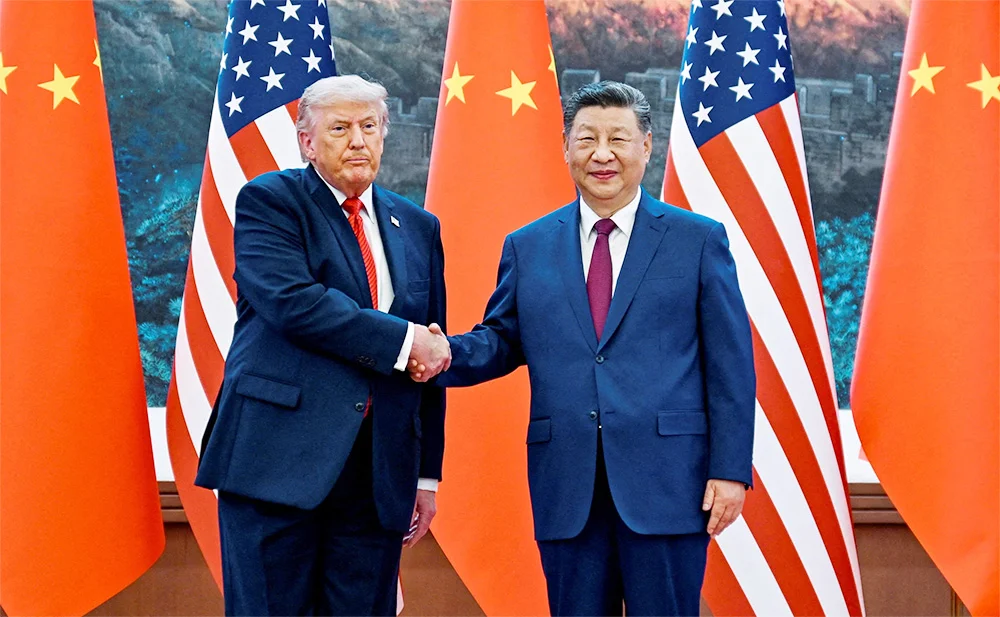
 The fact that some of the US’ topmost figures in business, such as Tesla chief Elon Musk and major US chipmaker Jensen Huang of NVIDIA fame, occupied as nearly a prominent a position as President Donald Trump at the recent ‘historic and landmark’ visit by the latter to China underscores the continuing vital importance of business in US-China ties. Business seemed to outweigh politics to a considerable degree in importance during the visit although the political dimension in US-China ties appeared to be more ‘headline grabbing’.
To be sure, the political dimension cannot be downplayed. For very good reason China could be seen as holding the power balance somewhat evenly between East and West. The international politics commentator couldn’t be seen as overstating the case if he takes the position that China could exercise substantial influence over the East currently; that is Russia and Iran, in the main. The latter powers hold the key in the Eastern hemisphere to shaping international politics in the direction of further war or of influencing it towards a measure of peace.
For example, time and again China has prevented the West from ‘having its own way’, so to speak, in the UN Security Council, for instance, in respect of the ongoing conflicts involving Russia and Iran, by way of abstaining from voting or by vetoing declarations that it sees as deleterious. That is, China has been what could be seen as a ‘moderating influence’ in international politics thus far. It has helped to keep the power balance somewhat intact between East and West.
At present a meet is ongoing between Chinese President Xi Jinping and Russian President Vladimir Putin in Beijing. This happened almost immediately after the Trump visit. Apparently, Beijing is in an effort to project itself as treating the US and Russia even-handedly while underscoring that it is no ‘special friend’ of the US or the West.
This effort at adopting a non-partisan stance on contentious questions in international politics is also seen in Beijing’s policy position on the Hormuz tangle and issues growing out of it. The Chinese authorities are quoted as saying in this regard, for instance, that China is for ‘a comprehensive and lasting ceasefire in the Middle East’.
Such a position has the effect of enhancing the perception that China is even-handed in its handling of divisive foreign policy posers. It is not openly anti-West nor is it weighing in with Iran and other Eastern actors that are opposed to the West in the West Asian theatre. A ‘comprehensive and lasting ceasefire’ implies that a solution needs to be arrived at that would be seen as fair by all quarters concerned.
On the highly sensitive Taiwan issue, President Xi was comparatively forthright during the Trump visit, but here too it was plain to see that Beijing was not intent on introducing a jarring, discordant note into the ongoing, largely cordial discussions with Washington. On the Taiwan question President Xi was quoted saying: ‘If mishandled, the two nations could collide even come into conflict.’ In other words, the US was cautioned that China’s interests need to be always borne in mind in its handling of the Taiwan issue.
The cautioning had the desired result because Trump in turn had reportedly conveyed to Taiwan that the latter’s concerns on the matter of independence had to be handled discreetly. He had told Taiwan plainly not to declare ‘independence.’
Accordingly, neither the US nor China had said or done anything that would have made either party lose face during their interaction. Apparently, both sides were sensitive to each others’ larger or national interests. And the economic interests of both powers were foremost among the latter considerations.
There is no glossing over or ignoring economic interests in the furtherance of ties between states. They are primal shaping forces of foreign policies and the fact that ‘economics drives politics’ is most apparent in US-China ties. That is, economic survival is fundamental.
Among the more memorable quotes from President Xi during the interaction, which also included US business leaders, was the following: ‘China’s doors will be open wider’ and US firms would have ‘broader prospects in the Chinese market.’
Xi went on to say that the sides had agreed to a ‘new positioning for ties’ based on ‘constructive strategic stability’. The implication here is that both sides would do well not to undermine existing, mutually beneficial economic relations in view of the wider national interests of both powers that are served by a continuation of these economic ties. That is, the way forward, in the words of the Chinese authorities, is ‘win-win cooperation.’
It is the above pronouncements by the Chinese authorities that probably led President Trump to gush that the talks were ‘very successful’ and of ‘historic and landmark’ importance. Such sentiments should only be expected of a billionaire US President, bent on economic empire-building.
One of the most important deals that were put through reportedly during the interaction was a Chinese agreement to buy some 200 Boeing jets and a ‘potential commitment to buy an additional 750 planes.’ However, details were not forthcoming on other business deals that may have been hatched.
Accordingly, from the viewpoint of the protagonists the talks went off well and the chances are that the sides would stand to gain substantially from unruffled future economic ties. However, there was no mention of whether the health of the world economy or the ongoing conflicts in West Asia were taken up for discussion.
Such neglect is regretful. Although the veritable economic power houses of the world, the US and China, are likely to thrive in the short and medium terms and their ruling strata could be expected to benefit enormously from these ongoing economic interactions the same could not be said of most of the rest of the world and its populations.
Needless to say, the ongoing oil and gas crisis, for instance, resulting from the conflict situation in West Asia, is taking a heavy toll on the majority of the world’s economies and the relevant publics. While no urgent intervention to ease the lot of the latter could be expected from the Trump administration there is much that China could do on this score.
China could use its good offices with the US to address the negative fallout on the poorer sections of the world from the present global economic crunch and urge the West to help in introducing systemic changes that could facilitate these positive outcomes. After all, China remains a socialist power.
“Everything ever said to me by any Chinese of any station during any visit was part of an intricate design”
— Henry Kissinger
That design may already be complete before this week’s , a meeting that could shape the future balance of global power.
The wind arrives quietly. By the time it is heard, history has already begun to turn. Across Asia, that wind is no longer distant. It carries with it the exhaustion of an old order and the uncertain birth of another. The question now is not whether the world will change. It is whether those who hold power possess the wisdom to guide that change toward something less violent than the century behind us.
Since 1945, the United States has carried the burden of a global order built with its Western allies. To its credit, the world avoided another direct world war between great powers. The conflicts remained contained in distant lands—proxy wars fought in the shadows of ideology, oil, and influence. From Latin America to Asia, the American century expanded not only through prosperity, but through intervention. Yet empires, even democratic ones, grow tired. Fatigue settles slowly into institutions, alliances, and public memory. The role of global policeman no longer inspires certainty in Washington as it once did.
The “rules-based order” now confronts its own contradiction: it was built to be universal, yet it often appeared selective. During my recent visit to , a young researcher asked me quietly, “Does the West itself still believe in the rules-based order?” The question lingered long after the conversation ended. The rising century demands a more inclusive architecture—one that recognises the reality of Asian power, especially China.
My three years of field research across South and Southeast Asia, documented in , revealed a transformation too significant to dismiss as temporary. China has moved beyond being merely a competitor to the United States. In trade, infrastructure, technology, cultural diplomacy, and economic influence, Beijing has established itself as what may be called the world’s “US +1.”
Great powers often search for such a partner. History shows this tendency clearly. When an empire becomes overextended—burdened by wars, alliances, sanctions, tariffs, and crises—it seeks another center of gravity to stabilize the system it can no longer manage alone. The United States today faces disorder stretching from Venezuela to Iran, from Ukraine to the unsettled Middle East. In this landscape, China emerges not simply as a rival, but as a state powerful enough to broker peace where Washington alone no longer can.
Drawing from the lessons of the Nixon–Mao era, warned that “” The United States and China are now engaged in a long-term economic, technological, political, and strategic competition. Managing that competition wisely may become the defining challenge of this century. In such a deeply polarized and unstable world, recognising China as a “US +1” partner is not surrender, but strategic realism.
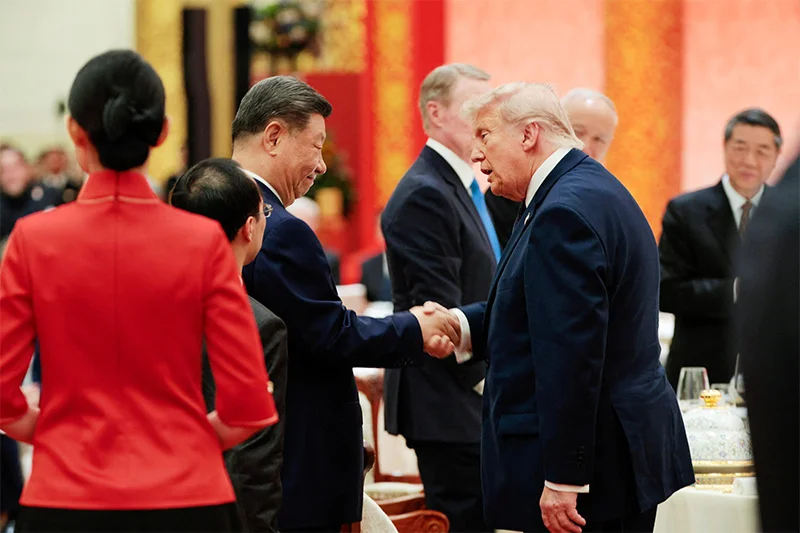
Donald Trump understood this reality before boarding his flight to meet Xi Jinping. Their meeting inside Zhongnanhai—the guarded compound where China’s leadership governs—was never merely ceremonial. It symbolized a deeper recognition already acknowledged quietly within the itself: China is the nearest peer competitor the United States has ever confronted. Before departing Washington, Trump seemed to reassess not only China’s strength, but its unavoidable position as a “” shaping the future global balance.
Yet the significance of a Trump–Xi meeting extends beyond trade wars, tariffs, or diplomatic spectacle. It presents an opportunity to confront two crises shaping the century ahead: global energy insecurity and regional instability. Washington increasingly understands the limits of direct engagement with Tehran. Decades of pressure, sanctions, and confrontation have produced exhaustion rather than resolution. In that vacuum, Beijing now possesses leverage that Washington does not.
For China, this is an opportunity to evolve from a development partner into a security actor. Xi Jinping’s (GSI) was never designed merely as rhetoric. It was intended as the next phase of Chinese influence—transforming economic dependence into strategic trust. The geopolitical spillover from the Iranian conflict now offers Beijing a historic opening to project itself as a stabilising force in the region, not against the United States, but alongside it as a “US +1” partner.
If China succeeds in helping stabilise the Gulf and secure energy corridors vital to Asia, it will reshape perceptions of Chinese power globally. Beijing would no longer be seen only as the builder of ports, railways, and industrial zones, but as a guarantor of regional balance. This transition—from infrastructure diplomacy to security diplomacy—may become one of the defining geopolitical shifts of the coming decade.
Xi Jinping does not seek open confrontation. His strategy is older, more patient, and perhaps more formidable because of its restraint. Beijing speaks not of domination, but of a “,” advanced through three instruments of influence: the Global Development Initiative (GDI), the Global Security Initiative (GSI), and the Global Civilization Initiative (GCI). These are not slogans alone. Across Asia, many governments increasingly trust China as a development partner more than any other power.
India, despite its ambitions, has not matched this scale of regional penetration. In both ASEAN and South Asia, China’s economic gravity is felt more deeply. Ports, railways, technology networks, and financial dependency have altered the geopolitical map quietly, without the spectacle of war.
In , I compared three inward-looking national strategies shaping Asia today: Trump’s MAGA, Modi’s emerging economic nationalism , and Xi’s strategy. Among them, China has demonstrated the greatest structural resilience. Faced with American tariffs and decoupling pressures, Beijing diversified its supply chains across Central Asia, Europe, and Southeast Asia. Rail corridors now connect Chinese industry to European markets through Eurasia. ASEAN has surpassed the United States as China’s largest trading partner, while the European Union follows closely behind. Exports to America have declined sharply, yet China continues to expand. Trump, once defined by confrontation, now arrives seeking a new “” with China—an acknowledgment that economic rivalry alone can no longer define the relationship between the world’s two largest powers.
Unlike Washington, which increasingly retreats from multilateral institutions, Beijing presents itself as the defender of multilateralism. Whether genuine or strategic matters less than perception. In geopolitics, perception often becomes reality.
What emerges, then, is not surrender between rivals, but interdependence between powers too large to isolate one another. The future may not belong to a bipolar Cold War, but to a reluctant coexistence. The United States now recognises that China possesses diversified markets and partnerships capable of reducing dependence on America. China, in turn, understands that its long march toward global primacy still requires strategic engagement with the United States.
This is where the true geopolitical shift begins.
Many analysts continue to frame China solely as a threat. Yet history rarely moves through absolutes. The next world order may not be built through confrontation alone, but through uneasy partnership. Artificial intelligence, technological supremacy, economic stability, and global governance now demand cooperation between Washington and Beijing, whether either side admits it publicly or not.
Trump will likely celebrate his personal relationship with Xi, presenting himself as the American leader capable of negotiating a “better deal” with China than his predecessors. But beneath the rhetoric lies something larger: the gradual acceptance of China’s indispensable role in shaping the future international order.
Even the question of war increasingly returns to Beijing. If Washington seeks an understanding with Tehran, China’s influence becomes unavoidable. Iran listens to Beijing in ways it no longer listens to the West. This alone signals how profoundly the balance of power has shifted. And Xi, careful as always, refuses to openly inherit the mantle of global leadership. He delays, softens, and obscures intention. It is part of a longer strategy: to rise without provoking the final resistance of a declining hegemon too early.
History rarely announces its turning point. Empires fade slowly, while new powers rise quietly beneath the noise of the old order. Washington still holds immense power, but Beijing increasingly holds the patience, reach, and strategic depth to shape what comes after.
The century ahead may not belong to one power alone, but to the uneasy balance between Washington and Beijing. And in that silence, a new world order is already taking shape.
By Asanga Abeyagoonasekera

Chit-Chat Nethali Withanage
 Three months ago, 19-year-old Nethali Withanage, with Brian Kerkoven as her mentor, walked the ramp at Colombo Fashion Week. On 06 June, she’ll walk for Sri Lanka in Hurghada, Egypt, as the country’s delegate to Top Model of the World 2026._
I caught up with Nethali as she prepares to fly out, this weekend, and here’s how our chit-chat went:
1. Tell me something about yourself?
I’m someone who blends creativity with ambition. I’ve always loved expressing myself, whether it’s through fashion, styling, or the way I present myself to the world. At the same time, I’m very driven and disciplined, especially when I was working, as a student counsellor, at Campus One, at a young age, where I’ve learned how to connect with people, understand them, and communicate with confidence. I believe I’m still evolving, and that’s what excites me the most … becoming better every single day.
2. What made you decide to be a model?
Modelling felt natural to me because it combines everything I love – fashion, confidence, and storytelling without words. I realised that modelling isn’t just about appearance, it’s about presence and how you carry your energy. I wanted to be part of an industry where I could express different sides of myself, while inspiring others to feel confident in their own skin.
3. What sets you apart from other models?
I would say my ability to connect. Whether it’s with the camera, a brand, or an audience, I bring authenticity. I also have a strong background in communication and sales, which gives me an edge in understanding how to represent a brand, not just wear it. I don’t want to just model clothes, I want to bring them to life.
4. What clothing do you prefer to model?
I enjoy modelling versatile styles, but I’m especially drawn to elegant and expressive fashion pieces that tells a story. I love looks that allow me to embody confidence and femininity, whether it’s a structured outfit or something soft and flowing.
5. What is the most important aspect of modelling?
Confidence combined with professionalism. Confidence allows you to own the moment, but professionalism ensures that you respect the work, the team, and the brand you represent. Both are equally important.
6. If you could change one thing about yourself, what would it be?
I would say I’m learning to trust myself more and not overthink. I’ve realised that growth comes from embracing who you are, not constantly trying to change it. So instead of changing something, I’m focused on becoming more confident in my own voice.
7. School?
I did my O/Ls at Seventh Day Adventist High School Kandana, and, while at school, I was actively involved in creative activities. I enjoyed participating in English Day events that allowed me to express myself and interact with others. Those experiences helped me build confidence, teamwork, and communication skills, which continue to shape who I am today.
8. Happiest moment?
One of my happiest moments is realising how far I’ve come from being unsure of myself to stepping into opportunities, like modelling, and representing myself with confidence. That feeling of growth is something I truly value, and also a dream come true!
9. Your idea of perfect happiness?
Perfect happiness for me is peace of mind, being surrounded by people I love, doing what I’m passionate about, and feeling proud of who I am becoming.
10. Your ideal guy?
My ideal partner is someone who is respectful, supportive, and confident in himself. Someone who values growth, understands my ambitions, and encourages me to be the best version of myself.
11. Which living person do you most admire?
I admire strong, self-made individuals who have built their identity through hard work and resilience. People who stay true to themselves, despite challenges, inspire me, because they show that success is not just about talent, but also about strength and consistency.
12. Your most treasured possession?
My most treasured possession is my confidence. It’s something I’ve built over time, and it allows me to face challenges, take opportunities, and believe in myself, even when things are uncertain.
13. If you were marooned on a desert island, who would you like as your companion?
I would choose someone who is calm, positive, and resourceful, someone who can turn a difficult situation into an adventure. The right mindset matters more than anything.
14. Your most embarrassing moment?
I’m 19 and still haven’t faced any most embarrassing moment. But I would say I’ve had small moments where things didn’t go as planned, but I’ve learned to laugh at myself. Those moments remind me that perfection isn’t necessary; confidence is about how you recover, not how you avoid mistakes.
15. Done anything daring?
Pursuing modelling and stepping into competitions is something I consider daring. It pushed me out of my comfort zone and challenged me to grow, both personally and professionally.
16. Your ideal vacation?
My ideal vacation would be somewhere peaceful, yet beautiful, like a beach destination where I can relax, reflect, and reconnect with myself, while enjoying nature.
17. What kind of music are you into?
I choose music that matches my mood at that time, whether it’s calm and relaxing or energetic and uplifting. Music is something that helps me express emotions and stay inspired.
18. Favourite radio station?
Usually I don’t listen to radio stations but whenever I get into a car I would search for Yes FM because it has a refined balance of contemporary hits and timeless music. I appreciate how it maintains a vibrant yet sophisticated energy, keeping listeners engaged while creating a consistently uplifting atmosphere. It’s something I enjoy because it adds a sense of positivity and elegance to my day.
19. Favourite TV station?
At the moment, I don’t have a television at home, but growing up, my favourite TV station was ‘Nickelodeon’. I genuinely loved the shows and series it aired; they were fun, creative, and full of personality. It was something I always looked forward to, and those memories still bring a sense of joy and nostalgia, whenever I think about it.
20. Any major plans for the future?
My future plans are to grow in the modelling industry, work with international brands, build a strong personal brand and finish completing a Bachelor’s Degree in Business Studies. At the same time, I want to explore my creative side further, especially in fashion and business, so I can create something of my own one day.

PM meets academic experts from the British Council

Gaby Lewis to lead Ireland at T20 World Cup

PM meets Sri Lankan community living in London

Kapila Wijegunawardena to head SLC’s new selection committee

Afghanistan refugee women’s team set for England tour under ECB initiative

DR Congo cancels World Cup training camp over Ebola outbreak

‘Dates have the highest sugar content to fight Coronavirus’

Sunday Island 27 December – Headlines

#SundayIsland 17th December – Headlines

Sunday Island – 28th March

Sunday Island Headlines – 21 March

Sunday Island – 21st February – Headlines
-

 Features5 days ago
Sri Lankan Airlines Airbus Scandal and the Death of Kapila Chandrasena and my Brother Rajeewa
-
 News6 days ago
Lanka’s eligibility to draw next IMF tranche of USD 700 mn hinges on ‘restoration of cost-recovery pricing for electricity and fuel’
-

 News5 days ago
Kapila Chandrasena case: GN phone records under court scrutiny
-
 News5 days ago
Rupee slide rekindles 2022 crisis fears as inflation risks mount
-
 Features2 days ago
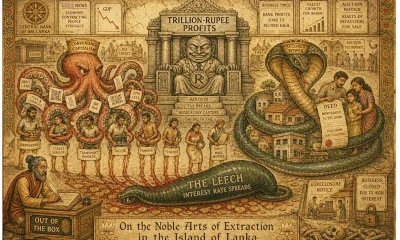
Octopus, Leech, and Snake: How Sri Lanka’s banks feast while the nation starves
-
 Business5 days ago
Expansion of PayPal services in Sri Lanka officially announced
-
 News21 hours ago
Steps underway to safeguard Sri Lanka’s maritime heritage
-

 Features7 days ago
Mysterious Death of United Nations Secretary General Hammarskjöld