
Business
Gal Oya Plantations seen as role model for profitable public-private partnerships

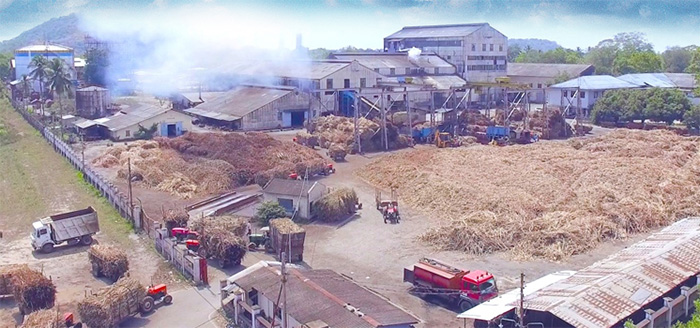
At a time when enhancing profitability of public enterprises is an urgent need to boost the national economy of Sri Lanka, the revival and turnaround of Gal Oya Plantations (formerly known as Hingurana Sugar factory) by LOLC is an embodiment of how the nation’s assets can be enhanced through professionalism and expertise by the private sector. Underperforming state enterprises are a drain on state coffers as has been seen only once too often, an LOLC press release said.
The release adds: ‘However a profit making state enterprise on the other hand can be a vibrant source of revenue, employment and a critical pillar of food security. Public-Private Partnerships (PPPs) of this nature demonstrate how having professionals from the private sector turning state enterprises profitable, can generate valuable income for the government while allowing the government to retain its majority stake. As Sri Lanka’s first PPP initiated to revive non-operational government entities in 2007, the revolution brought about by the Gal Oya plantations today is empowering the local sugarcane farmers and bringing prosperity to their lives and leading to social upliftment, all the while generating massive profits for state coffers.
‘The Hingurana Sugar Factory was Sri Lanka’s first set up in 1959 as a fully-owned subsidiary under the Sri Lankan Government till 1991, when it was fully privatized. However, by 1994 the project was abandoned and the government closed down the factory in 1997. The lack of required funding and technical expertise in the sugar industry led to the unfortunate shutdown of a fully functional plant. Even though the factory had been abandoned for over a decade, the Browns Group evinced an interest in reviving the project. Thus, Gal Oya Plantations was formed 15 years ago in 2007 as a joint venture between the Government and a consortium of private sector investors comprising Brown and Company PLC and LOLC Holdings PLC. Even today, 51 per cent of the ownership is with the Government and 49 per cent of the shares are owned by the consortium that was formed to revive the sugar factory.
‘Resuscitating an abandoned factory that has lain idle for 15 years and reviving a degraded plantation was no mean task, but LOLC was fully prepared. In addition to refurbishing the plant, supporting infrastructure was urgently required, including converting irrigation, roads, drainage and restarting sugarcane plantations. The company had to earn the trust of the local farmers who had been left high and dry the last time around when the government closed down the factory, forcing them to turn to paddy cultivation and odd jobs to make a living. Today, the thriving sugar plantation employs about 1,300 direct employees across 8,500 Ha of agri lands. About 8000 farmers are engaged in sugarcane cultivation and over 20,000 people gain indirect employment from this project. Gal Oya Plantations not only revived the plantation and generated employment for thousands but it also made it a profitable entity.
‘It was only LOLC’s passion to revive a national asset that kept them committed to this mammoth task. Since the factory is over 60 years old, its equipment needed improvement to drive higher efficiency and productivity and for extending the life of the plant. Moreover, skilled labour was a scarce commodity and had to be sourced from across the country. Overcoming all these seemingly insurmountable obstacles, Gal Oya has gained the reputation of being a giant in sugar production in the country, and a role-model of a successful PPP and professionally managed entity.
‘Sourcing the funding for the project itself was an epic undertaking as the government did not channel any investment in the factory revival project, except for its equity asset of LKR 516 million, which could not be given as security. Hence, funds could not be borrowed against it. Notwithstanding this road block, LOLC invested Private Equity amounting to LKR 495 million into the project, along with taking commercial loans.’
‘Productivity has skyrocketed as a result of improved machinery and agricultural practices. Some 374,000 metric tons of sugarcane was used for production last year and the quantity of sugar produced was 24,000 metric tons. The target for 2022/23 was to produce 30,000 metric tons. Besides sugar, the Gal Oya factory also produces 6.7 million litres of ENA (Extra Neutral Alcohol) from molasses, a byproduct of sugar production. This is the highest in the history of Hingurana since 1960. The distillery complex at Hingurana is designed to produce 21,500 litres of ENA/day.
‘Committed to making this project a role-model for PPPs in Sri Lanka, Gal Oya embedded sustainable systems and processes. The factory is currently in the process of expanding its power generation capacity up to 10 MW by investing in a modernized power plant with improvements to the existing sugar factory. Moreover, the required organic fertilizer for sugar cane cultivation is manufactured by utilizing 100% of factory waste of the Company. Achieving an annual production of 7500 MT organic fertilizer, the company is now engaged in producing liquid organic fertilizer and bio fertilizer.
‘The significance of a professionally managed, high returns project such as Gal Oya is boosting the grassroots and firing up the engine of the economy. In fact, in the next five-year plan for Gal Oya, the development of an area of 10,500 Ha is earmarked for sugarcane cultivation, which should result in a 1 Mn MT worth of cane supply. A further investment in factory expansion to 4000TCD is scheduled with an investment of US$25 to US$30 million.
‘It is pertinent to note that the economic benefits that emanate from the profit making status of Gal Oya. Producing 75,000 MT of sugar results in import substitution of US$ 35 million per annum and contributes 12% -15% of country’s requirement ONLY from Gal Oya. This foreign exchange saving in turn helps to enhance foreign exchange reserves in the country during the current economic crisis. In addition, production of 14 million liters of ENA results in import substitution of US$ 14 million per annum and further assists self-sufficiency in ENA.
‘The benefits flowing to the people in the community from Gal Oya are undeniable and it is imperative that the sugar factory continue smooth operations to enhance food security whilst also providing direct and indirect employment to keep home fires burning. At a time when the government is being asked to reverse the years of losses made by state enterprises in order to meet the requirements to be eligible for global funding, a profitable project like Gal Oya should be a shining example for more such PPPs – bringing the best of Sri Lanka together to serve the nation.’



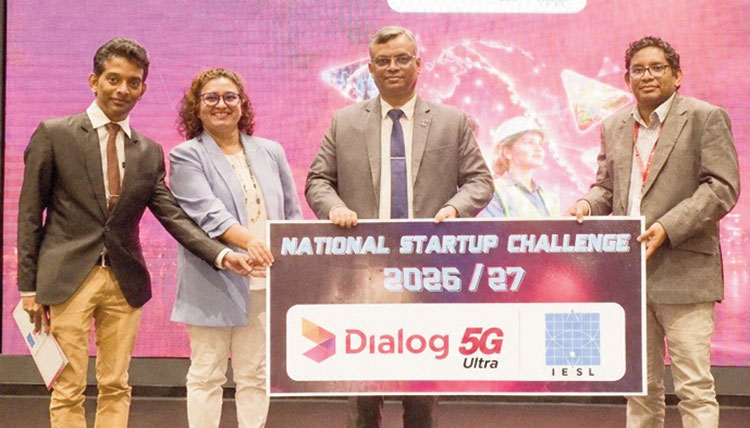
Dialog Axiata PLC, Sri Lanka’s #1 connectivity provider, joins the Institution of Engineers, Sri Lanka (IESL) to launch the IESL National Startup Challenge, creating a national pathway for aspiring entrepreneurs to transform innovative ideas into commercially viable, investment-ready startups. The initiative reflects a shared commitment to strengthening Sri Lanka’s entrepreneurship ecosystem through structured development, expert mentorship and practical support that enables promising ideas to progress towards market readiness and scale.
Launched through the IESL Entrepreneurship Forum at the Dialog Auditorium on 5 October 2026, the competition invites Engineering Undergraduates, Engineering Practitioners and participants in an Open Category for Non-Engineers to submit ideas across 12 innovation verticals aligned with national priorities, emerging technology and market trends, and inclusive innovation. Participants will progress through idea development, pitching, incubation, prototyping, validation, minimum viable product development and business scaling, supported by industry experts, mentors and ecosystem partners. The programme will culminate in a Top 10 selection, with the first-place winner receiving an award of LKR 1 million.
As title sponsor and a key ecosystem enabler, Dialog is contributing practical expertise and resources beyond sponsorship, providing technical expertise, mentors and digital resources to help participating teams develop, validate and scale their solutions. Each of the Top 10 teams will also receive a Dialog Digital Startup Support Package valued at LKR 250,000, comprising selected Dialog digital products and services.
“Dialog is committed to enabling Sri Lanka’s next generation of innovators by connecting entrepreneurial ambition with the technology, expertise and practical resources needed to turn ideas into scalable ventures. Through the IESL National Startup Challenge, Dialog is extending its digital capabilities, mentorship and ecosystem support to help promising teams progress from concept to validation and investment readiness,” said a representative of Dialog Axiata PLC.
Eng. Jasmine Nanayakkara, Chairperson of the Entrepreneurship Forum at the Institution of Engineers, Sri Lanka, added, “The IESL National Startup Challenge is designed to turn innovative ideas into viable businesses by connecting aspiring entrepreneurs with industry expertise, mentorship and continuous practical support. More importantly, it is about creating an ‘Engineer to Entrepreneur’ transformation and nurturing a stronger entrepreneurial culture within the IESL community. By encouraging our engineers and aspiring founders to create, commercialise and scale solutions, we aim to contribute to new ventures, new opportunities and meaningful job creation for Sri Lanka’s skilled and educated next generation. We are grateful to Dialog for partnering with IESL to create this pathway for innovation, entrepreneurship and national economic growth.”
Driving innovation across Sri Lanka, the National Startup Challenge also brings together a strong network of partners, including The Ceylon Chamber of Commerce as Ecosystem and Mentoring Partner, Helago as Official Mobility Partner, Helakuru as Official Digital News Partner, and Real Life as Official Climate Action Partner.
The IESL National Startup Challenge represents a collaborative effort to strengthen Sri Lanka’s innovation and entrepreneurship ecosystem by creating a structured pathway from promising ideas to market-ready businesses. Applications are now open via www.iesl.lk/announcements, giving aspiring entrepreneurs an opportunity to access the resources and funding they need to succeed. Applications close on 16th November 2026. For more information, contact mgr.pub@iesl.lk / 071 109 4393.

Keeping a home clean involves more than dealing with one kind of mess. Kitchens face grease and cooking splashes, bathrooms develop soap scum and limescale, while frequently used areas around the home collect marks, fingerprints and everyday dirt.
For households looking to simplify this routine, multi-surface cleaners offer a practical solution by allowing one product to tackle multiple cleaning needs across suitable surfaces.
One home, many everyday messes
In the kitchen, grease, splashes and burnt-on food can build up around hobs and hotplates. Cupboard doors and appliance exteriors can also collect smudges and marks through daily use.
Bathrooms present different challenges, including limescale, soap scum, toothpaste residue and water marks around sinks, washbasins and shower doors.
Even outside these rooms, surfaces such as door handles, baseboards, table mats and PVC areas can require regular attention.
Making everyday cleaning simpler
This is where the versatility of products such as CIF Cream becomes useful.
CIF Cream can help tackle a range of common household cleaning challenges across suitable surfaces, from grease and burnt-on food in the kitchen to limescale and soap scum in the bathroom.
Its uses can also extend to other suitable areas and items around the home, including cupboard doors, appliance exteriors, PVC surfaces and more, when used according to product directions.
For busy households, the benefit is straightforward: a versatile cleaner can help reduce the complexity of everyday cleaning by addressing several common cleaning needs with one product.
Consumers should always follow product instructions and check suitability before using any cleaner on a particular surface.
CIF products are now available at Cargills, Keells, Glomark and Celeste, as well as online through Daraz and uStore, at a retail price of Rs. 900 for 500ml. Shop CIF online at https://ustore.lk/collections/cif or https://www.daraz.lk/cif/
As household routines continue to evolve, multi-surface cleaning provides a simple approach to keeping different areas of the home clean — one versatile solution for many of the everyday messes that come with daily life.
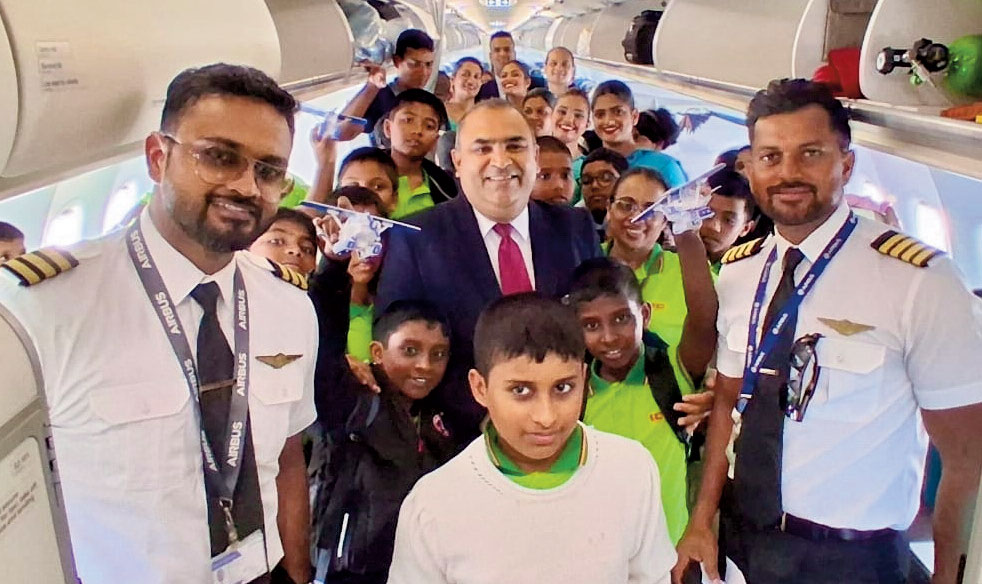
SriLankan Airlines set dreams in motion for 24 young students selected to represent Sri Lanka at the 2026 International Mathematics and Science Olympiad, held in Indonesia from 2 to 7 October 2026, helping make their journey to Indonesia and back an extra special one.
The students were selected through a four-stage national selection process covering school, zonal, provincial and national levels, with the highest-performing students progressing at each stage.
As a special initiative for Children’s Day, the Ministry of Education sponsored the air travel of all 24 students for the first time. Returning to Sri Lanka with an impressive haul of three Silver Medals and 10 Bronze Medals, the young contestants competed alongside students from 23 countries.
SriLankan Airlines was privileged to be part of their special journey, helping make their experience even more memorable as they represented Sri Lanka on the international stage.

NPP govt. reminded of its responsibilities as US warship leaves Colombo

CERT: Beware of foreign Uni. scams on social media

Shiranthi receives treatment at National Eye Hospital

PAFFREL, TISL checking whether govt. addressed their concerns as regards Anti-Corruption (Amendment) Bill

Baby elephant case: Suspended District judge removed from service

No-faith motion against Speaker handed over to Secy. Gen., Parliament

‘Dates have the highest sugar content to fight Coronavirus’

Sunday Island 27 December – Headlines

#SundayIsland 17th December – Headlines

Sunday Island – 28th March

Sunday Island Headlines – 21 March

Sunday Island – 21st February – Headlines
-

 Features6 days ago
The first woman in the foreign service or Ceylon Overseas Service it was then called
-

 News5 days ago
Geneva takes up Sallay’s case and govt. ignores opportunity to answer accusations
-

 Foreign News7 days ago
Ten injured after car crashes into rugby supporters in Australia
-

 News6 days ago
Nearly 20 Iranian tankers stranded off Lanka amid US sanctions
-

 Latest News7 days ago
Tharindu Rathnayake, bowlers secure Asian Games Bronze for Sri Lanka
-

 Features4 days ago
Preventing grievances from becoming communal
-

 Features5 days ago
Sri Lanka Cricket Bill: Governance reform is not yet a cricket strategy
-

 Sports2 days ago
Nissanka absence opens door for Sri Lanka’s young guns