
News
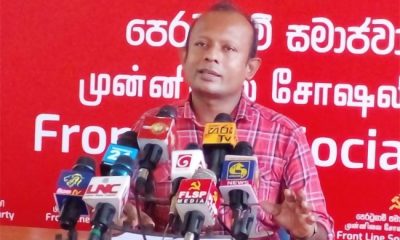
FSP: CEB twisting stats to help advance govt. agenda

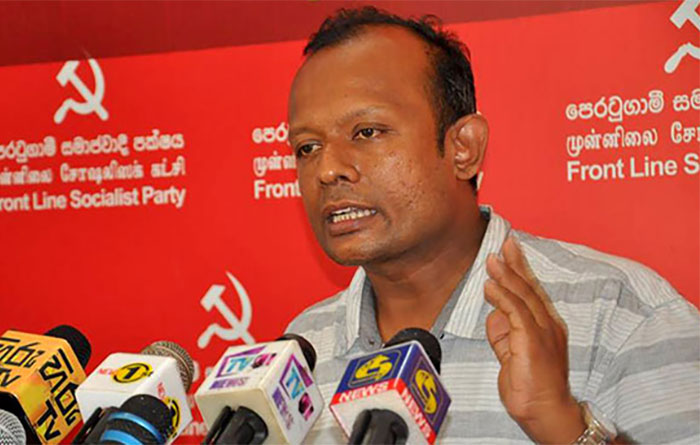
Even if the Ceylon Electricity Board (CEB) had not increased the tariff in October 2023, it would have made a profit of 40 billion rupees, Education Secretary of the Frontline Socialist Party (FSP), Pubudu Jayagoda said.
He added that the CEB can give a tariff reduction of 33 percent this year, given that it made a profit of 50 billion rupees in 2023 and because the estimates it has come up for 2024 are faulty.
“In response, the Minister of Power and Energy said that the CEB is making a profit and that he plans to distribute a part of the profit to the people. However, according to the laws that govern the CEB, this is an institution that should not determine prices in order to make a profit. The laws say that tariffs should be determined to cover costs in a just manner.”
Jayagoda said the CEB has determined that energy cost of generating electricity will be 351 billion rupees in 2024. This number was significantly lower in 2023, i.e., by 85 billion rupees. In 2023, the maintenance costs of power plants was 19.9 billion rupees. This has increased to 81 billion rupees for 2024. If we look at the distribution cost, it was 62 billion in 2023. In 2024, it will be 133 billion rupees.
“In 2023, the CEB had spent 21 billion rupees on salaries. This year, the salary bill is 43 billion rupees. All the data I have quoted is from a report the CEB sent to the Public Utilities Commission of Sri Lanka (PUCSL). How can the salaries double? There is no decision on a salary hike or bonuses by the government,” he said.
Jayagoda said that these numbers are used by the CEB to calculate the cost of production. Even if the salaries of all CEB workers are doubled, the estimated cost of salaries would be 42 billion rupees.
“Obviously, this kind of mammoth pay hike doesn’t take place anywhere. Why have they exaggerated numbers like this? It is obvious that the government wants to exaggerate the cost of production, increase tariffs and make a huge profit.”
Jayagoda said that last year, close to a million households have had their electricity disconnected. He said that there is a long-standing debate on whether electricity should be made a profit-making business or whether it is for public good.
“We can’t think of electricity supply from a business perspective alone. Now, electricity is a mainstay of daily life, and states provide electricity at a concessionary rate because it boosts productivity and quality of life. Imagine what a devastating impact the disconnection of electricity must have had on families,” the FSP Education Secretary asked.
In the last two years, 19,000 SMEs, too, have seen the power supply discontinued. The Minister of Power and Energy states that he has made the CEB profitable, but when one looks at the economy as a whole, the overall economy has suffered.
“The high electricity costs make our products less competitive, both domestically and internationally. I think we all agree that we need to boost our exports. How can we do that when electricity tariffs are this high?”
Jayagoda said that in the report to PUCSL, the CEB calculated finance cost for 2024 has gone up by 18 percent compared to 2023. This is not possible because the interest rates have gone down consistently in 2023 and 2024. RK








Latest News
Dilki Wathsala Marambage appointed as Director General of the Department of Technical Education and Training


The Cabinet of Ministers granted approval to the proposal forwarded by the Prime Minister in her capacity as the Minister of Education, Higher Education and Vocational Education to appoint Mrs. Dilki Wathsala Marambage to the post of Director General of the Department of Technical Education and Training.
Nearly 1,500 acres of land in the Galgamuwa Divisional Secretariat Division of the Kurunegala District, have been used by a number of private businesses for economic crop cultivation, mineral extraction, and excavation of soil.
Several environmental organizations had filed a petition before the Supreme Court requesting the suspention of the activities, stating that environmental damages have been caused due to the forest clearings carried out there and that the human-elephant conflict in the North Western Province has been aggravated.
In delivering its judgment regarding the said petition, the Supreme Court has ordered that the entire area, including residual forest parts, incorporating the extent of 55 hectares of lands cleared in that manner, should be declared as a sanctuary or an elephant management reserve under Section 2(2) of the Fauna and Flora Protection Ordinance.
According to the said order, a joint survey conducted by the Survey Department and the Department of Wildlife Conservation has identified an extent of 682 hectares of land to
be declared as a wildlife sanctuary.
Accordingly, with the agreement of the Irrigation Department, the Cabinet has approved the resolution furnished by the Minister of Environment to declare the said land area of 682 hectares as the Naakolagane Sanctuary under the provisions of the Fauna and Flora Protection Ordinance, incorporating the maximum water limit of the nearby Palukadawala Tank.
News
Cabinet approves transfer and maintenance of selected roads presently under PC’s and Local Authorities to the RDA
Considering the proposals forwarded by the District Coordination Committees, approval has been granted at the cabinet meeting held on 20-07-2026 to appoint a committee under the chairmanship of an Additional Secretary of the Ministry of Transport, Highways, and Urban Development to take further steps and submit recommendations regarding taking over the roads that do not belong to the Road Development Authority and are currently maintained under Provincial Councils or Local Government Institutes.
Taking into account the recommendations submitted by the aforementioned committee, the Cabinet of Ministers has approved the resolution furnished by the Minister of Transport, Highways, and Urban Development to take further steps for upgrading the said roads and to declare them as national highways, after examining fundamental qualifications, technical potential, and relevant criteria.

Dilki Wathsala Marambage appointed as Director General of the Department of Technical Education and Training
Declaration of Naakolagane Sanctuary under the Fauna and Flora Protection Ordinance
Cabinet approves transfer and maintenance of selected roads presently under PC’s and Local Authorities to the RDA
Obtaining financial facilities for the Water Supply and Sanitation Improvement Program (Sub-program 2) from the ADB

Delegation from Korean Volunteer Association meet Secretary to the President

Imran Khan’s PTI braces to fight federal takeover of Khyber Pakhtunkhwa

‘Dates have the highest sugar content to fight Coronavirus’

Sunday Island 27 December – Headlines

#SundayIsland 17th December – Headlines

Sunday Island – 28th March

Sunday Island Headlines – 21 March

Sunday Island – 21st February – Headlines
-

 Features6 days ago
The Sri Lankan who made Scottish history
-

 Sports6 days ago
Nissanka absence opens door for Sri Lanka’s young guns
-

 News5 days ago
NDB fraud Rs 60mn more than reported
-

 News7 days ago
Gnansara Thera to be assigned to prison printing section: Officials
-

 News5 days ago
Removing monk’s robes matter for Sangha to decide: Mahanayake Theras
-

 News7 days ago
OIC of FCID summoned before Maligakanda Magistrate
-

 Features6 days ago
Future of Sri Lanka’s state university system: Should it be shut down and reopened?
-
 News6 days ago
Shiranthi R remanded until 13 Oct.