
News
Replacing a state monopoly with a private sector oligopoly

Proposed Sri Lanka Electricity Bill
By Rathindra Kuruwita
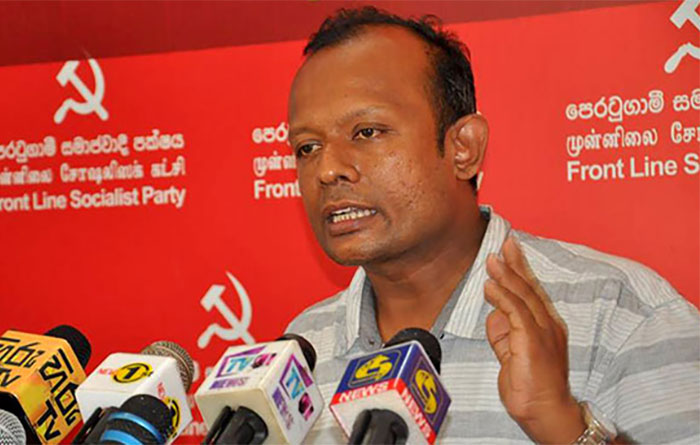
If the Sri Lanka Electricity Bill, currently under consideration in Parliament, is enacted, it could empower a handful of private companies, owning transmission lines, to exert undue control over the nation, potentially holding it hostage, the Education Secretary of the Frontline Socialist Party (FSP), Pubudu Jayagoda said.
The Bill, if passed, will replace Ceylon Electricity Board Act (No. 17 of 1969) and Sri Lanka Electricity Act (No. 20 of 2009).
One of the stated objectives of the Act is to attract new investment into the Electricity Industry, supported by segregation and separation of the activities of the Electricity Industry, currently vested in a single Government owned entity, by the incorporation of independent corporate entities in whom shall be vested all activities connected with the generation, transmission, distribution, trade, supply and procurement of electricity and who shall be responsible for the efficient management of these activities and for the creation of market competition, he said.
The other objectives are to facilitate private sector investment in every activity of the Electricity Industry using stock market listing and public private partnership modalities and transition and reorganisation of the Electricity Industry and the implementation of identified reforms based on timely and essential legal, structural, oversight and market-based changes.
Jayagoda remarked that essentially, the government has shifted its stance from viewing electricity as a public good, which it has a duty to furnish, to subjecting the sector to market forces. He noted that with the enactment of the Act, the government relinquishes its responsibility to provide electricity to households for improving their quality of life or to enterprises to stimulate economic endeavours.
“In the recent past, the electricity tariff increased dramatically. Electricity was disconnected in almost a million households and in 11,000 industries,” he said.
Jayagoda pointed out that the tariff adjustments were implemented with the aim of enabling the CEB to achieve a profit of approximately 62 billion rupees. However, according to some experts, the CEB actually recorded a profit of about 90 billion rupees.
“We cautioned that these adjustments were not solely aimed at covering CEB expenses, as claimed by the government, but rather to generate substantial profits. Now, it’s evident to everyone that our concerns were valid,” he remarked.
Jayagoda said according to laws that govern the electricity sector states that the baseload, apart from peak hours, must be generated using the least cost sources.
“Hydro power is the source that we can use to generate electricity at the lowest cost. One can generate a unit of electricity, using hydro-power, under five rupees at most. But the cost spikes to about 40-50 rupees when a unit is generated by coal. A unit of electricity, generated by diesel, costs about 90 rupees, and the CEB buys at around 120 rupees when they purchase from private power plants,” he said.
Thus, it is obvious that the raison d’etre of this Bill is to legalize increased electricity tariffs, he said. The existing laws that govern the sector frowns upon high-cost private thermal power plants, Jayagoda added.
Jayagoda stated that this Bill eliminates these barriers and grants the Cabinet of Ministers the authority to decide on the type of power plants to be constructed. Currently, it is the responsibility of the CEB to determine the selection of power plants.
“The government wants to allow private companies to produce, distribute, and transmit electricity. Giving transmission lines to the private companies poses serious problems. Already, India’s Adani is building a 400 kv transmission line from Kilinochchi to Habarana. Adani got this without a tender. When we ask the Ministry of Power and Energy, they claim this is a government to government project and this there was no need to call for tenders. However, it is a private Indian company that is building the transmission line and thus tenders should have been called,” he said.
Jayagoda questioned the potential scenario where the government seeks to transmit electricity generated by another company through this line. He inquired about the financial implications for the other company, asking how much they would need to pay Adani for the usage of the transmission line.
“What will be the fee for access? And what if Adani refuses to permit electricity generated by other companies to pass through their transmission lines?” Jayagoda questioned. “While the government claims the Bill aims to enhance competition in the sector, in reality, it could result in the formation of an oligopoly controlled by a handful of companies that own transmission infrastructure.”
Jayagoda highlighted that the new Bill has diminished the authority of the Public Utilities Commission (PUC). In Sri Lanka, long-term generation plans are periodically devised, and tariff revisions are conducted. Currently, the PUC is responsible for overseeing the implementation of these long-term plans and determining the extent of tariff revisions.
“The new Bill effectively strips the PUC of its authority in these areas. Additionally, it grants the line minister the discretion to determine tariffs and oversee the implementation of long-term generation plans. Furthermore, the Bill restricts the PUC’s regulatory scope to large-scale power plants, excluding its jurisdiction over small power plants (11 and 33 kV plants). Ensuring that these power plants adhere to specific quality standards is crucial for safeguarding life and property. What are the potential consequences when private entities establish small power plants and generate electricity without any regulatory oversight?” Jayagoda questioned.
Jayagoda pointed out that the new Bill introduces a provision allowing Sri Lanka’s national grid to be connected to the grid of a foreign power, a clause absent in previous legislation. He emphasized that due to its geographical location, Sri Lanka can only feasibly be linked to the Indian national grid.
“Even more concerning is the provision in the Bill stating that it’s the Cabinet of Ministers who will determine the terms of any agreement if our grid is linked to another country’s national grid. This decision-making process has been heavily politicised,” Jayagoda said.
“What if India imposes similar conditions on us as they did on Nepal and Bhutan? In agreements with those countries, India mandated that they purchase a specified volume of electricity from India. As a result, Nepal is now compelled to buy Indian electricity at a higher cost, despite having the capacity to generate inexpensive hydro power. This fate could very well be awaiting us.”








News
AgriConnect Sri Lanka’ to be launched on 30 October to Modernise the Agricultural Sector Through Digitalisation

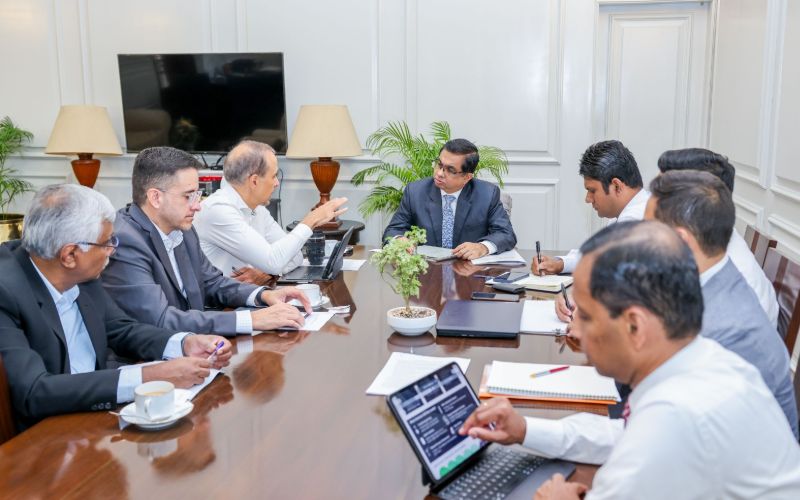
A discussion on the official launch of the ‘AgriConnect Sri Lanka’ programme was held at the Presidential Secretariat on Tuesday (13) morning between Secretary to the President Dr. Nandika Sanath Kumanayake and a delegation led by Gevorg Sargsyan, World Bank Group Manager for Sri Lanka and the Maldives.
The discussion focused on the official launch of the ‘AgriConnect Sri Lanka’ programme, scheduled to take place on 30 October at TRACE Expert City.
The World Bank delegation provided a comprehensive briefing on the programme and emphasised that Sri Lanka is set to become the first country in South Asia to join this global initiative of the World Bank Group, marking a significant milestone.
Victor Anthonypillai, Senior Country Officer of the International Finance Corporation (IFC), Tomas Ricardo Rosada Villamar Practice Manager at the World Bank, Felipe F. Dizon, Senior Economist and Athula Senaratne, Senior Agriculture Specialist, also attended the meeting. The Presidential Secretariat was represented by Senior Assistant Secretary to the President Dr Danushka Perera and Assistant Secretary to the President R. A. Ruwanpathirana.
President’s Media Division (PMD)
Appointment of committee eyewash, says UNP
The government is considering changes to prison regulations pertaining to the treatment of Buddhist monks serving jail terms, including their right to wear monastic robes when taken outside prison.
Justice and National Integration Minister Harshana Nanayakkara announced the proposed changes yesterday (14) following the submission of an interim report by a committee appointed to review the rules and procedures governing prisons.
The report was handed over to Secretary to the President Dr Nandika Sanath Kumanayake at the Presidential Secretariat.
One of the key recommendations is to amend Prison Standing Order 356 by introducing a new provision, 356(A). The proposed revision would require prison authorities to consult the Department of Buddhist Affairs on the removal of a monk’s robes upon admission to prison. The Commissioner of Prisons would be allowed 10 days to notify the department and take the necessary steps.
A separate amendment to Departmental Order 550 would allow Buddhist monks to wear their robes whenever they are taken outside prison, unless their respective Nikaya formally requests that the privilege be withdrawn.
The committee has also recommended extending similar arrangements, with suitable modifications, to members of other religious clergy who are imprisoned.
The proposals follow concerns raised over the treatment of Ven. Galagoda Aththe Gnanasara Thera after he was taken into custody. President Anura Kumara Dissanayake subsequently held discussions with representatives of the three main Buddhist Nikayas and appointed the committee to examine the existing legal framework.
Nanayakkara said the interim report had been forwarded to the Acting Commissioner General of Prisons, along with instructions to revise the relevant standing orders in accordance with its recommendations.
The proposed amendments have yet to be confirmed as formally implemented.
Meanwhile, the UNP yesterday criticised the government’s decision to appoint a committee to make recommendations on the attire to be worn by imprisoned Buddhist monks and other religious leaders when taken outside prison, describing the move as unnecessary.
In a statement issued yesterday (14), the UNP said the procedures governing the matter were already clearly set out in the Department of Prisons’ Standing Orders, making the appointment of a separate committee unwarranted.
The party cited remarks by Professor G.L. Peiris, Convenor of the Janathawadi Joint Opposition, who had described the committee’s appointment as a
“complete eyewash” and questioned the need for such a move.
Referring to Standing Order 550 of the Prisons Department, the UNP said convicted prisoners appearing before court for legal proceedings should not be required to wear prison uniforms.
It further stated that the regulations allowed prisoners to wear civilian clothing consistent with what they wore before imprisonment, including attire appropriate to their cultural and religious backgrounds.
The UNP accused the government of unnecessarily prolonging the issue by appointing a committee, despite the existence of regulations governing prisoners’ attire.
The party also called on the government to seek forgiveness from the Mahanayake Thera and the Sangha Council of the Kotte Sri Kalyani Samagri Dharma Maha Sangha Sabha of the Siyam Maha Nikaya over the decision concerning the religious attire of Ven. Galagoda Aththe Gnanasara Thera.
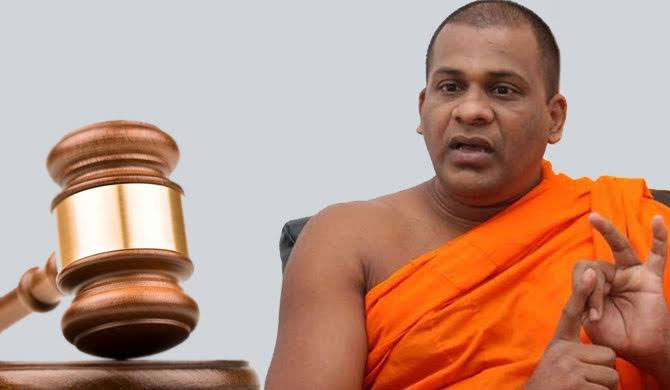
Court of Appeal President Justice Rohantha Abeysuriya yesterday withdrew from the bench hearing petitions challenging the decision by prison authorities to require Ven. Galagoda Aththe Gnanasara Thera to wear prison attire following his imprisonment.
The decision was announced when the petitions seeking to invalidate the prison authorities’ decision were taken up for consideration on October 14.
Following his withdrawal, a three-judge bench was appointed to hear the petitions.
The petitions relate to the prison authorities’ decision to require Gnanasara Thera to wear prison attire after he was taken into custody to serve the remainder of his sentence for contempt of court.
In September this year, the Supreme Court annulled the presidential pardon granted to Gnanasara Thera by former President Maithripala Sirisena in May 2019.
Following the ruling, the Court of Appeal directed the Commissioner General of Prisons to take the necessary steps to enforce the remainder of the monk’s prison sentence.
Gnanasara Thera had originally been sentenced to six years’ imprisonment for contempt of court but had served only around nine months before receiving the presidential pardon in 2019.

AgriConnect Sri Lanka’ to be launched on 30 October to Modernise the Agricultural Sector Through Digitalisation

57th Annual Saints’ Quadrangular Tournament on Saturday and Sunday

Showers or thundershowers will occur at most parts of the island

Prison rules to be revised over monks’ attire

AC President recuses himself from hearing prison attire case pertaining to Gnanasara Thera

Court orders steps to obtain INTERPOL Red Notice against Basil

‘Dates have the highest sugar content to fight Coronavirus’

Sunday Island 27 December – Headlines

#SundayIsland 17th December – Headlines

Sunday Island – 28th March

Sunday Island Headlines – 21 March

Sunday Island – 21st February – Headlines
-

 News7 days ago
NDB fraud Rs 60mn more than reported
-

 News7 days ago
Removing monk’s robes matter for Sangha to decide: Mahanayake Theras
-

 News5 days ago
Sri Lanka escalates anti-graft drive with Shiranthi’s jailing
-
 News6 days ago
NPP govt. reminded of its responsibilities as US warship leaves Colombo
-

 Latest News6 days ago
Farhan, Sadaqat help Pakistan ace 183 chase to go 1-0 up
-
 News7 days ago
BHC, Colombo: “LTTE remains a proscribed org. in the UK”
-

 Latest News4 days ago
Farhan and Sadaqat help Pakistan seal series in style
-
 News5 days ago
Iranian ships stranded, Lanka fears US sanctions