
Business
Fitch Ratings affirms National Long-Term Rating of Dialog Axiata at ‘AAA (lka)’, Outlook Stable


The affirmation and Stable Outlook reflect Fitch’s view that Dialog will be able to maintain a credit profile commensurate with a ‘AAA(lka)’ rating in the next 12-18 months, despite lower demand for telecom services, escalating costs and a significant increase in the company’s debt amid the Sri Lankan rupee’s devaluation.
Dialog’s rating is driven by its Standalone Credit Profile (SCP) of ‘aaa(lka)’, which reflects its market leadership across mobile, pay-TV and home-broadband (HBB) segments, better execution and network capability and a solid financial profile, offset to an extent by the high exposure of its revenue to the weak Sri Lankan market.
KEY RATING DRIVERS Weak Demand in 2023: We expect Dialog’s revenue growth to slow to around 10% in 2023, from 25% in 2022, amid weakening consumer spending. Consumers are increasingly prioritising essential needs, such as food and medicine, as real income has plunged following the currency depreciation and unprecedently high inflation. Dialog faced pressure on subscriber numbers and usage minutes in 2022. Telecom operators raised voice and data tariffs by 20% and pay-TV by 25% in 2022 to pass through the escalating costs, reducing the services’ affordability.
We believe the recent increases in telecom taxes would also discourage demand as consumers now have to pay 38% tax on voice and 20% on data. Sri Lanka currently has one of the highest telecom tax structures in Asia. To mitigate its domestic market exposure, Dialog is increasingly focusing on its international businesses and enterprise clients, who are somewhat immune to the local environment. The contribution from the international business climbed to 23% in 2022, from 16%17% earlier.
Market Leadership: Dialog is the domestic market leader across mobile, pay-TV and HBB segments. The competition within the mobile segment has intensified in recent months amid the falling demand, with some of the smaller operators aggressively cutting prices. However, we do not believe such a strategy is sustainable as the smaller telcos do not have the network capability, service quality or the financial strength to compete with operators such as Dialog.
Low Profitability: We expect Dialog’s EBITDA margin to improve to around 30%32% over 2023-2024 from 28% in 2022, benefitting from the recent tariff hikes and cost rationalisation measures. Dialog’s EBITDA margin contracted by 12 percentage points in 2022 amid the high inflation and currency depreciation. Around 52% of Dialog’s direct costs are in foreign currency (FC) compared with only 30% of its revenue, exposing the company to currency volatility.
Dialog expects to streamline its costs by consolidating its facilities, optimising its network and rationalising overheads, but we do not believe this will be sufficient to improve margins to the 39%-40% levels before 2022. The low realisation of the recent tariff hikes amid the drop in usage and increased contribution from the lowmargin international business would also mean margins would remain in the low-tomid 30s range in the next few years.
High Foreign-Currency Debt: Around 91% of Dialog’s outstanding debt was in FC at end-2022. The depreciation of the rupee by almost 80% in 2022 materially increased Dialog’s FC debt exposure, while it had to raise more FC debt to fund capex amid the FC shortage in Sri Lanka. We do not believe Dialog’s current FC revenue is sufficient to meet its FC debt obligations, but the company does not have any FC debt repayments due in the next 24 months. Dialog has USD41 million in FC deposits to meet its FC interest costs of around USD12 million per year.
Balance-Sheet Restructuring: Dialog is planning to manage its currency exposure by reducing the FC debt to less than 50% of its outstanding debt by end-2023. It is considering asset monetisation and alternative funding arrangements with existing lenders to achieve a more balanced funding mix. The higher debt stock also raised Dialog’s EBITDA net leverage to 1.3x in 2022, from 0.4x in 2021. We expect leverage to remain around 1.0x until there is a sustainable recovery in margins.
Positive FCF from 2024: We expect Dialog to generate negative free cash flow (FCF) in 2023 amid low profitability and high capex. Dialog’s capex has risen due to the currency devaluation as most of the equipment is imported. Therefore, we expect capex intensity to rise to around 27% of revenue in the next few years from around 23% earlier. Capex will be spent mostly on mobile and fixed-data capacity expansion to cater to the growing demand. Dialog’s FCF should turn positive from 2024, once EBITDA margins gradually recover.
Support from Strong Parent: Our assessment of ‘Medium’ legal and strategic support incentive from its stronger parent, Axiata Group Berhad, would result in a potential two-notch uplift to its rating if its SCP were to weaken, according to our Parent and Subsidiary Linkage Rating Criteria. Axiata guaranteed around 45% of Dialog’s debt as of end-2022. The subsidiary makes a reasonably material financial contribution to the parent, with moderate long-term growth potential. The operational support incentive is ‘Weak’ due to minimal operating synergies with the parent.
Sector Outlook Deteriorating: Fitch expects the average 2023 net debt/EBITDA ratio for Dialog and fixed-line leader Sri Lanka Telecom PLC (SLT, A(lka)/Stable) to weaken to 1.4x in 2023 (2022E: 1.2x) amid weak margins and high capex. We expect sector revenue growth to slow to 8% in 2023 (2022E: 15%), while theaverage 2023 EBITDA margin for SLT and Dialog will remain flat at 32% (2021: 38% and 2022E: 32%) amid low usage and high costs.


By Ifham Nizam
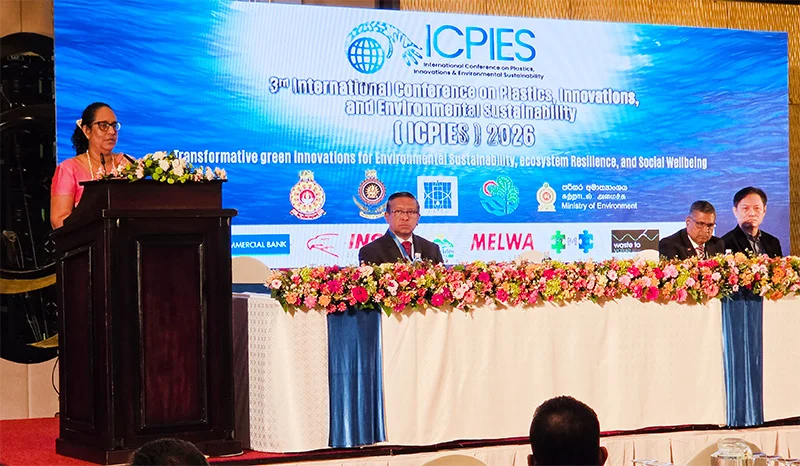
Prime Minister Dr. Harini Amarasuriya warned that Sri Lanka’s worsening waste-management crisis, particularly the uncontrolled accumulation of plastic waste and poorly managed landfills, was a “disaster waiting to happen”, urging scientists, researchers and policymakers to help the government find practical solutions before the problem reaches a critical point.
Addressing the launching of the Open University of Sri Lanka organized, ‘International Conference on Plastics, Innovations and Environmental Sustainability’ (ICPIES 2026) as Chief Guest, at the Cinnamon Lakeside Hotel yesterday she said waste management, waste reduction and recycling had become national priorities, with the government placing greater emphasis on the issue in its preparations for the 2027 Budget.
‘This is becoming a critical issue and something that, at any moment, if we don’t manage it properly, could become a huge disaster. It’s a disaster waiting to happen, Dr. Amarasuriya said.
She said unregulated and poorly managed landfills, particularly in and around Colombo, posed serious environmental and public risks, while increasing urbanisation was extending the waste-management challenge beyond the capital to other parts of the country.
‘As a member of Parliament for the Colombo District, I can tell you that one of the biggest challenges we are facing is waste management and actually managing the recycling of waste, and particularly of plastic products. This is something that we are battling every day, she said.
The Prime Minister said the government could not regard economic development as meaningful if it came at the expense of the country’s environment and natural resources.
‘If we are to speak of a beautiful life, we must first ensure that the air we breathe, the water we drink, the soil on which we live, the food we eat is clean and secure, she said.
She pointed to the scale of the global plastics crisis, noting that around 400 million tonnes of plastic waste are generated worldwide each year, while between 19 and 23 million metric tonnes of plastic waste enter natural ecosystems annually.
Plastic waste eventually breaks down into microplastics, which can enter aquatic organisms and subsequently the human food chain, she said.
Dr. Amarasuriya also linked plastic consumption and environmental degradation to the wider climate crisis, warning that the consequences of climate change were already being experienced by communities around the world.
She referred to devastating floods and landslides in the Himalayan region and said the impacts of climate change demonstrated that environmental damage could have consequences far beyond national boundaries.
Coastal clean-up projects and other waste-separation and recycling initiatives are also being implemented, while the government is working with the Western Provincial Council on a refuse-derived fuel project at Karadiyana.
The third ICPIES, held under the theme “Eco-Driven Innovations,” brings together researchers, policymakers, industry representatives and other stakeholders to examine plastic pollution, microplastics, circular-economy approaches, waste-management policy, technological innovation, artificial intelligence and smart environmental monitoring. The conference ends today.
Senior Professor P. M. C. Thilakarathne, Vice Chancellor of the Open University of Sri Lanka, was the Guest of Honour.

By Hiran H. Senewiratne
Stock investors were worried yesterday following Central Bank Governor Dr. Nandalal Weerasinghe’s mention at the CBSL monthly monetary policy review meet of possible future inflation pressures that may impact the economy.
The All Share Price Index went down by 4.89 points, while the S and P SL20 rose by 16.1 points. Turnover stood at Rs 1.55 billion with four crossings.
Those crossings were; Access Engineering crossed 1.5 million shares to the tune of Rs 119.8 million; its shares traded at Rs 79.60, Sampath Bank 450,000 shares crossed tfor Rs 63 million; its shares sold at Rs 140, Sunshine Holdings 750,000 shares crossed to the tune of Rs 21.4 million; its shares traded at Rs 28.50 and Softlogic Life 290,000 shares crossed for Rs 20.4 million; its shares sold at Rs 70.40.
In the retail market companies that mainly contributed to the turnover were: Access Engineering Rs 150 million (1.9 million shares traded), JKH Rs 113 million (six million shares traded), Softlogic Life Rs 80 million (one million shares traded), Softlogic Capital Rs 64.7 million (6.7 million shares traded), Lanka Realty Rs 64.3 million (1.3 million shares traded), Colombo Dockyard Rs 53.7 million (452,000 shares traded) and Sierra Cables Rs 50 million (1.43 million shares traded). During the day 58.9 million share volumes changed hands in 13536 transactions.
It is said that mixed market reactions were noted especially in manufacturing while banking, insurance and FMCG sectors performed well. Further, construction sector counters, especially Access Engineering, and banking sector counters, especially Sampath Bank, performed well.
People’s Leasing & Finance PLC announced its allotment basis for 100 million listed debentures it issued to raise Rs 10 billion, after receiving applications for the full amount.
Yesterday the rupee was quoted at Rs 330.68/75 to the US dollar in the spot market from Rs 330.70/90 the previous day, while bond yields were quoted steady to lower, dealers said.
An auction of Rs 80,000 million Treasury bills was ongoing.

Climate resilience has become the defining test of this El Niño year for Sri Lanka’s plantation sector. The National Disaster Relief Services Centre says over 81,000 people across 25,563 families in seven districts, Ampara, Polonnaruwa, Batticaloa, Badulla, Monaragala, Hambantota and Ratnapura, have been affected by the dry weather linked to the phenomenon. The government has raised daily water allocations from six to 15 litres per person, deployed 324 water bowsers, and set aside Rs. 4.8 billion for relief.
Several of the worst hit districts sit close to plantation country, a reminder that El Niño doesn’t stop at the edge of an estate. It touches every elevation, from low grown tea and rubber around Ratnapura and Galle, through the mid grown estates of Kandy, to the high grown gardens of Nuwara Eliya and Badulla. Low grown areas feel it fastest, since prolonged heat and soil moisture loss can hit yields within weeks. High grown tea is more sheltered from dry spells but carries its own slow burning risk from rising night temperatures.
Professor Buddhi Marambe, Senior Professor of Crop Science at the University of Peradeniya, draws a distinction often lost in public conversation. “El Niño is not caused by climate change. It is a natural climate variability that has occurred for hundreds of years,” he says. “But that doesn’t mean resilience building in our agricultural systems isn’t helping. It directly assists in mitigating the impacts of extreme events like El Niño.” That resilience takes time to build. The Tea Research Institute released Sri Lanka’s first drought tolerant tea cultivar only in 2016, after years of work. “It normally takes about 25 years to develop a new tea cultivar,” Marambe notes, underlining why the Planters’ Association keeps pressing for sustained, long term investment in plantation research rather than short funding cycles.
That long view is already showing up on the ground. At Udapussellawa Plantations PLC, the response to the prevailing drought has been an integrated field level programme rather than a single fix. Mother leaf plucking was made mandatory to protect bushes from moisture stress, foliar bio-fertiliser applications were intensified, and water was diverted to the worst affected fields. Shade cover was strengthened, potassium was applied to help regulate water loss through the stomata, and drains were cut in advance of the dry spell to hold moisture in the root zone. Rooftop solar has also been installed, easing pressure on hydro power so that conserved water can flow downstream for drinking and irrigation.
At Browns Plantations’ Maturata region estates, resilience has been built across water, soil and disaster planning together. Water bowsers and sprinkler systems now serve new clearings and nurseries, while thatching in young tea fields conserves soil moisture. Shade lopping and pruning have both been suspended during the dry period to protect plant health, and foliar potassium is being used as an immediate agronomic measure. On the disaster side, vulnerable housing and landslide prone locations are monitored continuously and assessed against the National Building Research Institute (NBRI) recommendations, with relocation planned in consultation with the relevant authorities.
Kelani Valley Plantations PLC has taken the longest horizon, treating climate resilience as something built years ahead of any single crisis. Its Agroforestry Pilot at Halgolla Estate, developed with Sri Lankan and international scientists, layers vegetation to deliver soil conservation, water retention and additional income, and is now being replicated across other estates. Soil and water measures such as soak pits, on site ponds and native tree planting support rainfall infiltration, while the company’s Surakimu Ganga programme has planted more than 10,000 native trees in the Kelani River basin, with a survival rate above 99 percent. KVPL also became the world’s first plantation company, and Halgolla the world’s first tea estate, to achieve regenagri certification, work underpinned by long standing research partnerships with the University of Peradeniya, Wageningen University and IUCN Sri Lanka.
Horana Plantations PLC, part of the Hayleys Plantation Sector, shows how technology is closing the same gap. Weather stations installed with the Arthur C. Clarke Institute feed early alerts on temperature, rainfall and soil moisture, drone mapping flags nutrient and pest problems, and smart fertigation cuts water waste in coffee. Solar installations and mini hydro plants generated 1,243 MWh last year, and the TeaShade Carbon Project is Sri Lanka’s first plantation scheme registered under the Verified Carbon Standard.
Taken together, these examples show a sector that is not waiting for policy to catch up before acting. Regional Plantation Companies (RPC’s) have, on their own initiative, built research partnerships, invested in monitoring technology and renewable energy, and embedded climate planning into daily estate management, often years ahead of national frameworks reaching the ground. Professor Marambe’s own prescription, continuous capacity building tied to economic reality, is one RPCs are already living out: “People respond when they understand the real economic risk. Every plantation crop is an export earner.” The response to El Niño is proof that climate resilience is already a core business strategy, and the strongest case yet for greater government and institutional support to help scale that work further, said Lalith Obeyesekere, Secretary General of the Planters’ Association of Ceylon.

What lessons can be learned to improve quality of Sri Lanka’s Grade 6 syllabus

Total overhaul of Sri Lanka Cricket and sports governing structure on the cards, Parliament announces

Gold winner Tharanga gets brand-new Honda Vezel from SLAAJ

PM warns Sri Lanka’s waste crisis is a ‘disaster waiting to happen’

Three magical nights at Colombo Fashion Week

Sri Lanka face strong India with Asian Games final at stake

‘Dates have the highest sugar content to fight Coronavirus’

Sunday Island 27 December – Headlines

#SundayIsland 17th December – Headlines

Sunday Island – 28th March

Sunday Island Headlines – 21 March

Sunday Island – 21st February – Headlines
-

 Latest News7 days ago
Showers above 100 mm are likely at some places in the Western, Sabaragamuwa, Central and North-western provinces and in Galle and Matara Districts
-

 Editorial7 days ago
Crimes punished and unpunished
-

 Features6 days ago
Beyond traditional jobs: Why Sri Lanka needs to facilitate the gig economy
-

 Editorial5 days ago
Birth of a bad law
-

 News3 days ago
Police remove Thileepan statue in Jaffna
-

 Latest News6 days ago
Kusal, Wellalage star as Sri Lanka defend 322 in Headingley thriller
-

 News5 days ago
TIN mandatory for key transactions from Nov. 1
-

 Features3 days ago
The 22nd Amendment, constitutional recovery and illiberal slippage