
News
First pygmy seahorse in Indian Ocean discovered

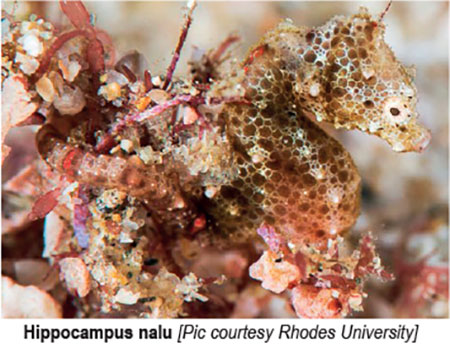
A pygmy seahorse about the size of a grain of rice has been first observed in the Indian oceans by a group of researchers including including Research Associate of Zoology and Entomology at Rhodes University, Professor Louw Claassens, Rhodes University said on its official web site yesterday.
Finding the new species in in the Indian ocean was very rare, the researchers stated.
“It’s like finding a kangaroo in Norway,” says Richard Smith, a marine biologist based in the United Kingdom and co-author of a new study on the species, known as the African or Sodwana Bay pygmy seahorse. The second name refers to the location where it was found, a popular scuba-diving spot close to the Mozambique border.
The finding shocked them because all seven species of pygmy seahorse, except for one in Japan, inhabit the Coral Triangle, a biodiverse region of more than two million square miles in the southwestern Pacific. This one lives 5,000 miles away, the first pygmy seahorse seen in all of the Indian Ocean and the continent of Africa.
The new species looks somewhat similar to other pygmy seahorses, except that it has one set of spines on its back that have sharp, incisor-like points on the tips, says co-author Graham Short, an ichthyologist at the California Academy of Sciences and the Australian Museum in Sydney. In contrast, the other similar pygmy seahorses have flat-tipped spines.
“We really don’t know what these spines are used for,” Short says. “Many species of seahorses in general are spiny, so their presence could be possibly due to sexual selection—the females may prefer spinier males.”
The surprising discovery, described in a study published May 19 in the journal ZooKeys, shows how little we know about the ocean, particularly when it comes to tiny creatures, the authors say—and that there are likely many more pygmy seahorse species to be identified.
Dive instructor Savannah Nalu Olivier first stumbled upon the creature in Sodwana Bay in 2017, while examining bits of algae on the seafloor. The bay is known for having many species of rare fish, sharks, and sea turtles.
She shared photographs of the fish with her colleagues, and in 2018 they made their way to Smith, who, with colleague and Research Associate of Zoology and Entomology at Rhodes University, Louw Claassens, collected several specimens of the animal at depths of 40 to 55 feet.
The researchers have named the new seahorse Hippocampus nalu, after Olivier, whose nickname is appropriately “Fish.” (She’s also a Pisces.) In the South African languages Xhosa and Zulu, “nalu” roughly translates to “here it is.”
“I told her that this was a gift from the sea,” says Louis Olivier, Savannah’s father, who owns a scuba diving outfit called Pisces Diving Sodwana Bay. He adds he’s “super stoked about her discovery.”
Smith sent several specimens of the new species to Short, who analyzed their genetics and body structures using a CT scanner.
His research revealed that, like other pygmy seahorses, the newly found animal has two wing-like structures on its back, rather than one, as in larger seahorses. These “wings” in general serve an unknown purpose for seahorses.
Also like other pygmy seahorses, the African species has only one gill slit on its upper back, instead of two below each side of the head, like larger seahorses—another mystery.
That would be “like having a nose on the back of your neck,” Short says.
But the new seahorse is unique from its tiny kin in that it was found living in turf-like algae, amid boulders and sand. Sodwana Bay has large swells, and the little seahorses appear to be comfortable being swept about, says Smith, who observed a pygmy seahorse get covered in sand and then wriggle its way out.
“They regularly get sand-blasted,” says Smith, who wrote a book about sea creatures called The World Beneath. Other pygmy seahorses, which stick to the calmer waters around coral reefs, “are more dainty. But this [species] is built of sturdier stuff.”
Like other pygmy seahorses, the African version is thought to eat tiny copepods and crustaceans. It also is well camouflaged to match its surroundings.
This finding “demonstrates that there are still many discoveries to be made in the oceans, even in shallow waters near the coast,” says Thomas Trnski, head of natural sciences at the Auckland Museum in New Zealand, who wasn’t involved in the study. Almost all pygmy seahorses have been discovered in just the last 20 years, he adds.
The only pygmy seahorse found outside the Coral Triangle is the Japanese pygmy seahorse, also known as the “Japan pig,” first described in August 2018.
Although populations of regular seahorses have fallen in many areas because of harvesting for use in traditional Chinese medicine and the aquarium trade, that’s not an issue for pygmy seahorses because they are difficult to find, Short says. That being said, some of these species have very low population densities, and there’s not enough data to get a good sense of how many there are, Smith adds.
These fish can spread only very short distances via the current. The study suggests that Hippocampus nalu diverged from the ancestors of all known pygmy seahorses species more than 12 million years ago.
“This means that it is extremely likely that there are many more species of pygmy seahorses yet to be discovered in the western Indian Ocean” and beyond, Short says.


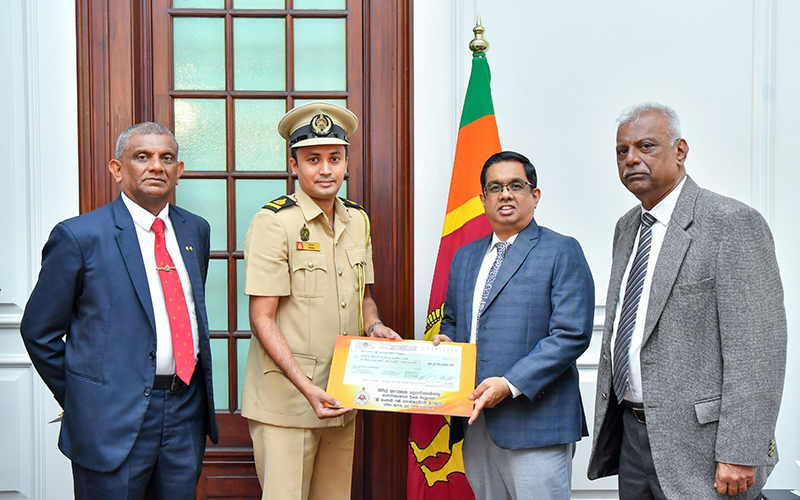
Members of the Civil Security Department have donated a day’s salary to the Rebuilding Sri Lanka Fund, which was established to restore livelihoods and rebuild the country following the devastation caused by cyclone Ditwah.
Accordingly, a cheque amounting to Rs. 40,870,686 was handed over on Thursday (22) at the Presidential Secretariat by the District Officer of the Civil Security Department G.Y.B. Perera to Secretary to the President, Dr. Nandika Sanath Kumanayake.
Secretary to the Ministry of Public Security Ravi Seneviratne and Director General of the Civil Security Department, Major General Palitha Fernando (Retired), were also present on the occasion.
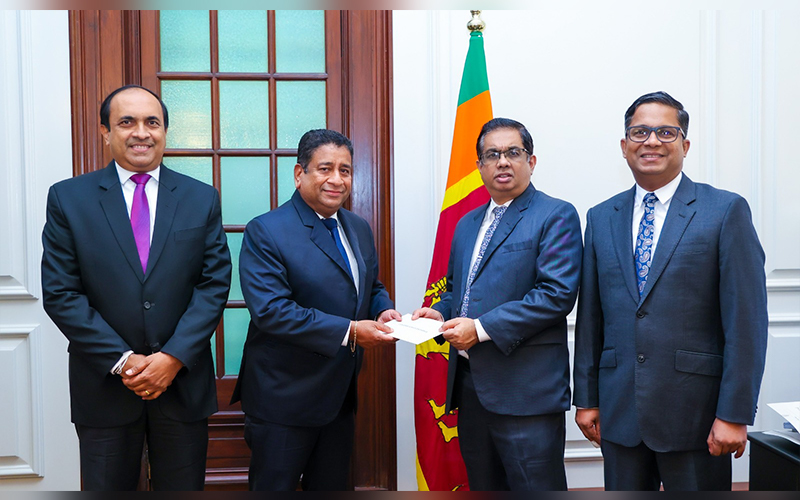
The Colombo Stock Exchange (GL 12) has contributed LKR 25 million to the Rebuilding Sri Lanka Fund.
The cheque was handed over to the Secretary to the President Dr. Nandika Sanath Kumanayake by the Chairman of the Colombo Stock Exchange, Dimuthu Abeyesekera, the Chief Executive Officer Rajeeva Bandaranaike and Senior Vice Chairman Kusal Nissanka at the Presidential Secretariat.
News
Karu argues against scrapping MPs’ pension as many less fortunate members entered Parliament after ’56


Former Speaker of Parliament Karu Jayasuriya has written to President Anura Kumara Dissanayake expressing concerns over the proposed abolition of MPs’ pensions.The letter was sent in his capacity as Patron of the Former Parliamentarians’ Caucus.
In his letter, Jayasuriya noted that at the time of Sri Lanka’s independence, political participation was largely limited to an educated, affluent land-owning elite. However, he said a significant social transformation took place after 1956, enabling ordinary citizens to enter politics.
He warned that under current conditions, removing parliamentary pensions would effectively confine politics to the wealthy, business interests, individuals engaged in illicit income-generating activities, and well-funded political parties. Such a move, he said, would discourage honest social workers and individuals of modest means from entering public life.
Jayasuriya also pointed out that while a small number of former MPs, including himself, use their pensions for social and charitable purposes, the majority rely on the pension as a primary source of income.
He urged the President to give due consideration to the matter and take appropriate action, particularly as the government prepares to draft a new constitution.The Bill seeking to abolish pensions for Members of Parliament was presented to Parliament on 07 January by Minister of Justice and National Integration Dr. Harshana Nanayakkara.

Civil Security Department Members Contribute a Day’s Salary to ‘Rebuilding Sri Lanka’ Fund

Naqvi casts uncertainty on Pakistan’s participation in T20 World Cup after Bangladesh ouster

Root 75 sets up series-levelling win after spin-heavy England limit Sri Lanka

Sri Lanka succumb for 219 as spin-heavy England turn screw

T20 World Cup 2026: ICC replace Bangladesh with Scotland

Indonesia landslide kills 7, dozens more missing

‘Dates have the highest sugar content to fight Coronavirus’

Sunday Island 27 December – Headlines

#SundayIsland 17th December – Headlines

Sunday Island – 28th March

Sunday Island Headlines – 21 March

Sunday Island – 21st February – Headlines
-

 Editorial7 days ago
Illusory rule of law
-
 Features7 days ago
Daydreams on a winter’s day
-
 Features7 days ago
Surprise move of both the Minister and myself from Agriculture to Education
-

 Features6 days ago
Extended mind thesis:A Buddhist perspective
-

 Features7 days ago
The Story of Furniture in Sri Lanka
-

 Opinion5 days ago
American rulers’ hatred for Venezuela and its leaders
-

 Features7 days ago
Writing a Sunday Column for the Island in the Sun
-
 Business3 days ago
CORALL Conservation Trust Fund – a historic first for SL