
News
China only watching, will not get involved in Sri Lankan election

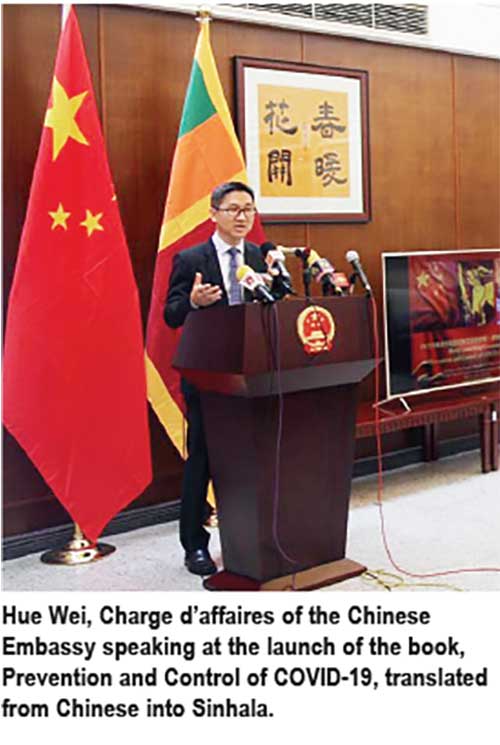
* Sinhala translation of Prevention and Control of COVID-19 launched
by Zacki Jabbar
China said yesterday that it was only watching the forthcoming general election in Sri Lanka as a true friend and would not get involved in it any manner.
Speaking to The Island on the sidelines of the launch of the translation of the book “Prevention and Control of COVID-19”, from Chinese to Sinhala, Hu Wei, Charge d’affaires of the Chinese Embassy said “We don’t wait until Sri Lanka comes to us with a request. We just help. As for the general election, we are only observing as a true friend should do, but will not get involved in any manner.”
Speaking earlier at the official launch ceremony, Wei said that China and Sri Lanka would discuss their experiences in combating the Coronavirus disease (COVID-19) and in turn would share it with the world. The objective of translating the book “Prevention and Control of COVID-19”, into Sinhala, he noted, was to convey their message to the world.
Wei observed that the outbreak of the novel coronavirus had taken the entire world by surprise, as it transcends wealth, fame, age, gender and nationality.
“Our friendship is not just with the Sri Lankan leaders but also with the people. It is a touching story. We think what you think, we worry about what you worry and your concerns are our concerns”, he noted.
Wei said that with a view to protecting the Sri Lankan people, the Embassy had donated thousands of masks to various institutions since the outbreak of COVID-19. “This includes the Health Ministry, 26 schools, five universities and three-wheel taxi drivers. Next week, we will provide a large number of masks to bus crews as well”, he added
Lakshmana Saparamadu, who translated the book said that a special word of thanks was due to the International Department of the Central Committee of the Communist Party of China, without which, the project would not have been possible. He also thanked the Sri Lanka Cooperation Studies Centre of the Pathfinder Foundation, Shanghai Scientific & Technical Publishers and the Chinese Embassy in Colombo.
The book features a range of prevention and control measures to be adopted at different places such as homes, outdoors, workplaces, etc., and also contains scenario – based strategies, frequently asked questions, and addresses myths and misconceptions prevalent among the public. Consequently, it would serve to educate students, teachers and management of institutions where groups of people are concentrated such as rehabilitation centres and the general society.
“Prevention and Control of COVID – 19” is edited by Professor Wenhong Zhang, who is a leading Chinese expert on infectious diseases and was Head of the Shanghai COVID – 19 Treatment Expert Group. He is also the Director of the Department of Infectious Diseases, Huashan Hospital of Fudan University.
The book is a valuable tool to all readers and provides simple, practical, scientific and targeted information on prevention and control measures. It states – Breaking the chain of infection is the only way to control the spread of infectious diseases. However, implementation of control principles requires each of us to properly protect ourselves and actively cooperate with anti-epidemic work, in addition to relying on national prevention and control measures, so that this battle may come to an end faster.


Prime Minister Dr. Harini Amarasuriya departed Sri Lanka on Monday, 31 August, to undertake an official visit to Bhutan to participate in the Global Conscious Food Systems Summit, scheduled to be held in Bhutan.
During her visit, Prime Minister Dr Amarasuriya participated in the opening plenary of the Summit on 1 September, where she delivered a keynote address under the theme “Rising to the Moment: Igniting Consciousness to Address the Polycrisis.”
The Prime Minister will also engage in discussions with international leaders and representatives on strengthening cooperation towards sustainable food systems, food security and resilient communities.

[Prime Minister’s Media Division]

Maia Bouchier’s century led England to their highest successful ODI run-chase to defeat Ireland by six wickets in the opening match of their three-game series in Leicester.
Bouchier initially played a supporting role to Sophia Dunkley’s 61-ball 73. But, after the duo had shared a 143-run opening stand off just 118 balls to set the foundations for England, Bouchier finished with an emphatic 104 off 95.
It was England’s older hands who saved the hosts after Ireland had posted an impressive 281 for 5 on a good batting track, with fifties to captain Gaby Lewis, Amy Hunter and Rebecca Stokell. But while Bouchier, Dunkley and Alice Capsey share more than 100 ODIs between them, in the context of the hosts’ developmental approach to this series, Bouchier’s performance was most on point.
On the eve of this first match, stand-in skipper Charlie Dean had emphasised the opportunities for players to establish themselves as top selection choices with five key players missing from the squad. Bouchier, who since the 2025 Ashes has only played a bit-part for her country, got the message and sent one right back.
With Tammy Beaumont and Heather Knight retired and Amy Jones rested for this series, England entered this match with a new top order, Dunkley promoted to open alongside Bouchier and Jodi Grewcock at No. 3, playing just her third international.
The new opening pair made light work of their task early on as Ireland’s bowlers struggled to make any impact, as England’s attack had earlier.
Bouchier crashed four fours in a row off Jane Maguire and, after 10 overs, they were 72 without loss, compared to Ireland’s 51 for 1.
Dunkley reached fifty first, off 40 balls with 10 fours, including the one that brought up the mark, crashed through the covers off Kia McCartney. Bouchier reached her half-century off 63.
Dunkley survived a stumping attempt while trying to drive legpsinner Cara Murray but she fell next ball, smashing one back for a sharp return catch.
Murray was finding appreciable turn and she bowled left-hander Grewcock through the gate with one that pitched on middle and hit the top of leg stump.
Bouchier raised her ton off 91 balls, driving McCartney through the covers for her 11th four. But she fell moments later, picking out Orla Prendergast at long-on off the bowling of Arlene Kelly.
That left Capsey to combine with another first-choice England player in Freya Kemp to take their side to the brink of victory with a 54-run partnership for the fourth wicket. With one shot needed for victort, Kemp holed out for a typically quickfire 36 off 22 balls, including four consecutive boundaries off Arlene Kelly, before Capsey struck the winning four to remain unbeaten on 41.
Earlier, the hosts had battled to crack a century stand for the second wicket between Hunter and Lewis, before Stokell fired off a 43-ball fifty.
Stand-in wicketkeeper Capsey, taking the gloves for Jones, took an excellent catch dive-rolling to her right to remove Alice Tector off an edge from Issy Wong to put Ireland at 13 for 1 in the fifth over.
But then Hunter and Lewis settled into their stubborn stand worth 136 runs off 152 balls, negating the hosts’ three-pronged spin attack with ease and showing little mercy to the seamers either.
The duo reached half-centuries within a few strokes of one another, Hunter first off 67 balls with a swept four over midwicket followed by a leg-side single off Mady Villiers, the off-spinner playing her first white-ball international in two years. Lewis raised her fifty off 66 balls by pulling a short ball from Lauren Filer for four.
Wong returned to the attack in the 30th over and struck with her third ball back, a fuller one which jagged in through the gate and clattered into Lewis’s stumps to break their union.
Tilly Corteen-Coleman was expensive in her fifth match for England, coming after she had warmed the bench in the shadow of fellow left-arm spinners Sophie Ecclestone and Linsey Smith during the T20 World Cup.
With Corteen-Coleman having conceded 53 runs off seven wicketless overs, England skipper Dean deployed her offspin to prise out Hunter, luring her down the pitch with one that slid past the inside edge and turned onto leg stump.
Stokell had raced to 46 off 37 balls when and was still on the cusp of her half-century when she overturned an lbw dismissal to Dean, with replays showing the ball pitched outside leg stump. Having already celebrated her fifty for a four that replays showed had actually come off her helmet, she brought up the milestone with a single back over the bowler’s head off Dean. who then bowled Leah Paul next ball to claim her second wicket.
Scores:
England Women 283 for 4 in 38.1 overs (Maia Bouchier 104, Sophia Dunkley 73, Alice Capsey 41*; Cara Murray 3-58) beat Ireland Women 281 for 5 in 50 overs (Gaby Lewis 69, Amy Hunter 62, Rebecca Stokell 54*; Issy Wong 2-57, Charlie Dean 2-44) by six wickets
[Cricinfo]
News
Showers will occur in the Western and Sabaragamuwa provinces and in Galle, Matara, Kandy and Nuwara-Eliya districts


WEATHER FORECAST FOR 02 SEPTEMBER 2026
Issued at 05.30 a.m. on 02 September 2026 by the Department of Meteorology
The atmospheric conditions are getting favorable for afternoon thundershowers in the Northern, North-central, Eastern and Uva provinces in the next few days.
Several spells of showers will occur in the Western and Sabaragamuwa provinces and in Galle, Matara, Kandy and Nuwara-Eliya districts. Showers or thundershowers may occur at a few places in the Eastern and Uva provinces and in Mullaitivu district after 2.00 p.m.
Fairly strong winds of about (30-40) kmph can be expected at times over the Western slopes of the Central hills, the North-central and North-western provinces and in Hambantota and Matale districts.
The general public is kindly requested to take adequate precautions to minimize damage caused by temporary localized strong winds and lightning during thundershowers.

Prime Minister participates in Global Conscious Food Systems Summit in Bhutan

Bouchier century sets England up for record 282-run chase against Ireland

Muneeba, Pakistan’s spinners knock Thailand out of Asia Cup

Showers will occur in the Western and Sabaragamuwa provinces and in Galle, Matara, Kandy and Nuwara-Eliya districts

Sun directly overhead Anamaduwa, Moragollagama, Dambulla, Manampitiya and Valaichchenai, at about 12.10 noon today (02)

SC rejects petitioners’ request for full bench

‘Dates have the highest sugar content to fight Coronavirus’

Sunday Island 27 December – Headlines

#SundayIsland 17th December – Headlines

Sunday Island – 28th March

Sunday Island Headlines – 21 March

Sunday Island – 21st February – Headlines
-

 News5 days ago
Eight politicians in drug kingpin probe
-

 Features3 days ago
“Wrap Me Up in My Blazer”— A Gentlemanly Bradby Reminiscence
-

 Business5 days ago
Sri Lanka opens up: A new season of direct connectivity
-

 Features5 days ago
Redefining ageing in Sri Lanka
-

 Latest News6 days ago
Nepal-Tibet floods: What happened, what caused them and who is missing?
-

 Editorial6 days ago
Unfolding El Niño and burning issues
-

 Features2 days ago
When Sri Lankan stories find their own voice
-

 Foreign News7 days ago
At least eight killed, hundreds missing after Nepal flash flood